
What's on the ACT Reading Section? The Complete 2026 Breakdown
On this page
- What Is on the Enhanced ACT Reading Section? Passages, Questions, Time
- How Many Passages Are on the ACT Reading Section?
- Does the ACT Still Have a Reading Section?
- What Does the ACT Reading Test Cover? Passage Types and Question Categories
- Literary Narrative and Informational Passages
- Paired Passages and Passages With a Graph
- On the ACT Reading Section You Will Be Asked To...
- What's a Good Score on the ACT Reading Section in 2026?
- Is a 27 on ACT Reading Good?
- How Rare Is a 36 on ACT Reading?
- How ACT Reading Counts Toward the Composite and ELA Scores
- How to Do the ACT Reading Section: A Four-Unit Pacing Plan
- FAQ: The Enhanced ACT Reading Section
- How long is the reading section on the ACT?
- How many questions are on the ACT Reading section?
- What is the ACT Reading section like?
- What is the ACT Reading test?
- Your Next Step on the ACT Reading Section
The enhanced ACT Reading section is a 40-minute, 36-question test of four passage units, each a single passage or a paired set with nine multiple-choice questions. Only 27 are scored. Passages are literary narratives or informational texts from the humanities, social sciences and natural sciences, and one may carry a graph or table.
ACT's exam sections and structure page lists the 36 questions, 27 of them scored, and the 40 minutes. Older prep books describe a Reading section with more questions, less time and a different passage mix, so check the edition first.
What Is on the Enhanced ACT Reading Section? Passages, Questions, Time
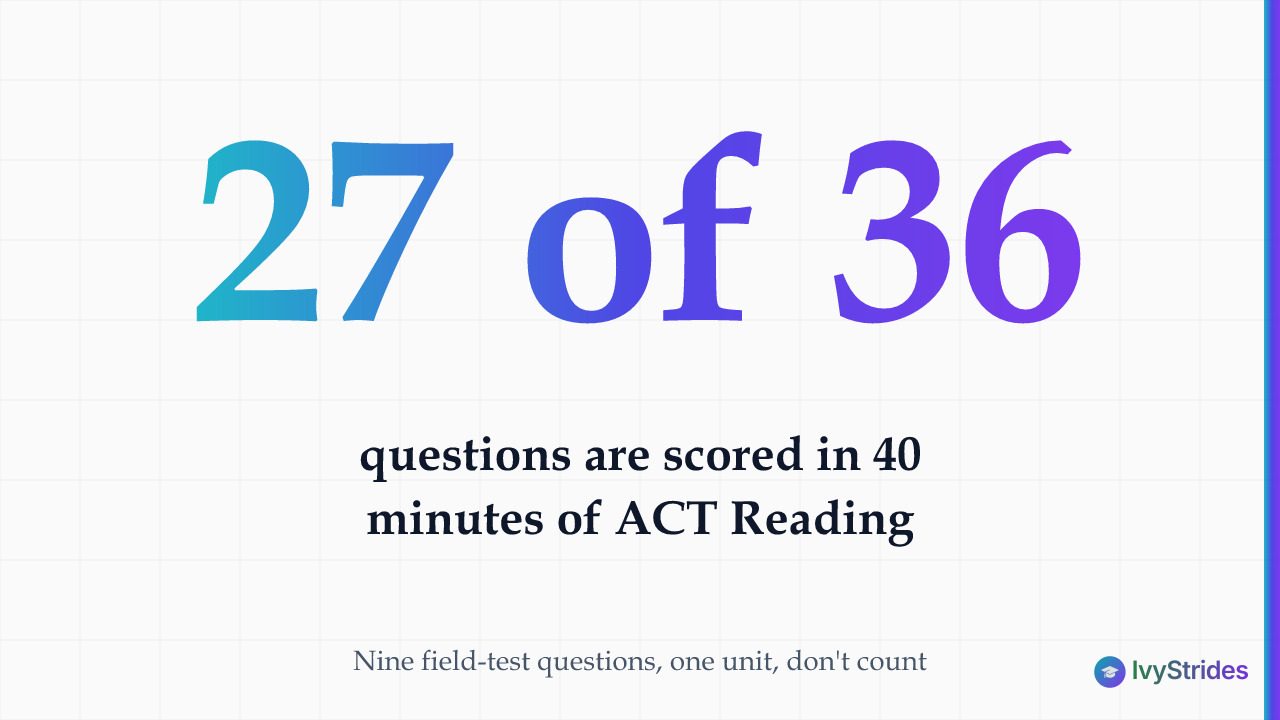
The enhanced ACT Reading section gives you 40 minutes for 36 multiple-choice questions, each with four answer choices. Nine are embedded field-test questions that don't count, so your Reading score rests on 27 scored questions.
| Feature | Enhanced ACT Reading | What it means on test day |
| Scored questions | 27 of 36 | Nine field-test questions add nothing |
| Passage units | Four, nine questions each | Three scored, one unlabeled field-test unit |
| Guessing penalty | None | Answer every question |
One unit in four doesn't count. ACT's Technical Manual says the 9 field-test items are indistinguishable from scored items, and in Reading they come as one whole unit: a passage with its questions.
How Many Passages Are on the ACT Reading Section?
How many passages are on the ACT Reading section? Four units, but only three are scored: ACT's design blueprint adds one field-test passage unit, and nothing on the page tells you which one it is.
Does the ACT Still Have a Reading Section?
Yes. Reading is one of three required ACT sections, with English and math; Science and Writing are optional on national test dates, though some school-day testing requires them. Optional Science comes after Reading; it sits outside the Composite and earns its own score and a STEM score.
On national test dates, students taking neither Science nor Writing leave after the reading test, the final required section in the enhanced ACT section lineup.
What Does the ACT Reading Test Cover? Passage Types and Question Categories
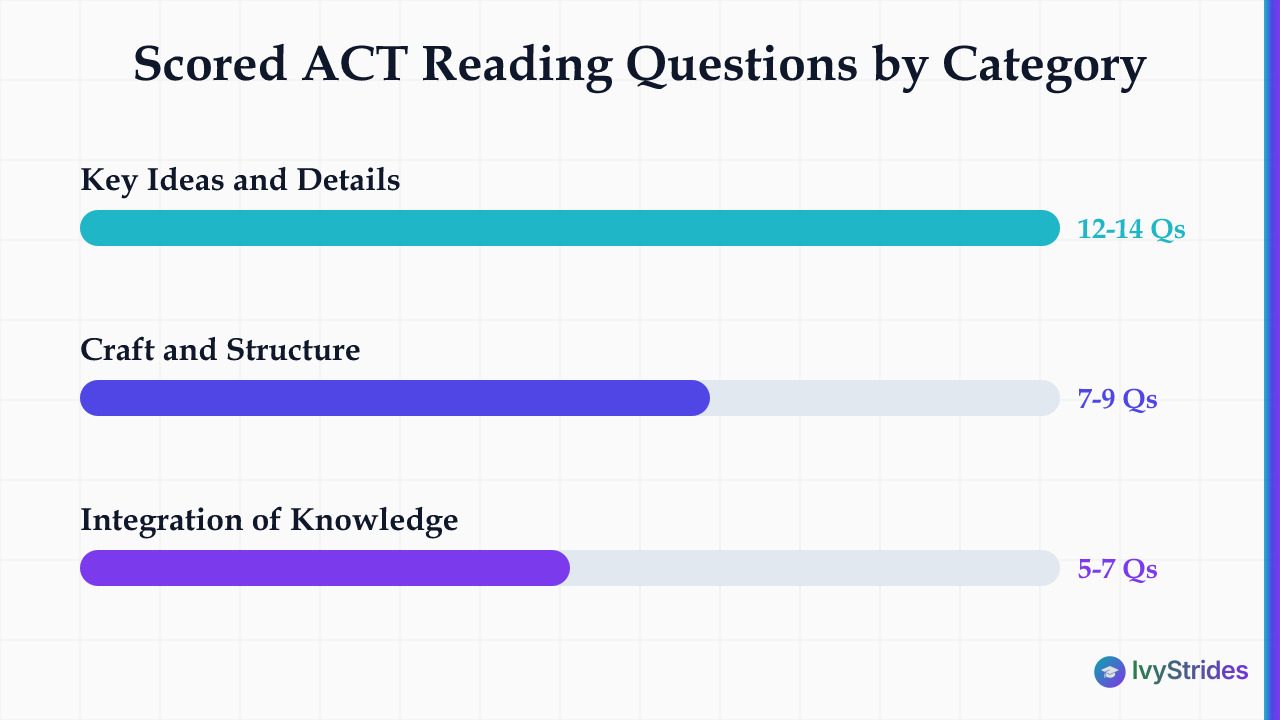
The ACT Reading test covers two passage types, literary narrative and informational text, and sorts its scored questions into three reporting categories. Its passages represent the kinds of texts students meet in high school and first-year college courses.
Literary Narrative and Informational Passages
Literary narratives come from fiction and memoirs; informational texts come from the humanities, natural sciences and social sciences. ACT's Design Framework report planned one literary narrative and two informational passages among the three scored units of its study forms.
Read the passage heading first. Each heading names the passage type (Literary Narrative or Informational) and the author, and may add background. In ACT's 2025-2026 practice test, Passage I is a Literary Narrative, the rest are Informational, and Passage III is a paired set; that form's scoring key marks Passage I's questions as not scored, so its scored units are all informational; ACT says field-test placement varies by form.
Paired Passages and Passages With a Graph
ACT's description of the Reading test says some units hold one long passage and others two shorter ones, and in a paired unit some questions involve both. One passage may also carry a graph, figure or table, and questions that combine it with the passage (visual and quantitative information) count toward Integration of Knowledge and Ideas.
Not every form has both. ACT's blueprint allows zero or one paired set and zero or one graph passage among the scored units, so don't expect one of each. And no question tests outside facts, formal logic or vocabulary you could answer without the passage.
On the ACT Reading Section You Will Be Asked To...
On the ACT Reading section you will be asked to find details, judge an author's choices and weigh evidence, grouped into three reporting categories.
| Reporting category | Share of scored questions | Scored questions per form | What the questions ask you to do |
| Key Ideas and Details | 44-52% | 12-14 | Identify central ideas, summarize, trace cause and effect |
| Craft and Structure | 26-33% | 7-9 | Interpret word meanings, author's choices, point of view |
| Integration of Knowledge and Ideas | 19-26% | 5-7 | Weigh claims and evidence, compare paired passages, read graphics |
ACT lists those shares on its score guide and the per-form ranges in its Technical Manual. Your score report then breaks out each reporting category.
What's a Good Score on the ACT Reading Section in 2026?
Two ACT yardsticks help you judge a Reading score: 22 meets ACT's College Readiness Benchmark for reading, and for admissions ACT calls a score good when it meets or exceeds the average score of students admitted to your colleges. Your score report shows each reporting category beside a Readiness Range, the typical category performance of students who met that Benchmark.
How 27 questions become a score. Your raw Reading score is the number of scored questions you get right, with no penalty for wrong answers, and ACT converts it to a 1 to 36 scale score. The report also gives the percentage correct in each reporting category.
The widest score range. ACT puts the standard error of measurement at about 3 points for Reading and about 2 for English and math, so a one-point Reading change between sittings may not be real progress.
| Reference point | ACT Reading score | What it tells you |
| Middle 50%, 2026 graduates | 14 to 24 | 25th to 75th percentile |
| Median, 2026 graduates | 19 | About half (52%) scored 19 or lower |
| Mean, 2026 graduates | 19.8 | The national average of most recent scores |
| College Readiness Benchmark | 22 | ACT's readiness line for related college courses |
Get your Daily IV Dose on Instagram: quick study tips and test-day advice for high school students. Follow @ivy.strides.
Those graduate figures use each student's most recent score from tests taken in any of the past three years, so they can include scores from tests taken before the enhanced format.
Is a 27 on ACT Reading Good?
By ACT's national numbers, yes. In ACT's 2026 graduating class profile, which can include tests taken before the enhanced format, 84% of graduates' most recent Reading scores were 27 or lower, and a 27 sits five points above the Benchmark.
How Rare Is a 36 on ACT Reading?
Rare. In the same profile, which can include older-format tests, about 2% of the 2026 graduating class's most recent Reading scores were 36. On the enhanced test, a 36 rests on only 27 scored questions, so it depends on accuracy in all three reporting categories.
How ACT Reading Counts Toward the Composite and ELA Scores
Your Reading scale score is one of the three in the ACT Composite average of English, math and reading, so a one-point Reading change moves the unrounded average by a third of a point.
Like Reading, English counts in the Composite and mixes unscored field-test questions in with scored ones; in ACT English field-test scoring, 40 of the 50 questions count.
Reading also feeds the ELA score, the average of English, reading and writing for students who take Writing. Since 2025 the ACT Superscore averages a student's best English, math and Reading scores, so a stronger Reading score on a later date can raise it.
Few questions, high stakes. Only 27 scored questions carry the whole Reading score, and you can't tell which unit is unscored, so one rushed unit can cost points you never see.
How to Do the ACT Reading Section: A Four-Unit Pacing Plan
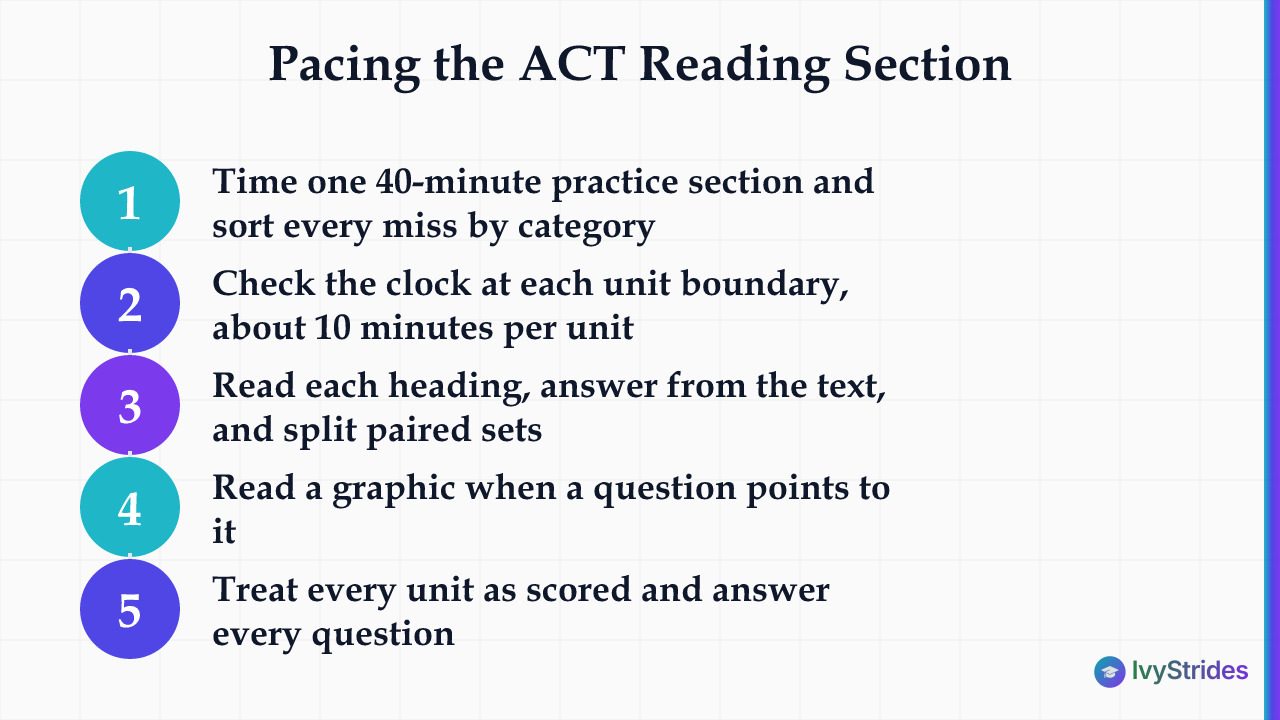
The ACT Reading section runs on one clock. IvyStrides' analysis of ACT's published Reading format, 40 minutes for four units of nine questions, puts the pace at about 10 minutes per unit, or about 67 seconds per question. Pace by unit so one rushed unit doesn't cost scored points.
Reading versus the other core sections. English gives you about 42 seconds per question (35 minutes for 50) and math about 67 (50 minutes for 45). Reading matches math's time per question but asks you to read first, which is why Reading needs its own line in your ACT pacing targets for each section.
Is the ACT Reading section hard? Time is the usual worry: ACT's design report says test takers' common concern on the older test was how much text they had to read in the time given, and the enhanced test gives more time per question.
Pace the section in this order:
-
Start with a timed diagnostic. Take one 40-minute Reading section from ACT's official practice test and sort every miss by reporting category and passage type.
-
Check the clock at each unit boundary. Four checkpoints beat 36.
-
Read the heading, then answer from the text. No question rewards outside knowledge.
-
Split a paired set. Answer each single-passage question before the questions about both.
-
Read a graphic when a question points to it. Those visual and quantitative information questions tie it to the passage.
-
Treat every unit as scored. ACT's Preparing for the ACT Test booklet says field-test items carry no label and advises your best effort on all items.
-
Answer every question. With no guessing penalty, pick an answer, flag it and return if time allows.
Where the diagnostic leads. When the timed section shows misses clustered in one reporting category or passage type, IvyStrides' one-on-one ACT prep starts from a diagnostic test and a custom ACT study roadmap, tunes section emphasis weekly, and follows each enhanced-format practice test with a detailed performance review.
Once your pacing holds, set a Reading target, especially if your family is weighing merit scholarships tied to ACT scores. A single Reading score won't show whether lost points come from timing or a passage type, and guessing at the cause means drilling the wrong skill.
FAQ: The Enhanced ACT Reading Section
How long is the reading section on the ACT?
The ACT Reading section lasts 40 minutes, about 67 seconds for each of its 36 questions. Students approved for one and one-half time at a national test center get 60 minutes instead.
How many questions are on the ACT Reading section?
Thirty-six, and 27 of them count toward your score. The other nine make up one unlabeled field-test unit, so give all four units full effort.
What is the ACT Reading section like?
Expect four units, each a single passage or paired set under a heading naming the passage type and author. Each question has four answer choices, and one passage may include a graph, figure or table.
What is the ACT Reading test?
The ACT Reading test is a required ACT section, alongside English and math. It measures close reading, reasoning with textual evidence and combining information across sources, and its 1 to 36 score counts toward the Composite.
Your Next Step on the ACT Reading Section
The enhanced ACT Reading section is short on questions and long on reading, so prepare on the real format.
- Sit one timed Reading section from ACT's official practice materials and sort the misses.
- Test your unit checkpoints on a second timed section.
- Confirm that any prep book shows 36 questions in 40 minutes.
Watch the method, then try it: IvyStrides explains SAT and ACT question types on YouTube.

Hemant is a seasoned entrepreneur, investor, and growth strategist with deep ground in education and technology-driven learning. His core training is in Mathematics and Physics — he authored Physics for IB Diploma: Ultimate Revision Guide, recognized as a top student resource.