
ACT Fees for International Students? Your Full 2026 Cost Breakdown (Plus Ways to Save)
On this page
- The 2026 ACT Fee Table for International Students: Every Line Item
- Why International ACT Fees Are So Much Higher Than US Domestic Fees
- ACT Fees by Country: What Students in India, Egypt, and Beyond Actually Pay
- ACT Fee Waivers for International Students: The Honest Answer
- SAT vs. ACT: Which Test Costs Less for International Students?
- How to Keep Your Total ACT Spend Low: Timing, Score Sends, and Prep Strategy
- Is Two Months Enough Time to Prepare for the ACT? A Realistic Timeline
- What Is a Good ACT Score for International Students Applying to US Colleges?
- FAQ
- Can I take the ACT online as an international student?
- Is there any way to get a cheaper ACT price as an international student?
- What is the ACT late registration fee, and when does it apply?
- Do international students need to take the ACT, or is it optional?
- What is the best test for an international student: SAT or ACT?
- How much does the ACT cost in India specifically?
- Making the Registration Count
International students pay $186.50 to register for the ACT core test (English, Math, Reading, and Science) in 2026, or $211.50 with the optional writing section. Late registration adds a $36 surcharge, and standby testing costs another $69. Fee waivers from ACT, Inc. are available only to students who reside and test inside the United States or US territories, so students registering at international test sites do not qualify.
All figures come from the ACT, Inc. official fee schedule and should be re-verified before you register. The harder question isn't the sticker price. It's how to avoid paying it two or three times because of a rushed registration or an underprepared first sitting, which is what the rest of this guide walks through.

The 2026 ACT Fee Table for International Students: Every Line Item
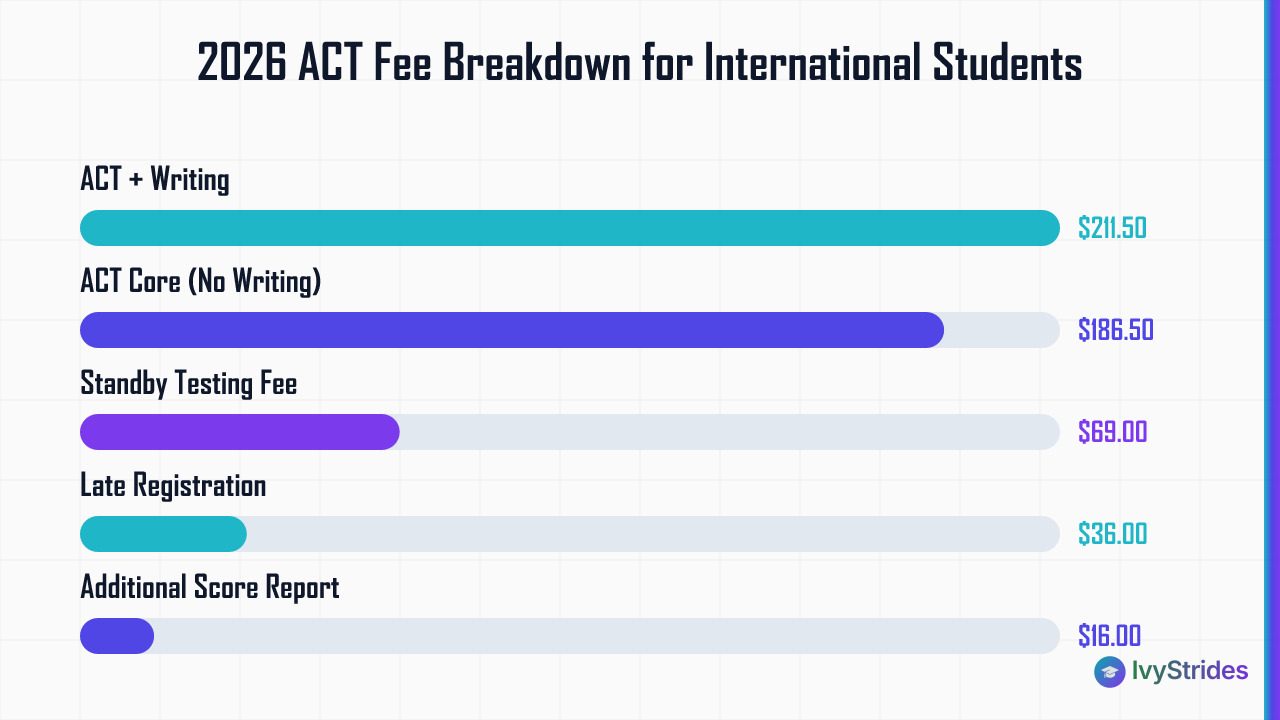
Here's the full 2026 fee schedule for students registering at an international test site, denominated in US dollars regardless of your home country.
| Item | Fee (USD) |
| ACT core test (no writing), per ACT, Inc. | $186.50 |
| ACT + optional writing section | $211.50 |
| Late registration surcharge | $36 |
| Standby testing fee | $69 |
| Test date or test center change | $36 |
| Additional score report (per recipient) | $16 |
| Rush score reporting | Additional fee, varies |
| Score reports included at registration | 4 (free) |
A few points that trip students up. The $186.50 is the whole international test fee, not a domestic fee plus a surcharge. The four free score reports must be selected at the time of registration; add them later and you'll pay $16 per school, per ACT, Inc.. And every figure is in USD, so your final charge in INR, EGP, or any other local currency depends on your bank's conversion rate on the day you pay.
Before committing to the registration fee, it helps to know what you're paying for. The ACT covers four sections (English, Math, Reading, and Science) plus an optional 40-minute writing essay, and understanding the ACT format and sections helps you decide whether to add writing to your order.
Verify all figures at act.org before you check out. Fees listed here reflect the 2025-2026 schedule.
Why International ACT Fees Are So Much Higher Than US Domestic Fees
The US domestic ACT costs $68 without writing, per ACT, Inc.. You're paying roughly 2.7 times that amount at an international site. It's a real gap, and students are right to be frustrated by it.
The premium exists because ACT, Inc. builds and secures its international administration differently. Materials are shipped and tracked internationally, proctors and test centers are contracted per region, and security protocols after past international breaches have tightened logistics. The higher fee is how the organization recoups those costs. None of that changes what you pay, but it does explain why no "international discount" pathway exists.
The fee waiver picture is also blunt. ACT, Inc. offers up to two fee waivers per eligible student, but eligibility is restricted to US residents and US territory residents whose school counselors certify financial need. If you're testing in Delhi, Cairo, Lagos, or Seoul, you don't qualify, no matter your family's financial situation. There's no international-equivalent program.
For a broader look at how this compares to your other option, see our ACT vs SAT breakdown.
ACT Fees by Country: What Students in India, Egypt, and Beyond Actually Pay
The $186.50 base fee applies uniformly at international sites, whether you're testing in Mumbai, Cairo, Dubai, Tokyo, or São Paulo. ACT, Inc. doesn't run country-specific pricing tiers. What varies is the real cost in your local currency and the number of test dates available near you.
India. Students registering in India pay $186.50 USD, or $211.50 with writing, per ACT, Inc.. Test centers operate in most major cities including Delhi, Mumbai, Bangalore, Chennai, Hyderabad, and Kolkata, though not every center runs every ACT test date. Payment is processed in USD; your INR outlay depends on the exchange rate at checkout.
Egypt. Same story, per ACT, Inc.: $186.50 USD core, $211.50 with writing. Cairo hosts the primary test centers. One quick note: some searches turn up the phrase "ACT 2 fees in Egypt." There's no separate "ACT 2" exam product. That phrasing usually refers to a student's second ACT sitting, which costs the full $186.50 again since ACT doesn't discount retakes.
Other high-volume markets. Students in Pakistan, Nigeria, UAE, Saudi Arabia, South Korea, Vietnam, and across Europe and Latin America pay the same $186.50 base. Site availability is the variable to check first, not price. Confirm your nearest center and its 2026 test dates at act.org before you plan your prep timeline.
If you want to sample the exam before committing, our ACT practice test online library gives you full-length material to establish a diagnostic baseline.
ACT Fee Waivers for International Students: The Honest Answer
This is the section most students land on hoping for good news. Here's the direct answer, drawn from ACT, Inc.'s official fee waiver policy:
"Fee waivers may be granted to eligible nationals of countries other than the United States only if they reside and test in the United States or United States territories."
Translation: if you live outside the US and are testing at an international site, you can't receive an ACT fee waiver. Full stop. The one narrow exception is international students who have relocated to the US (for example, boarding-school students on an F-1 visa attending a US high school). Those students can request a fee waiver through their US school counselor, subject to standard eligibility criteria.
Two more things worth saying plainly. First, no legitimate third-party "ACT promo code" or discount program exists for international registrations. If a site or DM offers you a code that "unlocks" a lower rate, it's a scam. Don't enter your card details. Second, some students look for ways to route registration through a US address to claim a waiver; ACT, Inc. treats this as fraud and can cancel scores.
Focus on what you can control: how many times you sit for the test. In our coaching with international students at the 22-28 composite band, the most common registration mistake is paying the late fee because the student waited to confirm their prep timeline before registering. Register early on your target date, then adjust prep intensity around it. One well-prepared sitting is far cheaper than three underprepared ones.
If you want a coach to help calibrate that decision, our 1-on-1 ACT prep program is built around this diagnostic-first approach.
SAT vs. ACT: Which Test Costs Less for International Students?
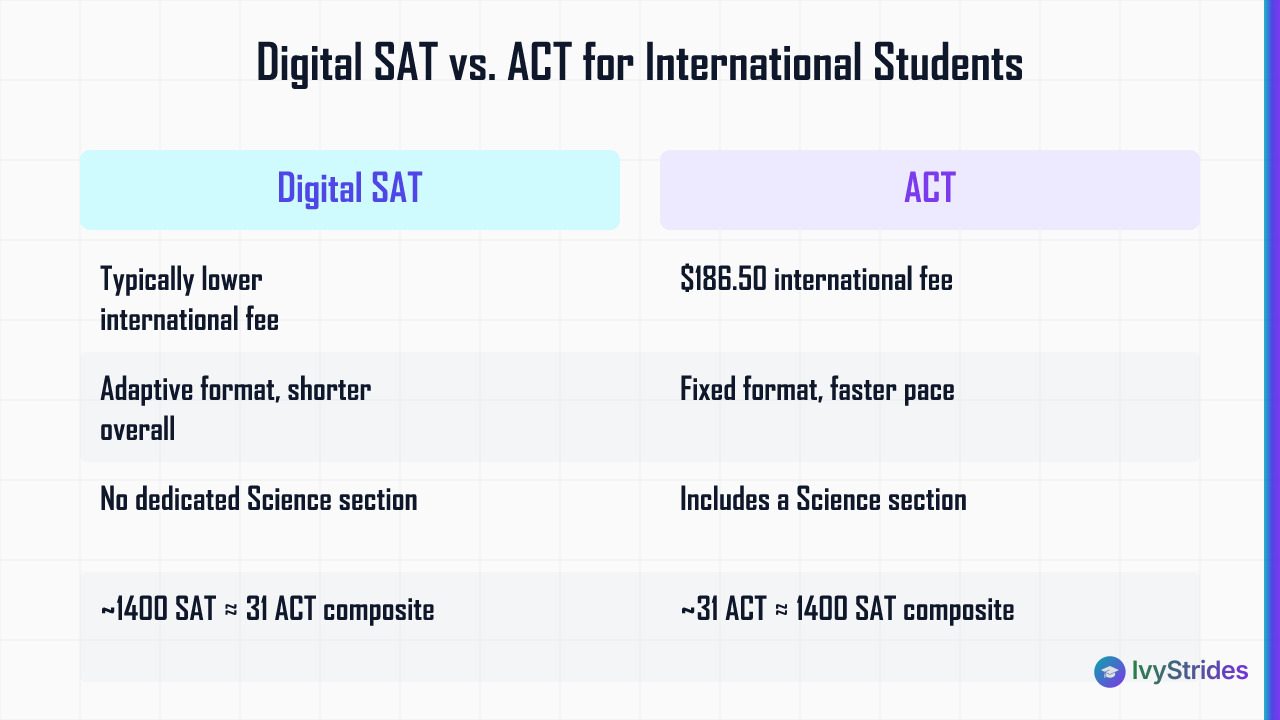
For most international markets, the Digital SAT is cheaper than the ACT. The College Board Digital SAT international registration fee typically runs lower than the ACT's $186.50 in many countries, though College Board applies regional service fees that vary. Verify the current SAT figure for your country at satsuite.collegeboard.org before comparing.
Cost shouldn't be the deciding factor, though. Both tests are accepted equally by every US college. What matters more is which format plays to your strengths. The ACT includes a Science section and moves faster: about 35 questions in 35 minutes on Reading, for example. The Digital SAT is adaptive, shorter overall, and has no dedicated Science section.
For a longer look at format fit, see our take on whether the SAT is harder than the ACT. A rough concordance point worth remembering: a 1400 Digital SAT is roughly equivalent to a 31 ACT composite, per College Board's concordance table. If you're consistently scoring higher on one format after a diagnostic on each, take that one, cost differences notwithstanding.
Honestly, take a full-length practice test for each before you register for either. A $186.50 registration isn't the place to guess. Once you know your format, our ACT prep overview covers the full section-specialist approach.
How to Keep Your Total ACT Spend Low: Timing, Score Sends, and Prep Strategy
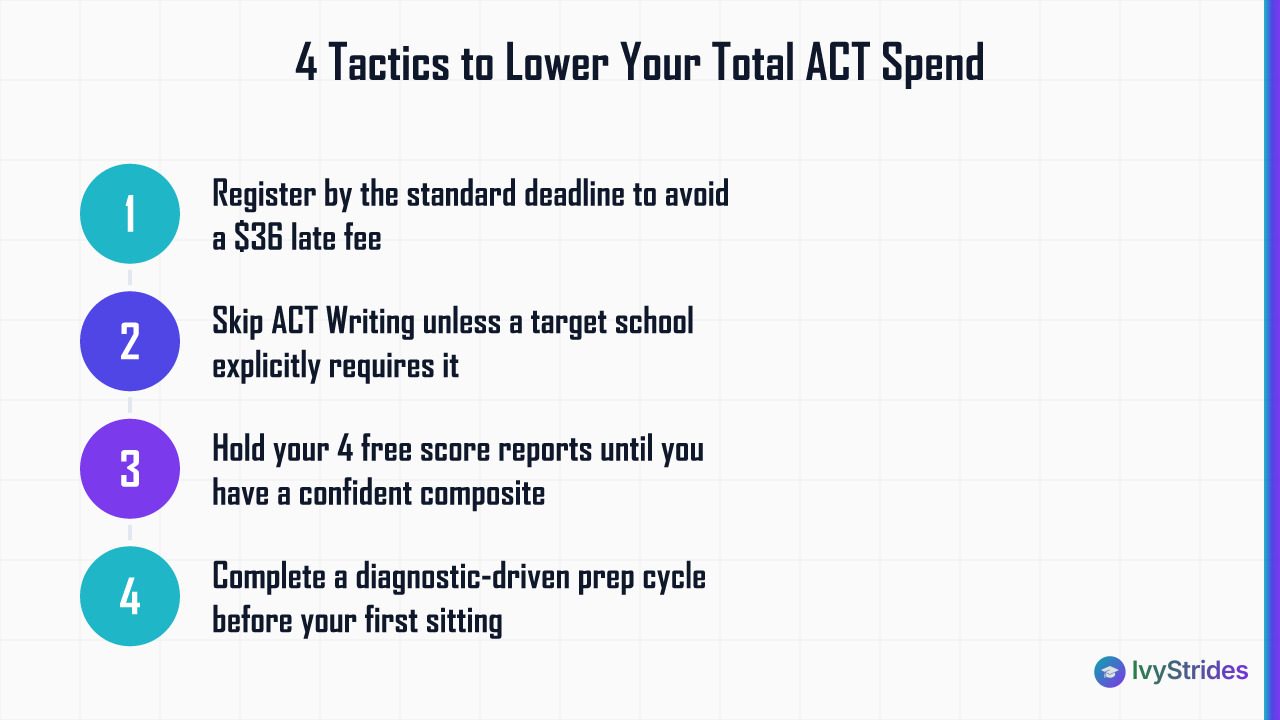
Every retake is another $186.50 (ACT, Inc.). That's the math that should shape your registration strategy. Here are the tactics that work.
Register by the standard deadline. The late deadline hits roughly five weeks before the test date and adds $36 (ACT, Inc.). Registering early costs nothing extra and locks in your seat at your preferred center, which fills fast in India, Egypt, and Nigeria for popular dates like October and April.
Skip the writing section unless a target school requires it. The list of colleges requiring ACT Writing has shrunk to a handful. Check each school's admissions page directly. Across our coaching cohort, students who verify their target schools don't require writing save $25 per sitting (ACT, Inc. fee schedule) with no admissions downside.
Hold your four free score reports. You can send them free at registration, but if you're planning a possible retake, wait. Send after you have a composite you're confident in. Sending early to schools you later underperform for is one of the more common regrets we see.
Invest in a diagnostic-driven prep cycle before your first sitting. In our coaching with students completing the full diagnostic-to-test-day program at the 22-28 composite band, a 4+ composite point gain is typical. That's the difference between one $186.50 sitting and three. Our approach: full-length diagnostic first, section-specialist coaches for English/Reading, Math, and Science, targeted weakness work, and spaced retesting. See how to raise your ACT score 4 points for the full framework.
Once you've budgeted for registration, the next question is how many attempts you'll need, and a diagnostic-driven prep plan is the most reliable way to reach your target score in the fewest sittings, keeping your total ACT spend as low as possible. Our digital ACT prep library is where students typically start their baseline.
Two caveats worth naming. Test-optional policies vary by school and year, so verify each college's current policy before deciding whether the ACT registration fee is a required investment for your specific target list. And a strong ACT score and a compelling admissions essay work together as parts of the same application strategy, so budgeting for both early in junior year gives you the most flexibility.
Is Two Months Enough Time to Prepare for the ACT? A Realistic Timeline
Short answer: two months is workable but tight. Three months is the more common target. One month isn't enough for most students to see meaningful composite improvement.
The rough math on a two-month plan: roughly 80 hours of focused study, which works out to about 8-10 hours per week across 8 weeks. That's tight around school, especially during IB or A-Level exam season. Push to three months if your schedule is heavy.
Your starting composite matters more than the calendar. A student at a 24 needs a different plan than a student at a 28. In our coaching with students at the 22-26 composite band, two months of focused work typically yields roughly 3-4 composite points when the student completes all assigned practice sets. At the 27-30 band, gains come slower and require sharper section-specific work, particularly on ACT Science pacing and the harder ACT Math questions.
Non-negotiables regardless of timeline: take a full-length diagnostic before you write a single flashcard. Section-specific tactics matter more than generic "study more" advice, since ACT English rewards different skills than ACT Reading. And schedule your registered test date to give yourself at least roughly 10-12 weeks of prep after your diagnostic.
For students building a plan around practice material, our best ACT practice tests breakdown covers what to use and in what order. If you're also weighing AP prep alongside ACT prep, see how do international students study AP online for scheduling patterns that work.
What Is a Good ACT Score for International Students Applying to US Colleges?
The ACT composite runs from 1 to 36. The national average sits around a 19.5 composite, per ACT, Inc.'s most recent annual score report. International applicants are graded on the same scale as domestic ones, so the same benchmarks apply.
A 27 composite puts you at around the 85th percentile per ACT, Inc. norms. That's competitive at many strong US universities, including flagship state schools and mid-tier private institutions. But it's below the middle-50 range for the most selective schools.
Rough benchmarks for target planning:
- Top-25 universities (Ivies, Stanford, MIT, UChicago, Duke): mid-50 ACT composites typically run around 33-36. See our takes on whether you should apply to Cornell University in 2026 and whether you should apply to Johns Hopkins University for named-school context.
- Selective private and top-tier public (Michigan, UNC, NYU, USC): mid-50 typically around 30-34.
- Strong regional universities: mid-50 typically around 26-30.
Always cross-check the current mid-50 range on each school's Common Data Set, which they publish annually. A 27 sitting below roughly the 25th percentile at your target school is a signal to prep for a retake; a 27 at a school where that line sits at roughly 24 is a strong application asset.
For SAT equivalency: a 1400 SAT concords to about a 31 ACT, per College Board's concordance table. Use that when comparing your practice scores across the two tests.
One important caveat. Even at test-optional schools, a strong score strengthens your file, and some merit scholarships still require a submitted score. Test-optional doesn't mean test-irrelevant. Verify each school's current policy before deciding whether to submit.
FAQ
Can I take the ACT online as an international student?
As of 2026, the ACT is administered as a paper-based test at international test sites. The online (computer-based) ACT is available at select US-based schools and test centers but hasn't been broadly rolled out internationally. Check act.org for the current international delivery format before you register, since ACT, Inc. is actively expanding digital delivery.
Is there any way to get a cheaper ACT price as an international student?
Not directly. No fee waiver, no promo code, no regional discount exists for international registrations. The productive path is reducing your total sittings: register by the standard deadline to skip the $36 late fee (ACT, Inc.), skip the $25 writing add-on unless your target schools require it, and hold your four free score reports until you have a composite you're confident in. One well-prepared sitting beats three underprepared ones at $186.50 each.
What is the ACT late registration fee, and when does it apply?
ACT, Inc. charges a $36 late registration surcharge for students who register after the standard deadline, which typically falls about five weeks before the test date. Standby testing (arriving without a confirmed registration) costs another $69 and doesn't guarantee a seat. Registering as early as possible is the cleanest way to avoid both.
Do international students need to take the ACT, or is it optional?
It depends on your target schools. Test-optional policies vary by school and by admissions cycle. Many US colleges no longer require the ACT or SAT, but some have reinstated the requirement recently, and merit scholarships often still require a submitted score. Verify each target school's current policy on their admissions page or via FairTest before deciding. If you're also weighing the PSAT/NMSQT for the National Merit Scholarship pathway, note that the PSAT is a separate registration with its own fee structure and is only available at participating US high schools, so it isn't a pathway for students testing abroad.
What is the best test for an international student: SAT or ACT?
Neither is universally better. The Digital SAT is adaptive, shorter, and typically cheaper internationally. The ACT includes a Science section and rewards students who can move quickly through Reading and English. Take a full-length practice test for each before committing to a registration fee. Whichever format you score higher on after two diagnostics is your test.
How much does the ACT cost in India specifically?
Students registering in India pay the standard international fee of $186.50 USD for the core test, or $211.50 USD with the optional writing section, per ACT, Inc.. There's no India-specific discount or surcharge. Your INR cost depends on your bank's USD conversion rate at checkout, and no ACT fee waivers are available for students testing in India.
Making the Registration Count
The $186.50 registration fee (ACT, Inc.) is fixed. What you control is how many times you pay it. Register on your target date early, verify writing-section requirements at your target schools, hold your free score reports, and go into your first sitting with a real prep plan behind you. That's how international students at the 22-28 band end up spending $186.50 once instead of three times.
If you'd like a coach to help build that plan, learn more about IvyStrides. You can also meet the tutors who work with international students in our 1-on-1 ACT program.

Award-winning author (South Asian Book Award) and graduate of BITS Pilani and UCLA Luskin School of Public Affairs. Brings a published writer's eye to Common App essays and grammatical precision to SAT and ACT R&W instruction.