
How Much Does the ACT Matter for College Admission in 2026?
On this page
- The Short Answer: Yes, the ACT Still Matters in 2026 (Here Is Why)
- Test-Optional in 2026: What It Really Means for Your ACT Score
- What ACT Score Do You Actually Need? Benchmarks by School Tier
- Is Investing in ACT Prep Worth It? The Real Cost of a Low Score
- The Scholarship Angle: Why a Strong ACT Score Is Worth More Than the Admission Boost Alone
- ACT Score, GPA, and Essays: How Colleges Actually Weigh Each Piece
- Do Colleges Prefer the ACT or the SAT? What the Data Actually Shows
- The 2025 ACT Format Change: What 2026 Applicants Need to Know
- FAQ
- Do colleges still look at ACT scores, or has test-optional made them irrelevant?
- Is a 27 ACT score good enough for selective colleges?
- Is a 19 ACT score good enough for college?
- Can I get into Harvard with a 28 ACT?
- Should I retake the ACT if my score is below my target school's middle-50?
- Does the 2025 ACT format change affect how my score is evaluated in 2026?
- Where This Leaves You
Yes, the ACT still matters for college admission in 2026. A composite at or above your target school's middle-50 range strengthens your application and can unlock merit scholarships that test-optional admissions policy does not cover. Below the middle-50, withholding is often the right call. At highly selective schools, many of which reinstated test requirements in 2024 and 2025, a composite of roughly 34 or above is typically competitive. At mid-tier four-year colleges, a 24 to 28 is a solid target.
The specifics behind those benchmarks come from ACT, Inc.'s official scoring documentation, the FairTest test-optional tracker, and each school's Common Data Set. The rest of this article translates those numbers into a submit-or-withhold decision, what to do if your score isn't yet where it needs to be, and how the 2025 ACT format change affects 2026 applicants.

The Short Answer: Yes, the ACT Still Matters in 2026 (Here Is Why)
The ACT composite runs on a 1 to 36 scale, calculated from your section scores in English, Math, Reading, and (now optional) Science, per ACT, Inc.. The national average composite sits at roughly 20 to 21. That average is your first calibration point. Anything above it puts you in the upper half nationally; the further above, the more admissions weight the score carries at selective schools.
Test-optional does not mean score-blind. When a student submits a score to a test-optional school, that score is read and weighed alongside GPA, coursework, and essays. A strong score validates a strong GPA. A weak score submitted below the middle-50 can actively hurt an otherwise competitive application. That's the whole game in one sentence.
Here's the part most students miss: the scholarship layer is separate from the admissions layer. Many state flagship and institutional merit awards typically require a submitted ACT score of around 25 or above regardless of the school's test-optional admissions policy. Withhold the score, get admitted, lose the scholarship. If you're deciding whether the ACT is the right test to focus on, our overview of is the SAT harder than the ACT can help.
Three things the ACT still does in 2026: validates your GPA, gives you a competitive edge at test-optional schools when your score is at or above the middle-50, and qualifies you for merit money that would otherwise be locked.
Test-Optional in 2026: What It Really Means for Your ACT Score
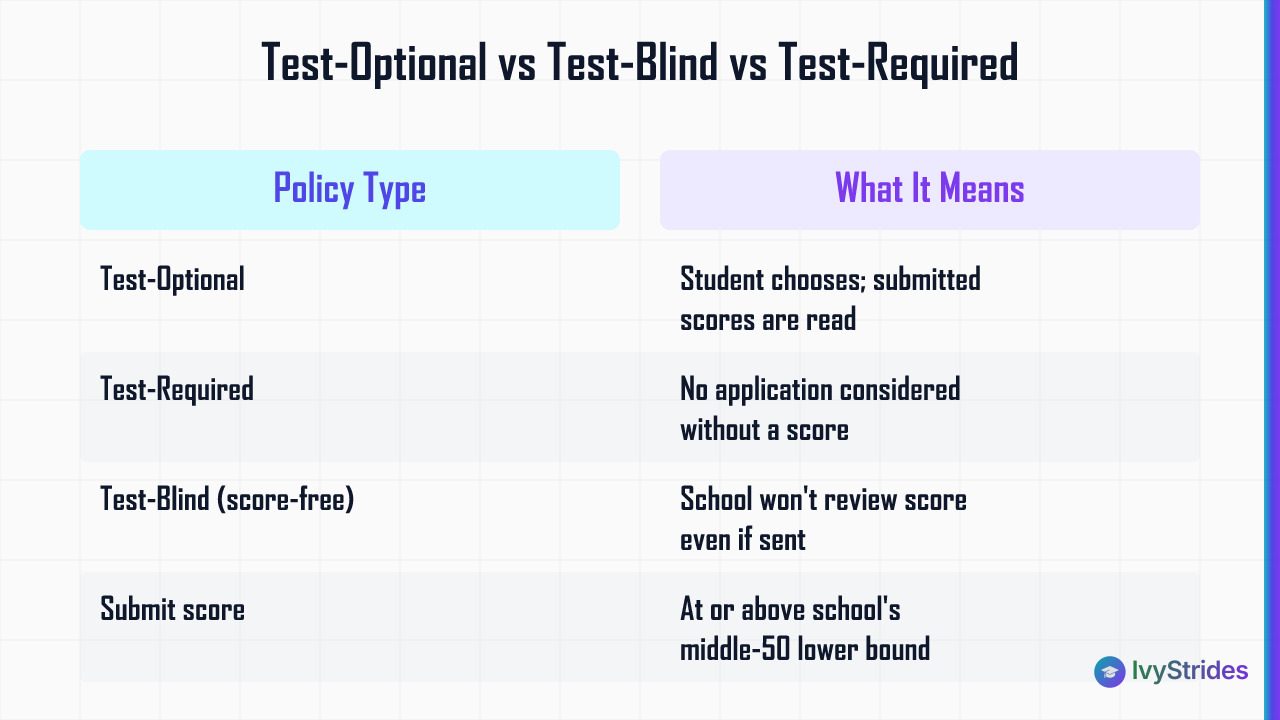
Three policies exist, and confusing them is the most common mistake we see. Test-optional means the student chooses whether to submit; submitted scores are read and evaluated. Test-required means the school will not consider your application without a score. Test-blind (sometimes called score-free) means the school will not review a score even if you send one. The University of California system is the highest-profile test-blind holdout. Most schools aren't.
The direction of travel matters. Between 2022 and 2025, several highly selective schools reinstated test requirements: MIT in 2022, then Yale, Dartmouth, Brown, and Harvard in 2024 for classes applying in the 2025-2026 cycle and beyond. Others remain test-optional but publish data showing submitters are admitted at meaningfully higher rates. FairTest maintains the current test-optional tracker, and each school's admissions page is the authoritative source for that school's current policy.
The submit-or-withhold rule we use in our coaching is simple: submit if your composite is at or above the school's middle-50 lower bound. Withhold if it's below. A 29 at a school with a 30-34 middle-50 is a submit-only-if-context-supports-it call. A 26 at that same school is a clear withhold. A 32 there is a clear submit.
One caveat worth surfacing: policies can and do change year to year. What was test-optional for the class of 2024 may be test-required for the class of 2027. Verify each school's current policy on its admissions page the summer before you apply, not from a blog post written a year ago. Once you're ready to send scores, our guide on how to send ACT scores covers the logistics. If Dartmouth is on your list, our take on Should You Apply to Dartmouth College? SAT Scores and Trends walks through the reinstated-test-requirement implications in more detail.
What ACT Score Do You Actually Need? Benchmarks by School Tier
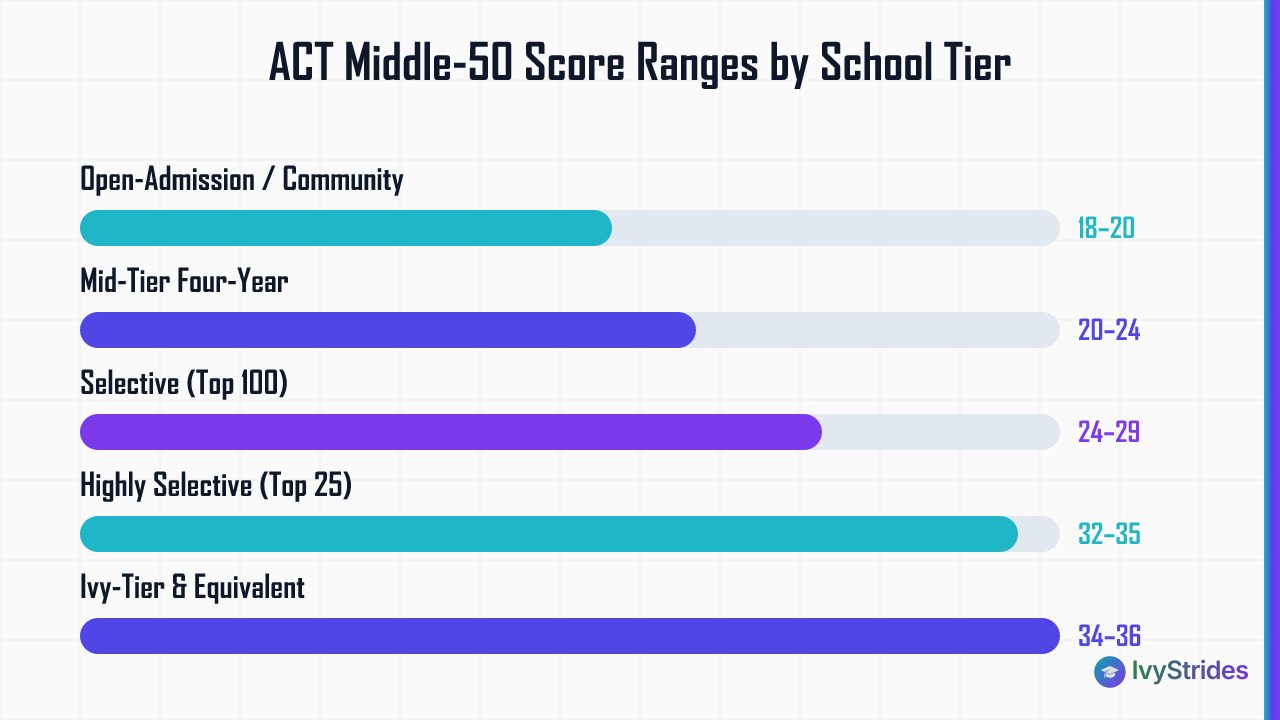
Here are the middle-50 ranges we use as working benchmarks, cross-checked against ACT, Inc. scoring data and representative Common Data Sets. These shift year to year, so verify the exact ranges for your specific target schools before finalizing your strategy.
Open-admission and community college: roughly 18 to 20 is widely accepted, and many open-admission four-year schools don't require a score at all.
Mid-tier four-year colleges: roughly 20 to 24 is a competitive middle-50 at most regional universities and less selective flagships. A 22 sits at around the 63rd percentile nationally.
Selective colleges (roughly top 100): typically 24 to 29. A 27 places you at approximately the 88th percentile nationally, which is a strong score at the majority of schools in this tier.
Highly selective colleges (roughly top 25): typically 32 to 35. At this tier, a 30 is usually below the lower bound.
Ivy-tier and equivalent: Harvard's middle-50 sits at 34 to 36 per its Common Data Set. Stanford, Yale, Princeton, MIT, and peer institutions cluster in the same range. A 34 is the practical floor for competitive applicants, and 35-36 is where the bulk of admitted students score.
So what does this mean in practice? A 27 is a strong score in absolute terms and competitive at hundreds of very good colleges. It is not competitive at Harvard. A 19 is just below the national average, widely accepted at open-admission and many regional four-year schools, and below the middle-50 at almost every selective school. It's not a dead end, but it does limit options at selective institutions unless you retake with structured prep.
Once you know your target composite, the next step is identifying which of the four sections is holding your score back, a process we cover in our ACT section-by-section prep guide. For students applying to US colleges from outside the United States, the ACT carries the same weight as it does for domestic applicants, and our guide to the ACT for international students covers registration, prep timelines, and admissions context. If you want to benchmark your current score cold, start with our act practice test online library.
Is Investing in ACT Prep Worth It? The Real Cost of a Low Score
Parents ask this in almost every first strategy call. The short answer: at almost every score band below 32, structured prep typically pays for itself, often several times over, through the scholarship dimension alone.
Consider the math. A 4-point composite improvement (say, 24 to 28) can cross the threshold for institutional merit scholarships at many state flagships and mid-tier privates. Award ranges we regularly see: roughly $5,000 to $20,000+ per year, renewable across four years. That's $20,000 to $80,000+ over the degree. Prep programs that cost a fraction of that first-year award aren't close calls.
The methodology matters more than the hours. We work every student through the same framework: a full-length diagnostic practice test to identify which of the four sections is dragging the composite; targeted section-specialist coaching (a Math specialist works Math, a Reading specialist works Reading, and so on); spaced retesting to lock in gains and expose remaining weak spots. In our coaching with students in the 20 to 26 score band, a 4+ composite point gain is typical for students who complete the 1-on-1 ACT program.
Timeline expectations should be realistic. Most students need roughly 8 to 16 weeks of structured prep to see a meaningful composite gain. Cramming a serious score jump into three weeks before a test date isn't a plan, it's a wish. And no honest coach guarantees a specific score improvement; outcomes depend on your starting score, the hours you actually put in, and consistency between sessions.
One pattern worth naming from our coaching: students who try to review "everything equally" almost always underperform students who identify their two weakest sections and pour the majority of their prep hours there. The diagnostic-first approach is what makes the hours count.
If you want to see the section-specialist model in action, our 1-on-1 ACT prep page walks through how we match each student to the right coach per section.
The Scholarship Angle: Why a Strong ACT Score Is Worth More Than the Admission Boost Alone
Test-optional admissions policy and merit scholarship policy are two different things, administered by two different offices, on two different timelines. Confusing them is expensive.
At many state flagship universities, automatic merit consideration requires a submitted ACT score, even when admissions is test-optional. The composite thresholds we see most often for institutional merit tiers sit in the roughly 25 to 30 range, with higher awards at higher scores. Verify the exact threshold with your target school's financial aid office; the specifics shift and vary widely.
Concrete stakes: a student who withholds a 26 at a test-optional school may still be admitted on the strength of GPA, essays, and rigor. That same student may miss out on a renewable award in the range of roughly $8,000 to $15,000 per year that required a submitted score for consideration. Over four years, that's $32,000 to $60,000 of foregone aid because the student read "test-optional" and assumed the score didn't matter. It mattered.
The PSAT doesn't feed into ACT scoring, but a strong PSAT score can open the National Merit pathway, which is a separate scholarship credential worth pursuing alongside ACT prep. Our overview of National Merit Scholarship cutoffs and how to qualify walks through the Selection Index math. If you're building your overall plan, our ACT prep overview covers how the score-improvement work connects to the scholarship dimension.
One caveat: scholarship policies vary by institution and change annually. Never assume this year's threshold matches last year's. Confirm directly with the financial aid office at each target school before locking in your ACT strategy.
ACT Score, GPA, and Essays: How Colleges Actually Weigh Each Piece
Most selective colleges use holistic review, which means no single factor automatically admits or automatically rejects. GPA, course rigor, ACT score, AP scores, essays, recommendations, and extracurriculars are all read together. That said, "holistic" doesn't mean "equal weight." Academic factors (GPA, rigor, test scores) carry the most weight at most selective schools, per the NACAC State of College Admission report.
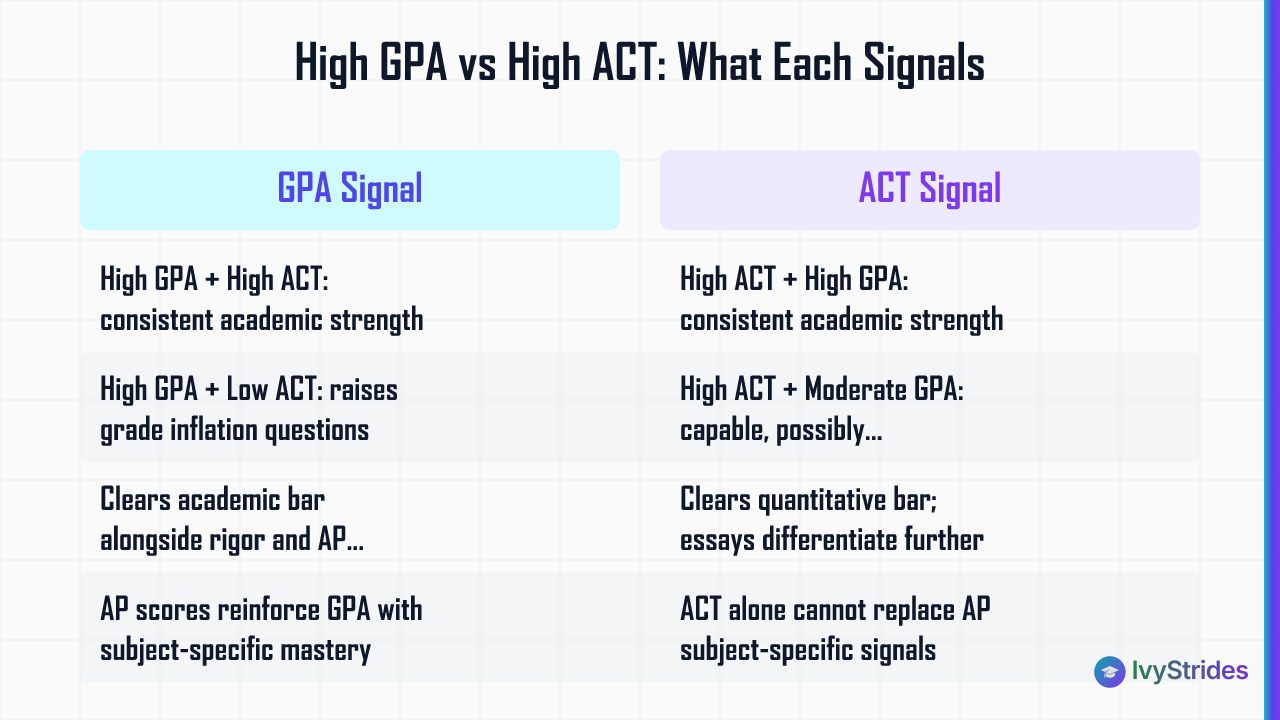
The interaction between GPA and ACT is where holistic review gets interesting. A high GPA paired with a high ACT sends a consistent signal: this student is academically strong. A high GPA paired with a low ACT can raise questions about grade inflation, especially at schools an admissions office does not know well. A moderate GPA paired with a high ACT tells a different story: capable student, possibly under-challenged or dealing with a specific obstacle. Neither combination is automatically fatal; both get read in context.
AP scores work as a parallel signal. They speak to course rigor and subject-specific mastery, and they do so independently of the ACT. A 5 on AP Calculus BC and a 5 on AP English Language make a case for readiness the ACT alone cannot make. If AP courses are part of your plan, they belong in the strategy from junior year forward, not as an afterthought.
A competitive ACT score clears the quantitative bar; a well-crafted personal statement and supplemental essays are what differentiate you once you're in the review pile. In our coaching, students who improve both their ACT composite and their essay quality see the strongest overall application profiles. That's not a coincidence, and it isn't a game of adding up points. It's a coherent story told across every application component.
If essays are the next lever for you, our guide on how to write a standout personal statement is where we'd point you. For context on how one specific selective school weighs the pieces, our take on Should You Apply to Johns Hopkins University walks through the weighting in more detail.
Do Colleges Prefer the ACT or the SAT? What the Data Actually Shows
No. This is the single most persistent myth in college admissions, and it's wrong.
Every four-year college in the United States that accepts standardized test scores accepts both the ACT and the SAT with equal weight. There's no admissions preference. Admissions officers use concordance tables to compare scores across the two exams, and no school gives an advantage to one over the other. A 34 ACT and a 1510 SAT are read the same way.
The concordance is straightforward. Per the College Board and ACT concordance table, a 31 ACT is roughly equivalent to a 1400 SAT, and a 36 ACT maps to a 1600 SAT. The full table covers every point in between and is worth looking up if you're deciding between the exams.
Format differences do matter for which test suits you. The ACT tests Science reasoning as a distinct section (now optional starting 2025); the Digital SAT has no Science section. The Digital SAT is section-adaptive across two modules per section; the ACT is linear, meaning question difficulty doesn't shift based on your Module 1 performance. The ACT gives you less time per question in Reading and Science; the Digital SAT gives you slightly more breathing room per question in Reading & Writing.
Our recommendation: take a full-length practice test of each exam under timed conditions, convert both to the concordance scale, and commit to whichever produced the stronger scaled score with the strategy you find more natural. If you're still deciding between the two exams, our detailed ACT vs. SAT comparison walks through format differences, timing, and which test tends to suit which student profile. If difficulty perception is part of your call, our take on is the SAT harder than the ACT covers the section-by-section comparison.
The 2025 ACT Format Change: What 2026 Applicants Need to Know
Starting in 2025, ACT, Inc. shortened the core test and made Science optional. Here's what changed and what it means for 2026 applicants.
The core test now runs approximately 2 hours 5 minutes, down from approximately 2 hours 55 minutes with Science included. The required sections are English, Math, and Reading. Science is optional, taken as an add-on. Writing (the essay) remains optional and separate, as it has been. The composite is calculated from the three required sections when Science isn't taken. Verify the current composite calculation against ACT, Inc.'s official documentation before your test date, since implementation details continue to be refined.
Should you take the optional Science section? For students targeting engineering, pre-med, computer science, or other STEM-heavy programs, yes. Admissions officers reading those applications will notice a missing Science section, and the section provides an additional data point that supports STEM readiness. For students targeting humanities and social science programs at schools that historically weighted Science less, skipping it is often the correct call. When in doubt, take it once, see how you score, and decide whether to include it on your score report.
Colleges are aware of the format change and adjust their evaluation accordingly. A composite earned under the new format is treated as comparable to composites from prior years. There's no penalty for taking the shorter test, and there's no bonus for taking the older longer version. If your test date falls under the new format, take the new format. Our overview of ACT vs. Digital SAT transitions walks through how both exams are evolving in parallel.
FAQ
Do colleges still look at ACT scores, or has test-optional made them irrelevant?
Colleges absolutely still look at ACT scores when they are submitted. Test-optional means the student chooses whether to submit; it doesn't mean submitted scores are ignored. Several highly selective schools, including MIT, Yale, Dartmouth, Brown, and Harvard, reinstated test requirements between 2022 and 2025. Even at schools that remain test-optional, a score at or above the middle-50 range strengthens the application, while a score below it is often better withheld. Verify each school's current policy via FairTest or the school's admissions page before applying.
Is a 27 ACT score good enough for selective colleges?
A 27 places a student at approximately the 88th percentile nationally, which is a strong score by any national benchmark. At many selective colleges with middle-50 ranges of roughly 28 to 33, a 27 falls just below the lower bound, meaning submitting it at a test-optional school may not help. At mid-tier colleges with middle-50 ranges of roughly 23 to 28, a 27 is solidly competitive. The right benchmark is always the specific school's Common Data Set, not a generic label.
Is a 19 ACT score good enough for college?
A 19 is just below the national average of roughly 20 to 21, placing a student at approximately the 40th to 44th percentile nationally. It's widely accepted at open-admission and many regional four-year colleges. At selective schools with middle-50 ranges starting at 24 or above, a 19 is below the competitive range, and submitting it at a test-optional school would likely not help. Students in this band who want to expand their options typically benefit from a structured prep plan targeting the two sections dragging the composite down.
Can I get into Harvard with a 28 ACT?
Harvard's middle-50 ACT range is 34 to 36 per its Common Data Set. A 28 is below the lower bound of that range. Harvard doesn't publish a minimum cutoff and states it does not admit by numbers alone, but the data is clear: the vast majority of admitted students score in the 34 to 36 range. A 28 would be a significant statistical outlier in the admitted class. Students targeting Harvard or similarly selective schools should treat a 34 or above as the practical target composite.
Should I retake the ACT if my score is below my target school's middle-50?
Yes, if your score is below the middle-50 lower bound of your target schools and you have time before application deadlines. In our coaching with students in the 22 to 28 score band, a 2 to 5 point composite improvement is typical after a structured, diagnostic-driven program between attempts. The key is identifying which section or sections are holding down the composite and targeting those specifically, rather than reviewing everything equally.
Does the 2025 ACT format change affect how my score is evaluated in 2026?
Colleges are aware of the 2025 ACT format change, which shortened the core test and made the Science section optional. Admissions offices adjust their evaluation accordingly, so a composite earned under the new format is treated comparably to scores from prior years. If you're targeting STEM programs or schools that historically valued Science reasoning, taking the optional Science section is usually advisable. Confirm the current composite calculation method with ACT, Inc. before your test date.
Where This Leaves You
The ACT still matters in 2026. Not equally at every school, not for every student, but meaningfully enough that a diagnostic-first prep decision is worth making deliberately rather than by default. Two questions determine your path: what composite are you scoring right now, and what does your target school list look like. Answer those two, and the submit-or-withhold, retake-or-move-on, prep-hard-or-shift-focus decisions all become clearer. If you want a second set of eyes on how those pieces fit together for your specific situation, our coaching team works with students at every score band. You can also meet the tutors who specialize by section.

Award-winning author (South Asian Book Award) and graduate of BITS Pilani and UCLA Luskin School of Public Affairs. Brings a published writer's eye to Common App essays and grammatical precision to SAT and ACT R&W instruction.