
How Much Does SAT/ACT Tutoring Cost? Full Pricing Guide for Parents in 2026
On this page
- SAT and ACT Tutoring Costs at a Glance: 2026 Price Ranges
- What Drives the Price Difference: Tutor Experience, Specialization, and Format
- Section-Specialist vs. Generalist Tutor: Which Delivers More Points Per Dollar
- How Many Hours of SAT or ACT Tutoring Do You Actually Need
- Not Sure How Many Hours Your Student Needs?
- Is SAT or ACT Tutoring Worth the Cost
- What an SAT or ACT Tutor Should Actually Charge: Red Flags and Green Flags
- What Else Goes Into the Total Cost of College Prep
- How to Choose the Right SAT or ACT Prep Format for Your Budget
- FAQ
- How much does an SAT tutor charge per hour in 2026?
- Is $50 an hour a fair rate for SAT tutoring?
- Is it worth getting a tutor for the SAT or ACT?
- How much does ACT tutoring cost compared to SAT tutoring?
- What is the difference between a group SAT prep class and 1-on-1 tutoring?
- Can I find good SAT tutoring near me, or is online just as effective?
- Ready to Know Exactly What Your Student Needs?
SAT and ACT tutoring costs range from $45 to $500 or more per hour in 2026. Entry-level or graduate-student tutors typically charge $45 to $80 per hour. Experienced independent tutors charge $80 to $200 per hour. Section-specialist coaches at structured programs charge $150 to $500+ per hour. A full 1-on-1 prep program covering 20 to 40 hours typically runs $2,000 to $8,000. Group prep courses cost $300 to $1,500 total. The right budget depends on your student's score gap and how many hours they realistically need.
Those ranges reflect current market rates for the Digital SAT and the ACT. The harder question, and the one this article answers, is which tier actually moves a score. Price alone doesn't predict point gains. Specialization, methodology, and hours invested do.
SAT and ACT Tutoring Costs at a Glance: 2026 Price Ranges
Here's the 2026 pricing landscape, organized by tutor tier, based on current rates surveyed across major test-prep providers per College Board's preparation resources page and live tutor marketplace listings:
| Tutor tier | Hourly rate | Typical 20-40 hour program |
| Entry-level (grad students, newer tutors) | $45 to $80 | $900 to $3,200 |
| Experienced independent tutor (generalist) | $80 to $200 | $1,600 to $8,000 |
| Section-specialist coach at a structured program | $150 to $500+ | $3,000 to $20,000+ |
| Group prep class (fixed curriculum) | flat rate | $300 to $1,500 total |
A few things to know before reading further. The Digital SAT, since March 2024, runs as two adaptive Reading and Writing modules followed by two adaptive Math modules, with Module 2 routing based on Module 1 performance (College Board). That structure changes what a good tutor actually teaches. The ACT remains four scored sections (English, Math, Reading, Science) plus optional Writing, scored 1 to 36 with a composite average (ACT, Inc.).
Rates vary by geography, tutor experience, and market conditions, so treat these ranges as anchors rather than fixed numbers. Section-specialist rates sit higher because the coach focuses on one section (SAT Math, SAT Reading and Writing, ACT English, ACT Math, ACT Reading, or ACT Science) rather than spreading attention across the full exam. Why that matters for points-per-dollar shows up two sections down. Families researching the full service shape first can start with our SAT prep overview.
What Drives the Price Difference: Tutor Experience, Specialization, and Format
Five variables explain almost every price difference you'll see on a tutor's rate sheet.
Experience level. In our coaching market, a tutor in their first year, often a current college student or recent graduate, typically charges $45 to $80 per hour per published tutor-marketplace data from major tutor-marketplace platforms and similar platforms. A tutor with five-plus years and a documented track record charges $100 to $200. A coach who has specialized in one section for years, with hundreds of students through that exact content, charges $150 to $500+.
Specialization. A generalist tutor covers both SAT Reading and Writing and SAT Math, or all four ACT sections. Generalists typically charge $80 to $150 per hour. A section-specialist coach focuses on one section only. They charge more per hour, but they know the question-type taxonomy cold. More on this next.
Delivery format. Online tutoring runs 10 to 20 percent less than in-person at the same quality tier, and it gives families access to specialists regardless of geography. A student in Singapore or Riyadh can work with the same SAT Math coach as a student in Boston. See online sat prep for busy students for how that works in practice.
Company-affiliated vs. independent. Large test-prep companies typically push group classes ($300 to $1,500 total) and high-priced 1-on-1 packages ($5,000 to $20,000+) per their published rate sheets and the published rate sheets of large national test-prep providers. Independent specialists and boutique academies often sit between those two with more flexibility. The trade-off: companies offer brand reassurance; independents offer hyper-personalization.
Methodology. This is the quality signal most parents miss. Any credible program starts with a full-length diagnostic test before quoting hours or pricing. If a tutor quotes a package before seeing the student's section-level breakdown, that's a curriculum-first program, not a diagnostic-first one. Our 1-on-1 SAT prep (signature service) starts every plan from a diagnostic, which is how the hour estimate gets honest.
Section-Specialist vs. Generalist Tutor: Which Delivers More Points Per Dollar
Here's the part most families get wrong. They optimize for hourly rate when they should be optimizing for points per hour.
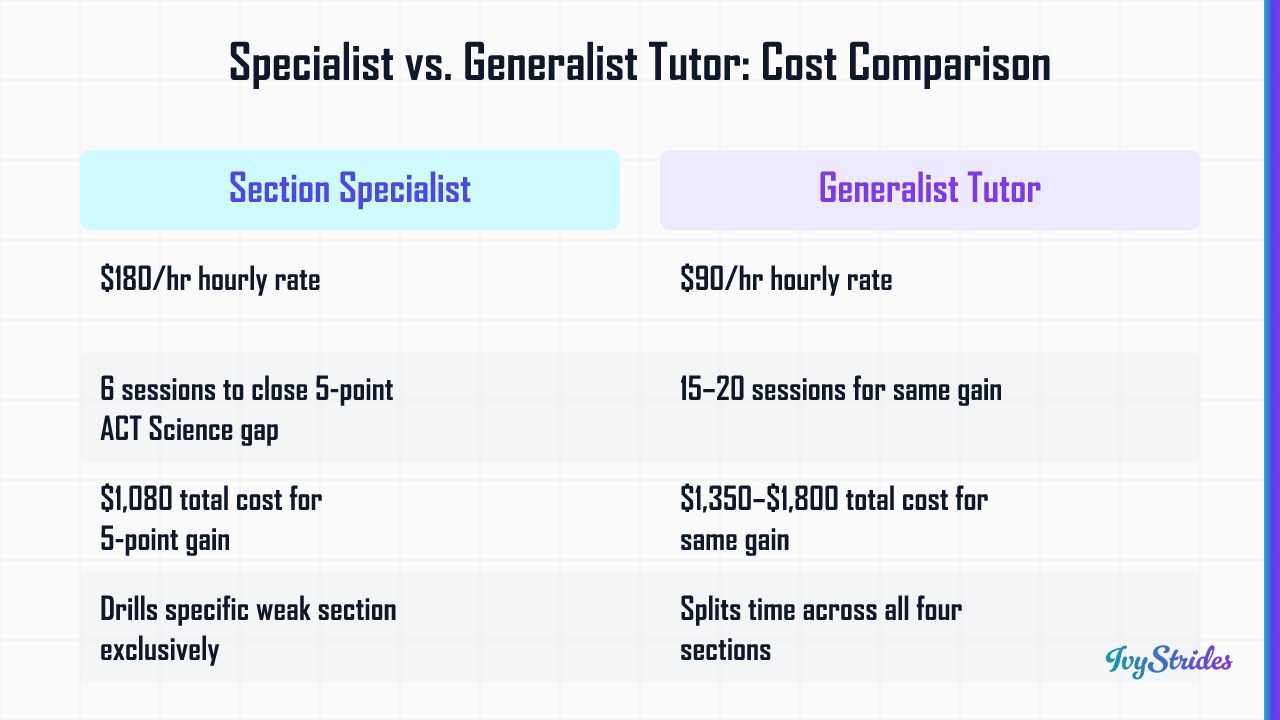
A generalist tutor who covers all four ACT sections or both SAT sections charges less per hour, but in our coaching we consistently see students gain more points per hour when working with a coach who specializes in their weakest section, whether that's SAT Math, SAT Reading and Writing, or ACT Science. The math works because the specialist diagnoses faster, drills the right question types, and doesn't waste sessions on areas the student already has locked.
A concrete example. The Digital SAT adapts after Module 1: a student who performs well in R&W Module 1 routes into a harder R&W Module 2 with more challenging inference and rhetorical synthesis questions. A SAT Reading and Writing specialist knows which Module 2 question types (command of evidence, transitions, cross-text connections) hit hardest at the 650-plus band and drills those specifically. A generalist teaching all sections rarely maintains that depth.
ACT Science is the cleanest illustration. Students who can't distinguish data representation passages from research summary passages, or who don't know the conflicting viewpoints passage shows up exactly once per test, lose 3 to 5 composite points on Science alone. A junior we worked with last fall came in with a 30 composite but a 25 in Science; six sessions with an ACT Science specialist focused on passage typing and graph-reading drills moved her Science to 31 and the composite to 32. A generalist covering all four ACT sections rarely gets there in the same number of hours, because Science only gets a quarter of the time.
The implication for budget. A $180/hr specialist who closes a 5-point ACT Science gap in 6 sessions costs $1,080. A $90/hr generalist who spreads attention across all four sections may need 15 to 20 sessions for the same gain, costing $1,350 to $1,800. Higher hourly rate, lower total cost. Families weighing the ACT specifically can see how we assign specialists per weakness in our 1-on-1 ACT prep (signature service). Students preparing on their own can start with how to study for the act.
How Many Hours of SAT or ACT Tutoring Do You Actually Need
This is the question that determines your total program cost. Hourly rate matters. Hours required matters more. Here's the honest framework we use after a diagnostic.
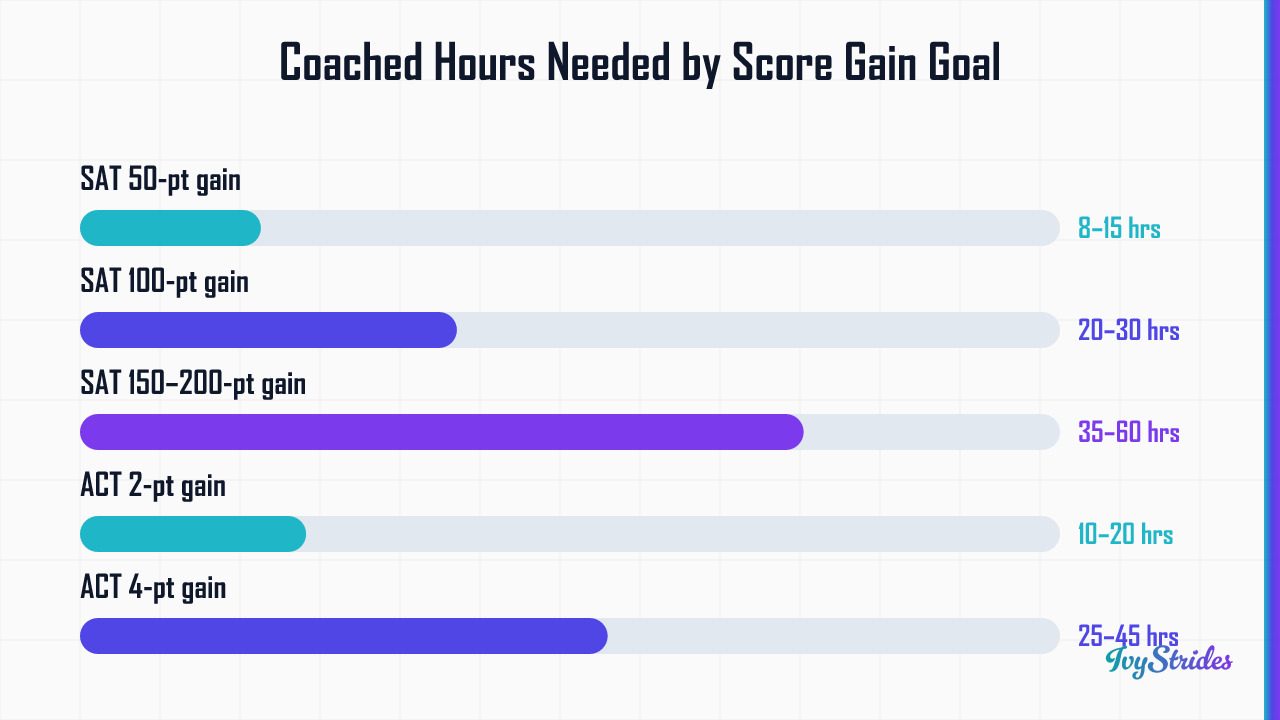
Typical coached-hour ranges from our coaching, calibrated against College Board's score-improvement guidance:
| Score gap | Typical coached hours |
| SAT 50-point gain | 8 to 15 hours |
| SAT 100-point gain | 20 to 30 hours |
| SAT 150 to 200-point gain | 35 to 60 hours |
| ACT 2-point composite gain | 10 to 20 hours |
| ACT 4-point composite gain | 25 to 45 hours |
| ACT 6+ point composite gain | 50 to 80 hours |
A student targeting a 150-point SAT gain from 1150 to 1300 typically needs 30 to 50 focused hours of coached practice, which means the total program cost depends as much on hours required as on the hourly rate. At $120/hr that's $3,600 to $6,000. At $200/hr it's $6,000 to $10,000. Same goal, different paths.
Three caveats. First, hours depend on the student's starting weaknesses, not just the gap size. A student missing 20 points entirely from careless errors needs fewer hours than a student missing 20 points from genuine content gaps. Second, hours depend on what the student does between sessions. Six to eight hours of independent practice per week roughly doubles the return on each coached hour. Third, hours depend on spaced retesting. In our coaching, students who complete a full-length diagnostic before their first session and retest every 3 to 4 weeks show faster improvement than those who skip the diagnostic or never retest under timed conditions. Results still vary by student starting point, hours invested, and consistency.
The diagnostic point is the one most families underestimate. Without it, you're paying a tutor to figure out, slowly and expensively, what a 3-hour practice test would have told them in week one. We use official SAT practice tests for diagnostic accuracy. Students tracking errors between sessions can use our sat mistake tracker.
Not Sure How Many Hours Your Student Needs?
Book a free 15-minute strategy call. We'll review your student's current score, identify the sections costing the most points, and recommend the right prep format and realistic timeline before you spend a dollar on tutoring.
Is SAT or ACT Tutoring Worth the Cost
Yes, in three conditions. The student has a meaningful score gap (50+ SAT points or 2+ ACT composite points below their target school median). The tutor uses a diagnostic-first, section-specialist methodology. The student commits to practice between sessions. Without all three, the return on tutoring drops fast.
A few numbers to anchor the ROI conversation. In our coaching, students who complete 30+ hours of coached prep with a section-specialist and full-length retesting typically see 100 to 200+ point SAT gains or 4+ ACT composite point gains. Students who do 5 to 10 hours of generic tutoring rarely move more than 30 to 50 SAT points. The difference is methodology and hours, not hourly rate. Admissions outcomes also depend on the full application, so a strong score is one input among several.
The merit-aid angle matters too. In our coaching, a 50-point SAT gain from 1350 to 1400 can typically cross a scholarship threshold worth $10,000 to $40,000 per year at some universities per the published Common Data Set tracker. Families should check each school's Common Data Set for current score-based aid cutoffs (search "Common Data Set [University Name]"). A $4,000 tutoring investment that unlocks $40,000 in merit aid is a different calculation than a $4,000 investment for a 30-point bump that crosses no threshold.
On test-optional. Policies vary by school and year, and the FairTest tracker lists current data. The honest read: at test-optional schools, strong scores still help applications; at test-required schools they're non-negotiable. See do colleges require sat 2026 for the school-by-school picture.
When tutoring isn't worth it. If the student is already at or above the 75th percentile for their target schools, additional tutoring offers diminishing returns. Better to invest those dollars in essay coaching, AP prep, or extracurricular depth. A student wondering whether they're already there can read is 1540 a good sat score.
Free resources have a real role too. The College Board's official Bluebook practice tests are the gold standard for self-directed students, and in our coaching free official practice can typically close 50 to 100 point gaps for disciplined juniors with consistent self-study. The ceiling: free resources rarely produce 150+ point gains for students with specific skill gaps, because no software diagnoses why a student keeps missing inference questions in R&W Module 2 the way a section-specialist can in one session.
Students aiming for National Merit Semifinalist status through the PSAT/NMSQT face a separate calculation, since that pathway depends on a Selection Index cutoff in the top 1% for the student's state.
What an SAT or ACT Tutor Should Actually Charge: Red Flags and Green Flags
So is $50 an hour reasonable? Below market for an experienced tutor in 2026. Tutor communities on Reddit and elsewhere note $75 to $85/hr as a reasonable floor for tutors with documented results and a structured methodology. At $50/hr you're typically working with a newer tutor, fine for basic content review, less reliable for the targeted weakness work a 100+ point gain requires.
Hourly rate is one quality signal. It isn't the only one. Here are the others.
Red flags.
- No full-length diagnostic before recommending hours or pricing.
- Score guarantees in writing. Reputable programs don't promise specific score outcomes because results depend on student effort and starting point.
- One tutor covers all subjects and all sections with no specialization.
- No practice test retesting built into the plan.
- Vague answers to "how do you track progress between sessions?"
Green flags drawn from the methodology recommendations published in College Board's official SAT preparation guidance and our own coaching:
- Starts with a full-length official practice test, scored and broken down by section and question type.
- Assigns a section-specialist to the student's weakest area.
- Typically schedules spaced retesting every 3 to 4 weeks.
- Provides a written plan with hour estimates and milestones before charging.
- Uses an error-tracking system the student can review between sessions.
The single best question to ask any tutor before hiring: "What's your methodology for identifying which question types my student is losing points on, and how do you track progress between sessions?" A vague answer means a vague program. A specific answer (named question types, mistake categorization system, retest cadence) means a real methodology.
You can meet the tutors we assign by section. Students preparing independently can use our sat mistake tracker to build the same diagnostic loop.
What Else Goes Into the Total Cost of College Prep
SAT or ACT tutoring is one line item. A realistic college prep budget covers three to four more.
AP exam fees and AP prep. Each AP exam costs $98 in 2026 (AP Students, College Board); fees are set annually, so verify before testing season. AP tutoring or course costs vary by provider and subject, and the strongest applicants to selective schools typically sit four to eight APs across high school. Our ap classes online assign a per-subject specialist for each AP.
Admissions essay coaching. The Common App personal statement (650 words) plus supplemental essays for 8 to 12 schools can require 10 to 20 hours of coached drafting and revision. Typical cost runs $500 to $3,000 depending on provider and depth. A parent recently asked us how to tell whether an essay coach was worth the rate. The answer: families who evaluate an essay coach with the same rigor they apply to a test prep tutor, asking about methodology, sample feedback, and realistic timelines, tend to get stronger supplemental essays and avoid paying for generic editing that doesn't move the needle. Our approach to that work sits in our common app essay tutor service.
PSAT and National Merit. Students aiming for National Merit Semifinalist status need a PSAT/NMSQT Selection Index in the top 1% for their state. PSAT prep overlaps with SAT prep but has distinct percentile dynamics. See psat percentiles for current state cutoffs.
Total range. Families investing in SAT/ACT tutoring, AP support, and essay coaching typically spend $3,000 to $15,000 across junior and senior year. IvyStrides covers all five service lines (SAT, ACT, PSAT, AP, essays) under one academy, which is how families avoid paying four separate providers and getting four disconnected strategies.
How to Choose the Right SAT or ACT Prep Format for Your Budget
Match the format to the budget. Take the diagnostic first regardless.
Typical budget-to-format mapping in our coaching, calibrated against College Board's prep resource recommendations:
| Budget | Recommended format |
| Under $500 | Self-study with official Bluebook practice tests and disciplined error tracking |
| $500 to $1,500 | Group prep course or test pack bundle plus self-study |
| $1,500 to $4,000 | 1-on-1 generalist tutoring, 15 to 25 hours, focused on one to two weak sections |
| $4,000 to $10,000+ | 1-on-1 section-specialist coaching, 30 to 60 hours, full diagnostic-driven plan |
One rule applies across every budget. Take a full-length official practice test before spending a dollar on coaching. It tells you the actual score gap, the section weights, and the question types costing the most points. Without it, you're guessing at format and hours.
For students with a January or March test date, SAT winter batch enrollment gives a structured 8-to-12-week runway. Students who want to start self-directed before committing to coaching can browse our free sat resources. Families on the ACT track can begin with an act practice test online to set the baseline.
FAQ
How much does an SAT tutor charge per hour in 2026?
SAT tutors typically charge $45 to $80/hr at the entry level, $80 to $200/hr for experienced independent tutors, and $150 to $500+ per hour for section-specialist coaches at structured programs, based on current rates surveyed across major test-prep marketplaces. The rate reflects experience, specialization, and whether the tutor is independent or company-affiliated. In our coaching market, online tutoring typically runs 10 to 20 percent less than in-person for comparable quality and opens access to specialists outside major metro areas. Rates vary by geography and market conditions.
Is $50 an hour a fair rate for SAT tutoring?
$50 per hour typically sits below the current market floor for an experienced SAT tutor per published rates on major tutor-marketplace platforms and similar platforms. Tutor communities note $75 to $85/hr as a reasonable minimum for tutors with documented results and a structured methodology. At $50/hr you're likely working with a newer tutor or a current college student, which can work for basic content review but rarely delivers the targeted weakness work needed for a 100+ point gain.
Is it worth getting a tutor for the SAT or ACT?
In our coaching, tutoring typically delivers strong return on investment when the student has a meaningful score gap (50+ SAT points or 2+ ACT composite points below their target school median per the school's Common Data Set), the tutor uses a diagnostic-first section-specialist methodology, and the student practices consistently between sessions. It's less worth it when the student is already at or above the 75th percentile for their target schools. Free official practice resources can close small gaps for disciplined self-directed students but rarely produce 100+ point SAT gains without coached accountability.
How much does ACT tutoring cost compared to SAT tutoring?
ACT tutoring costs are typically comparable to SAT tutoring at each tier per ACT's official prep resources page and current marketplace listings: $45 to $80/hr entry-level, $80 to $200/hr experienced, $150 to $400+/hr for section specialists. Total program cost depends on the student's composite score gap and which sections need the most work. ACT Science and Reading are the sections where specialist coaching tends to pay off most per hour, because the passage-type strategies are highly learnable with targeted practice.
What is the difference between a group SAT prep class and 1-on-1 tutoring?
Group classes cost $300 to $1,500 total and follow a fixed curriculum that covers all sections for all students regardless of individual weaknesses. 1-on-1 tutoring costs more per hour but starts from a diagnostic and targets only the question types and sections where the student is losing points. In our coaching, students with specific skill gaps gain more points per hour in 1-on-1 prep than in group classes, because the plan adapts to the student rather than the other way around.
Can I find good SAT tutoring near me, or is online just as effective?
In our coaching, online SAT and ACT tutoring is typically as effective as in-person for most high school juniors and seniors, and it opens access to section-specialist coaches regardless of geography, an approach validated in College Board's digital preparation resources. In-person can suit younger students who need more structured accountability. For most college-bound students, online delivery with a strong methodology and regular full-length practice tests typically produces comparable results at 10 to 20 percent lower cost than in-person at the same quality tier.
The honest answer to "how much should we spend?" starts with one number: your student's current score and the question types costing the most points. Hourly rate, format, total hours follow from that diagnostic. Skip it and the budget conversation is guesswork. Take it first and the right format and price tier become obvious.
Ready to Know Exactly What Your Student Needs?
A 15-minute call with an IvyStrides coach gives you a diagnostic snapshot, a realistic hour estimate, and a service-fit recommendation, whether that's 1-on-1 SAT prep, ACT coaching, AP classes, or essay support. No commitment required.

Kunal writes about Digital SAT and ACT strategy for the IvyStrides blog.