
How Much Does the ACT Cost? The Honest, Data-Backed Answer for 2026
On this page
- ACT Registration Fee in 2026: The Complete Fee Table
- What the ACT Registration Fee Actually Covers in 2026
- ACT Late Registration and Change Fees: What They Cost and How to Avoid Them
- Not Sure Which ACT Date or Add-Ons Are Right for Your Student?
- ACT Fee Waiver Program: Who Qualifies and How to Apply
- ACT Fees for International Students: Why the Cost Is Higher
- How Much Does It Cost to Retake the ACT?
- Is the ACT Worth the Cost? Putting the Fee in Perspective
- Practical Tips to Keep Your ACT Costs as Low as Possible
- FAQ: ACT Costs in 2026
- Is a 27 a good ACT score?
- How rare is a 32 on the ACT?
- Is the ACT harder than the SAT?
- Is 2 months enough time to study for the ACT?
- Does the ACT cost the same in Florida and Texas as in other states?
- Can you get a refund if you cancel your ACT registration?
- How much does it cost to send ACT scores to colleges after registration?
- Does the ACT fee waiver cover the Science and Writing sections?
- Ready to Make Every ACT Dollar Count?
The ACT base registration fee in 2026 is $70, covering English, Math, and Reading plus score reports to you, your high school, and up to four colleges. The optional Science section adds $5; the optional Writing section adds $25. Register after the standard deadline and a $42 late fee applies. Most students pay between $70 and $100, depending on which sections they select. Eligible US students can get the base fee (and typically the add-ons) covered by an ACT fee waiver.
Every figure in this guide comes from the ACT, Inc. official fees page. Fees change; verify at ACT.org before you register. The next sections break down what the base fee actually covers, where families most often overspend, and how to keep your total as close to $70 as possible.
ACT Registration Fee in 2026: The Complete Fee Table
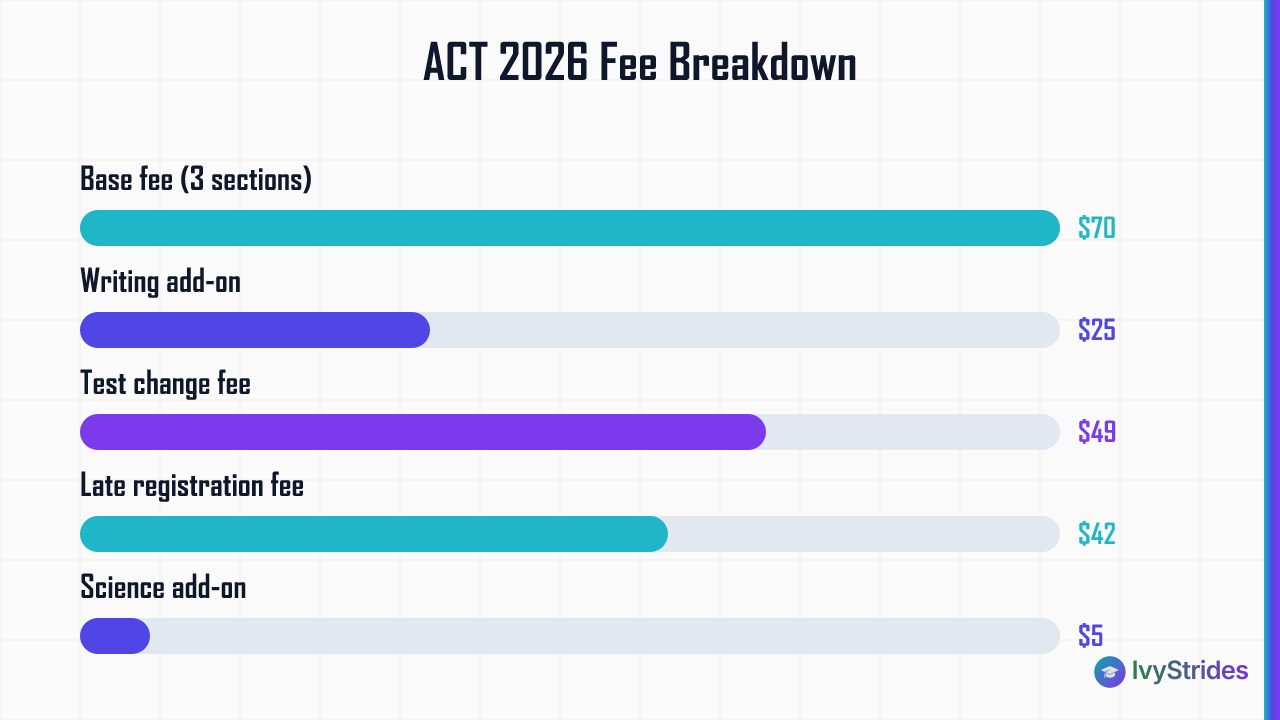
The ACT registration fee is the amount ACT, Inc. charges to sit for the test on a specific national test date. Here is the full 2026 fee table, line by line, from ACT.org.
| Fee | 2026 Amount | What it buys |
| ACT base fee (English, Math, Reading) | $70 | Test seat plus score reports to you, your high school, and up to 4 colleges |
| Science add-on | $5 | Adds the Science section to your test |
| Writing add-on | $25 | Adds the 40-minute essay section |
| Late registration fee | $42 | Surcharge for registering in the late window |
| Test change fee | $49 | Change test date, test center, or test form |
| Additional score report | $20 each | Sending scores to a 5th, 6th, 7th college, and so on |
| Score verification (multiple-choice) | $67 | Re-scoring of your MC answer sheet |
| Score verification (Writing) | $67 | Re-reading of your essay |
| Score verification (both) | $134 | Both services combined |
| Source | ACT official fees | Verified 19 August 2026 |
A student taking all four sections plus Writing pays $100 ($70 + $5 + $25), per the ACT fee schedule. Add the late fee and the total lands at $142. Miss the late deadline, change the date, and add Writing, and the number climbs past $190. Small choices stack fast.
Register on time and you can plan around the ACT test dates 2026-2027 calendar without paying a cent in surcharges.
Source: ACT.org official fees page. Fees are subject to change; confirm current amounts at ACT.org before registering.
What the ACT Registration Fee Actually Covers in 2026
The $70 base fee bundles four things: your test seat on the chosen date, one score report to you, one score report to your high school, and score reports sent to up to four colleges you designate at registration.
That "up to four colleges" line is the one most families miss. List four colleges when you register and those reports are free. List fewer, and you can't claim the leftover slots later. List more than four, and each extra report costs $20.
Here's what the base fee does NOT include:
- Additional score reports beyond the first four ($20 each)
- Score verification or hand-scoring ($67 to $134)
- Test Information Release, when offered (extra fee for a copy of your test questions and answers)
- Any change to date, center, or test form after registration ($49)
Once your budget is set, our step-by-step ACT registration guide walks you through the exact ACT.org sign-up, including how to add Science or Writing during registration. When it's time to send scores past your fourth college, see how to send ACT scores to colleges.
Practical rule: at registration, list the four colleges you're most likely to actually apply to. Not your dream list. Your real list. You can always send more later, at $20 each.
ACT Late Registration and Change Fees: What They Cost and How to Avoid Them
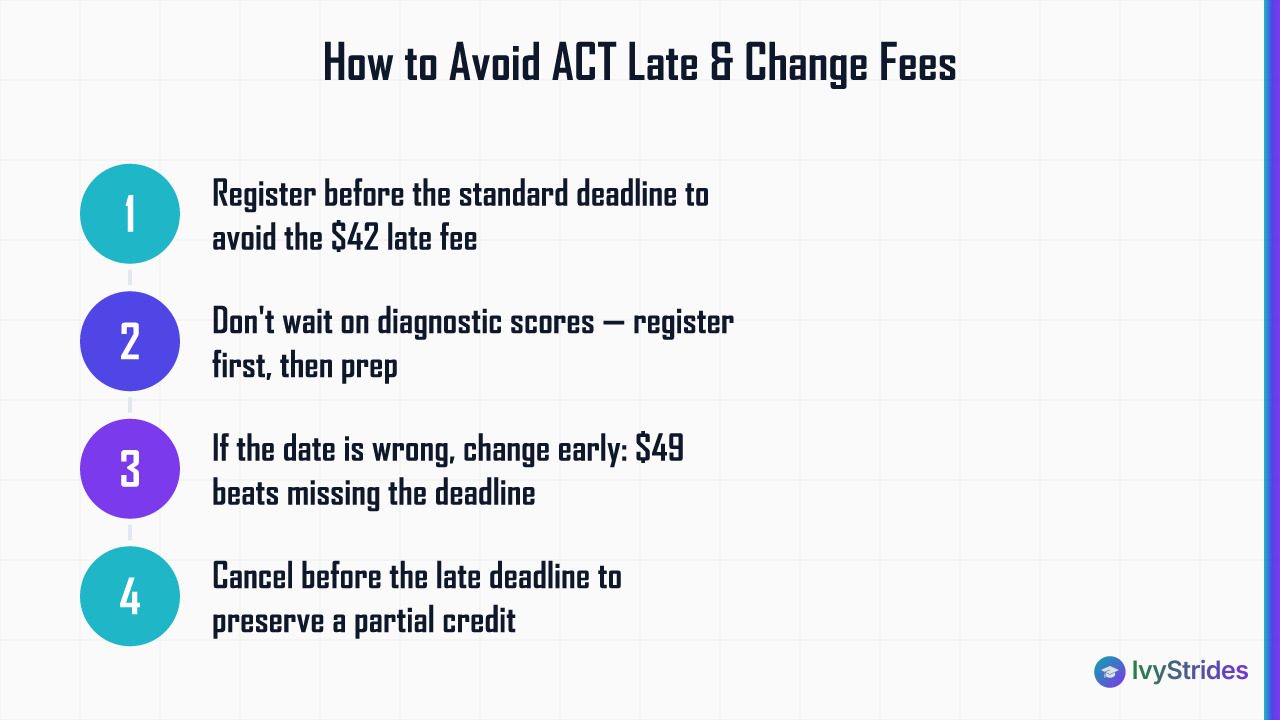
The single most avoidable ACT cost is the $42 late registration fee, and the second most avoidable is the $49 test change fee, both published by ACT, Inc.. Both hit students who register in a rush.
ACT, Inc. publishes a standard registration deadline and a late registration deadline for each national test date. Register on or before the standard deadline and you pay the base fee. Register between the standard deadline and the late deadline and the $42 surcharge stacks on top. Register after the late deadline and, for most dates, you can't register at all without contacting ACT about standby options.
The test change fee is separate. Change your date, test center, or test form and ACT charges $49 on its current fee list. Do that during the late window and both fees stack: the change fee plus the late fee, on the same registration.
Registering before the standard deadline is the single easiest way to avoid the $42 late fee; see the full ACT test dates and registration deadlines for 2026-2027 to plan ahead.
In our coaching, students who register late usually do so because they were waiting on a diagnostic score to decide whether to sit for a test. That's backwards. Register first, then use the weeks before test day to prep. If your diagnostic later says the date is wrong, changing costs $49; missing the standard deadline entirely costs $42. Either way, decide early.
Refunds? ACT doesn't issue cash refunds. A partial credit toward a future date is sometimes available if you cancel before the late deadline. For the mechanics, see how to change or cancel an ACT registration.
Not Sure Which ACT Date or Add-Ons Are Right for Your Student?
Book a free 15-minute strategy call. Our ACT coaches will review your current score, recommend the right test date, and tell you exactly which sections to register for so you don't pay for add-ons you don't need.
ACT Fee Waiver Program: Who Qualifies and How to Apply
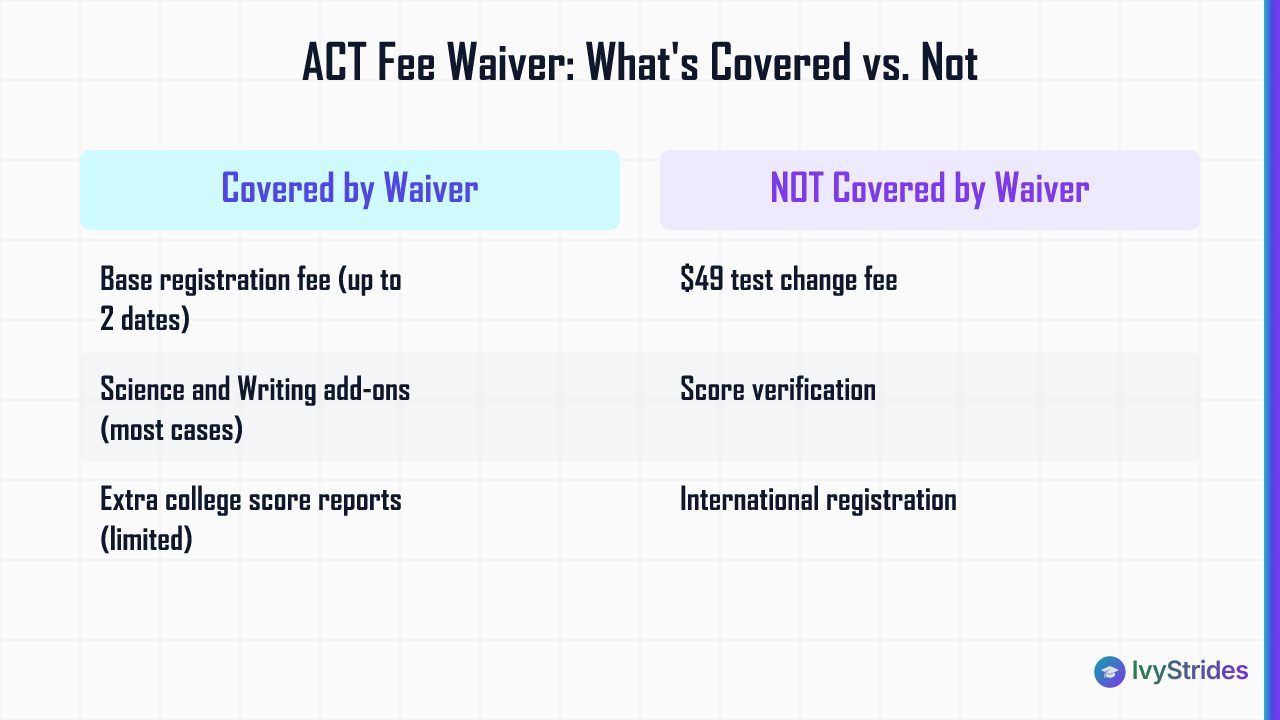
The ACT fee waiver removes the base registration fee, and in most cases the Science and Writing add-ons, for eligible US students. If cost is a barrier, check this first, before you spend anything.
Eligibility is set by ACT, Inc. and is based on financial-need criteria similar to those used for federal free-or-reduced-lunch programs. Broadly, an 11th or 12th grade student enrolled in a US high school who meets ACT's financial-need thresholds qualifies. Full current criteria are on ACT.org.
You don't apply directly to ACT. Fee waivers are administered through your high school counselor. The counselor confirms eligibility and issues the waiver code, which you enter during ACT registration.
What the waiver typically covers:
- Base registration fee for up to two ACT test dates
- Science and Writing add-ons on those dates, in most cases
- A limited number of additional college score reports at no extra charge (beyond the standard four)
What it does not cover:
- The $49 test change fee (ACT fees)
- Score verification
- International registration
The ACT fee waiver isn't available to international students. Waiver scope has shifted before and can shift again, especially as the Enhanced ACT changes for 2026 roll out. Confirm current scope with your counselor and at ACT.org.
Honest note from coaching: fee-waiver-eligible students often don't know the program exists until a counselor mentions it. If you think you might qualify, ask. The worst answer is no.
ACT Fees for International Students: Why the Cost Is Higher
International students pay meaningfully more than the domestic $70. ACT, Inc. charges a separate international test center fee on top of the base fee, and the total varies by country and specific test center.
The international structure exists because ACT contracts with test centers abroad to administer the exam under the same security conditions as US centers. That infrastructure, proctors, secure test delivery, and materials handling across borders, costs more, and the fee reflects it.
Two hard rules for international families:
- No fee waiver program applies internationally. The ACT fee waiver is US-only.
- The country-specific fee changes. Testing in Seoul isn't priced identically to testing in Dubai or London.
If you're registering from outside the United States, the fee structure is meaningfully different; our dedicated guide to ACT fees for international students covers every country-specific cost and saving strategy. For broader strategic context on international testing, see the ACT for international students.
In our coaching with international families, we see budgets set to the base fee alone. Registration plus prep materials can typically reach $300 or more before any tutoring.
How Much Does It Cost to Retake the ACT?
A retake costs exactly the same as the first attempt: $70 base, plus $5 for Science and $25 for Writing if you want them. No discount for repeat test-takers, no penalty either.
The question isn't really about cost. It's about score-improvement math. Will the retake raise your composite enough to matter for admissions or scholarships? For most students taking the ACT twice or three times, the answer is yes; ACT, Inc.'s own retake data shows a majority of retakers improve their composite score.
Two policy points worth understanding:
ACT Score Choice. You control which test date's scores go to colleges. If your retake goes worse than your first attempt, colleges don't automatically see it. You send only the sitting you choose. A handful of schools require all scores; check each school's policy.
No cumulative discount. Take the ACT four times and you pay four full registration fees. Which is why every attempt should have a plan behind it, not just hope.
For the strategic decision, see our guide on should you retake the ACT. If you're weighing point-gain potential, how much can you improve your ACT realistically walks through the math score band by score band.
Is the ACT Worth the Cost? Putting the Fee in Perspective
Set against merit-scholarship potential, $70 is a small line item. A composite around 30 clears the automatic-scholarship threshold at many public universities. Some flagship state schools offer awards of $5,000 to $20,000 or more per year tied to specific ACT bands. The ROI math favors registering.
For a fuller breakdown of thresholds and awards, see how ACT scores affect merit scholarships.
Cost against the SAT? Roughly the same. The Digital SAT registration fee is comparable to the ACT base plus Writing. If you're choosing between the two, fee difference isn't the decision-maker; format fit is. Our ACT vs SAT comparison walks through which test suits which student.
Prep investment is where the numbers get more interesting. Free ACT prep materials exist and are useful, but coverage is thin on pacing strategy, Science passage types, and per-section weakness targeting. See is free ACT prep enough to raise your composite for an honest breakdown.
Timeline matters too. In our coaching, students working roughly 40 to 60 focused hours over about 8 weeks, starting from a diagnostic, typically gain 2 to 4 composite points. Larger jumps of 5 or more points usually need 3 to 4 months. If you have exactly two months, ACT prep in 2 months shows what a realistic plan looks like.
The registration fee is a floor. Prep is the multiplier. Skip prep and the $70 buys a score reflecting where you already are.
Practical Tips to Keep Your ACT Costs as Low as Possible
Six actions that cut avoidable spending:
-
Register by the standard deadline. Saves the $42 late fee. Set a calendar reminder the day the test date is announced.
-
Decide on Science and Writing before you register. Changing sections later triggers the $49 test change fee. Confirm which colleges on your list want or require Science and Writing, then commit.
-
Check fee waiver eligibility first. If you qualify, waiver students save the full base fee plus, in most cases, both add-ons. Ask your school counselor before spending anything.
-
Use your four free score reports strategically. List four colleges at registration only if you're seriously considering applying. Don't waste slots on aspirational or throwaway schools; you'll pay $20 each for real ones later.
-
Take a diagnostic before you register. A full-length practice test tells you whether the ACT (versus the SAT) fits your strengths, and confirms which test date matches your realistic prep timeline. See our ACT practice tests library, or best ACT practice tests in 2026 for a curated list.
-
Plan retake timing. Two well-prepped attempts usually beat three under-prepped ones. Two sittings at $70 equals $140; three at $70 equals $210. If the third attempt won't add prep hours, skip it.
FAQ: ACT Costs in 2026
Is a 27 a good ACT score?
A 27 sits around the 83rd percentile nationally, above the composite of roughly 8 out of 10 test-takers. It's competitive at many public flagships and mid-selective private colleges, and often clears merit-scholarship thresholds. It's below the median for highly selective schools. Check each target college's Common Data Set for the middle-50% ACT range of admitted students.
How rare is a 32 on the ACT?
Roughly 3 in 100 test-takers reach a 32, placing that score at approximately the 97th percentile nationally. It's competitive at most selective universities and meets or exceeds the 75th-percentile ACT at many top-25 schools, though not sufficient on its own; admissions decisions depend on the full application.
Is the ACT harder than the SAT?
Neither test is objectively harder. They test overlapping skills in different formats. The ACT moves faster, with more questions per minute, and includes a Science section. The Digital SAT is section-adaptive with fewer total questions. Most students score at similar percentiles on both after a fair diagnostic. Take a timed practice test of each and let the score decide.
Is 2 months enough time to study for the ACT?
Yes for many students. Two focused months from a diagnostic baseline is typically enough to move a composite by roughly 2 to 4 points, which is often the difference between missing and clearing a scholarship band. Bigger jumps of about 5 points or more generally need 3 to 4 months of consistent work rather than a heavier last-minute push.
Does the ACT cost the same in Florida and Texas as in other states?
Yes. The ACT registration fee is uniform for all domestic US test-takers regardless of state. The $70 base, $5 Science, and $25 Writing apply in Florida, Texas, and every other state. State-specific pricing arises only when your school administers the ACT as part of a state-funded testing program, in which case students often test at no personal cost. (This article covers the ACT college admissions test only; unrelated Florida statutes with similar names are outside scope.)
Can you get a refund if you cancel your ACT registration?
Cash refunds aren't offered. Cancel before the late registration deadline and you may receive a partial credit toward a future test date. Cancel after the late deadline and the fee is typically forfeited. Confirm current cancellation policy at ACT.org before registering.
How much does it cost to send ACT scores to colleges after registration?
Free reports go to your high school and up to four colleges designated at registration. Each additional report sent later costs $20. If you're planning to apply to more than four colleges, designate wisely at registration to avoid paying for reports you could have gotten free.
Does the ACT fee waiver cover the Science and Writing sections?
In most cases, yes. The waiver typically covers the base fee and both add-ons for eligible US students. Eligibility is determined through your high school counselor based on ACT, Inc.'s financial-need criteria. Verify current waiver scope with your counselor and at ACT.org before assuming full coverage.
The ACT costs $70 to sit for, and the gap between a well-spent $70 and a wasted one is prep. Register on time, pick your add-ons deliberately, and know your target score before you buy the seat. Learn how we structure diagnostic-driven plans on our about page. You can also meet the tutors who coach at each score band.
Ready to Make Every ACT Dollar Count?
A free 15-minute call with an IvyStrides ACT coach gives you a diagnostic snapshot, a realistic score target, and a prep plan so your registration fee is the start of a real score gain, not a sunk cost.

Award-winning author (South Asian Book Award) and graduate of BITS Pilani and UCLA Luskin School of Public Affairs. Brings a published writer's eye to Common App essays and grammatical precision to SAT and ACT R&W instruction.