
How to Fill Out a Brag Sheet: What Your Counselor Actually Needs
On this page
- What a Brag Sheet Actually Does for Your College Application
- Is a Brag Sheet the Same as a Resume? The Key Difference
- What to Include in a Brag Sheet: A Section-by-Section Breakdown
- The Academic Section of a Brag Sheet: Grades, Scores, and Coursework
- The Personal Section: Stories and Qualities Your Recommender Cannot See From Grades Alone
- Not sure how your brag sheet fits into your full application strategy?
- How Long Should a Brag Sheet Be? Format and Length Guidelines
- Strong vs. Weak Brag Sheet Entries: Side-by-Side Examples
- When to Give Your Brag Sheet and Who Gets It
- Common Brag Sheet Mistakes That Weaken Your Recommendation Letters
- How a Strong Brag Sheet Fits Into Your Broader College Application Strategy
- Frequently Asked Questions About High School Brag Sheets
- Do colleges see brag sheets?
- What accomplishments are good for a brag sheet?
- How long should a brag sheet be?
- Who fills out a brag sheet?
- Is a brag sheet the same as a resume?
- What are some good adjectives to use on a brag sheet?
- Should I give a different brag sheet to my counselor and my teachers?
- How do I write a brag sheet without sounding arrogant?
- Your brag sheet is one piece of a connected application strategy.
A brag sheet should include six core sections: your basic contact information, your academic record (GPA, SAT or ACT scores, AP courses and scores), your extracurricular activities with roles and concrete achievements, honors and awards, a personal qualities section with specific anecdotes, and your college goals including intended major. Keep it to one or two pages. The goal is to give your counselor and teachers the specific details they need to write a letter that goes beyond "she was a good student" and into evidence an admissions officer can actually use.
Here's the part most families miss: colleges never see this document. It travels only to the recommender. That single fact changes how you should write it. You aren't performing for an admissions committee; you're briefing a busy adult who wants to help but can't recall every detail of your junior year. The sections below walk through what belongs in each part, with side-by-side examples of strong versus weak entries.

What a Brag Sheet Actually Does for Your College Application
A brag sheet is a structured self-summary a student gives to a counselor and to subject teachers before those adults write college recommendation letters. Its job is narrow and important: supply the specific evidence, anecdotes, and context a recommender needs to write a letter that names real moments instead of generic praise.
Most selective colleges collect recommendations through the Common App, which includes one counselor recommendation and up to two teacher evaluations. Your counselor writes about the whole student. Each teacher writes from the vantage point of one class. The letter's quality depends heavily on the raw material you hand over.
Here's the part most students miss. A counselor at a public high school may advise several hundred students at once, and a popular AP teacher might write twenty or more letters each fall. Without a written prompt from you, even a teacher who genuinely likes you defaults to the vague, forgettable letter: hardworking, respectful, a pleasure to have in class. That letter helps no one.
Do colleges read your brag sheet? No. The document goes to the recommender and stops there. The letter is what an admissions officer reads during holistic review, where recommendation letters serve as third-party evidence of your character and academic ability alongside grades, scores, and essays. For a full picture of how recommendation letters fit into the Common App and what admissions officers look for in them, read our guide to college recommendation letters.
Think of the brag sheet as the difference between handing your recommender a blank page and handing them a folder of usable evidence. Same teacher, same goodwill, radically different letter.
Is a Brag Sheet the Same as a Resume? The Key Difference
A brag sheet is not a resume. A resume lists roles and dates in a formal, employer-facing format. A brag sheet is a personal, narrative document built to help someone write about who you are, not just what titles you've held.
The distinction matters more than it sounds. A resume line reads "Treasurer, Key Club, 2023-2025." A brag sheet entry explains the context and impact behind that line: what you managed, what changed because you were there, what it revealed about how you work. The recommender needs the second version to write a sentence worth reading.
Brag sheets also include prompts a resume never would. Describe a challenge you overcame. List three adjectives your friends would use to describe you. Explain what you want this letter to convey. Many school-provided templates, and the widely used Common App-style brag sheet formats, lean on exactly these open-ended prompts because they surface the stories that make a letter specific.
Keep it to one or two pages. This is a functional briefing document, not a design portfolio and not a multi-page CV. In our coaching with students preparing recommendation packets, the two-page brag sheet with concrete stories consistently produces a stronger letter than the four-page document that logs every activity since ninth grade. Length dilutes; specificity concentrates.
What to Include in a Brag Sheet: A Section-by-Section Breakdown
A complete brag sheet has six sections. Each has a distinct job, and skipping any one of them leaves your recommender guessing.
| Section | What it contains | Why the recommender needs it |
| Basic information | Full name, email, phone, graduation date, pronouns if comfortable | Contact and identification; correct name spelling for the letter |
| Academic record | GPA (weighted and unweighted), class rank if reported, SAT or ACT score, PSAT if National Merit relevant, AP courses and scores | Establishes academic ability with real data points |
| Extracurricular activities | Activity name, role, years involved, hours per week, one concrete achievement each | Shows commitment and impact beyond the classroom |
| Honors and awards | Award name, granting body, year, selectivity context | Signals recognition and how competitive it was |
| Personal qualities | Three to five adjectives with a one-line story behind each; a classroom moment; a challenge overcome | Gives the recommender anecdotes they can't see from grades |
| Goals and intended major | Intended field, one or two target colleges if comfortable, what you want the letter to convey | Lets the recommender connect your strengths to your direction |
Basic information is quick but load-bearing. Use your full name as it appears on your transcript, an email you actually check, your phone number, expected graduation date, and pronouns if you're comfortable sharing them. Get the name right so the letter does too.
The academic record deserves its own full section below, because it's where students most often undersell themselves.
Extracurricular activities are where vagueness kills a letter. Give the activity name, your role, how many years you've been involved, and rough hours per week. Then, and this is the part that matters, one concrete achievement per activity. Not "treasurer of Key Club" but "raised $4,200 for the local food bank as Key Club treasurer by running two fundraising drives." That discipline of specific, quantified impact is what separates a strong Common App activities list from a forgettable one; see our breakdown of how to write strong activities list descriptions.
Honors and awards need context. "National Merit Commended Student" or "first place, regional science fair, 320 entrants" tells the recommender how selective the recognition was. Name the granting body and the year.
Personal qualities is the section most students rush and most recommenders wish they had more of. Pick three to five adjectives, each backed by a single sentence of evidence. Add one specific classroom story the teacher can reference, and one challenge you faced and what came of it.
Goals and intended major closes the loop. If you plan to study biomedical engineering, say so, because it lets the recommender tie your strengths to a direction. The self-knowledge you build filling this out is the same raw material behind a strong personal statement; our guide on what makes a college essay good covers how those stories carry into the essay itself.
The Academic Section of a Brag Sheet: Grades, Scores, and Coursework
The academic section of a brag sheet is where students leave the most on the table. List both your weighted and unweighted GPA so the recommender can choose whichever fits the point they're making. If your school reports class rank, include it. If it doesn't, leave it out rather than guess.
Report test scores in the correct format. The Digital SAT is scored on a 400 to 1600 scale, split across Reading and Writing and Math sections, per College Board. The ACT composite runs 1 to 36. Write the score as you'd submit it: "SAT: 1420 (Math 740, Reading and Writing 680)" gives the recommender something precise to reference.
Include your SAT or ACT score in this section if you plan to submit it. If you're applying test-optional, note that decision so your recommender doesn't inadvertently reference a score you're not submitting. Test-optional policies vary by school and by year, and whether to submit is its own strategic call, covered in what is test-optional and should you submit SAT scores.
AP scores carry weight when you use them right. The AP Program scores exams on a 1 to 5 scale, and a 4 or 5 signals college-level mastery of the subject. If you've taken rigorous AP courses, list them by subject name with your scores; a recommender who can cite your AP Chemistry 5 adds real credibility to any claim about your readiness for a STEM major. Don't write "several AP classes." Name them.
If your PSAT/NMSQT score lands in National Merit range, note it so your counselor can reference it in the school report. The relevant figure is the NMSC Selection Index, reported on a 48 to 228 scale on the PSAT/NMSQT score report, per College Board. One caveat worth flagging: the National Merit Scholarship Corporation sets qualifying cutoffs per state and per year, and those numbers aren't published in advance, so treat a strong Selection Index as promising, not as a confirmed qualification.
Recognition tied to AP performance, such as AP Scholar distinctions, belongs in your honors section; our overview of AP Scholar Awards explains which ones are worth naming.
The Personal Section: Stories and Qualities Your Recommender Cannot See From Grades Alone

The personal section is the one most students either skip or fill with empty adjectives, and it's the single biggest reason letters come back generic. A recommender can read your transcript. What they can't see is the moment you rebuilt a failed project, the decision you made as a captain, the way you actually behave when something goes wrong.
In our coaching with students preparing applications, the brag sheet entries that generate the strongest letters are specific micro-stories: a moment in class, a project that failed and was rebuilt, a leadership decision with a concrete outcome. Not qualities. Moments.
Look at the difference. Weak entry: "I am hardworking and dedicated." Strong entry: "In AP Chemistry, I redesigned my lab report after scoring a 68 on the first draft, met with my teacher twice, and raised the resubmission to a 94." The first tells the recommender nothing they can quote. The second hands them a scene.
Pick three to five adjectives and back each with one sentence of evidence: resilient, intellectually curious, collaborative, persistent, empathetic, analytical. Any of these works if you can prove it. "Persistent" means little on its own; "persistent, as when I spent a month in office hours turning a failed DBQ into a 7 out of 9" means a great deal.
One qualitative pattern from our coaching makes the point. Students who submit a one-paragraph brag sheet tend to get a warm but generic letter back. Rebuild that same document section by section with specific classroom moments, and the same teacher can name three distinct scenes and tie them to the student's intended major. Same teacher, same student, completely different letter.
The personal stories you surface here often become the raw material for your Common App personal statement and supplemental essays, so treat this document as a brainstorming asset for your entire application. Our walkthrough on how to brainstorm college essay ideas uses the same excavation process.
Not sure how your brag sheet fits into your full application strategy?
In a free 15-minute call, an IvyStrides coach will review your current prep stage, identify the strongest stories for your brag sheet and essays, and map out a concrete next step for your application.
How Long Should a Brag Sheet Be? Format and Length Guidelines
A brag sheet should run one to two pages. One page fits a student earlier in high school with fewer than three years of activities. Two pages suit juniors and seniors with a substantial record. Beyond two pages, you start burying the details that matter, and a busy recommender skims right past them.
Format for scanning, not for beauty. Use clear section headers so the recommender can find the academic record, the activities, and the personal stories in seconds. A 12-point readable font and standard margins are all you need. Nobody grades the layout.
Send it as a PDF so your formatting holds on whatever device the recommender opens. Put your name in the file name: "Jordan-Lee-Brag-Sheet.pdf" beats "brag sheet final v3.pdf" when a teacher is managing twenty of them in a downloads folder.
One rule overrides the rest. If your school provides its own brag sheet template, complete that form first. Counselors often feed those forms directly into the school report. Fill out the school's version completely, then attach your own supplementary document only if you have stories or context the form left no room for.
Strong vs. Weak Brag Sheet Entries: Side-by-Side Examples
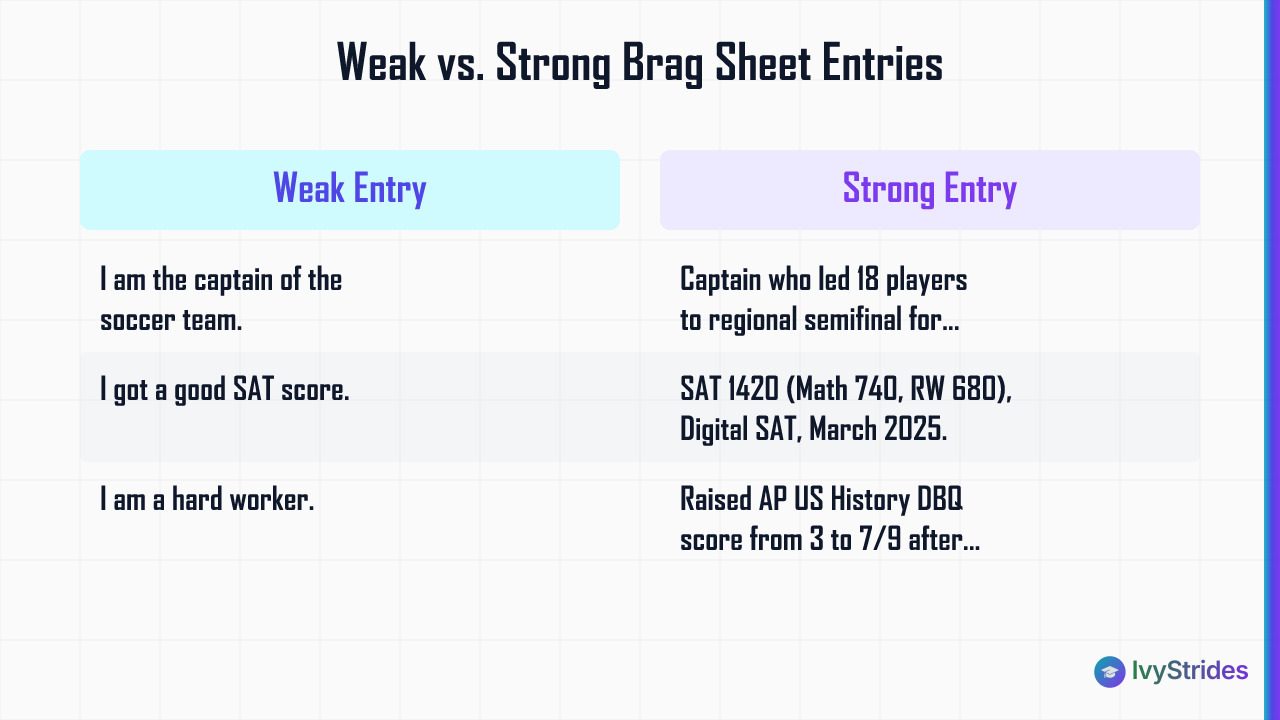
The gap between a useful brag sheet entry and a useless one comes down to numbers, timelines, and before-and-after outcomes. Here are three pairs that show the pattern across the sections you'll actually fill out.
| Section | Weak entry | Strong entry |
| Extracurricular | "I am the captain of the soccer team." | "Soccer team captain, junior and senior year. Led a team of 18 to a regional semifinal for the first time in six years, and organized three extra weekly practices in the off-season." |
| Academic | "I got a good SAT score." | "SAT: 1420 (Math 740, Reading and Writing 680), taken on the Digital SAT in March 2025 after a structured prep program." |
| Personal quality | "I am a hard worker." | "When I failed my first AP US History DBQ, I attended office hours weekly for a month and raised my essay score from a 3 to a 7 out of 9 by semester's end." |
Notice what the strong column shares. Each names a number, a timeline, or a shift from one state to another. The weak column gives the recommender an adjective and a title. The strong column gives them a scene they can drop straight into a paragraph.
In our coaching with students preparing recommendation packets, the entries that produce the most specific letters are exactly these: quantified, dated, outcome-driven. A recommender writing about "led a team of 18 to a regional semifinal" can build a whole paragraph. A recommender staring at "captain of the soccer team" has nothing to add beyond what the activities list already said.
The same principle governs strong supplemental essays, where a single concrete scene outperforms a paragraph of self-description; our supplemental essay examples show the technique at full length.
When to Give Your Brag Sheet and Who Gets It

Photo by RDNE Stock project on Pexels
The student fills out the brag sheet and hands it to two kinds of people: the counselor, who writes the school counselor recommendation, and one or two subject teachers, who write the teacher evaluations. Timing and tailoring both matter.
Give the brag sheet at the same moment you ask for the letter, or within 48 hours of the ask. Don't make the recommender chase you for it. And ask early. Aim for at least four to six weeks before your earliest application deadline; give it eight weeks if you're applying early decision, since those deadlines cluster in early November and teachers get swamped.
Before you hand over your brag sheet, you need to ask the right person at the right time; see our step-by-step guide on how to ask for a letter of recommendation for the exact script and timing. Choosing the right teacher matters as much as what you put in the brag sheet. Our guide on who should write your recommendation letters walks through how to pick the two teachers most likely to write a compelling, specific letter.
Tailor the document to the reader. For a subject teacher, add a short paragraph at the top explaining why you chose them and which class experience you hope they'll highlight: the semester you turned around in their AP Biology class, the research project they supervised, the seminar where you found your voice. For the counselor, include your full academic and extracurricular record, because the counselor writes about the whole student rather than a single class. The core content can stay the same; the framing note at the top is what changes.
After you hand it over, a brief thank-you note is enough. Don't pepper the recommender with reminders. A single polite check-in about two weeks before the deadline is fine if the letter hasn't been submitted.
Common Brag Sheet Mistakes That Weaken Your Recommendation Letters
The most common brag sheet mistakes all share one root: they leave the recommender with less to work with than they need. In our coaching with students, the mistake we see most often is listing club memberships without a single achievement or piece of context, which gives the recommender nothing beyond what the activities list already shows.
The recurring errors:
- Being too vague. "Member of debate, three years" tells no story. Add the record, the tournament, the role you grew into.
- Omitting goals and intended major. Without your direction, the recommender can't connect your strengths to where you're headed. A letter that ties your persistence to your intended engineering major lands harder than one that praises persistence in a vacuum.
- Listing titles without context. "Editor-in-chief" is a title. "Editor-in-chief who grew the paper from four to eleven staff writers" is evidence.
- Making it too long. A brag sheet past two pages buries the details that matter. Recommenders are busy; they skim, and they'll miss your best story if it sits on page four.
- Forgetting to tailor for the recommender. A generic document sent to three people produces three generic letters.
- Submitting too late. Handing the brag sheet over the week before the deadline gives the recommender no time to write anything thoughtful.
One line to remember: never exaggerate or invent. A brag sheet works because it's accurate and specific. A recommender who catches an inflated claim writes a warier letter, and colleges read a lot of letters. Represent yourself truthfully and let the concrete facts carry the weight. The same discipline that keeps an essay honest applies here; our list of common college essay mistakes to avoid covers the overlap.
How a Strong Brag Sheet Fits Into Your Broader College Application Strategy
A brag sheet is not an isolated errand. It's one piece of a connected application in which your activities list, personal statement, supplemental essays, test scores, and recommendation letters should all reinforce a single, coherent story about who you are and what you'll bring to a campus.
That coherence is what holistic review rewards. If your brag sheet, your essays, and your activities list all point toward a genuine interest in environmental science, an admissions officer reads a consistent applicant. If they contradict each other, the picture blurs. The brag sheet is where you make sure your recommenders reinforce the same narrative rather than an accidental side note.
Your academic data threads through the whole application. A strong SAT or ACT score noted in the brag sheet gives the recommender a data point to reference when discussing your academic ability. AP scores of 4 or 5 in subjects related to your intended major are worth highlighting explicitly, because they let a teacher speak to demonstrated college-level readiness in the field you plan to study. How many rigorous courses to take is its own question, addressed in how many AP classes do you need for the Ivy League.
Timing ties back to your application plan. For early decision applicants, have the brag sheet ready by late September of senior year. For regular decision, late October gives your recommenders room to write well. Map these dates against the rest of your calendar using our college application timeline 2026-27.
This connected view is how our coaches work: test scores, AP prep, and admissions essays as a single plan rather than separate tasks. You can read more about that approach on the IvyStrides About page. You can also meet the section-specialist coaches and essay strategists who work with students on it. One caveat stands over all of it: admission outcomes depend on the full application, not on any single component, recommendation letters included.
Frequently Asked Questions About High School Brag Sheets
Do colleges see brag sheets?
No. The brag sheet goes only to your counselor or teacher and stops there. Colleges never receive it. It's a private briefing document that helps your recommender write a more specific, accurate letter. What an admissions officer reads is the finished letter, not the notes you used to inform it.
What accomplishments are good for a brag sheet?
Accomplishments that carry a number, a timeline, or a before-and-after outcome. Raising a club's fundraising by a specific dollar amount. Improving an AP exam score from a 3 to a 5 after targeted prep. Leading a team to a regional competition for the first time in years. A title with no context is the weakest thing you can list, because it repeats what the activities list already says.
How long should a brag sheet be?
One to two pages. One page fits a student earlier in high school with a shorter record; two pages suit a junior or senior with a full slate of activities. Going longer buries your best material and makes a busy recommender work harder to find the anecdotes that matter most.
Who fills out a brag sheet?
The student, not the parent and not the recommender. It's a self-summary you prepare and hand to your counselor and teachers before they write your letters. Some schools give you a structured template to complete; others leave the format entirely open.
Is a brag sheet the same as a resume?
No. A resume lists roles and dates in a formal, employer-facing layout. A brag sheet is personal and narrative, built around specific stories, self-descriptive adjectives, challenges you overcame, and your goals. Its purpose is to help a recommender write about who you are, not just which positions you've held.
What are some good adjectives to use on a brag sheet?
Pick ones you can prove in a single sentence: resilient, intellectually curious, collaborative, persistent, empathetic, analytical. Each should sit next to a specific moment that backs it up. Skip generic words like "hardworking" unless you follow them immediately with evidence, because an unsupported adjective gives the recommender nothing.
Should I give a different brag sheet to my counselor and my teachers?
Yes, with one deliberate difference. The counselor version covers your full academic and extracurricular record, since the counselor writes about the whole student. For each teacher, add a short paragraph at the top explaining why you chose them and which class experience you hope they'll highlight. The main content can stay the same across both.
How do I write a brag sheet without sounding arrogant?
Frame accomplishments with context and outcome instead of self-praise. Rather than "I am the best writer in my class," write "My AP Language teacher chose my synthesis essay as a class model in October 2024." State the facts and let the recommender draw the flattering conclusion. Concrete evidence never reads as bragging; unsupported superlatives always do.
Your brag sheet is the briefing that decides whether your recommenders write a forgettable letter or a specific one. Fill out all six sections with real numbers and real stories, tailor it to each reader, and hand it over early enough that a busy adult can do it justice.
Your brag sheet is one piece of a connected application strategy.
IvyStrides coaches work with students on test scores, AP prep, and admissions essays as a single plan, not separate tasks. Book a free 15-minute call to see where your application stands and what to do next.

Award-winning author (South Asian Book Award) and graduate of BITS Pilani and UCLA Luskin School of Public Affairs. Brings a published writer's eye to Common App essays and grammatical precision to SAT and ACT R&W instruction.