
What Is Test-optional and Should You Submit SAT Scores? A Clear, Complete Guide for Students and Parents
On this page
- What Test-Optional, Test-Blind, and Test-Required Actually Mean in 2026
- The Three-Zone SAT Submit Rule: Above, Inside, or Below the Middle 50 Percent
- Not Sure Which Zone Your SAT Score Falls In?
- What Happens to Your Application When You Do Not Submit SAT Scores
- Is the SAT Optional for Harvard, and What Does That Mean for Other Selective Schools?
- Should You Submit a 1200, 1300, or 1400 SAT Score to a Test-Optional School?
- How to Self-Report SAT Scores on the Common App (and When to Send Official Scores)
- If Your SAT Score Is Below Target, Here Is What to Do Before Application Deadlines
- FAQ: Test-Optional SAT Score Submission
- Should I submit my SAT scores if it's optional?
- Is a 1500 SAT score in the top 1 percent?
- Is a 1300 a bad SAT score?
- Is the SAT optional for Harvard?
- Should I submit a 1200 SAT score to a test-optional school?
- Does going test-optional actually hurt your chances?
- Can I send SAT scores after I submit my Common App application?
- Do test-optional policies apply to merit scholarships too?
- Know Your Score. Know Your Move.
Test-optional means a college doesn't require SAT or ACT scores for admission but will consider them if you choose to submit. The decision rule is short: submit your SAT score if it meets or exceeds the school's middle 50 percent range for admitted students; withhold it only if it falls clearly below that range and your GPA, AP scores, and essays tell a stronger story without it. A score inside or above the middle 50 percent almost always helps. A score well below it rarely does.
That middle 50 percent range lives in each school's Common Data Set, and the current Digital SAT uses a 400 to 1600 scale you'll measure yourself against. One caveat up front, because it matters: test-optional policies change every application cycle. This article is dated for the 2026 cycle, and you must verify each school's current policy on its official admissions page before you apply. The next section turns the rule into a school-by-school process.
What Test-Optional, Test-Blind, and Test-Required Actually Mean in 2026
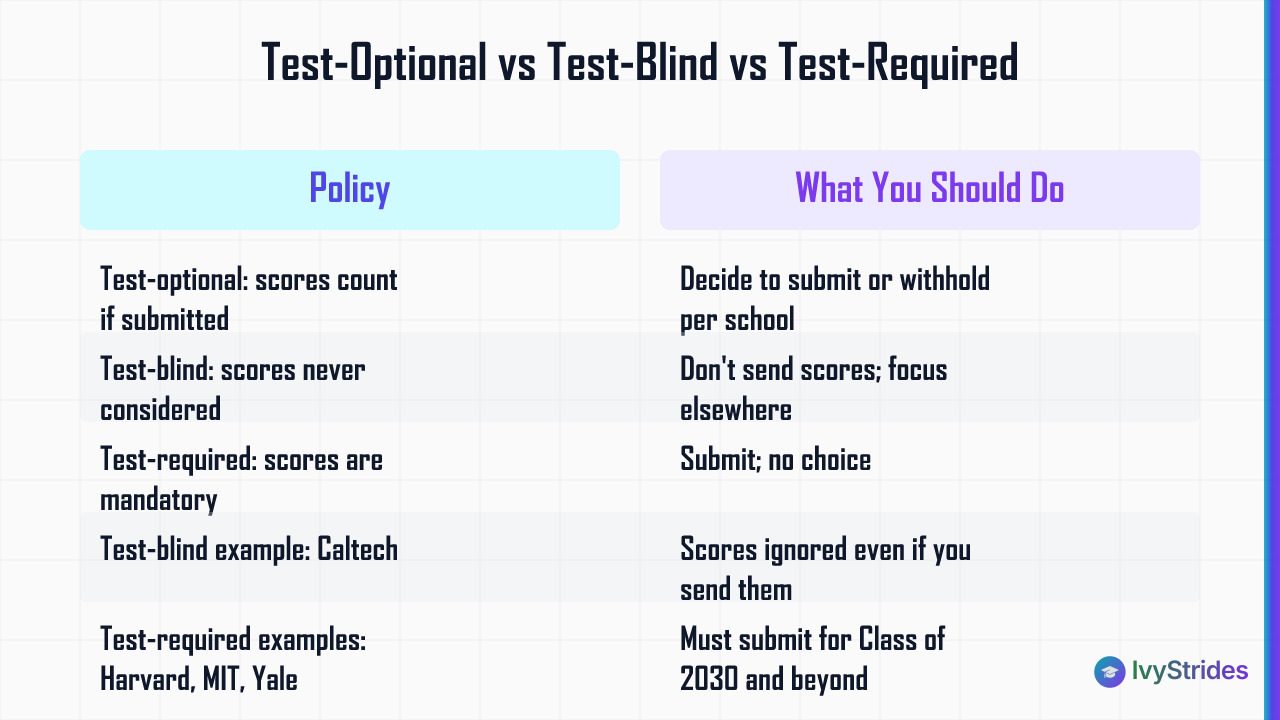
Test-optional, test-blind, and test-required are three distinct admissions policies, and confusing them is the most common mistake we see. Test-optional means scores are accepted but not required, and they count if you send them. Test-blind means the school will not look at your scores even if you submit them. Test-required means you must submit an SAT or ACT score to be considered at all.
The gap between those three is not academic. At a test-optional school, a strong score is a lever you can choose to pull. At a test-blind school, that same score is invisible, so there's no reason to spend money sending it. According to FairTest, roughly 1,900 or more colleges and universities carry some form of test-optional policy as of 2026, so the category is broad and the details vary school by school.
| Policy | Scores considered? | What you do |
| Test-optional | Yes, if you submit | Decide submit vs. Withhold per school |
| Test-blind | No, ever | Don't send scores; focus elsewhere |
| Test-required | Yes, mandatory | Submit; no choice |
The California Institute of Technology is a clear test-blind example: it does not consider SAT scores in review even when a student submits them. On the other side, Harvard, MIT, and Yale have returned to test-required for the Class of 2030 and beyond. Most state flagships and many liberal arts colleges remain test-optional in 2026, but "most" is not "all," and policies shift annually.
For a full list of which schools are currently test-required, test-optional, or test-blind in 2026, see our companion guide on do colleges still require the SAT.
The Three-Zone SAT Submit Rule: Above, Inside, or Below the Middle 50 Percent
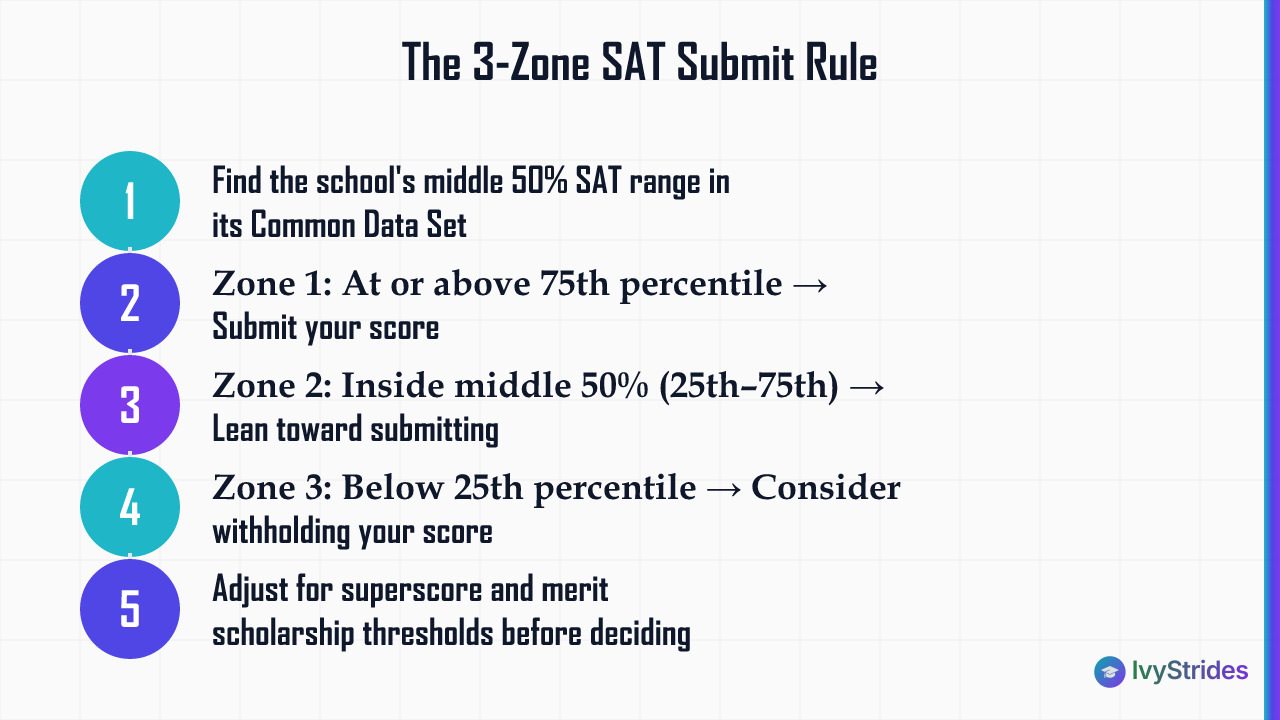
The middle 50 percent range is the single benchmark that answers the submit question. It's the span from the 25th percentile to the 75th percentile of scores among a school's enrolled students, and every college publishes it in its Common Data Set. Find that range, locate your score inside it, and you have your answer. Three zones, three rules.
Zone 1, at or above the 75th percentile: submit. Your score is stronger than three-quarters of the admitted class. It's an asset. Send it.
Zone 2, inside the middle 50 (25th to 75th percentile): lean submit. You're squarely in the pool the school actually admits. A score here confirms academic readiness rather than raising doubt. Submit in nearly every case.
Zone 3, clearly below the 25th percentile: consider withholding. Here the score may signal below-range academic readiness. If your GPA, course rigor, AP scores, and essays are stronger without it, withholding is defensible.
Work a real example. Say a school's middle 50 SAT range is 1350 to 1530. A 1550 sits above the range, which is Zone 1, submit. A 1400 lands inside, Zone 2, lean submit. A 1250 falls below the 25th percentile, Zone 3, so think hard before sending. Pull the actual range for each of your target schools from its Common Data Set (search "Common Data Set" plus the university name), because a 1400 that's a proud submit at one school is a below-range withhold at another.
Two adjustments before you lock in a zone. First, superscore. Many schools combine your highest Reading & Writing and highest Math across sittings into one superscore, so calculate your superscore first; it can move you up a zone. Second, merit scholarships. A school that's test-optional for admission may still require a score for automatic merit aid, and some state flagships trigger scholarship consideration at around 1400 or higher. That merit scholarship threshold is separate from admissions policy, and withholding your score can quietly forfeit money.
Your application round matters too. Early Decision applicants at test-optional schools submit scores at higher rates, a pattern worth understanding before you choose your round; our guide on early decision vs early action vs regular decision walks through it. If you want to understand how much weight an admissions officer actually places on scores relative to GPA and essays, our guide on how much the SAT matters for college admission covers the full picture. For percentile context on what counts as strong in the first place, see what is a good SAT score.
Submit rates tell you how a school actually treats scores. For the Class of 2029, published analyses put submit rates at selective test-optional schools somewhere between roughly 55 and 85 percent. A high submit rate is a tell: it means scores matter there, and a missing score stands out.
Not Sure Which Zone Your SAT Score Falls In?
Book a free 15-minute strategy call. An IvyStrides coach will look at your current score, your target schools, and their middle 50 ranges, and tell you exactly whether to submit, retake, or apply test-optional.
What Happens to Your Application When You Do Not Submit SAT Scores
Not submitting SAT scores does not automatically hurt you, but it does remove one quantitative data point from a holistic review, and an admissions officer fills that gap with everything else on your file. When there's no score, your GPA and the rigor of your course load become the primary academic signal. That's the honest version, and it's worth sitting with before you decide.
Here's the part most students miss. At highly selective schools where a large majority of applicants submit scores, choosing not to submit can read as a signal that your score fell below range. It isn't proof of anything, and reviewers know that, but the inference exists. Where roughly 70 to 80 percent of applicants at a school submit, a blank score line is conspicuous. That's not a reason to submit a weak score. It's a reason to make the rest of your file undeniable.
Two things carry more weight when scores are withheld. First, AP scores. If you're applying test-optional, strong AP scores on your transcript become a more important signal of academic readiness, since an admissions officer has one fewer quantitative data point. In our coaching with students who applied test-optional, those with three or more AP scores of 4 or 5 on their transcripts reported stronger outcomes than those with no quantitative academic signal at all. See does AP help with college admission for how those scores read to a reviewer.
Second, essays. When scores are withheld, your essays carry more weight in demonstrating intellectual capacity and fit, which is why essay quality becomes especially critical for test-optional applicants. In our coaching, students who applied test-optional to schools where the majority of applicants submitted scores faced a harder burden on their essays and activities list, because those pieces had to do the work the score would have done. If that's your situation, deliberate college essay coaching is where the effort pays off.
Is the SAT Optional for Harvard, and What Does That Mean for Other Selective Schools?
No, the SAT is not optional for Harvard. Harvard returned to a test-required policy for the Class of 2030 and beyond, meaning applicants must submit an SAT or ACT score to be considered. Verify this on Harvard's official application requirements page before you apply, because it's the kind of policy that gets misreported on secondhand sites.
Harvard's middle 50 SAT range sits at approximately 1580 to 1600 for recent admitted classes based on its Common Data Set filings, which tells you the practical bar is near the top of the scale. Harvard is not alone in reversing course. MIT reinstated its testing requirement earlier, and Yale is test-required for the 2025 to 2026 cycles as well. The direction of travel at the most selective schools is back toward required scores.
The reversal isn't universal, though. The University of Chicago remains test-optional, as do many liberal arts colleges and most state schools, as of 2026. So the trend signal for you is not "everyone requires scores now." It's "check every school individually, and expect the most selective ones to require them." If your score is in the 1500 range and you're targeting the Ivy League, our breakdown of whether a 1500 SAT is good enough for Ivy League admission gives school-by-school context. For the very top of the scale, see whether a 1540 SAT is good enough for Harvard, Yale, Princeton.
One note for international applicants: test-optional policies at US schools generally apply equally to international students, but this is exactly the kind of detail that varies, so confirm it on each school's admissions page rather than assuming parity.
Should You Submit a 1200, 1300, or 1400 SAT Score to a Test-Optional School?
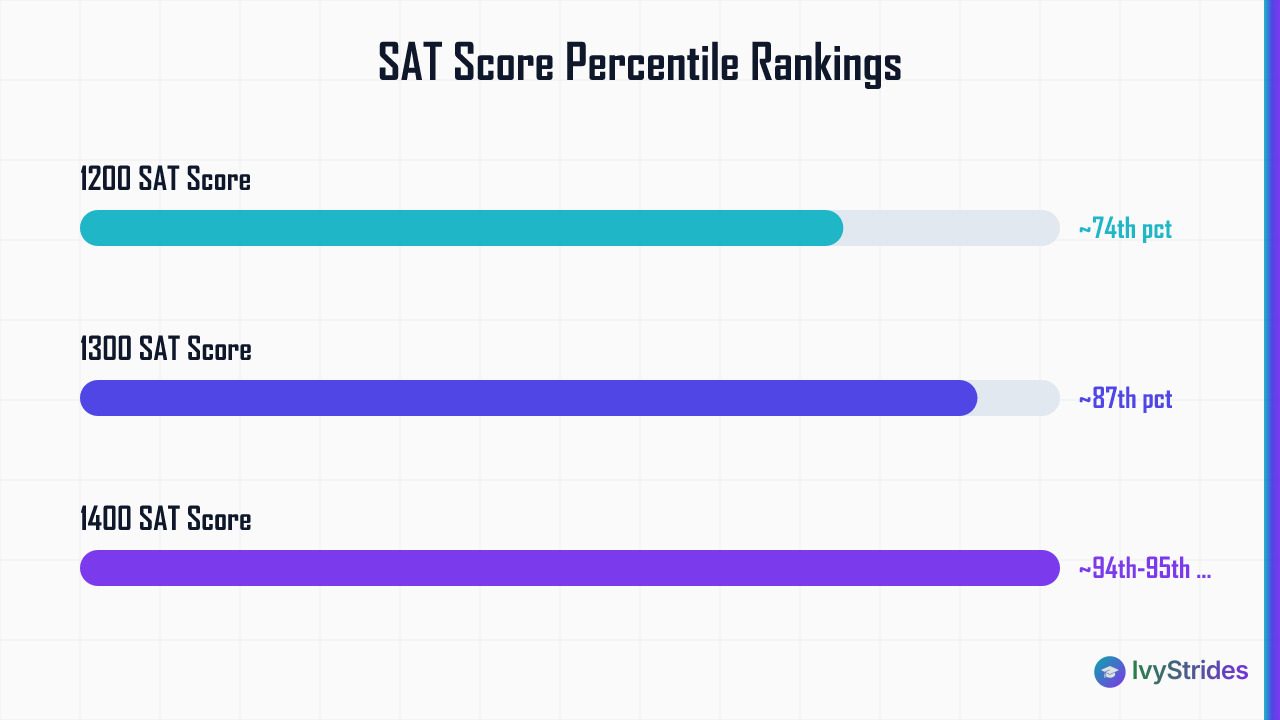
Whether to submit a 1200, 1300, or 1400 depends entirely on the school's middle 50 range, not on whether the number feels high. A score that's a confident submit at one school is a clear withhold at another. National percentile tells you how you rank against all test-takers; the school's range tells you whether the score helps your specific application.
Here's how the three most-asked score bands map, using approximate percentiles from College Board data:
| Score | National percentile (approx.) | Submit at a 1200-1400 range school? | Submit at a 1450+ floor school? |
| 1200 | ~74th | Often yes (near/above 25th pct) | No, well below range |
| 1300 | ~87th | Yes, solid submit | No, below 25th percentile |
| 1400 | ~94th-95th | Yes, competitive | Borderline, likely below middle 50 |
So a 1300 at a school with a 1200 to 1400 middle 50 is a submit; that same 1300 at a school with a 1450 to 1570 range is a withhold. A 1400 sits above roughly the 95th percentile nationally and reads as competitive at many strong schools, yet it still lands below the middle 50 at Ivy-level institutions. Context is everything.
There's one exception to the withhold logic: merit aid. A below-range admissions score can still be worth submitting if it clears a published scholarship threshold at that school. Money is a legitimate reason to send a number that won't move the admissions needle.
The stronger play, if you have time, is to raise the score. In our coaching with students in the 1250 to 1350 range, those who retook the SAT and raised their score by 100 or more points before November deadlines consistently had more options than those who applied test-optional with a below-range number. If you're sitting on a 1300 and want the school list that fits it right now, read is a 1300 SAT score good enough. If you'd rather lift it, start with how to improve your SAT score and check the SAT test dates that still fit your deadlines.
How to Self-Report SAT Scores on the Common App (and When to Send Official Scores)
Self-reporting on the Common App means you type your SAT scores into the testing section yourself, and most schools accept those self-reported numbers for the entire application review. You typically only need to send official scores through College Board once you enroll, or if a specific school requests them earlier. This saves you money during the application phase, since you're not paying to send official reports to every school on your list.
The mechanics are simple. In the Common App testing section, you enter your highest section scores. For superscoring, report your highest Reading & Writing and highest Math from any sitting; most schools that superscore recalculate it themselves from your official reports later, so you don't need to do anything fancy. Report the strongest legitimate combination you have.
Two things to watch. First, deadlines. Official scores must arrive by the school's stated score deadline, which for Regular Decision is usually the application deadline itself. Once you decide to submit, the mechanics of sending official scores through College Board are straightforward; our step-by-step guide on how to send SAT scores to colleges walks through the process. Second, platform quirks. Schools on the Coalition App or their own portals sometimes use different self-reporting fields, so always follow the specific school's instructions rather than assuming the Common App layout applies everywhere.
If you're weighing whether another sitting is worth it before you finalize what to self-report, see how many times can you take the SAT.
If Your SAT Score Is Below Target, Here Is What to Do Before Application Deadlines
If your SAT score is below your target schools' middle 50 ranges and you still have time before deadlines, run a diagnostic, target your weakest question types, and retake before your last available date. That beats applying test-optional with a below-range score in most cases, because a stronger number expands your list rather than shrinking it.
Timeline is the deciding factor. A meaningful improvement needs at minimum roughly 6 to 8 weeks of structured prep, and a 100 to 200 point gain typically takes a 12-week window or longer. In our coaching with students in the 1200 to 1350 range who had 10 to 12 weeks before their target test date, a diagnostic followed by targeted work on their weakest question types and a retake produced typical gains of 80 to 150 points. That's the diagnostic-first methodology in one sentence: measure, target, retest, with a section-specialist coach on Reading & Writing or Math depending on where the diagnostic points.
For seniors applying Regular Decision, the August, October, and November SAT dates are the usual retake windows. Map your deadline backward from there. If your deadlines are within about four weeks and your score is below range, don't force a rushed retake; apply test-optional while you strengthen essays and lean on AP signals instead. Match the plan to the calendar you actually have.
To build that plan, our SAT study plan lays out a structured week-by-week path. If you're aiming for the top end of that gain range, how to raise your SAT score 200 points shows what that requires. When you want a coach on it, SAT 1-on-1 prep pairs you with a section specialist.
FAQ: Test-Optional SAT Score Submission
Should I submit my SAT scores if it's optional?
Submit if your score meets or exceeds the school's middle 50 percent range for admitted students. Hold it back only when it sits clearly under the 25th percentile and your GPA, AP scores, and essays make a stronger case on their own. Inside or above the middle 50, a score almost always works in your favor.
Is a 1500 SAT score in the top 1 percent?
A 1500 sits at approximately the 98th to 99th percentile nationally per College Board data, which places it in the top 1 to 2 percent of test-takers rather than strictly the top 1 percent. It reads as strong nearly everywhere. At the most selective schools, where the range runs closer to 1550 to 1600, it lands at or slightly below the middle 50.
Is a 1300 a bad SAT score?
No. A 1300 falls around the 87th percentile nationally, well above the national average. Whether to send it is a school-by-school call: a solid submit at colleges with a 1200 to 1400 middle 50, and a likely withhold at schools with a 1450 or higher floor.
Is the SAT optional for Harvard?
No. Harvard reinstated a test-required policy for the Class of 2030 and beyond, so every applicant must submit an SAT or ACT score. Because requirements can shift between cycles, confirm the current one on Harvard's official admissions page before you apply.
Should I submit a 1200 SAT score to a test-optional school?
Only if the 1200 meets or clears the school's 25th percentile. At less-selective schools with a middle 50 around 1050 to 1250, a 1200 is a strong submit. Where the floor climbs to 1350 or higher, it falls well below range and is usually better held back.
Does going test-optional actually hurt your chances?
Not on its own, but at selective schools where roughly 70 to 80 percent of applicants submit, a blank score line can read as a below-range score. Withholding removes a data point that might have helped, which is why AP scores, course rigor, and essays carry the load instead.
Can I send SAT scores after I submit my Common App application?
Yes. College Board lets you send official scores after your Common App goes in, provided they arrive by the school's score deadline. Since most schools accept scores through their Regular Decision deadline, verify each one's specific date on its admissions page.
Do test-optional policies apply to merit scholarships too?
Not always. Plenty of schools that are test-optional for admission still require a score for automatic merit scholarship consideration. Read the scholarship requirements as a separate document from the admissions requirements, since withholding a score can quietly cost you aid eligibility.
Your score is not the whole application, but it's the one piece where the submit-or-withhold call has a clear, testable answer. Pull each school's middle 50 range, place your score in a zone, and decide from evidence rather than the false comfort of the word "optional." If the number needs to climb before your deadlines, you still have moves left.
Know Your Score. Know Your Move.
Whether you need to raise your SAT score before deadlines or want a second opinion on whether to submit what you have, IvyStrides coaches work 1-on-1 with students worldwide. Start with a free 15-minute call.

Award-winning author (South Asian Book Award) and graduate of BITS Pilani and UCLA Luskin School of Public Affairs. Brings a published writer's eye to Common App essays and grammatical precision to SAT and ACT R&W instruction.