
College Recommendation Letters: How to Get Two That Actually Help
On this page
- Do College Recommendation Letters Actually Matter?
- What Strong College Recommendation Letters Actually Include
- Who Should Write Your College Recommendation Letters
- When to Ask for a College Recommendation Letter (and How Much Lead Time You Need)
- Not sure how your application is shaping up? Let's look at the full picture.
- How to Help Your Recommenders Write a Stronger Letter: The Brag Sheet
- Can a College Recommendation Letter Hurt Your Application?
- How College Recommendation Letters Work on Common App
- Frequently Asked Questions About College Recommendation Letters
- What should a college recommendation letter include?
- Can ChatGPT generate recommendation letters?
- Do recommendation letters matter for college?
- Who can write a college recommendation letter?
- What happens if you cannot get a letter from a core teacher?
- Are recommendation letters due the same day as the application?
- Is 2 weeks enough time for a recommendation letter?
- How many recommendation letters do most colleges require?
- Your recommendation letters are one piece. Let's make sure the rest of your application is just as strong.
Most colleges require two teacher recommendation letters plus one counselor recommendation, submitted through the Common App or a college's own portal. The single quality that separates a letter that helps from one that just checks a box: specificity. A strong letter names a moment, a project, or a question the student asked that reveals who they are past the transcript. You can improve your own letters by choosing recommenders who know your work deeply, asking at least six weeks before your earliest deadline, and handing them a one-page brag sheet with real examples.
Those requirement figures come from the platform's own recommender documentation, linked throughout. The harder work is choosing the right two teachers and giving them material worth writing about. That's what the rest of this covers, section by section: who to ask, when, what to hand them, and how to make the letter add a dimension your essays and scores can't.

Do College Recommendation Letters Actually Matter?
College recommendation letters matter, yes, especially at selective schools that practice holistic review. A recommendation letter is a written endorsement from a teacher, counselor, or other qualified adult that gives an admissions officer evidence about a student's academic ability and character that grades and test scores can't show on their own.
Holistic review means an admissions officer reads the whole application together: GPA, course rigor, test scores, essays, activities, and letters, rather than filtering on any single number. At the most selective colleges, every letter gets read. At larger or less selective schools, letters are sometimes reviewed only for borderline applicants, which means a strong one can tip a close call.
The Common App structure reinforces how central letters are. At most member schools you'll submit one counselor recommendation and two teacher recommendations, and the two do different jobs. The teacher recommendation speaks to how you think and work inside a classroom. The counselor recommendation gives context about your school, your course load, and how you compare to your graduating class.
Here's where it gets consequential. At schools where a student chooses not to submit test scores, recommendation letters carry relatively more weight in the holistic review, making the quality of those letters even more consequential. Test-optional policies vary by school and by year; the current landscape is tracked by FairTest. If you're weighing whether to submit at all, our guide on what is test-optional and should you submit SAT scores walks through the decision.
One caveat, stated plainly: no single component decides an admission. A great letter supports a strong application. It doesn't rescue a weak one or guarantee a seat. Your letters work alongside your college essay coaching output, your scores, and your transcript as one connected picture.
What Strong College Recommendation Letters Actually Include
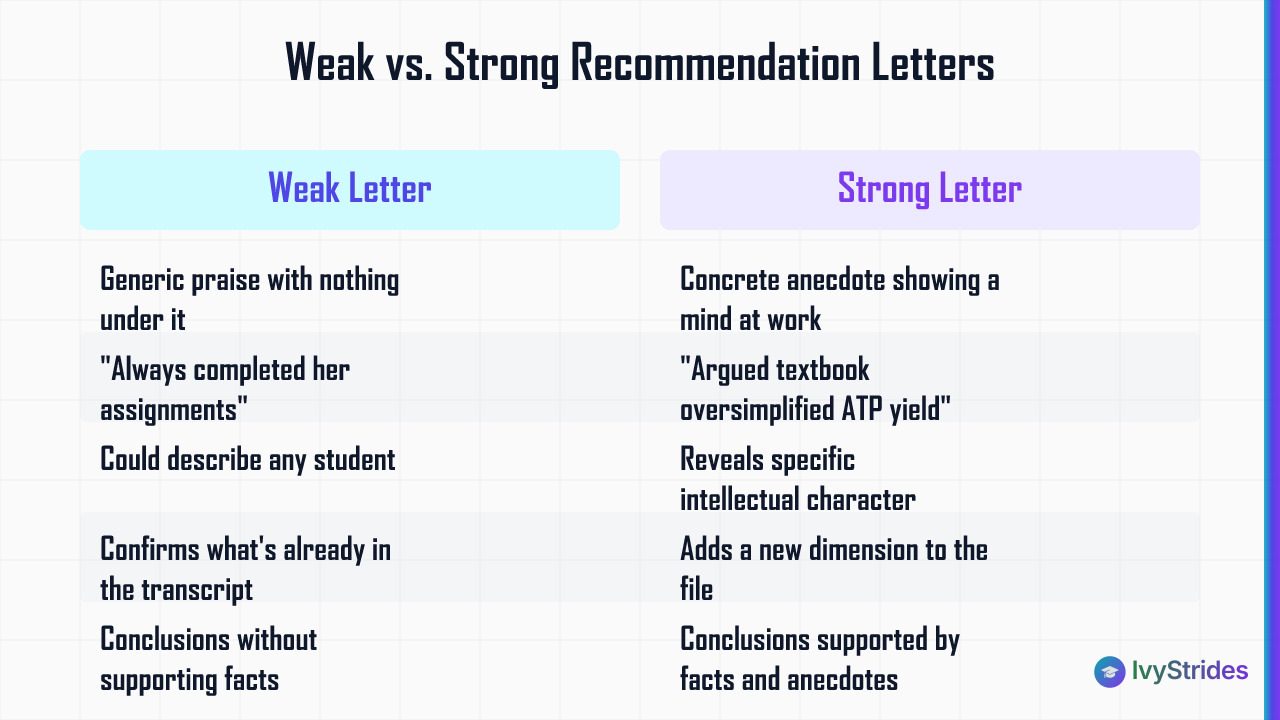
A strong college recommendation letter includes four things: the recommender's specific relationship to the student, at least one concrete anecdote, an honest read on the student's intellectual character, and a clear endorsement. Length usually lands between 400 and 700 words. The anecdote carries the weight.
Look at the difference. A weak letter says "Maria was one of my best students and always completed her assignments." That's generic praise with nothing under it, and admissions officers discount it fast. A strong letter says "When our AP Biology class hit the Krebs cycle, Maria stayed after to argue that the textbook diagram oversimplified the ATP yield, then brought in a research paper the next day to make her case." One of those sentences shows a mind at work. The other could describe anyone.
MIT Admissions tells recommenders directly to "support conclusions with facts and anecdotes" in its guidance for writing recommendations. That's the standard. Not "she's brilliant," but the moment that proves it.
The best letters obey what we'll call the new-dimension principle. A letter that merely confirms your transcript adds little; the reader already has the transcript. A letter that reveals intellectual curiosity, growth after a setback, or resilience under pressure adds something new to the file. That's the letter worth having.
This connects directly to your essays. A recommendation letter works best when it adds a dimension the admissions essays cannot show on their own, so students who have already drafted their personal statement can share a summary with their recommenders to avoid overlap. If your essay is already about the debate tournament, you don't want your teacher's letter retelling the same story. Point them somewhere else. Our breakdown of what makes a college essay good helps you map which stories your essays already cover.
For the supplementals, where each college asks something specific, the same logic holds: coordinate so your voice and your recommender's don't collide. The worked models in our supplemental essay examples show how a focused application avoids repeating itself across components.
Who Should Write Your College Recommendation Letters
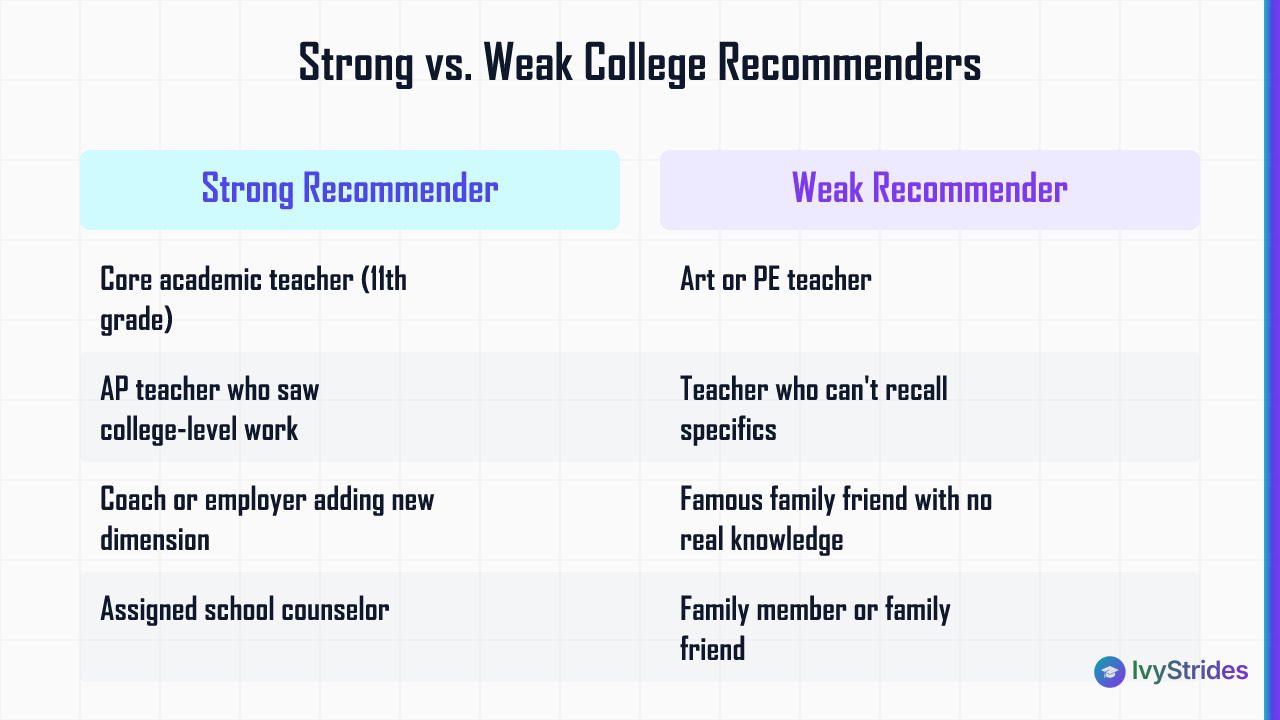
The right teacher recommender is a core academic teacher, ideally from 11th grade, who has seen how you think and not just what you scored. Core academic subjects are English, math, science, history, and foreign language. Most selective colleges specify these subjects on purpose, so an art or PE teacher usually won't satisfy the teacher-letter requirement even if they adore you.
Why junior year? It's your most recent full year with a teacher who watched you handle demanding material, and senior-year teachers have barely met you when fall deadlines hit. A junior-year teacher can speak to a full arc.
Here's a real edge. A teacher who taught a student in an AP course can speak directly to how the student handled college-level material, which is one reason AP teachers are often the strongest recommenders for academically ambitious applicants. When an AP Chemistry teacher says you reasoned through equilibrium problems the way a first-year college student should, that's a concrete signal, not a vague compliment. If you're mapping which courses to take with admissions in mind, see does AP help with college admission.
| Recommender type | Best fit | What they speak to |
| Core academic teacher (required) | 11th-grade English, math, science, history, or foreign language | Classroom thinking, intellectual curiosity, growth |
| Counselor (required, separate) | Your assigned school counselor | Course rigor, school context, character in the wider file |
| Optional third | Coach, employer, research mentor, club advisor | Leadership, work ethic, a dimension teachers can't see |
The counselor recommendation is required in addition to your two teacher letters, and it does a distinct job. Your counselor sets the context: how rigorous your schedule was relative to what your school offered, what your environment is like, how you show up beyond one classroom. Counselors write for many students at once, so a detailed brag sheet matters even more here.
An optional third recommender, a coach or an employer, can serve as a character witness in a way no teacher can, speaking to how you lead a team or carry responsibility at a job. Use that slot only when the person genuinely adds something new.
Who should not write your letter: family members, family friends with no academic context, and any teacher who can't recall a specific thing about your work. Most college guidelines exclude relatives outright. A famous family friend with an impressive title but no real knowledge of you produces the weakest letter in the pile. If you're still deciding how ambitious your course load should be, how many AP classes for Ivy League and top colleges puts the rigor question in context.
When to Ask for a College Recommendation Letter (and How Much Lead Time You Need)
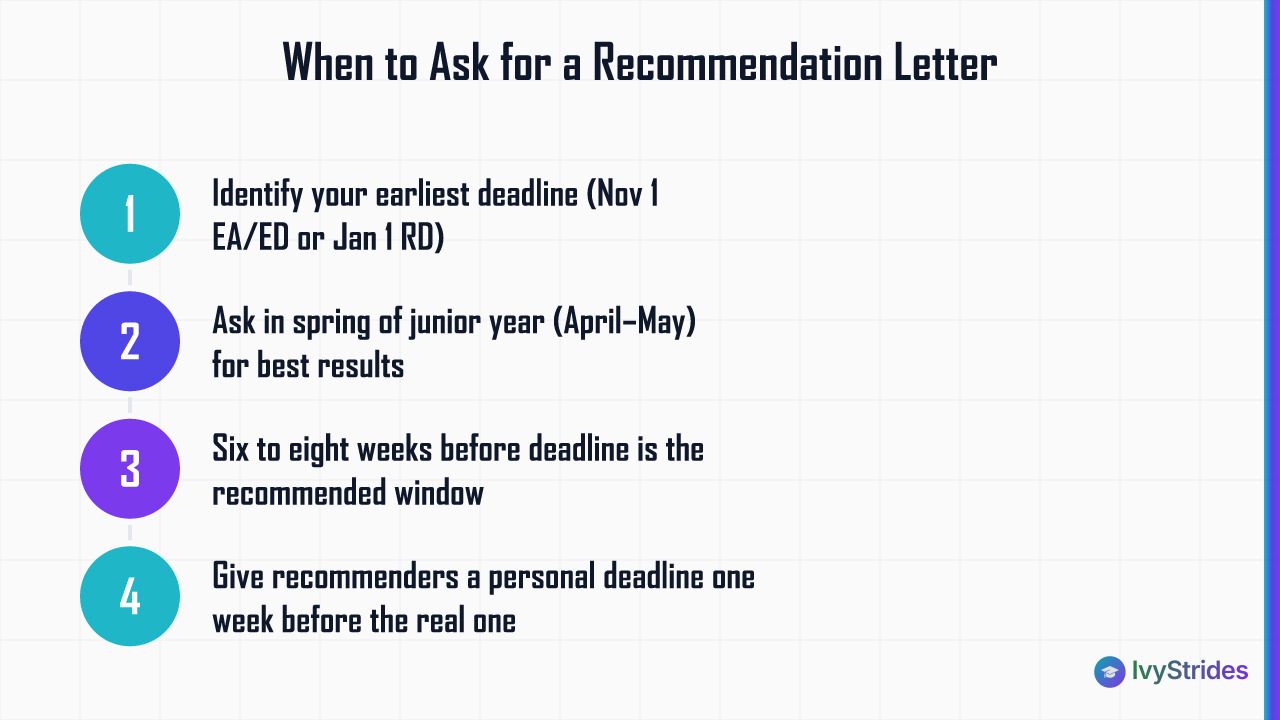
Ask at least six weeks before your earliest deadline. Roughly six to eight weeks is the recommended window; the ideal move is to ask in the spring of junior year, around April or May, for November Early Action and Early Decision deadlines. Four weeks is a hard minimum. Two weeks is genuinely risky, and three weeks is too short for most teachers to write anything thoughtful.
Timing against the calendar matters. Because recommendation letters are due at the same time as the application itself, students should map their request timeline against their earliest application deadline, whether that is Early Decision in November or Regular Decision in January. Early Action and Early Decision deadlines typically fall on November 1 or November 15; Regular Decision deadlines usually fall on January 1 or January 15, per the Common App. Your earliest deadline sets the clock for everyone.
Asking in spring of junior year is the strongest play for a simple reason: teachers aren't yet buried under a stack of senior requests. You get their attention, and often a better letter, by being early. If your list runs Early Decision, back-count from November 1 and you'll see why a May ask beats a September scramble.
Are letters due the exact same day as your application? Usually the platform accepts a recommender's letter a few days after your submission, but don't build your plan around that grace. Confirm each school's policy, and give your recommenders a personal deadline at least a week before the real one. Our college application timeline and deadlines guide sequences every moving part. early decision vs early action vs regular decision clarifies which deadline actually applies to you.
Free 15-minute call
Not sure how your application is shaping up? Let's look at the full picture.
In a free 15-minute strategy call, an IvyStrides coach will review your current application timeline, identify gaps in your essays and test scores, and recommend a concrete next step. No pressure, no pitch.
Free · No obligation
How to Help Your Recommenders Write a Stronger Letter: The Brag Sheet
A brag sheet is a one-to-two-page student information sheet you hand your recommender, and it's the highest-use thing you can do to improve your letters. It gives a busy teacher the specific material to write about you instead of about a generic strong student. In our coaching with students preparing applications, the most common reason a letter turns out generic is that the recommender had no specific material to work from.
Keep it curated, not a resume dump. A brag sheet that runs past two pages buries the useful parts. Here's what earns its place:
- The exact class and year you had them, so they anchor their memory ("AP US History, junior year, fifth period").
- One or two moments they might remember: the debate you started, the lab you troubleshot, the essay you rewrote three times.
- A short activities summary that mirrors your Common App list. The brag sheet a student gives a recommender should mirror the activities list on the Common App so the letter reinforces, rather than contradicts, what the application already documents.
- Your intended major or direction, so the teacher connects what they saw to where you're headed.
- The list of schools and deadlines, with your earliest date flagged.
- A one-line summary of your personal statement topic, so the letter goes somewhere your essay doesn't.
To pull the activities piece together cleanly, how to write strong activities list descriptions shows the format. If you're still surfacing the classroom moments worth handing over, how to brainstorm college essay ideas uses the same excavation approach.
Frame the ask politely, specifically, with a clear deadline. "Would you be willing to write a strong letter of recommendation for my college applications? My earliest deadline is November 1, and I've put together a page of notes to help." That respects their time and signals you're organized.
One pattern from our coaching: students who supply a rich, story-driven brag sheet get letters built around a specific classroom moment, while students who hand over a bare resume get letters that could describe anyone. The story does the work. The teacher just needs it in front of them.
Finally, the FERPA waiver. When you add recommenders on the Common App, you'll be asked whether you waive your right to view the letter under the Family Educational Rights and Privacy Act. Waive it. A waived letter signals to the admissions officer that the recommender wrote candidly, and most colleges expect the waiver. An un-waived letter can read as a student who didn't trust what would be said.
Can a College Recommendation Letter Hurt Your Application?
A college recommendation letter can hurt your application, yes, when it's lukewarm, contradicts your narrative, or comes from someone who plainly doesn't know you. Admissions officers read these by the thousands and are trained to read between the lines. A letter that praises only effort with no intellectual substance often reads as a soft endorsement, not a strong one.
Watch the specific red flags. Phrases like "an adequate student" or "always completed assignments on time" damn with faint praise. A letter that describes a quiet, reserved student when your essays present a bold campus leader raises questions about authenticity. And a letter thin on any concrete detail signals the recommender didn't know you well enough to write one, which is its own quiet negative.
In our coaching observations, students who asked a teacher out of obligation rather than genuine relationship consistently received letters that added little to their application. The teacher wasn't unkind. They simply had nothing specific to say, so they said nothing specific.
Read the signal when you ask. If a teacher hesitates, or says "I'll do my best" without any warmth, treat that as information. You can give yourself an exit and them an out: "I want to make sure you have enough to write a strong letter for me; if this is a difficult time, I completely understand." That's a graceful redirect, not a burned bridge. Never ghost a teacher who has already agreed. Have the respectful conversation instead.
If you suspect a letter will be flat and the person hasn't committed yet, quietly ask someone else who knows your work better. The same instinct that helps you avoid common college essay mistakes to avoid, choosing substance over surface, applies to picking recommenders.
How College Recommendation Letters Work on Common App
On the Common App, you invite recommenders under the "Recommenders and FERPA" section, and each one receives an automated email with a secure link to upload their letter directly. The student never sees or handles the letter itself; the recommender submits it straight to the platform. That's the whole flow, and it's worth understanding before deadlines close in.
Add your recommenders early. The system gives the teacher maximum runway, and it doesn't nag them; the Common App won't auto-remind a recommender who's running late, so a polite follow-up email from you is fair game as the deadline nears. Full recommender mechanics live on the Common App site.
The slots are structured. You assign one counselor recommendation and, at most member schools, two teacher recommendations. Some schools open an optional additional recommender slot for a coach, mentor, or employer; a few highly selective schools invite one extra letter, and a handful require only a single teacher letter. Requirements vary by school, so verify each college's specifics on its Common App page rather than assuming a universal rule.
The FERPA waiver lives in this same section. When you waive, you give up the right to view submitted letters, which is the standard and expected choice. Recommenders and admissions officers both read a waiver as a marker of candor.
Because your recommenders submit alongside your own essays, coordinate the timing with your writing. If your Common App essay 2026 prompts decoded work is still in progress, don't let the letters wait on it; the two move on separate tracks. The same goes for how to write supplemental essays that get you in, where school-specific timing can shift your earliest real deadline.
Frequently Asked Questions About College Recommendation Letters
What should a college recommendation letter include?
A strong letter names the recommender's relationship to you, at least one specific anecdote showing academic ability or character, a read on your intellectual curiosity or growth, and a clear endorsement. The weakness admissions officers flag most is praise with no example behind it.
Can ChatGPT generate recommendation letters?
Technically yes, but AI-generated writing is increasingly detectable, and a templated-sounding letter undermines your credibility. A recommender who runs a draft through AI without personalizing it risks a letter that reads identically to dozens of others, which lands worse than a short, genuine one.
Do recommendation letters matter for college?
At selective colleges, they're a required and read part of the application. In holistic review, a letter that reveals intellectual character or resilience can support a borderline case. Under test-optional policies, letters carry relatively more weight because one data point is missing.
Who can write a college recommendation letter?
Most colleges want letters from core academic teachers in English, math, science, history, or foreign language, plus a school counselor. An optional third letter can come from a coach, employer, or mentor who adds a dimension teachers can't. Relatives and family friends without academic or professional context aren't appropriate.
What happens if you cannot get a letter from a core teacher?
If you genuinely have no relationship with a core teacher, an elective teacher who knows your work deeply beats a core teacher who barely remembers you. Applicants in unusual situations, like homeschool, international, or gap-year students, should contact each college's admissions office directly about acceptable alternatives.
Are recommendation letters due the same day as the application?
Most colleges accept letters a few days after the application deadline, but don't plan around it. Confirm each school's policy. Give your recommenders a personal deadline at least a week before the official date, so any delay still lands you inside the window.
Is 2 weeks enough time for a recommendation letter?
Two weeks is too short for most teachers to write something thoughtful and specific. Roughly six weeks is the recommended minimum, and eight weeks is better for November Early Action and Early Decision deadlines. A spring-of-junior-year ask for fall deadlines is stronger still.
How many recommendation letters do most colleges require?
Most Common App member colleges require one counselor recommendation and two teacher recommendations. Some highly selective schools encourage or accept one additional optional letter, and a few require only one teacher letter. Check each school's requirement on its Common App page or admissions site.
Recommendation letters are one piece of a file that also runs on essays, test scores, and course rigor, and they land best when every piece points the same direction. Choose your two teachers now, ask early, and hand them a brag sheet worth writing from. You can see how we work with students across the full application on our About page. To put faces to the process, meet the coaches who do it.
Free 15-minute call
Your recommendation letters are one piece. Let's make sure the rest of your application is just as strong.
IvyStrides essay coaches work 1-on-1 with students on Common App personal statements, supplemental essays, and application strategy. Book a free call to see if we are the right fit.
Free · No obligation

Award-winning author (South Asian Book Award) and graduate of BITS Pilani and UCLA Luskin School of Public Affairs. Brings a published writer's eye to Common App essays and grammatical precision to SAT and ACT R&W instruction.