
How to Write Strong Activities List Descriptions: The Complete 2026 Playbook for a Top Score
On this page
- What the Common App Activities List Actually Is (and Why Admissions Readers Care)
- The 150-Character Rule: How to Maximize Every Character in Your Common App Description
- Why Most Students Waste Their Activities List Descriptions (and How to Fix It)
- How to Quantify Your Impact Even When the Numbers Are Not Obvious
- Real Activity Description Examples: Before and After Across Five Common Activity Types
- How to Order and Prioritize Your Common App Activities List
- How the Common App Activities List Connects to Your Supplemental Essays
- FAQ: Common App Activities List Descriptions
- How do you write a list of activities for the Common App?
- What is an example of an activity description for the Common App?
- How do you list extracurricular activities on the Common App?
- Can you provide some examples of activity descriptions for the Common App?
- Should I write in full sentences or fragments in the 150-character description field?
- What counts as an activity for the Common App activities list?
- How do I describe an extracurricular activity that has no obvious numbers?
- Is the order of activities on the Common App important?
- What is the difference between the position field and the description field on the Common App?
- Before You Submit
To write a strong Common App activities list description, open every entry with an active verb, stay inside the 150-character limit, and pack in at least one concrete number that shows scope or result. Replace "Helped with school newspaper" with "Edited 12 monthly issues; grew readership 40% by launching Instagram coverage of local events." The position/organization field holds your title in 50 characters. The description field is for action and impact, not repetition.
Those field limits come straight from the Common Application. What most students miss is the second layer: an admissions reader is skimming for evidence of scope, initiative, and consistency, and the description is where that evidence lives. The rest of this playbook walks through the mechanics, the fixes, and the ordering strategy that turn ten flat entries into a coherent narrative.
What the Common App Activities List Actually Is (and Why Admissions Readers Care)
The Common App activities list is a structured, ten-slot section of the Common Application where you enter your extracurricular activities, employment, family responsibilities, and independent projects. Each slot has five fields: activity type (dropdown), position/leadership title and organization name (50 characters), description (150 characters), hours per week, and weeks per year. You also check which grade levels the activity spans: 9, 10, 11, 12, or post-graduate.
The activity type dropdown covers categories like Arts, Athletics, Career Oriented, Community Service (Volunteer), Computer/Technology, Cultural, Dance, Debate/Speech, Environmental, Family Responsibilities, Foreign Exchange, Internship, Journalism/Publication, Junior R.O.T.C., Music, Religious, Research, Robotics, School Spirit, Science/Math, Social Justice, Student Govt./Politics, Theater/Drama, Work (Paid), and Other. If your activity is caregiving for siblings or paid tutoring at a family business, use Family Responsibilities or Work (Paid). Don't force it into "Other" when a specific category fits.
Why does this section carry weight? It's one of the few parts of the application where you define what you did in your own words, alongside your GPA, test scores, and essays. If you're still choosing which schools use it, our Common App essay prompts walkthrough covers the roster. In our coaching with students working through the full application, we see readers move through a file quickly, often in the range of eight to ten minutes across everything. Your description gets seconds, not minutes. Scannability is the whole game.
If you are unsure whether something belongs on the list at all, the test is simple: it counts if you gave it sustained time outside required coursework and can describe what changed because you were there. Paid work, family caregiving and self-directed projects all qualify, and admissions readers weigh them the same as a school club.
The 150-Character Rule: How to Maximize Every Character in Your Common App Description
Every character has to earn its place. The 150-character limit is a hard cap, not a target: your description can run shorter, but nothing over 150 will save. Here are the writing mechanics that make each character count.
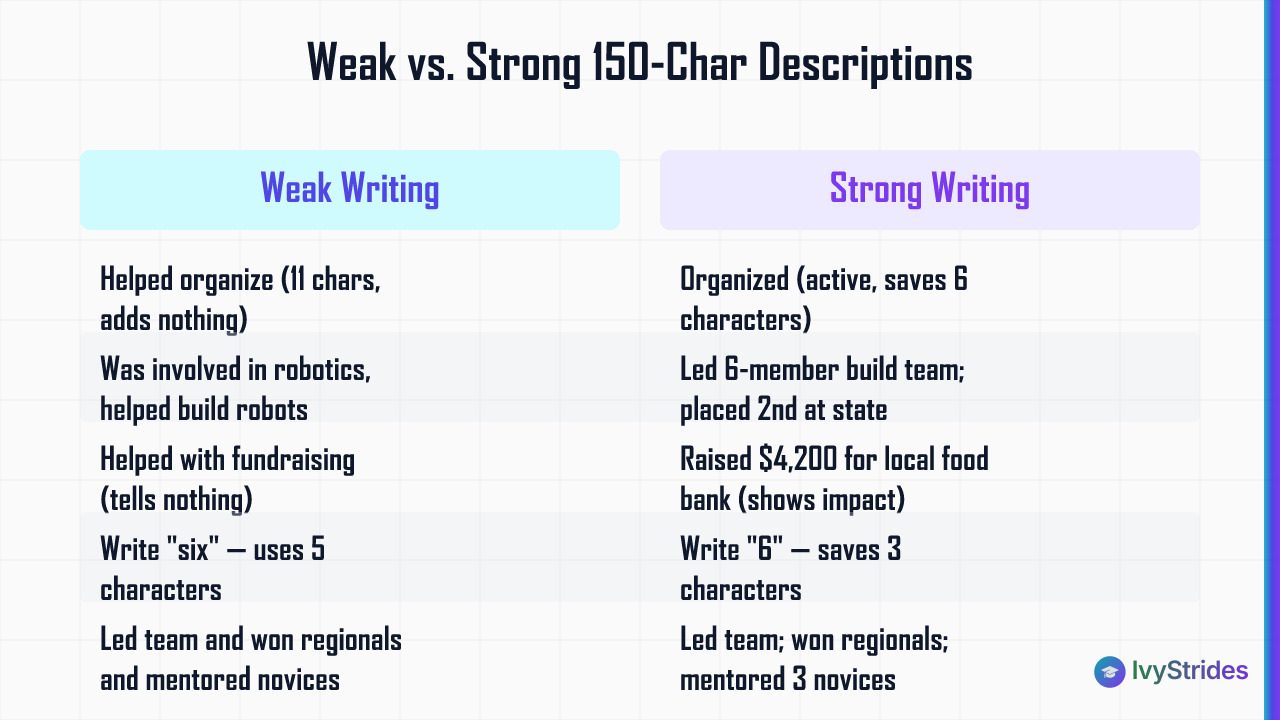
Open with an active verb. The first word signals what you did. Strong verbs: founded, coached, raised, published, directed, designed, mentored, competed, managed, organized, trained, launched, represented, produced, negotiated, taught. Weak verbs to strike: participated, helped, assisted, was involved in, worked on, was part of. "Helped organize" burns eleven characters and adds nothing that "organized" doesn't already say.
Write fragments, not full sentences. Full sentences waste characters on articles ("the", "a", "an") and linking verbs ("was", "were", "have been"). Compare:
| Version | Characters | What happened |
| "I was involved in the robotics club and helped build robots for competitions" | 78 | Weak verbs, no numbers, restates a title |
| "Led 6-member build team; placed 2nd at state FIRST Robotics; mentored 3 freshmen" | 80 | Active verb, three quantifiers, adds a leadership signal |
Same length, radically different signal. The same show-don't-tell principle that strengthens a personal statement applies here: "raised $4,200 for local food bank" shows impact; "helped with fundraising" tells nothing. Our guide on show don't tell in college essays covers the underlying technique.
Tense follows time. Present tense for ongoing activities ("Direct 22-member club"). Past tense for completed ones ("Founded environmental coalition sophomore year"). Don't mix inside a single entry.
Character-saving tactics that add up fast:
- Drop articles: "the", "a", "an" almost never carry meaning here.
- Use numerals, not words: write "6" instead of "six", which saves three characters.
- Use semicolons to chain actions instead of "and": "Led team; won regionals; mentored 3 novices."
- Skip the organization name in the description if it already appears in the 50-character position/org field.
Why Most Students Waste Their Activities List Descriptions (and How to Fix It)
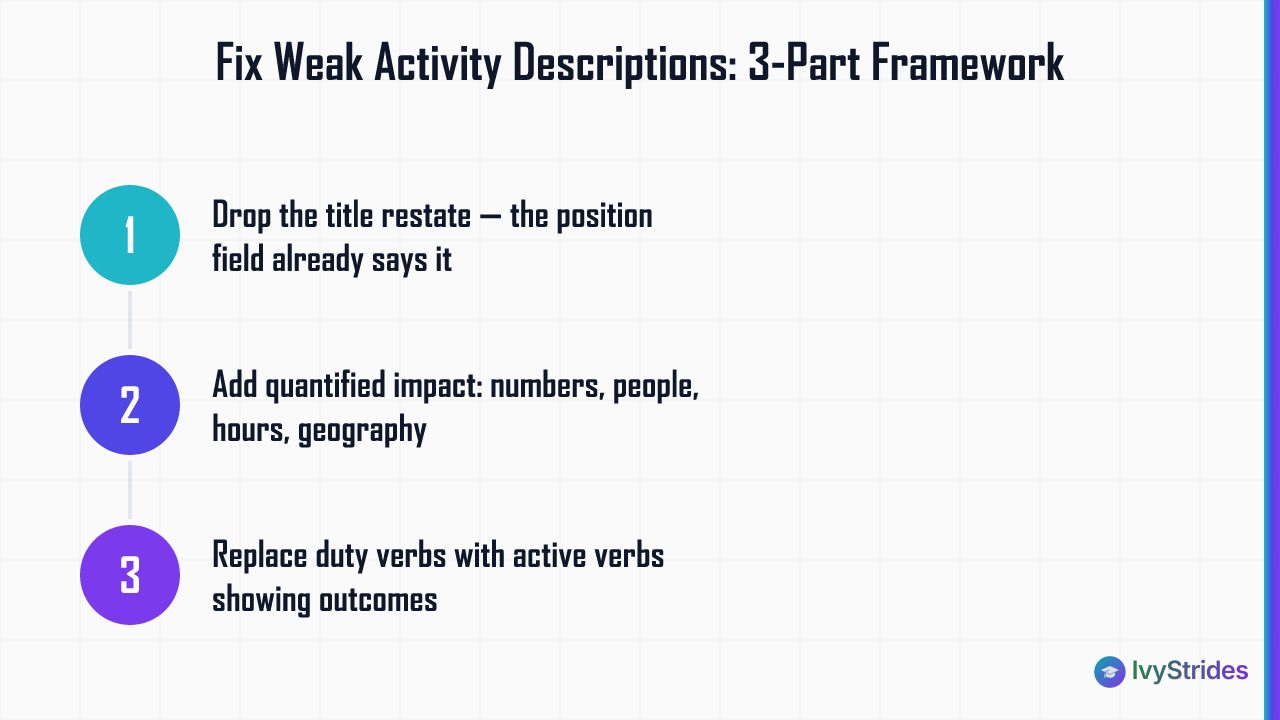
The five most common mistakes we see across essay coaching sessions share one root cause: students treat the description field as a place to explain what the activity is, rather than what they did inside it.
Mistake 1: repeating the title field. The position/organization field already says "President, Debate Club." Don't open the description with "As president of the debate club, I…". You just spent 35 characters restating what the reader can already see.
- Before (108 chars): "I was the president of the debate club and I organized meetings and helped members prepare for competitions."
- After (96 chars): "Directed 22-member club; scheduled 30+ practice rounds; coached 4 novices to regional finals."
Mistake 2: no quantified impact. Vague scope is invisible scope.
- Before (37 chars): "Volunteered at a food bank on weekends."
- After (98 chars): "Sorted 800+ lbs donations weekly; coordinated 15 volunteers; helped serve 200 families per month."
Mistake 3: listing duties instead of achievements. "Attended weekly meetings and helped plan events" describes attendance, not contribution. Replace duties with outcomes: what changed because you were there?
Mistake 4: weak or generic verbs. "Participated in", "was involved with", "helped out with" signal a passenger, not a driver. Even a genuine supporting role reads as active work when you write "supported 40-person production crew; managed props for 6 shows."
Mistake 5: complete sentences that waste characters on grammar. "I have been a member of the varsity soccer team for three years" spends nineteen characters on "I have been a member of." "Varsity soccer, 3 years; started 24 games junior year; team went 15-3" gives more information in the same space.
The fix for all five is the same three-part framework: verb, action, impact. What did you do (active verb)? What was the scope of the doing (numbers, people, hours, geography)? What resulted (placement, growth, dollars, people served)?
Across hundreds of essay coaching sessions, the single most common mistake we see is students using the description field to restate the position title already entered in the field above it. Fix that one mistake and about a third of your descriptions get stronger before you touch anything else.
For students who want a coach's eye on the full list, our college essay coaching walks students through the activities section, personal statement, and supplementals together.
How to Quantify Your Impact Even When the Numbers Are Not Obvious
"My activity doesn't have numbers" is almost always wrong. It has numbers; you just haven't found them yet. Six angles work for nearly any activity.
Participants or audience. How many people did you interact with, teach, perform for, or serve? A tutor: "Tutored 8 classmates in AP Calculus; 6 improved by one letter grade." A musician: "Performed in 4 regional concerts; ensemble placed 1st at state adjudication."
Funds raised or managed. Any dollar figure is instant scope: "$1,200 grant secured", "$4,200 raised across 3 events", "$800 budget managed for supplies."
Competition placement or ranking. State finalist, regional champion, top 10%, 3rd of 45 teams. Even non-placing entries count: "Competed at 6 tournaments; posted top-25% finish at state."
Growth or improvement metrics. Membership grown from 12 to 34. Readership up 40%. Personal best improved by 4 seconds. Test scores raised by one letter grade. Growth beats absolute numbers because it isolates your contribution.
Geographic scope as a proxy for scale. School-wide, district, county, state, national, international. Each level adds weight. "Placed 3rd at county math league" carries more than "competed in math league"; "represented state at National Ocean Sciences Bowl" carries more still.
Time investment as a quantifier. For activities where nothing else quantifies cleanly, hours plus consistency plus duration works: "Practiced 10 hrs/week over 3 years; performed in 6 regional venues." For family responsibilities: "Managed household for 3 younger siblings 20 hrs/week while parents worked evenings; maintained 3.9 GPA."
If two of your top activities feel equally important and you can't decide which goes in slot one, a college admissions counseling session can map your list against the narrative your target schools want. Ordering is a strategy decision, not a data-entry decision.
Real Activity Description Examples: Before and After Across Five Common Activity Types
The examples below are illustrative, modeled on patterns from our coaching work rather than real student records. Character counts include spaces.
Leadership / Student Government
- Before (117 chars): "Vice President of Student Council. I helped plan events, ran meetings when the president was absent, and worked on the budget."
- After (144 chars): "Managed $8K annual budget; led 4 school-wide events reaching 1,200 students; restructured meeting agendas, cutting length 30%."
- What changed: dropped the restatement of title, added a dollar figure, quantified reach, named a specific process improvement.
Athletics
- Before (74 chars): "Played varsity soccer for three years. Team captain during senior year."
- After (139 chars): "Varsity soccer, 3 yrs; captain senior yr; led team to 15-3 record and state quarterfinals; organized 4 summer training camps for 20 players."
- What changed: kept "captain" as a leadership signal but added record, tournament round, and off-season initiative.
Arts / Performance
- Before (63 chars): "I sing in the school choir and love performing in concerts."
- After (146 chars): "Soprano, chamber choir (auditioned, 16 members); performed in 8 concerts/yr; ensemble earned Superior rating at state MEA adjudication 2024."
- What changed: added a selectivity signal (auditioned), specified voice part, quantified performance frequency, named a specific award.
Community Service / Volunteering
- Before (52 chars): "Volunteered at the local library reading to kids."
- After (135 chars): "Ran weekly bilingual story hour for 15-20 children ages 4-7; recruited 3 volunteer readers; expanded Spanish-language collection by 40 books."
- What changed: named the specific program, added a weekly participant count, showed leadership by recruiting others, quantified a concrete deliverable.
Independent Project / Self-Initiated Activity
- Before (56 chars): "Started a podcast about environmental issues in my town."
- After (149 chars): "Produced 22-episode local environment podcast; 1,400 total downloads; interviewed 8 city officials; content cited in 2 town council meetings."
- What changed: quantified output (episodes, downloads), showed access to authorities (interviews), documented external validation (cited in council).
If you're a junior or senior mapping activities to schools, our college counseling for grades 11 and 12 works through the list alongside your school list.
How to Order and Prioritize Your Common App Activities List
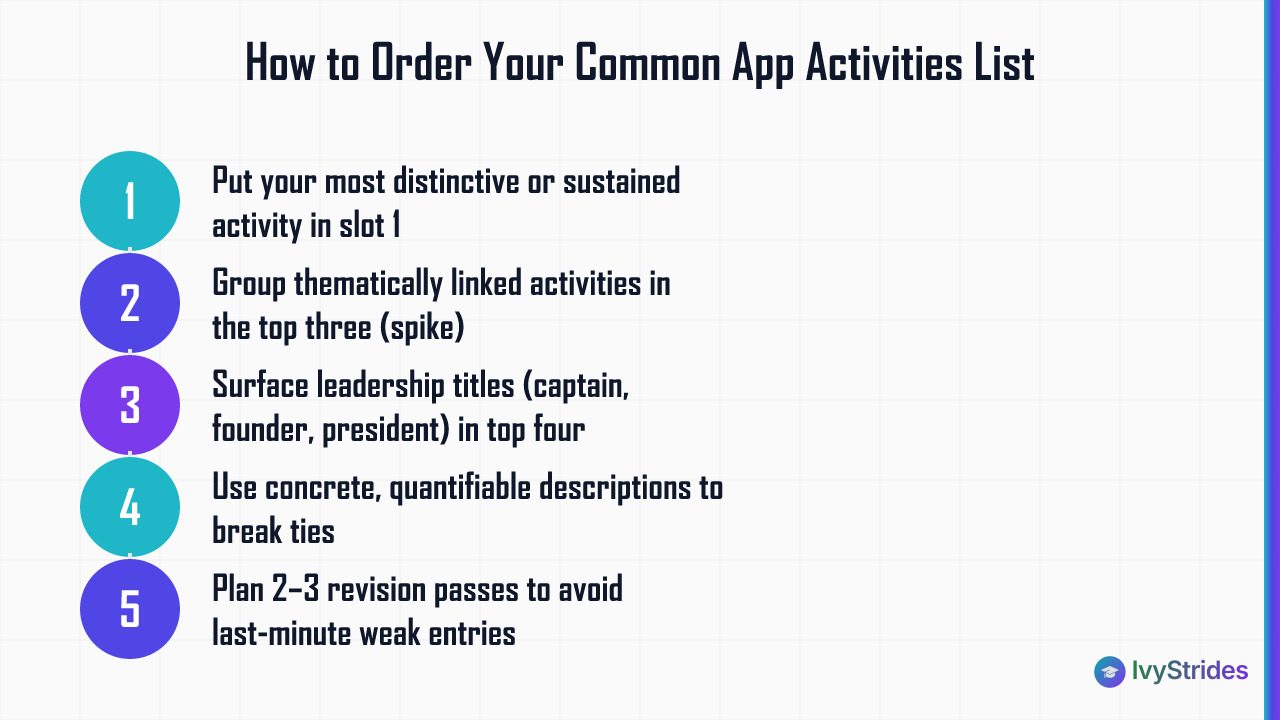
The Common App activities list does not require chronological ordering. You choose. Order by significance, and treat the top three slots as prime real estate.
Significance first. Admissions readers move fastest through slots 5-10. Your most distinctive, most impactful, or most sustained activity goes in slot 1, regardless of whether it started freshman year or senior year. A three-year commitment usually beats a one-semester leadership role, but a founded initiative with real outcomes can beat a routine three-year membership.
Spike or thematic coherence in the top three. If three of your top activities share a theme, group them at the top. STEM research, entrepreneurship, performing arts, environmental advocacy: any of these can anchor the sequence. This is what admissions professionals call a "spike," a signal that you have genuine depth in one area rather than a scattered pattern of one-off involvements. A spike is not required, but when you have one, front-loading it sharpens the reader's mental model of you.
Surface leadership early. If you were captain, founder, president, editor, or director, that entry usually belongs in the top four. Titles are the easiest scannable signal a reader picks up.
Tie-breaking rule. When two activities feel equally important, the one with the more concrete, quantifiable description goes first. It sets the tone for how the reader reads everything below it. In our coaching, we see students list their most time-intensive activity first out of habit, then bury a distinctive independent project at position 7 or 8 where it rarely gets read. Fix that.
Most students underestimate how long it takes to revise all ten descriptions; building two to three revision passes into your college application timeline 2026-27 prevents last-minute entries that read as afterthoughts. Which activities you pursue in the first place is a separate strategic question, covered in best extracurricular activities for college applications.
How the Common App Activities List Connects to Your Supplemental Essays
Your list and your essays reinforce each other. Handled well, they compound. Handled poorly, they repeat.
Several schools, including MIT and Stanford, ask supplemental essay prompts that directly reference your activities list, so a strong description often becomes the seed of a compelling supplemental response. MIT's application asks you to describe one activity you enjoy and why. Stanford's short essays ask about your intellectual vitality and what matters to you. When your activities list entry for the relevant activity is vague, your supplemental has to do more heavy lifting. When the list entry is sharp, your supplemental can skip the setup and go straight to the meaningful part: the specific moment, the lesson, the change in perspective.
The personal statement and the activities list should reinforce each other without repeating the same story word for word: the essay adds depth to what the list can only name. If your list says "Founded environmental coalition; secured $1,200 grant; grew membership to 45," your essay does not need to re-narrate what you did. It goes underneath: the moment you realized the town's recycling program was broken, the conversation with the skeptical council member, what you learned about coalition-building when three volunteers quit at once.
The Common App also includes an Additional Information field (up to 650 words as of the current cycle; verify at commonapp.org) that you can use to expand on one activity when 150 characters truly cannot hold the context. Research projects, complex family situations, and interrupted timelines are the usual candidates. Use it sparingly. It is not a place for a second personal statement.
In our coaching, students who draft their activities list before writing supplemental essays find it easier to identify which activity deserves a full essay treatment, because the list forces them to see, in numbers, which activities actually carry weight. For the essay side of that work, see how to write supplemental essays that get you in and how to write a college essay.
FAQ: Common App Activities List Descriptions
How do you write a list of activities for the Common App?
Start by brainstorming every activity you've done in grades 9-12, including jobs, family responsibilities, and independent projects. Cut the list to your ten most meaningful ones, ordered by significance rather than chronology. For each, select the activity type from the dropdown, enter your role and organization name in the 50-character position/organization field, check the correct grade levels and hours per week, and write a 150-character description that opens with an active verb and includes at least one concrete number.
What is an example of an activity description for the Common App?
Here's one that fits: "Founded school's first environmental club; organized 4 campus clean-ups; secured $1,200 grant; grew membership to 45 students in one year." That's 137 characters. It opens with an active verb ("Founded"), quantifies impact three separate ways ($1,200, 4 events, 45 members), and names a specific outcome.
How do you list extracurricular activities on the Common App?
Rank up to ten activities by significance, not by when they happened. For each, use the activity type dropdown to pick the closest category, enter your position and organization in the 50-character field, check grade levels 9 through 12 (and post-graduate if applicable), enter hours per week and weeks per year honestly, and write a 150-character description focused on what you did and what resulted.
Can you provide some examples of activity descriptions for the Common App?
Athletics: "Varsity captain; led team to 3rd-place state finish; improved personal 400m time by 4 sec; mentored 5 JV athletes." Community service: "Coordinated weekly tutoring for 12 Title I students; 9 passed state math assessment; recruited 4 additional tutors." Each opens with a strong verb and stacks multiple quantifiers.
Should I write in full sentences or fragments in the 150-character description field?
Fragments win. Full sentences burn characters on articles and linking verbs that carry no information. "Directed 22-member club; coached 4 novices to regionals" reads faster and says more than "I directed a 22-member club and I coached four novices who went to regionals." Admissions readers expect fragments in this field.
What counts as an activity for the Common App activities list?
Almost anything consistent and meaningful. Sports, paid jobs, internships, volunteer work, religious involvement, family caregiving, independent research, creative projects, and hobbies all qualify. The Common App includes Family Responsibilities and Work (Paid) as explicit categories, so caregiving for siblings or working at a family business absolutely belongs on the list.
How do I describe an extracurricular activity that has no obvious numbers?
Estimate scope. How many people did you reach, how many hours per week over how many years, how many events did you organize, or what geographic level did you reach? "Practiced 10 hrs/week over 3 yrs; performed in 6 regional venues" gives an arts activity real weight even without a competition ranking. Time, consistency, and reach are all numbers.
Is the order of activities on the Common App important?
Yes. Readers give the first two or three entries the most attention. Put your most meaningful or distinctive activity in slot one regardless of when it started or how many hours it took. When your top three activities share a theme, grouping them signals genuine depth in one area, which reads as coherent identity rather than scattered involvement.
What is the difference between the position field and the description field on the Common App?
The position/organization field (50 characters) holds your title and the organization's name, for example "President, Model UN Club." The description field (150 characters) is for what you actually did and what resulted. Never repeat your title in the description; the reader can already see it directly above.
Before You Submit
Your activities list is one of the few parts of the Common App you can fully control. Test scores are already set. Your GPA is what it is. But every one of those ten 150-character boxes is a choice you make right now. Strong descriptions don't guarantee admission (nothing does; admissions decisions rest on your full file), but weak descriptions cost you signal you've already earned.
If you want a second set of eyes, our essay strategists and college counselors do this work every application cycle. Meet the tutors who coach students through the full application. You can also read about our approach on the about page.

Award-winning author (South Asian Book Award) and graduate of BITS Pilani and UCLA Luskin School of Public Affairs. Brings a published writer's eye to Common App essays and grammatical precision to SAT and ACT R&W instruction.