
How to Ask for a Letter of Recommendation in 2026: A Step-by-Step Guide That Actually Works
On this page
- What a College Recommendation Letter Actually Does for Your Application
- Who to Ask for a College Recommendation Letter
- When to Ask for a College Recommendation Letter (and Why Timing Is Everything)
- Not sure where your application stands beyond the letter?
- How to Ask for a Recommendation Letter in Person
- How to Ask for a Recommendation Letter via Email (With a Template)
- What to Include in Your Recommendation Request Packet
- What Makes a Recommendation Letter Strong (and What Makes It Weak)
- How to Follow Up on a Recommendation Letter Politely
- Frequently Asked Questions About Asking for a College Recommendation Letter
- How do I politely ask for a letter of recommendation?
- How to ask for a letter of recommendation via email: what should the email include?
- What questions should I ask when requesting a letter of recommendation?
- How do I ask for a letter of recommendation from my employer?
- How late is too late to ask for a letter of recommendation?
- Is it better to ask for a letter of recommendation in person or by email?
- How do you get letters of recommendation if you don't know any teachers well?
- Your recommendation letters are one piece of a stronger application.
To ask for a letter of recommendation, choose a teacher who knows your work well, ask at least 4 to 6 weeks before your earliest application deadline, and make the request in person first. Follow up within 48 hours with an email that includes your resume, a list of target colleges with deadlines, and specific accomplishments you hope your recommender will mention. That context is what turns a generic letter into a specific one.
The 4 to 6 week lead time is the standard cited by ACT, Inc.'s college planning resource. Requirements vary by school, so verify each college's exact recommendation rules on its admissions page before you finalize your list. This guide reflects 2026 Common App policies and walks the process from choosing recommenders to sending the thank-you note.
What a College Recommendation Letter Actually Does for Your Application
A letter of recommendation is a written evaluation, usually one to two pages, submitted directly to colleges by a teacher, school counselor, or other adult who knows you. It speaks to character, intellectual curiosity, and classroom presence, the qualities your GPA and test scores can't show on their own.
Most colleges using the Common App ask for two teacher recommendations and one school counselor recommendation. Some selective schools accept a third optional letter from an employer or mentor, and a handful require letters from specific subjects. Check each college's page, because these rules genuinely differ by school and year.
Here's the distinction students miss: the counselor recommendation and the teacher recommendation are not interchangeable. Your counselor speaks to your record in context, how you fit within your graduating class, what you overcame. Your teachers speak to how you think in their subject. Colleges want both angles.
So what does a strong letter add that a transcript can't? Evidence of how you engage. A transcript shows an A in AP Biology. A letter shows the student who stayed after class to argue about the ethics of gene editing, and that second signal is the one admissions officers read for. For a deeper look at what admissions officers actually read in a strong letter and how to help your recommender write one, see our college recommendation letters guide.
Who to Ask for a College Recommendation Letter
The right recommender for a college letter is a teacher from your junior or senior year who taught you in a core academic subject: English, math, science, history, or a foreign language. This is the person who has watched you think over months, not the one who happens to have given you the highest grade.
That distinction matters more than students expect. In our coaching with students preparing their full applications, we've seen a student ask a teacher who gave them an A but barely knew their name, and the resulting letter was so generic it added nothing. The student who asked a teacher from a B-grade class, where they'd had a real intellectual exchange, got a letter admissions officers noted specifically. Colleges want recommenders who can speak to engagement, not just performance.
Your counselor recommendation is separate and required by most colleges through the Common App. You don't choose your counselor the way you choose teachers, but you can still help them by sharing your materials early.
An optional third letter can come from an employer, a coach, a research mentor, or an extracurricular supervisor. Use it only if that person adds something your teachers can't, like leadership in a job or commitment in a sport.
What if you don't feel close to any teacher? Start with anyone who has seen you engage beyond surface participation, even if the relationship feels thin. A supervisor from a part-time job or a community organization leader can serve as that optional third recommender. Students who've taken college courses can ask a professor or community college instructor. Building those relationships earlier, through class participation and office hours, is the most reliable long-term fix. The same instinct for specific detail shows up in what makes a college essay good.
When to Ask for a College Recommendation Letter (and Why Timing Is Everything)
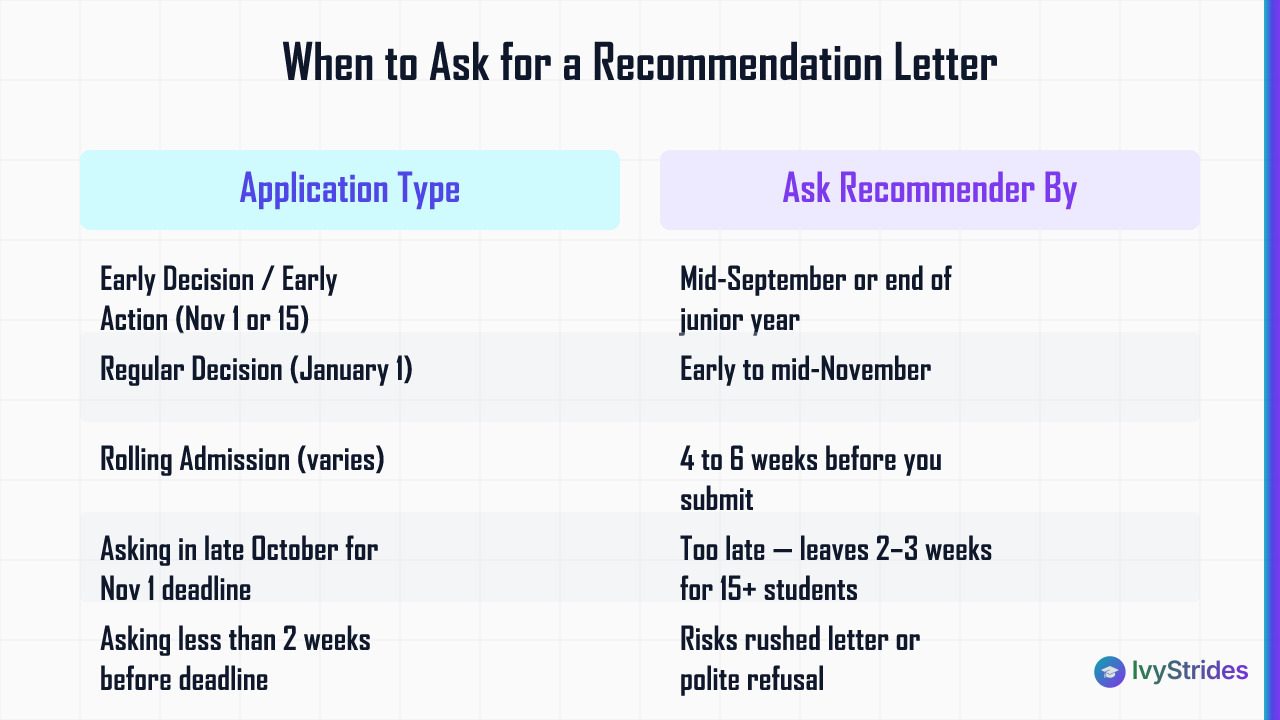
Ask at least 4 to 6 weeks before your earliest application deadline, and ideally at the end of junior year, in May or June, if you plan to apply Early Decision or Early Action. Your recommendation letter deadlines are tied directly to your application deadlines, so mapping them against your Early Decision, Early Action, and Regular Decision dates is the first step in planning when to ask.
Run the arithmetic. Early Decision and Early Action deadlines usually fall on November 1 or November 15. Working back 6 weeks from November 1 lands you in mid-September at the latest. Regular Decision deadlines are typically January 1, which means a December ask is cutting it close, especially over winter break when teachers are offline.
| Application type | Typical deadline | Ask your recommender by |
| Early Decision / Early Action | November 1 or 15 | Mid-September, or end of junior year |
| Regular Decision | January 1 | Early to mid-November |
| Rolling admission | Varies | 4 to 6 weeks before you plan to submit |
Why does earlier win? Because your teacher isn't writing only for you. A teacher managing 20 senior requests in October can't give the same attention to one that arrives October 25 that they'd give one received in June. Across hundreds of application cycles, the most common recommendation mistake we see is asking too late, typically in October for November 1 deadlines, which leaves teachers two to three weeks to write for 15 or more students at once.
How late is too late? Asking less than two weeks before a deadline risks a rushed letter or a polite no. For the full sequence, see our college application timeline and deadlines. If you're still deciding between application rounds, our breakdown of Early Decision vs Early Action vs Regular Decision will help you set those dates first.
Not sure where your application stands beyond the letter?
Book a free 15-minute strategy call. Our coaches will review your current test scores, essay status, and application timeline and tell you exactly where to focus next.
How to Ask for a Recommendation Letter in Person
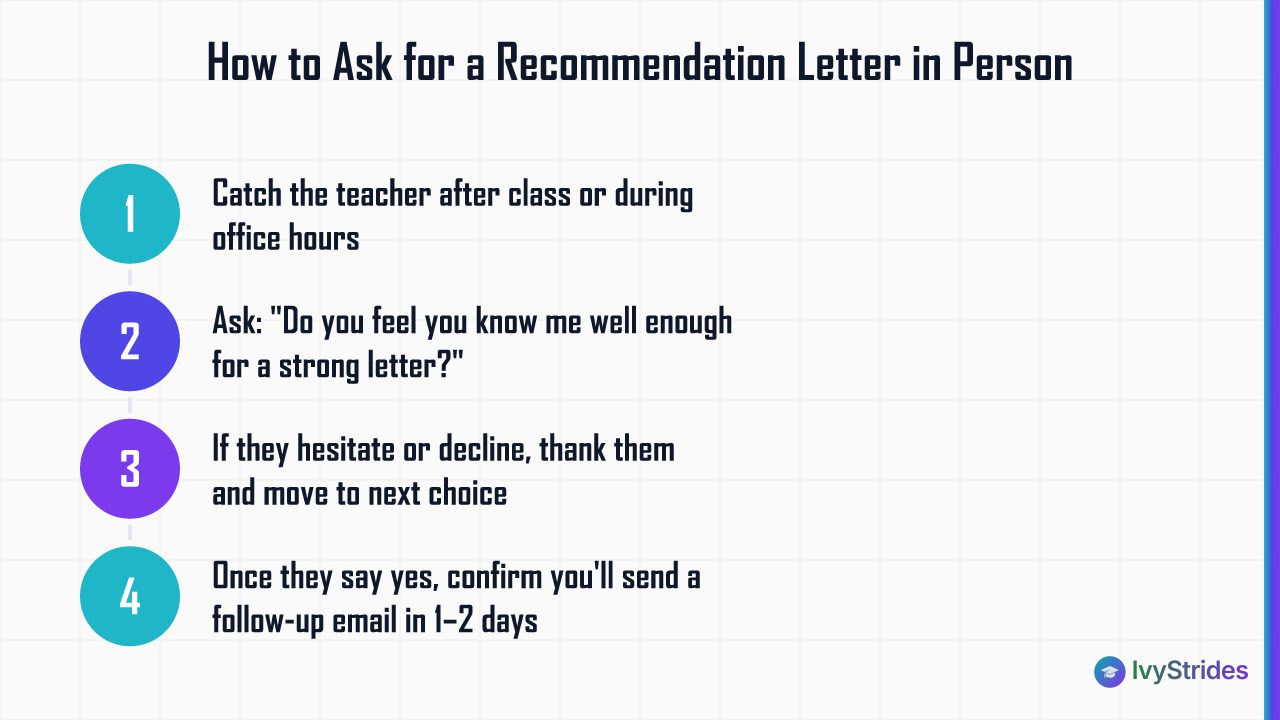
The in-person ask should come first, before any email. A face-to-face conversation lets your teacher gauge how serious you are, ask questions on the spot, and, if they're honest, tell you they can't write a strong one. That last part protects you.
Open it simply. Catch the teacher after class or during office hours and say you're starting your college applications and hoped to talk about a recommendation. Then use the question that does the real work: "Do you feel you know me well enough to write a strong letter?" Not just a letter. A strong one. Stanford's academic advising guidance recommends beginning with a genuine conversation about your goals before the formal ask, and this framing gives your recommender a graceful exit if they can't do you justice.
What if they hesitate or say they're swamped? Take it at face value and thank them. A reluctant writer produces a lukewarm letter, and a lukewarm letter can quietly hurt you. Move to your second choice. This is exactly why you identify two or three potential recommenders before you start asking.
Once a teacher says yes, close the loop right there. Tell them you'll send an email with everything they need, your resume, deadlines, and a few notes, within the next day or two. That transition from spoken yes to written packet is where most students drop the ball. When you're pulling your accomplishments together, our guide on how to write strong activities list descriptions doubles as raw material for your recommender.
How to Ask for a Recommendation Letter via Email (With a Template)
Send the follow-up email within 24 to 48 hours of the in-person yes, while the conversation is fresh. This email is not a second ask. It's the delivery of everything your recommender needs to write well: context, deadlines, and materials.
Your subject line should be specific enough to survive a crowded inbox: "Recommendation Letter Request, [Your Name], [Deadline: Month Day]." The body stays to three or four short paragraphs. Remind the teacher of the class and year, name a specific project or moment they'll remember, make the ask clearly, list your schools with deadlines, and note that your materials are attached.
Here's a template you can adapt:
Subject: Recommendation Letter Request, Maya Chen, Deadline November 1 Dear Ms. Alvarez, Thank you again for agreeing to write my recommendation. I loved your AP US History class last year, especially the unit where we debated the New Deal's legacy; that discussion is part of why I'm applying as a history major. I'm applying to five schools. My earliest deadline is November 1 (Early Decision). I've attached my resume, my activities list, a draft of my personal statement, and a one-page sheet of a few moments from your class I'm hoping you might mention. A full list of schools and deadlines is in the attached document. I'll send the Common App invitation to your email this week so you can submit directly through the platform. Please let me know if anything else would help. Thank you so much. Warmly, Maya Chen
Two variations worth knowing. To ask a professor for a letter, keep the tone a notch more formal and reference the specific course number and your final work in it, since college instructors juggle far more students than high school teachers. To ask a teacher from two years ago, spend your first two sentences rebuilding context: remind them which class, which year, and one thing you did that stood out, before you ask, because they need that anchor.
Attach or link five things every time: resume, activities list, personal statement draft or topic summary, list of schools with deadlines, and Common App invitation instructions. ACT, Inc.'s guidance lists deadlines and submission details as essential parts of a formal written request. If your personal statement isn't drafted yet, our walkthrough on how to brainstorm college essay ideas will get you a topic summary you can share.
What to Include in Your Recommendation Request Packet
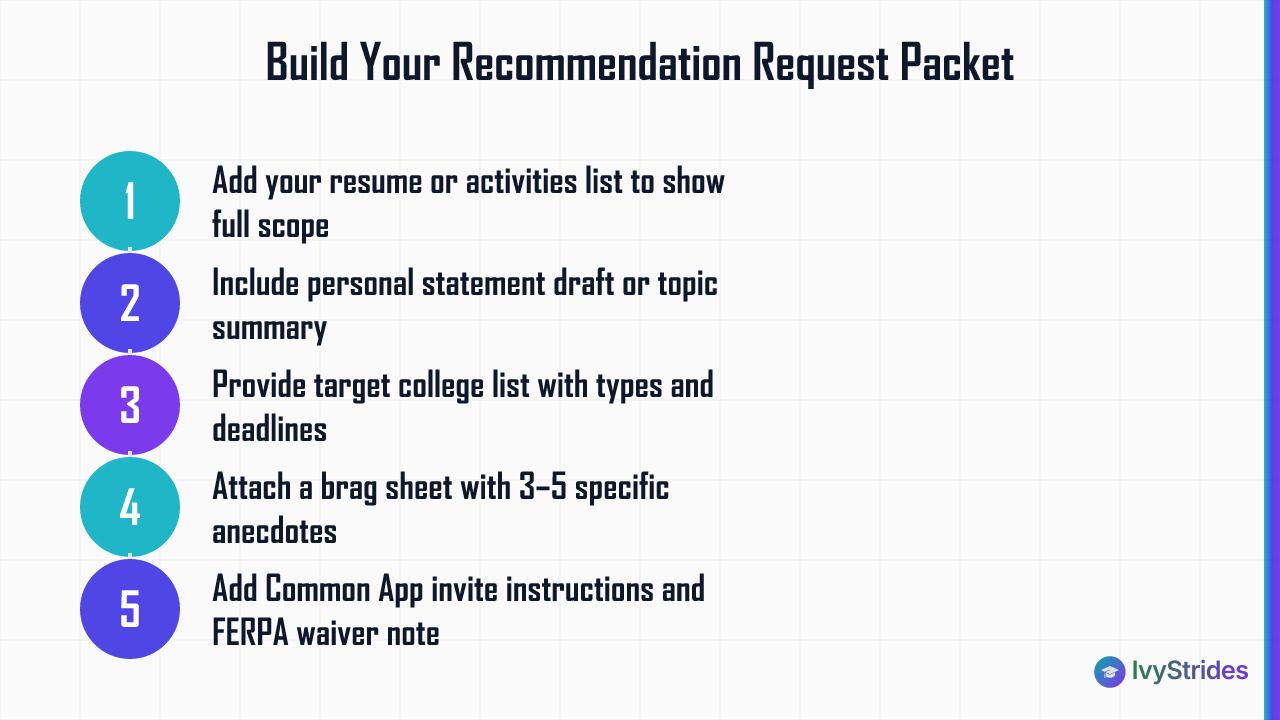
Your request packet is the set of materials that lets a recommender write something specific instead of generic. In our coaching with students preparing their full applications, the students who receive the most compelling letters are consistently the ones who handed over a detailed packet, especially a brag sheet with three to five concrete anecdotes.
Give your recommender these six things:
| Item | Why it helps the writer |
| Resume or activities list | Shows the full scope of what you do outside their class |
| Personal statement draft or topic summary | Aligns their letter with the story you're telling |
| List of target colleges with type and deadline | Lets them plan and prioritize by date |
| One-page brag sheet: 3 to 5 specific moments | Gives concrete material, the antidote to a generic letter |
| Common App invitation instructions | Tells them exactly how to submit |
| Note on the FERPA waiver | Sets expectation on whether you'll view the letter |
Sharing your activities list gives them concrete material to draw from, the same list you'll submit on the Common App. The same qualities you highlight in your college admissions essays, your growth, your specific contributions, your voice, are exactly what you want your recommender to reinforce from their own perspective. When both documents point the same direction, the application reads as one coherent person.
On the Common App teacher recommendation itself: you send a digital invitation from your Common App account, your teacher gets a link, and they submit directly through the platform. You never handle the letter.
That leads to the waiver. When you invite a recommender, the Common App asks whether you want to waive the right to view the letter. Waive it. Most college counselors recommend this because admissions officers give more weight to letters the student hasn't seen; the waiver signals candor. Waiving does not mean the letter will be negative. It means your recommender can write freely and the reader can trust it. For the essay side of this coordination, see Common App essay prompts decoded. If you'd rather have a coach shape the whole narrative with you, that's what our college essay coaching does.
What Makes a Recommendation Letter Strong (and What Makes It Weak)
A strong recommendation letter names specific moments; a weak one lists adjectives. That single difference decides whether a letter helps you. "In our AP US History class, she was the only student who connected a primary source to a contemporary policy debate without prompting" tells an admissions officer something. "She is a hard worker" tells them nothing they didn't assume.
The red flags in a weak letter are predictable: it's short, it's vague, it could describe any student, and it recycles your transcript back to the reader. Admissions officers read hundreds of these. They notice the ones with texture, and they discount the ones without.
Your two levers here are the recommender you choose and the packet you provide. A teacher who knows you plus a brag sheet with real anecdotes produces specificity. A distant teacher plus a bare invitation produces filler. This is entirely within your control.
At test-optional schools, a compelling recommendation letter carries even more weight because it may be one of the few qualitative signals an admissions officer has about your character and classroom presence. If you're weighing whether to submit scores at all, our guide on what is test-optional and should you submit SAT scores covers that decision.
One honest caveat: no letter guarantees anything. Admissions decisions rest on the full application, your grades, your scores, your essays, your activities, and your letters together. A strong letter strengthens the picture. It doesn't override the rest of it.
How to Follow Up on a Recommendation Letter Politely
Send one polite follow-up 2 weeks before the deadline if you haven't received confirmation that the letter is submitted. That's the window. A reminder two weeks out is professional; a reminder the day after you asked is not.
Keep the follow-up short and gracious. Acknowledge that the teacher is busy, restate the deadline in a single clear line, and offer to answer any questions or resend materials. Something like: "I know this is a busy stretch. I wanted to gently flag that my Early Decision deadline is November 1. Please let me know if there's anything else I can send." That's it. No pressure, no guilt.
What if the deadline is 48 hours out and the letter still isn't in? Send a brief, warm note that repeats the deadline and asks whether they need anything from you. If it's your counselor, loop them in, since counselors often track submission status through the school portal. Stay respectful. Panic doesn't produce letters faster.
After the letter goes in, send a thank-you note. Handwritten or email, both work. A thank-you closes the relationship well, and it matters practically: you may need this same person again for scholarship applications or a transfer. Teachers remember the students who thanked them. If a scholarship is on your radar, our guide on how to write a scholarship essay pairs naturally with a letter you can reuse.
Frequently Asked Questions About Asking for a College Recommendation Letter
How do I politely ask for a letter of recommendation?
Ask in person first, using a phrase like "Do you feel you know me well enough to write a strong letter?" That question gives your teacher a graceful way to decline if they can't write a compelling one. Then follow up within 48 hours with an email carrying your resume, deadlines, and a short list of accomplishments you hope they'll mention.
How to ask for a letter of recommendation via email: what should the email include?
Lead with a clear subject line stating your name and deadline. Inside, remind the teacher which class and year you shared, make a specific and polite ask, list your target colleges with deadlines, and attach your resume and personal statement draft. Keep it to three or four short paragraphs so it reads easily on a phone.
What questions should I ask when requesting a letter of recommendation?
The first question is whether the teacher feels they know you well enough to write a strong letter, not just any letter. Follow that by asking what information or format would help them most, and whether they have questions about your schools or deadlines. Questions like these signal respect for their time and give them a better foundation to write from.
How do I ask for a letter of recommendation from my employer?
Approach your employer in person or through a brief, professional email. Explain that you're applying to college and that an optional third recommendation from a supervisor would strengthen your application. Hand over the same packet you'd give a teacher: your resume, a list of schools and deadlines, and a few talking points about what you contributed in the role.
How late is too late to ask for a letter of recommendation?
Anything less than two weeks before a deadline is generally too late and risks a rushed or declined letter. Aim for the standard minimum of 4 to 6 weeks before your earliest deadline. Early Decision and Early Action applicants facing November 1 deadlines should treat mid-September as the practical target.
Is it better to ask for a letter of recommendation in person or by email?
In person wins for the initial ask. A real conversation lets the teacher ask questions and shows you take the request seriously. Email then becomes the right channel for the formal follow-up that delivers your packet, deadline list, and Common App invitation link.
How do you get letters of recommendation if you don't know any teachers well?
Begin with any teacher who has seen you engage past basic participation, even if the relationship feels thin. A part-time job supervisor, a coach, or a community leader can serve as an optional third recommender. Longer term, building relationships in class and during office hours is the surest way to secure strong letters. For students taking college-level work, our overview of whether does AP help with college admission explains how those instructors can become recommenders. And if you're drafting the essays that sit beside your letters, browse our supplemental essay examples.
Your recommendation letters are one input among several. The students whose applications land hardest treat scores, AP results, essays, and letters as a single coordinated story rather than four separate errands. You can read how we approach that on our about page. Or meet the coaches on our tutors page.
Your recommendation letters are one piece of a stronger application.
IvyStrides coaches work with students on the full picture: test scores, AP results, and essays that make admissions officers take notice. Book a free 15-minute call to see where you stand.