
Georgia Tech Out-of-State Acceptance Rate: 9% vs 28%. What You Control

On this page
- Why Georgia Tech's Out-of-State Acceptance Rate Is 9%, Not 28%
- What Georgia Tech Reviewers Actually Weigh for Out-of-State Applicants
- Is a 1400 SAT Competitive for Georgia Tech Out-of-State Applicants?
- Georgia Tech Early Action Deadlines and Decision Timelines for Nonresidents
- FAQ: Georgia Tech Out-of-State Admissions
- How hard is it to get into Georgia Tech from out of state?
- Is a 1400 SAT good enough for Georgia Tech?
- Does Early Action increase chances for Georgia Tech?
- Does Georgia Tech require a supplemental essay?
- Your Next Step on Georgia Tech Out-of-State Admission
Georgia Tech's out-of-state acceptance rate is 9%, versus 28% for Georgia residents. Georgia Tech is a selective public research university that admitted more than 8,700 of nearly 68,000 first-year applicants for its 2026 first-year class. The gap is structural, not a verdict on your file alone.
Both rates come from the admissions office's news release of 27 March. The release applies its lower rate to nonresidents, a group that includes international applicants, so it is not a figure for domestic out-of-state applicants alone. Admission from outside Georgia is realistic, but only with a deliberate application.
Why Georgia Tech's Out-of-State Acceptance Rate Is 9%, Not 28%
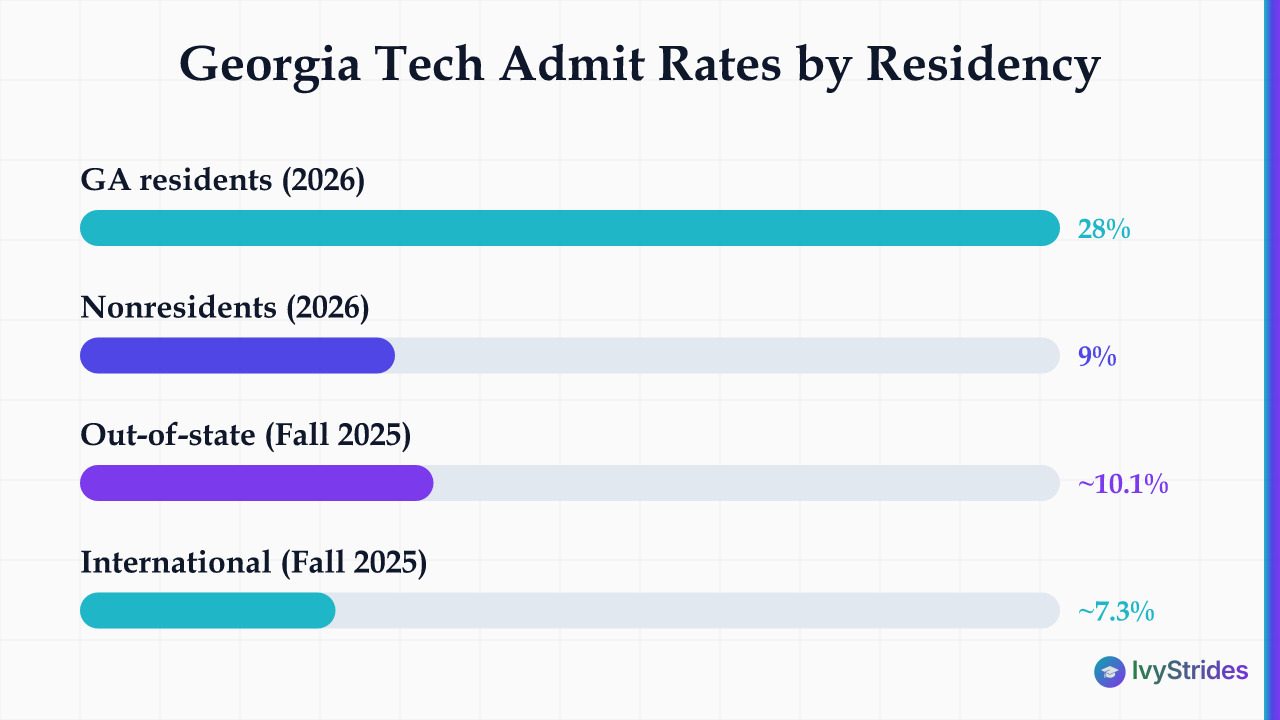
Georgia Tech's out-of-state admit rate is 9%, roughly a third of the 28% rate Georgia residents see, and Georgia Tech itself names the reason. Residency is "one of the biggest impacts" on a student's odds, per Georgia Tech's institutional fit page, because the school aims for Georgia students to make up the majority of each enrolled class.
Georgia students come first by design. With Georgia students as the planned majority, nonresidents compete for the smaller share of seats. The applicant volume compounds the squeeze: nearly 68,000 students applied for the 2026 first-year class, a record.
The blended rate. Georgia Tech publishes the 9% and 28% rates separately, not as a single number. IvyStrides divides the release's more than 8,700 admits by its nearly 68,000 applicants for the 2026 first-year class: an overall admit rate of about 13%.
Splitting the 9%. The prior year's Common Data Set separates domestic out-of-state applicants from international ones. For Fall 2025, by IvyStrides' calculation from section C1, out-of-state applicants were admitted at about 10.1% (4,513 of 44,596) and international applicants at about 7.3% (716 of 9,758).
| Applicant Group | Admit Rate | Basis |
| Georgia residents | 28% | 2026 first-year class, news release |
| Nonresidents (incl. international) | 9% | 2026 first-year class, news release |
| All applicants | about 13% | 8,700+ of ~68,000, news release |
| Out-of-state, domestic | about 10.1% | Fall 2025, CDS C1 counts |
| International | about 7.3% | Fall 2025, CDS C1 counts |
Georgia Tech publishes the first two rates. IvyStrides calculated the other three from the admit and applicant counts Georgia Tech publishes.
So the 9% is not a wall built against you specifically. It's math driven by a state mission, and what you control sits inside the review itself.
What Georgia Tech Reviewers Actually Weigh for Out-of-State Applicants
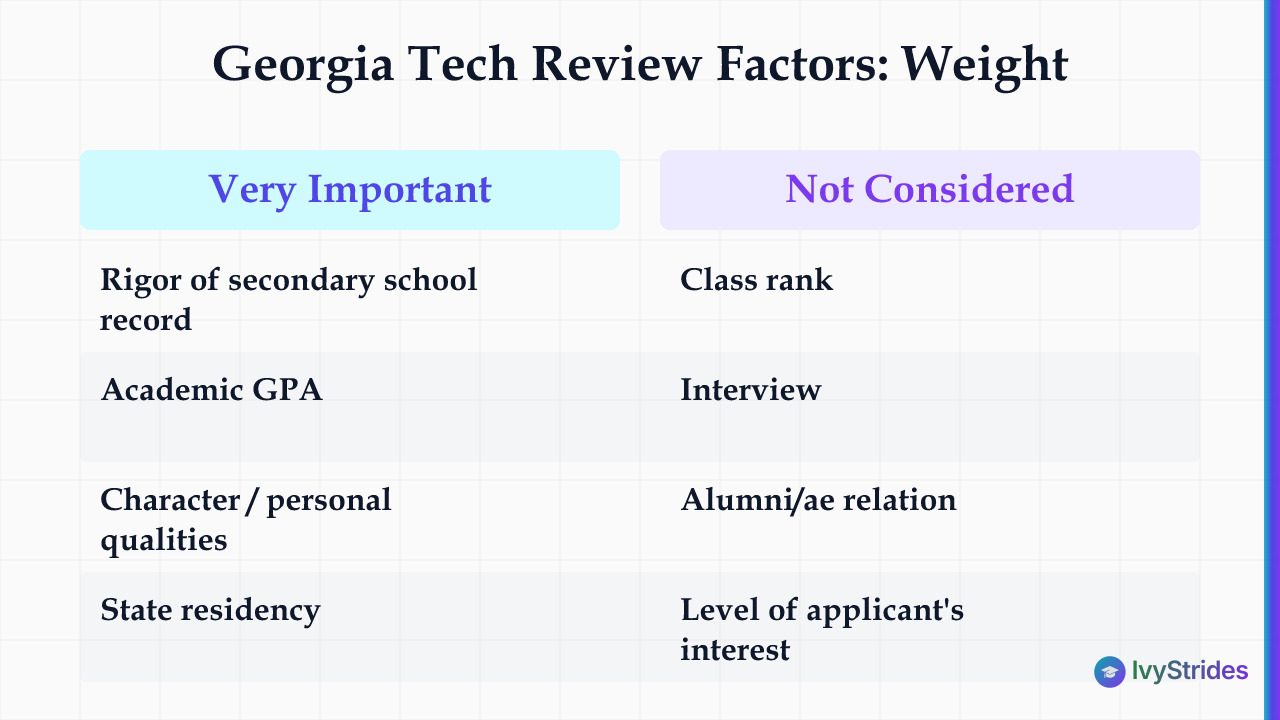
Georgia Tech reviewers weigh four factors as Very Important in its 2025-26 Common Data Set, section C7: rigor of secondary school record, academic GPA, character and personal qualities, and state residency (CDS 2025-2026 FINAL R4). Residency is the one of the four you cannot change, so rigor, GPA, and character are where your file does its work.
Rigor means stretch, not perfection. Academic preparation measures how you challenged yourself relative to what your school offered, through AP, IB, dual enrollment, or A Levels (academic preparation). Georgia Tech uses the GPA on your transcript. If your school does not report one, it recalculates a weighted 4.0 GPA from core courses, adding 0.5 for AP, IB, dual enrollment, and AS and A Level courses.
Several factors Georgia Tech rates Not Considered: class rank, interview, first generation, alumni relation, religious affiliation, and level of applicant interest. Level of applicant's interest is Not Considered, so contact-tracking strategies earn nothing here.
| Factor | Weight in Review |
| Rigor of secondary school record | Very Important |
| Academic GPA | Very Important |
| Character / personal qualities | Very Important |
| State residency | Very Important |
| Class rank | Not Considered |
| Interview | Not Considered |
| First generation | Not Considered |
| Alumni/ae relation | Not Considered |
| Level of applicant's interest | Not Considered |
Major matters. Georgia Tech applies major-aware review: you select a primary and an optional secondary intended major, and reviewers look for evidence of interest and preparation, using major to build an academically diverse class (major selection). Treat major fit as a narrative thread, not an afterthought, precisely because reviewers build that class by intended major.
For contribution to community, Georgia Tech values commitment, initiative, and leadership, typically across three to five meaningful activities, and work and family responsibilities count (contribution to community). No separate resumes are accepted. Recommendations are optional: Georgia Tech accepts one counselor letter and up to two teacher letters, preferably from core academic subjects, and says a counselor who cannot write one will not count against you (recommendations).
Then the essay. Georgia Tech removed its short-answer supplement starting with the 2026-27 cycle, so only the Common App personal essay is required (news release, 29 July 2026). That essay runs 250 to 650 words on one of seven prompts, unchanged for 2026-27 (Common App). With no supplement, the personal essay is the only essay Georgia Tech reads. Its 2025-26 CDS, which describes Fall 2025 when a supplement still existed, rated the application essay Important.
Building a college list that accounts for residency-driven admit rates is exactly the kind of planning a counselor works through with students in grades 11 and 12.
Is a 1400 SAT Competitive for Georgia Tech Out-of-State Applicants?
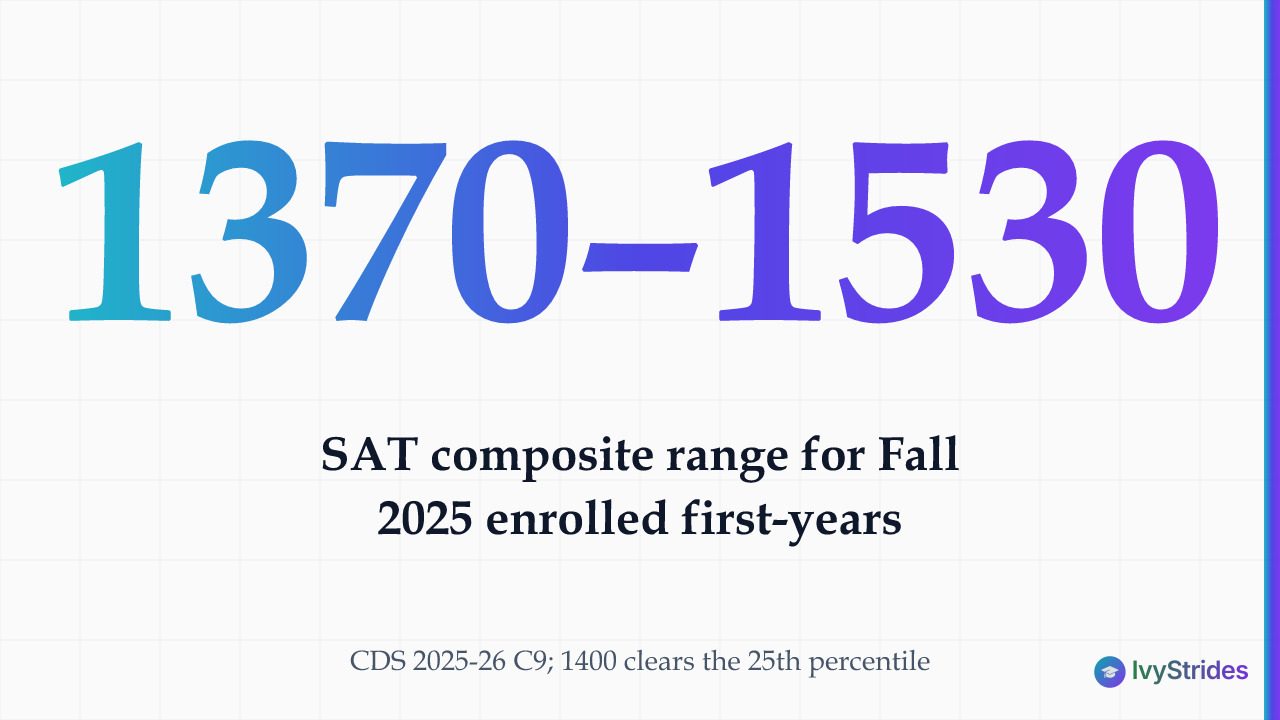
A 1400 SAT is inside Georgia Tech's range: the middle 50% of Fall 2025 enrolled first-years ran 1370 to 1530 (CDS 2025-2026 FINAL R4).
Georgia Tech is test-required for 2026-27, so you must submit at least one SAT and/or ACT result to be considered (standardized tests). Yet CDS C7 rates test scores Considered, a tier below the four Very Important factors.
Read the range correctly. That 1370 to 1530 band describes enrolled students who sent a score, across all residencies; Georgia Tech does not publish ranges by residency. Among SAT submitters, 70.30% scored 1400 to 1600. A 1400 clears the 25th percentile. In our view, because nonresidents face the more selective pool, the upper half of the range is the safer target.
| Test | 25th Percentile | Median | 75th Percentile | Source |
| SAT composite | 1370 | 1460 | 1530 | CDS 2025-26 C9 (Fall 2025) |
| ACT composite | 31 | 33 | 35 | CDS 2025-26 C9 (Fall 2025) |
For Fall 2025, 78% of enrollees submitted an SAT and 33% an ACT. If your score sits below the 1460 median, a retake before the EA2 score deadline is worth weighing. One-on-one SAT coaching with a section specialist works on the domains where you lose the most points. ACT takers can get the same focus from one-on-one ACT coaching.
Score outcomes depend on sustained work, and admission depends on the full application, not any single number. No score guarantees a seat.
Georgia Tech Early Action Deadlines and Decision Timelines for Nonresidents
Georgia Tech runs two Early Action plans split by residency, and nonresidents use Early Action 2 (EA2): application due Nov. 2, documents Nov. 16, self-reported test scores Dec. 8, decisions late January (deadlines). EA1 is reserved for Georgia high school students and Georgia residents. All plans are nonbinding and use the same holistic review.
| Plan | Who It Is For | Application Deadline | Score Deadline | Decision Timeline |
| EA1 | Georgia residents / GA high school | Oct. 15 | Nov. 16 | Early December |
| EA2 | Non-Georgia (incl. international) | Nov. 2 | Dec. 8 | Late January |
| RD | All applicants | Jan. 6 | Jan. 22 | Mid-March |
Georgia Tech does not publish separate EA versus RD admit rates by residency, so applying EA2 carries no confirmed odds boost. What Early Action does give you is an earlier decision, and merit scholarships such as the Stamps President's Scholars Program and the Scheller Dean's Scholarship require applying through an Early Action plan. One caution carries real weight: EA-denied applicants cannot reapply in Regular Decision (decision outcomes).
Outcomes beyond admit or deny. Georgia Tech issues several: a fall admit, a summer admit through the Ignite Program (600 first-years start in the summer each year), a First-Year Semester Abroad admit, an EA defer to RD, a waitlist spot, a transfer pathway offer, or a deny. If you're deferred from Early Action, your file rolls into the RD round for a second read.
Don't bank on the waitlist. For Fall 2025, Georgia Tech offered 7,651 waitlist spots, 4,875 students accepted a place, and 653 won admission (CDS 2025-2026 FINAL R4). That's a low conversion, so treat a waitlist offer as a long shot, not a plan.
FAQ: Georgia Tech Out-of-State Admissions
How hard is it to get into Georgia Tech from out of state?
Very competitive. The nonresident admit rate is 9%, against 28% for Georgia residents, from a pool of nearly 68,000 applicants (news release, 27 Mar 2026).
The gap is structural because Georgia Tech aims for Georgia students to make up the majority of each class. Strong rigor, a competitive SAT or ACT score, and a clear major fit are the factors you can move.
Is a 1400 SAT good enough for Georgia Tech?
A 1400 sits inside Georgia Tech's middle 50% for Fall 2025 enrollees, 1370 to 1530, just above the 25th percentile (CDS 2025-26 C9). Georgia Tech is test-required, so a score clears a threshold rather than setting you apart. Because nonresidents compete in a stronger pool, aim higher if you can before ruling out a retake.
Does Early Action increase chances for Georgia Tech?
Georgia Tech offers EA2 for non-Georgia applicants, with a Nov. 2 deadline and late-January decisions. Every plan is nonbinding, and Georgia Tech reviews Early Action and Regular Decision files the same way. Georgia Tech does not publish separate EA versus RD rates by residency, so a direct odds benefit isn't confirmed. One caution: EA-denied applicants cannot reapply in RD.
Does Georgia Tech require a supplemental essay?
No. For 2026-27 the Common App personal essay is the only essay, since Georgia Tech dropped its short-answer question this cycle (news release, 29 July 2026).
Your Next Step on Georgia Tech Out-of-State Admission
The 9% rate is set by Georgia Tech's state mission. Your file is set by you. Treat the structural gap as the reason to sharpen every controllable factor, not the reason to drop Georgia Tech from the list.
- Check your SAT or ACT score against the 1370 to 1530 band and decide whether a retake clears the upper half.
- Map your rigor and GPA against Georgia Tech's Very Important factors, and tie your intended major to a clear preparation story.
- Decide whether the Nov. 2 EA2 deadline fits your timeline, remembering an EA denial closes the RD door.
- Draft the Common App personal essay early, since it now carries the full written component.

Hemant is a seasoned entrepreneur, investor, and growth strategist with deep ground in education and technology-driven learning. His core training is in Mathematics and Physics — he authored Physics for IB Diploma: Ultimate Revision Guide, recognized as a top student resource.