
UMich Acceptance Rate: 16.4%, and Where Your GPA Actually Stands

On this page
- UMich Acceptance Rate: The Numbers Behind 16.4%
- What GPA and Test Scores Do Enrolled UMich Students Have
- What UMich's Whole-Person Review Actually Weighs
- EA, ED, and RD at UMich: Which Round Fits Your Strategy
- FAQ: UMich Acceptance Rate, GPA, and Application Rounds
- Is it easier to get into UMich Early Action?
- Does Early Decision increase chances at UMich?
- Is a 1400 SAT good for UMich?
- What GPA do you need for UMich?
- Your Next Step at UMich
The University of Michigan Ann Arbor accepted 16.4% of applicants for the Class of 2029, the class that entered in fall 2025, admitting 17,915 students from 109,112 who applied. UMich is a selective public research university that reads every file through a whole-person review.
Those admit and applicant counts come from UMich's Common Data Set 2025-26, the university's own report on that class. One detail most students overlook: UMich is test-optional for fall 2027, so whether you submit a score is your call, not a requirement.
UMich Acceptance Rate: The Numbers Behind 16.4%
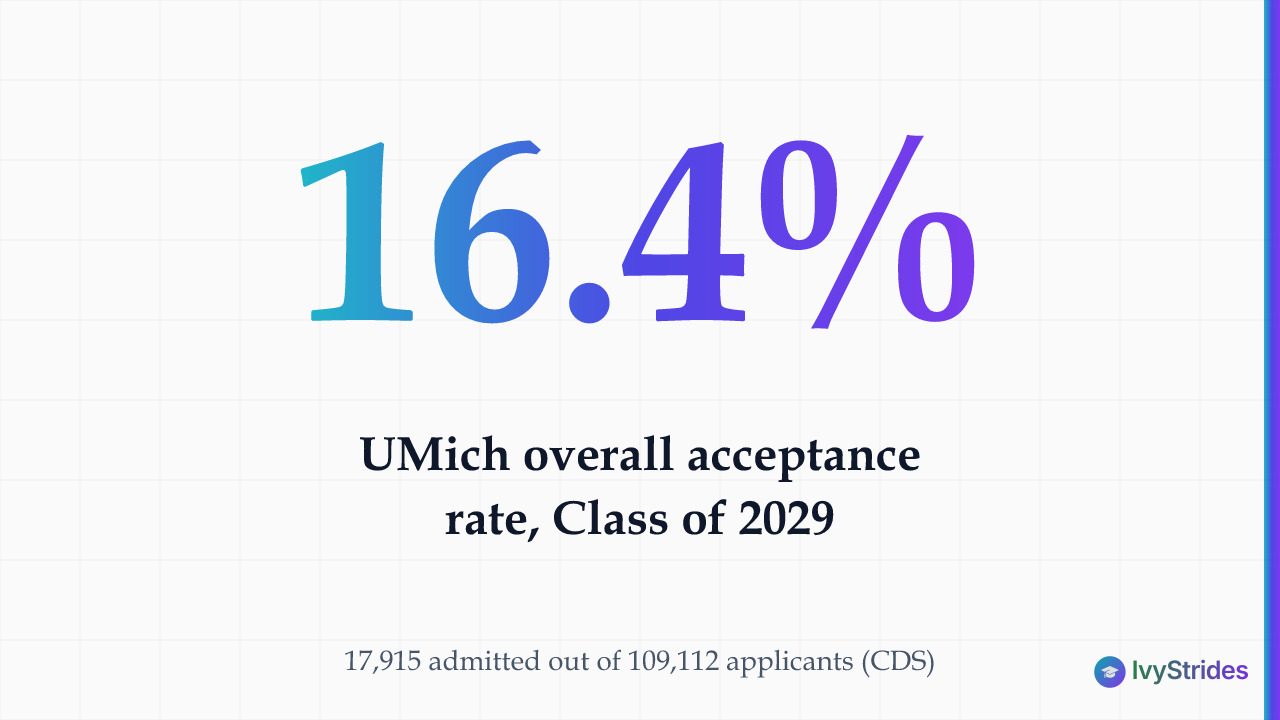
The UMich acceptance rate for the Class of 2029 was 16.4%, but that single figure is a blend: it covers every applicant, in state and out, across every first-year admitting school. IvyStrides calculated it by dividing the 17,915 admits by the 109,112 applicants in that Common Data Set. UMich rates state residency as a Considered factor in its Common Data Set, so treat the 16.4% as a starting point rather than a personal benchmark.
In-state versus out-of-state. UMich's 2025-26 Common Data Set leaves its in-state, out-of-state and international applicant and admit breakdown blank, so there is no official residency admit rate to quote. Treat any in-state or out-of-state percentage you see elsewhere as an estimate, not a UMich figure.
| Applicant Group | Applicants | Admitted | Acceptance Rate |
| All applicants | 109,112 | 17,915 | 16.4% |
Because no official residency split exists, plan against the published 16.4% rather than a guessed in-state or out-of-state figure, and read what do colleges look for in students for the context behind what selective schools reward.
What GPA and Test Scores Do Enrolled UMich Students Have
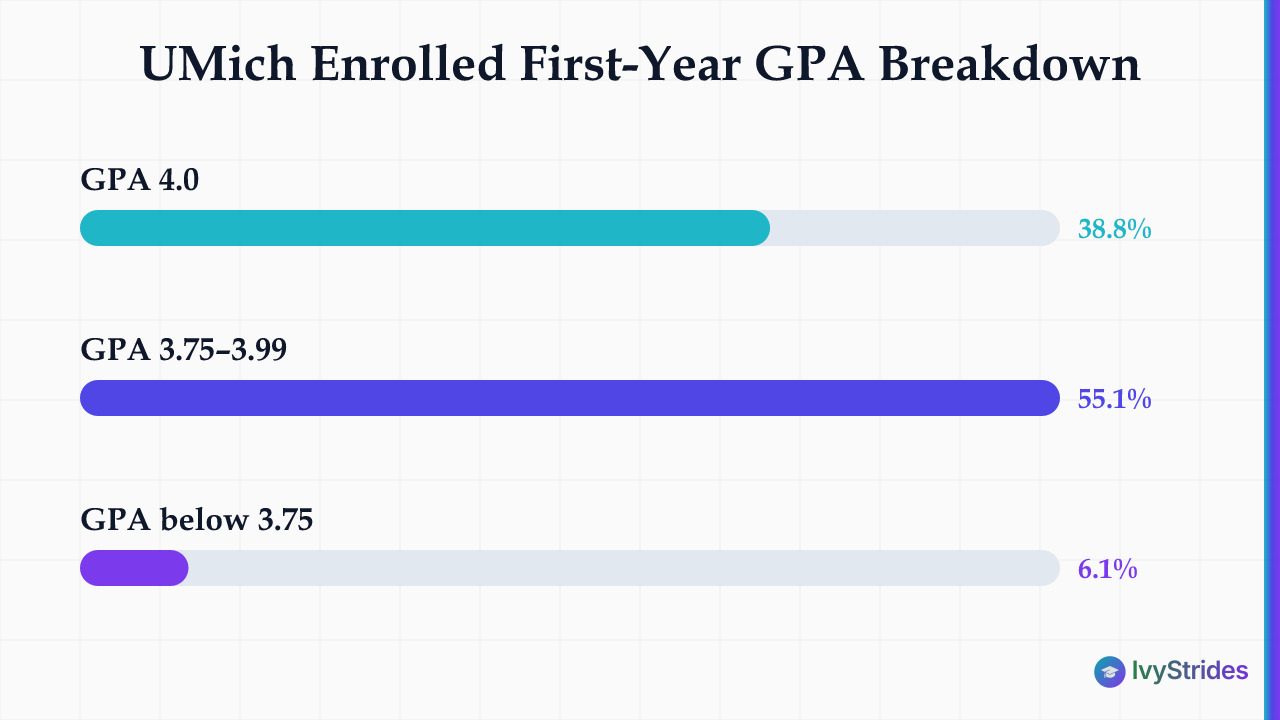
UMich's enrolled first-years cluster at a high GPA: 93.9% held a 3.75 or higher (38.8% at 4.0 and 55.1% between 3.75 and 3.99, per the Common Data Set), which makes GPA and course rigor the clearest benchmarks you can measure yourself against right now. The admit rate is out of your hands, but your academic profile is the lever you control before any deadline.
For scores, the middle 50 percent of UMich's enrolled first-years who submitted scores runs 1370 to 1530 on the SAT and 32 to 34 on the ACT. UMich is test-optional for fall 2027, so use that band as your guide: a score in its upper half is more likely to help your file, while a score near the bottom is a judgment call (see below).
| Metric | Benchmark | Source |
| Enrolled first-year GPA | 93.9% at 3.75 or higher | UMich Common Data Set 2025-26 |
| SAT middle 50 percent (enrolled) | 1370-1530 | UMich Common Data Set 2025-26 |
| ACT middle 50 percent (enrolled) | 32-34 | UMich Common Data Set 2025-26 |
| Test policy (fall 2027) | Test-optional | UMich Admissions |
When to submit, when to omit. If your GPA sits at or above 3.75 and your rigor is strong, a score inside that middle 50 can support your file. If your score sits near the 25th percentile (1370) and the rest of your file is strong, weigh omitting it under test-optional policy. That's a judgment call, not a rule.
One caveat worth stating plainly: the UMich Common Data Set 2025-26 rates academic GPA and rigor of secondary school record as Very Important, so grades carry more weight than any single test result. Worried a single grade drop hurts you? Read will one B ruin a 4.0 GPA. If you're planning senior-year courses, does senior year GPA matter.
What UMich's Whole-Person Review Actually Weighs
UMich uses a whole-person review and does not admit or deny on any single criterion, not GPA and not test scores. Multiple evaluators read each file and rate it on five criteria. Because GPA and rigor already set your academic floor, these five criteria decide where a competitive file lands.
The five rated criteria are secondary school academic performance, educational environment, counselor and teacher recommendation, essays, and awards/honors/involvement/leadership/service. UMich states that how much intellectual challenge you took on relative to what your school offers "will be highly important," so your AP course selection feeds the rigor criterion directly.
| Admissions Factor | CDS C7 Rating |
| Rigor of secondary school record | Very Important |
| Academic GPA | Very Important |
| Application essay | Important |
| Standardized test scores | Important |
| Recommendation | Important |
| Extracurricular activities | Considered |
| Class rank | Not Considered |
| Interview (general admission) | Not Considered |
| Alumni/ae relation | Not Considered |
| Religious affiliation | Not Considered |
Essays count, and the second one is specific. UMich's Common Data Set rates the application essay as Important. The second UMich essay asks why you chose your specific school or college, so write to that program's curriculum rather than about Ann Arbor in general. The first essay asks how you'll contribute as a leader and citizen. Check the current word limits on that page before you draft.
School-by-school requirements. You apply to a specific first-year admitting school or college, and some add their own steps: UMich's Common Data Set notes that a portfolio is required for Art, Architecture and the Ross School of Business, and that some Music, Theatre and Dance applicants and some Engineering applicants may be interviewed. The Common Data Set does not break out admission rates by school, so treat any school-specific rate you see elsewhere as an estimate.
Reading course rigor off a transcript is its own skill, so see how colleges read your transcript. Because the review is multi-dimensional, you can't optimize one factor in isolation, and that's where a counselor maps all five against your profile in college counseling for grades 11-12.
EA, ED, and RD at UMich: Which Round Fits Your Strategy
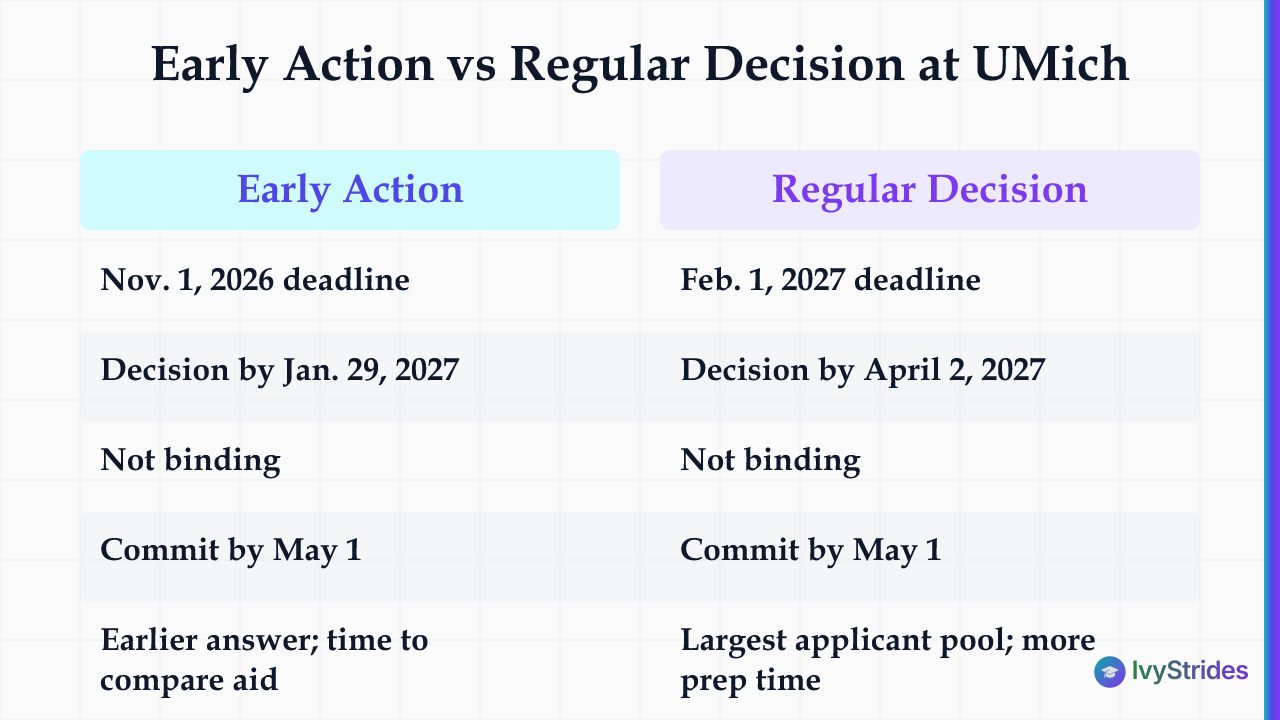
UMich offers three application plans for the 2026-27 cycle: binding Early Decision, nonbinding Early Action, and Regular Decision. Because your profile readiness already shapes your realistic odds, the round you choose is the last strategic variable you control before submitting.
UMich offers binding Early Decision for fall 2027 applicants, with a Nov. 1 deadline. Its 2025-26 Common Data Set, which covers the class that entered in fall 2025, lists no Early Decision plan, so ED is a recent addition. Decisions come by Dec. 24, and ED is binding: if you are admitted, you commit to enroll by Jan. 6 and withdraw your other applications, and you, a parent or guardian, and your counselor sign an ED agreement.
| Round | Deadline | Decision dates | Binding? | Key Notes |
| Early Decision | Nov. 1, 2026 | By Dec. 24, 2026 | Yes | Commit by Jan. 6; no published ED admit rate yet |
| Early Action | Nov. 1, 2026 | By Jan. 29, 2027 | No | Earlier answer; commit by May 1 |
| Regular Decision | Feb. 1, 2027 | By April 2, 2027 | No | Largest applicant pool; commit by May 1 |
Those deadlines and decision dates are UMich's own, from its application plans page. One exception to plan around: School of Music, Theatre and Dance programs run through Regular Decision only, with their own Dec. 1 deadline.
Does an early round improve odds? UMich does not publish a separate EA or ED acceptance rate, so treat any round-specific odds claim with caution. EA gives you an earlier answer and time to compare aid; it does not promise a higher admit rate.
For the full framework, see early decision vs early action vs regular decision. If your score sits below the middle 50, read applying early decision with a borderline test score.
Your choice comes down to one honest question: is UMich clearly your first choice, and is your file ready by Nov. 1? If yes on both, ED is defensible. If you need senior-fall grades or a stronger essay, EA or RD buys you time without a binding penalty.
FAQ: UMich Acceptance Rate, GPA, and Application Rounds
Is it easier to get into UMich Early Action?
Not necessarily. UMich does not publish a separate EA acceptance rate, so there is no official figure showing an EA advantage. The real advantage of EA is an earlier decision and more time to compare financial aid offers before you commit.
Does Early Decision increase chances at UMich?
UMich's 2025-26 Common Data Set, which covers the class that entered in fall 2025, lists no Early Decision plan, so there is no published UMich ED acceptance rate yet. The same Common Data Set rates an applicant's level of interest as Considered, and a binding ED application is the clearest signal of interest you can send. The case for ED is strongest when UMich is your clear first choice and your file is fully ready by Nov. 1.
Is a 1400 SAT good for UMich?
A 1400 sits inside UMich's middle-50 range of 1370-1530, in its lower half: 1370 is the 25th percentile and 1470 the median for enrolled first-years who submitted the SAT, per UMich's Common Data Set. Under test-optional policy, submitting it is a judgment call. If your GPA is at or above 3.75 and your course rigor is high, a 1400 is unlikely to hurt an otherwise strong file, but omitting it may serve you better.
What GPA do you need for UMich?
Of UMich's enrolled first-years, 93.9% held a GPA of 3.75 or higher, and UMich rates academic GPA as Very Important in its Common Data Set alongside rigor of secondary school record. A GPA below 3.75 is not disqualifying, but it places you outside the profile of most enrolled students, so course rigor, essays, and extracurricular depth have to carry more weight.
Your Next Step at UMich
You now have the numbers that decide whether UMich is a realistic target: the 16.4% overall rate, the 3.75-plus GPA benchmark, the 1370-1530 score band, and the three application rounds. Match your own profile against them honestly, then act on the gap.
- Place your GPA against the 3.75 benchmark and check whether your rigor reflects what your school offers.
- Decide whether your score falls inside 1370-1530 before you submit under test-optional policy.
- Choose your round: ED only if UMich is your clear first choice and your file is ready by Nov. 1.
- Draft the second essay to a specific school or college, not to Ann Arbor in general.
- Identify the single weakest of your five rated criteria and fix that one first.

Hemant is a seasoned entrepreneur, investor, and growth strategist with deep ground in education and technology-driven learning. His core training is in Mathematics and Physics — he authored Physics for IB Diploma: Ultimate Revision Guide, recognized as a top student resource.