
Who Should Write Your Recommendation Letters? Choosing the Right Two Teachers
On this page
- What Admissions Officers Actually Look for in a College Recommendation Letter
- The Two Teacher Slots: Which Subjects and Which Grade Level to Prioritize
- The Real Criterion: Depth of Relationship Over Prestige of Recommender
- Red flags that a letter will be weak before it's written
- Not sure your application is telling the right story?
- Who Should Not Write Your College Recommendation Letters
- Can a Coach, Employer, or Mentor Replace One of the Two Teacher Letters?
- When to Ask: The Timing That Separates Strong Letters from Rushed Ones
- How to approach a teacher who seems reluctant or too busy
- How to Give Your Recommenders the Best Chance of Writing a Strong Letter
- How Many Recommendation Letters Should You Submit for College?
- Frequently Asked Questions About College Recommendation Letters
- Can a family member write a letter of recommendation for college?
- Who is a good person to write a letter of recommendation for college?
- Who should letters of recommendation come from?
- Who should not write letters of recommendation for you?
- Does it matter which subject the recommending teacher teaches?
- Can a peer or classmate write a recommendation letter for college?
- What do I do if I think my teacher wrote a weak letter?
- How do recommendation letters work on Common App?
- Your recommenders are chosen. Now make sure the rest of your application matches.
For most college applications, ask two teachers who taught you a core academic subject, ideally in 11th grade, and who know you well enough to write with specific examples. The strongest letters come from teachers who can describe a moment you struggled and grew, asked a question that reshaped a class discussion, or produced work that stood out. Subject area matters less than depth of relationship, though matching one letter to your intended major is a smart move when you can.
The Common App treats these as teacher evaluations, and its standard structure supports two of them plus a separate counselor recommendation, per Common App. This guide reflects 2026-27 Common App policies. The harder question, which teacher out of several will actually write something specific about you, is where the next sections start, because the choice you make in April of junior year sets the ceiling on how strong those letters can be.

What Admissions Officers Actually Look for in a College Recommendation Letter
A strong college recommendation letter gives an admissions officer information the transcript cannot: how you think, how you respond to difficulty, what you're like in a room full of your peers. Admissions officers read letters looking for concrete anecdotes, not adjectives. A letter that calls you "a hard worker" adds nothing your grades don't already imply.
This is the difference between a letter that confirms and a letter that reveals. A confirming letter restates what an admissions officer can already see: good grades, consistent effort, "a pleasure to teach." A revealing letter surfaces something the file doesn't contain. It describes the day you rewrote a lab report three times after your hypothesis collapsed, then reframed the failed result as the interesting part. The first letter is redundant with your transcript. The second one changes the picture. In our coaching with students, the letters admissions officers flag as memorable almost always include a named project, a specific question the student asked, or a moment of visible intellectual risk-taking.
Here's the part most students miss: a letter that only confirms the transcript is close to wasted, even when it's positive. Your grades already prove you work hard. A recommender's job is to add the part grades can't show.
Letters sit inside holistic review, which means they're weighed alongside your grades, activities, and essays as one cumulative picture. They work best when they complement, rather than repeat, what you've already said in your personal statement and supplemental essays. At test-optional schools, where a submitted SAT or ACT score is absent from the file, recommendation letters often carry even more weight in the holistic review. Test-optional policies vary by school and by year, so confirm each college's current stance.
The Common App allows up to two teacher evaluations plus a counselor evaluation as the standard, and some colleges permit one additional recommender. For a deeper look at what admissions officers actually read in a strong letter, see our guide to college recommendation letters. If you want to see how a letter and an essay reinforce each other, our piece on what makes a college essay good covers the specificity principle from the other side.
The Two Teacher Slots: Which Subjects and Which Grade Level to Prioritize
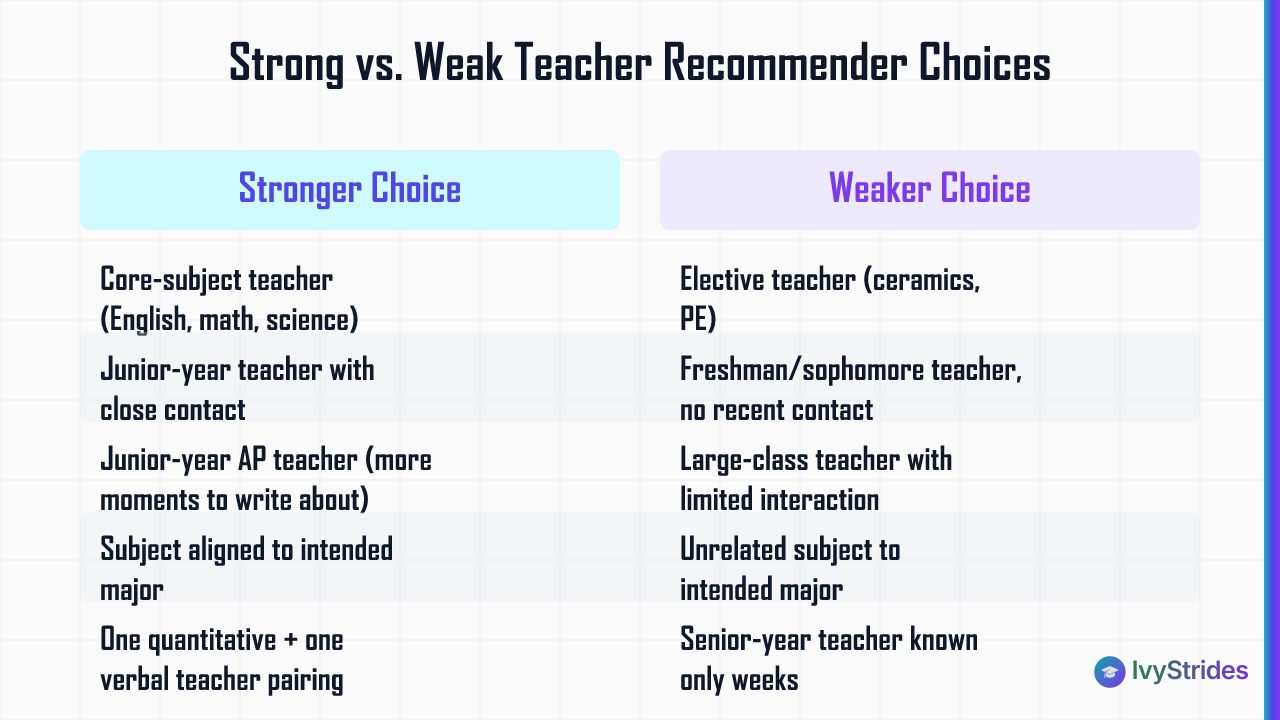
Your two teacher recommenders should come from core academic subjects: English, math, science, history, or a foreign language. Most selective colleges expect at least one letter from a core-subject teacher, and many prefer both. A letter from your ceramics or PE teacher can be warm, but it rarely speaks to the academic ability admissions officers are trying to gauge.
Prioritize junior-year teachers. Here's why: 11th grade is your most recent and most rigorous academic year, so those teachers can speak to who you are now, not who you were at 14. A teacher who had you in 9th grade and hasn't seen you since can attest to a version of you that no longer exists. Recency is itself a signal of current ability.
| Recommender profile | Strength |
| Junior-year core-subject teacher who knows you well | Strongest default choice |
| Junior-year core-subject teacher, large class, limited contact | Weak; will read as generic |
| Senior-year teacher (fall) with a fast, strong bond | Usable, but they've known you weeks, not months |
| Freshman or sophomore teacher, no recent contact | Avoid; cannot speak to current work |
| Elective teacher who knows you deeply | Only as a supplemental third letter |
Subject-to-major alignment is a tactical edge. Applying to an engineering program? A letter from a math or physics teacher who knows you well is more relevant than one from an art teacher. A student applying to study biology who has a strong relationship with their AP Biology teacher and their AP English teacher covers both the STEM and writing dimensions admissions officers want to see. That pairing, one quantitative and one verbal, is a reliable default when you're unsure.
If your junior-year schedule was heavy on APs, the teachers in those courses often make the best recommenders because rigorous classes create more moments worth writing about. Our guide on how many AP classes for Ivy League and top colleges explains how course rigor and recommender quality tend to move together.
The Real Criterion: Depth of Relationship Over Prestige of Recommender
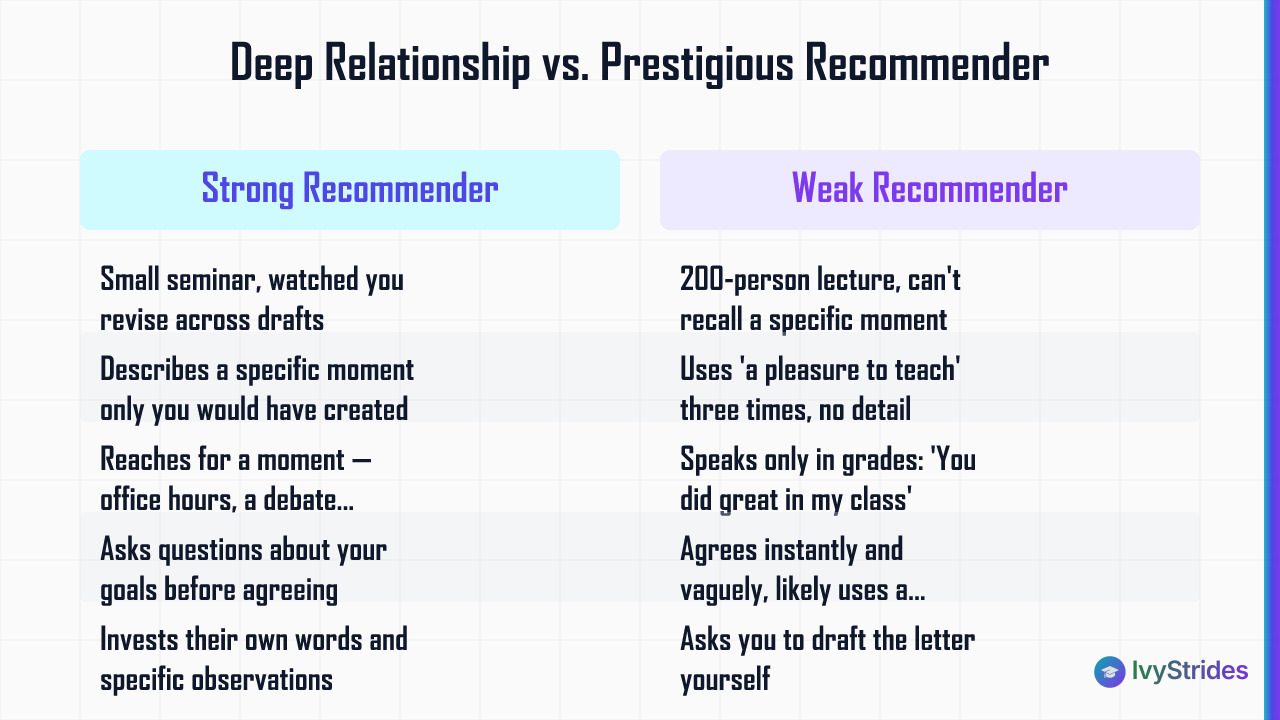
Depth of relationship beats prestige every time. The teacher who ran a small seminar and watched you revise an argument across three drafts will write a stronger letter than a department chair who had you in a 200-person lecture and can't recall a single specific moment. Prestige of the teacher's institution or their own academic credentials does not transfer to the letter's strength.
Here's a test that cuts through the uncertainty. Ask yourself: could this teacher describe one specific moment in their class that only I would have created? If the answer is no, look for a different teacher. A letter with no unique anecdote reads as filler no matter how senior its author.
What creates those moments is intellectual engagement. Class participation, a question that redirected a discussion, a project you took further than the assignment required, a growth arc the teacher watched unfold. In our coaching, the students whose letters land hardest are usually the ones who showed up to office hours, argued a point respectfully, or turned a B-minus first draft into an A final through visible effort the teacher could name.
Consider two anonymized patterns we see often. One student asked an AP English teacher after a full year of strong Socratic-seminar participation, and the letter described a specific seminar exchange where the student changed the room's reading of a text. Another asked a teacher they'd had for a single semester, and the letter used the phrase "a pleasure to teach" three times with no supporting detail. Same effort in asking. Very different letters.
Red flags that a letter will be weak before it's written
You can usually spot a thin letter before the teacher writes a word. Watch for these signals when you gauge a potential recommender:
- They can't place you without your schedule. If a teacher needs your class period and seat to remember who you are, they have no anecdote to write.
- They speak only in grades. "You did great in my class" points at the transcript, not at you. A strong recommender reaches for a moment, not a mark.
- They agree instantly and vaguely. A teacher who says "sure, no problem" without a single question about your goals is likely writing from a template.
- They mention how busy they are as they agree. Genuine willingness sounds different from reluctant obligation, and the letter follows the feeling.
- They ask you to draft it yourself. This is both a red flag and an integrity trap, covered below. A teacher who won't invest their own words won't invest their own specifics.
If two or three of these show up at once, choose someone else. A polite recommender who can't get specific about you is a slot spent on filler.
When you're weighing the choice, the next practical step is the ask itself. Our guide on how to ask for a letter of recommendation covers the script and framing that make a teacher want to say yes.
Not sure your application is telling the right story?
Book a free 15-minute strategy call. An IvyStrides admissions essay coach will review your recommender choices, your essay angle, and your overall application plan, and give you a concrete next step.
Who Should Not Write Your College Recommendation Letters
Some recommenders actively hurt an application. The clearest rule: no family members. Colleges expect letters from adults outside your family who can evaluate you objectively. A parent's or relative's letter signals a lack of appropriate adult relationships and is typically discarded or viewed negatively by admissions officers. This holds even if a parent is also a teacher at another school.
The next category is trickier because the teacher isn't obviously wrong. A teacher who gave you an A but can't recall you specifically will write a generic letter that reads as filler. High grades and a strong letter are not the same thing. You want the teacher who knows you, not the one whose gradebook happens to like you.
- Family members: disqualified across the board.
- Teachers who barely know you: an A-grade class with zero real contact produces a hollow letter.
- Freshman or sophomore teachers with no recent contact: they can't speak to your current academic maturity.
- A coach or activity mentor in a required teacher slot: valuable as a supplemental letter, but they don't fulfill a teacher evaluation unless the college specifically permits it.
- A teacher you clashed with: a real risk unless the relationship has been openly repaired and the teacher has confirmed they can write positively.
That last one deserves care. If you had a conflict or earned a poor grade with a teacher, don't assume the letter will be balanced. Ask directly whether they feel they can write a strong, positive letter, and read the answer honestly. A hesitant yes is a no.
One integrity line is non-negotiable: never draft your own letter for a teacher to sign. Some overwhelmed teachers ask students to do this. It's an integrity violation that can result in an offer being rescinded. If a teacher asks, that's your cue to provide a detailed brag sheet instead, which is exactly the material the next sections cover. When a teacher genuinely can't take you on, a strong supplemental angle sometimes lives in your writing instead; our supplemental essay examples show how to carry character detail there.
Can a Coach, Employer, or Mentor Replace One of the Two Teacher Letters?
A coach, employer, or mentor generally cannot replace one of your two required teacher letters. Common App's standard structure requires two teacher evaluations, and a non-teacher does not fill a teacher evaluation slot, per Common App. What a coach or employer can do is serve as a supplemental recommender at colleges that invite a third letter.
The distinction matters. Your two teachers speak to academic ability inside a classroom. A supplemental recommender speaks to a different dimension: work ethic on a job, leadership on a team, sustained commitment to research. That's additive, not a substitute.
| Recommender | When it helps | Where it goes |
| Coach | Recruited athlete, or team leadership is central to your story | Supplemental third letter, if allowed |
| Employer | Significant work history not captured elsewhere in the application | Supplemental third letter, if allowed |
| Research or activity mentor | Deep project the transcript can't show | Supplemental third letter, if allowed |
| Teacher (core subject) | Always | One of the two required slots |
An employer letter earns its place when you've held a substantial job that shaped you and appears nowhere else in the file. A coach letter earns its place when you're a recruited athlete or when your role on a team is a genuine throughline of your application. Absent those, a third letter that just repeats "great kid" adds noise.
Always check each college's specific requirements on their admissions page before asking a non-teacher to write anything. Requirements vary by school and by year, and submitting an uninvited extra letter can work against you. Sync the whole sequence with your college application timeline 2026-27 so a supplemental letter doesn't arrive after the deadline.
When to Ask: The Timing That Separates Strong Letters from Rushed Ones
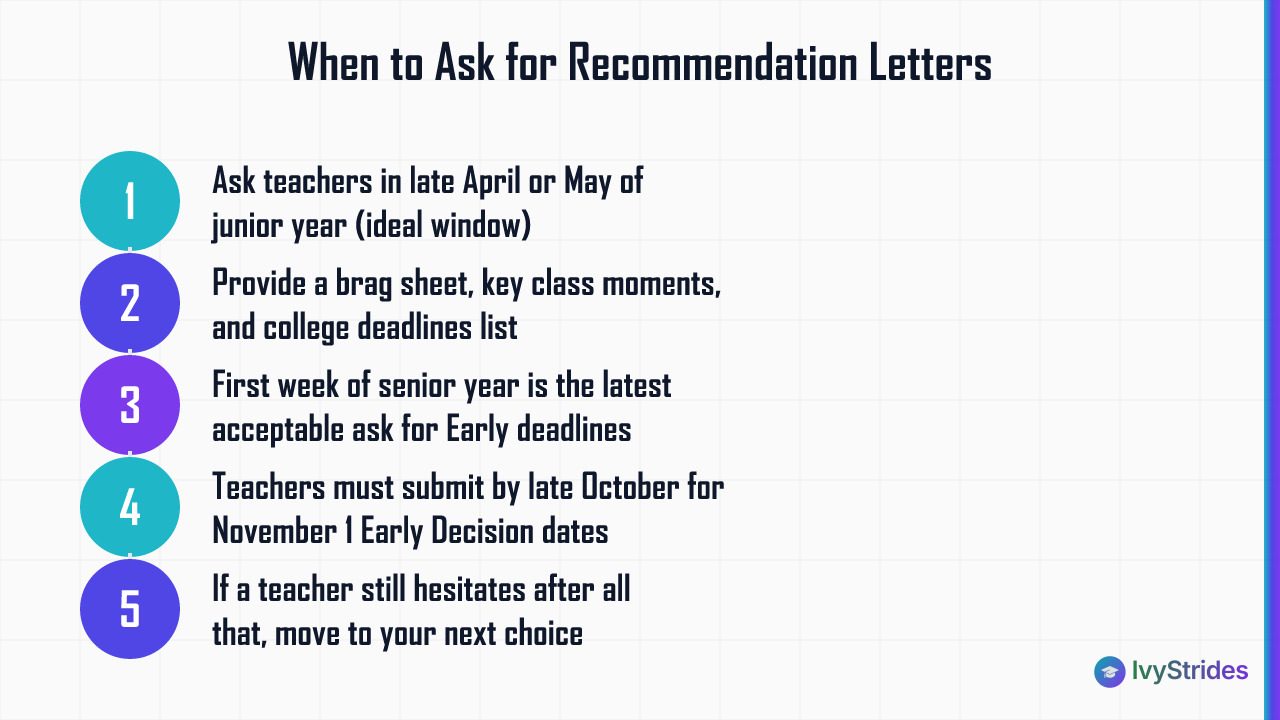
Ask your teachers by late April or May of junior year, before summer break. This is the single timing decision that most affects letter quality. A teacher who agrees in May has the summer to reflect and draft, and the fall to refine. A teacher asked in late September for a November 1 deadline has roughly four to six weeks and around 120 other students, which is not enough runway for a specific, thoughtful letter.
Recommendation letters have hard deadlines tied to Early Decision and Regular Decision submission windows, so syncing your ask with your overall college application timeline is essential. Early Decision and Early Action deadlines at many selective colleges fall in early November, which means teachers need to submit by late October. Work backward from that date, not forward from when you happen to remember.
- Late April to May of junior year: the ideal ask window. Maximum lead time.
- First week of senior year: the latest acceptable ask for Early deadlines. Already tight.
- Late September for a November 1 deadline: risky; expect a shorter, less specific letter.
- October for an Early Decision deadline: too late for most teachers to do you justice.
The mechanism is simple. A teacher managing a full course load writes better letters for students who gave them months than for students who gave them weeks. Asking early isn't about politeness; it's about the quality of the finished letter. If you're deciding between application rounds, our breakdown of early decision vs early action vs regular decision shows exactly which deadlines your recommenders are working toward.
How to approach a teacher who seems reluctant or too busy
Sometimes the teacher you want most is the one who looks overloaded, or who hesitates when you raise it. Don't read hesitation as rejection, and don't push a plainly reluctant teacher into a slot. Do both of these instead.
First, ask in a way that gives them an honest exit. Try: "Would you be able to write me a strong letter of recommendation? If you don't feel you know my work well enough, I completely understand." That phrasing lets a teacher decline without friction, which protects you from a lukewarm letter you'd never see coming.
Second, remove the workload objection before it's raised. A busy teacher's real fear is a blank page under deadline pressure. Show up with the fix: a brag sheet, two or three specific class moments they can build on, a clean list of colleges and dates, and the offer to send everything through Common App the moment they say yes. In our coaching with students, a teacher who says "I'm swamped" usually means "I don't have time to reconstruct who you are from scratch," and that objection dissolves the moment you hand over the raw material.
If a teacher still hesitates after all that, take the hint gracefully and move to your next choice. A reluctant yes rarely becomes a specific letter.
How to Give Your Recommenders the Best Chance of Writing a Strong Letter
Give every recommender a brag sheet, a clear list of colleges with deadlines, and, ideally, a draft of your personal statement. In our coaching with students, the single most common reason a letter comes back generic is that the student gave the teacher nothing to work with beyond a name and a class. You control that input more than you think.
A useful brag sheet includes four things:
- Activities and leadership roles, so the teacher sees you beyond their classroom.
- Academic achievements, including honors, competitions, and independent projects.
- Your intended major or career direction, so the letter can point where you're headed.
- Two or three specific memories from that teacher's class you hope they'll mention: the seminar you led, the lab you rescued, the essay you rewrote.
That last item does the heavy lifting. You're not writing the letter for them, which you must never do, but you are jogging their memory toward the concrete moments that make a letter specific. Providing a draft of your personal statement helps the teacher avoid retelling the same story you're already telling in the essay, so the letter adds rather than duplicates.
Include the practical logistics too: each college, its portal, and its submission deadline, laid out so the teacher can manage their own calendar. And waive your right to view the letter when Common App prompts you. Admissions officers treat waived letters as more credible, and most teachers write more candidly when they know you won't read what they wrote. A confidential letter carries more weight than one you could have edited.
Once you have identified your two teachers, the next step is asking them in a way that makes it easy for them to say yes and write well; our guide on how to ask for a letter of recommendation walks through the exact timing, script, and materials to provide. The same specificity principle applies to your activities section, which our guide on how to write strong activities list descriptions breaks down line by line.
How Many Recommendation Letters Should You Submit for College?
Submit exactly what each college asks for, which is most often two teacher letters. A third letter helps only when the college explicitly invites it and the letter adds a genuinely new dimension. Submitting four or five letters when a college asks for two signals poor judgment and can irritate admissions officers who have to read everything you send.
The counselor recommendation is a separate component. Your school counselor submits it, not you, and it speaks to your record and context across all four years rather than a single classroom. It does not count against your two teacher slots. Think of it as its own track running alongside the teacher letters.
A strong third letter is appropriate at colleges that explicitly allow it, and some highly selective universities invite one, where you have a substantial story to tell in a domain your teachers can't cover: a research supervisor, an employer, a coach. The key word is "substantial." A third letter that repeats what the first two already established weakens the file by diluting it. When in doubt, follow the college's stated preference exactly.
Recommendation letters are one component of a holistic file, alongside your grades, your activities, and your essays. No single letter, and no number of letters, determines an outcome. If you're mapping how the written pieces fit together, our decoding of the Common App essay 2026 prompts shows where your own voice needs to carry the file that the letters support.
Frequently Asked Questions About College Recommendation Letters
Can a family member write a letter of recommendation for college?
No. The letter needs to come from someone outside the household who can judge you objectively. A parent or relative writing one signals a lack of appropriate adult relationships and is typically viewed negatively or disregarded. Choose a teacher, counselor, or other non-family adult, even if a relative teaches at another school.
Who is a good person to write a letter of recommendation for college?
A junior-year teacher in a core academic subject who taught you in a class where you engaged meaningfully and can cite specific examples of your work, growth, or curiosity. Depth of relationship and the ability to write with specificity matter more than the teacher's title, seniority, or the prestige of their credentials.
Who should letters of recommendation come from?
For most applications, from two teachers who taught you in 11th grade in core subjects: English, math, science, history, or a foreign language. Your school counselor typically submits a separate letter. Some colleges allow one additional letter from a non-teacher such as a coach or employer, but only when explicitly invited.
Who should not write letters of recommendation for you?
Steer clear of family members, close friends, teachers who barely know you, teachers from early high school with no recent contact, and anyone who can't write positively about your academic work. A famous teacher who can't recall a specific moment in your class writes a weaker letter than a less prominent teacher who knows you well.
Does it matter which subject the recommending teacher teaches?
Subject matters, but relationship depth matters more. Aligning at least one letter with your intended major is a smart move. A student applying to engineering benefits from a strong math or physics teacher's letter, while a student applying to study English benefits from a writing or humanities teacher who can speak to their thinking on the page.
Can a peer or classmate write a recommendation letter for college?
A small number of colleges, including Davidson and Duke, invite an optional peer recommendation. This is separate from the required teacher letters and useful only when the college explicitly requests it. For the two required teacher slots, a peer letter does not qualify and should never be submitted in place of a teacher evaluation.
What do I do if I think my teacher wrote a weak letter?
Once a letter is submitted through Common App and you've waived your right to view it, you can't read it or retract it from a specific college. Your best protection is choosing recommenders carefully and handing over a strong brag sheet. If you have serious concerns before submission, it's acceptable to line up a second teacher as a backup.
How do recommendation letters work on Common App?
You invite teachers directly through your Common App account, and they receive an email with a link to submit. Your dashboard tracks whether each letter has landed. Most colleges require letters by the application deadline, though some allow a short grace period. Confirm the exact deadline with each college, and consider our college essay coaching if you want the whole written file reviewed together.
Choosing the right two recommenders is a decision you make once, early, and it quietly shapes how a large share of your written application reads. Pick teachers who know you, ask them by May of junior year, and hand them the material to write with specificity. You can read more about how we approach the full written application on our About page. You can also meet the coaches who work with students on it.
Your recommenders are chosen. Now make sure the rest of your application matches.
IvyStrides essay coaches work 1-on-1 with students on the personal statement, supplemental essays, and the full written application. Book a free 15-minute call to see where your application stands.

Award-winning author (South Asian Book Award) and graduate of BITS Pilani and UCLA Luskin School of Public Affairs. Brings a published writer's eye to Common App essays and grammatical precision to SAT and ACT R&W instruction.