
What Is the PSAT? The Complete 2026 Guide for Students and Parents

On this page
- What Is the PSAT? Definition, Full Name, and Purpose in 60 Seconds
- How the PSAT Format Works: Sections, Timing, and the Adaptive Structure
- Which PSAT Should You Take by Grade, and When Does It Count?
- The National Merit Pathway: Why the Junior-Year PSAT/NMSQT Actually Matters
- Is the PSAT Harder Than the SAT? An Honest Difficulty Comparison
- What Is a Good PSAT Score, and What Does It Predict for the SAT?
- PSAT Cost, Registration, and What to Expect on Test Day
- How to Use Your PSAT Score as a Launchpad for SAT Prep
- Frequently Asked Questions About the PSAT
- Does the PSAT matter for college admissions?
- Should I take the PSAT in 10th grade?
- What is a good score for the PSAT?
- Is the PSAT harder than the SAT?
- Is the PSAT free?
- What does PSAT stand for?
- Do colleges see your PSAT scores?
- What is the PSAT out of?
- Where can I find PSAT practice tests?
The PSAT, or Preliminary SAT/National Merit Scholarship Qualifying Test (PSAT/NMSQT), is a digital, adaptive standardized test built by the College Board. It measures the same Reading and Writing and Math skills as the SAT, runs 2 hours and 14 minutes, and scores on a 320-1520 scale. Taken in school each October, it does two jobs: it functions as SAT practice for every student, and it serves as the qualifying test for the National Merit Scholarship Program when taken in 11th grade. Colleges don't receive PSAT scores unless a student chooses to share them.
The harder questions are which version your student should take, what a competitive score actually looks like at their grade, and how to turn that October score report into a real SAT plan. That's what the rest of this guide covers, updated for the 2026 test cycle.
What Is the PSAT? Definition, Full Name, and Purpose in 60 Seconds

Photo by Andy Barbour on Pexels
PSAT stands for Preliminary SAT. The full formal name of the 10th and 11th grade version is the PSAT/NMSQT: Preliminary SAT/National Merit Scholarship Qualifying Test. It's one of four assessments in the College Board's SAT Suite of Assessments, alongside the PSAT 8/9, PSAT 10, and the SAT itself.
The PSAT/NMSQT has been fully digital since fall 2023. Students take it inside the Bluebook app, the same platform that delivers the Digital SAT. Two sections, Reading and Writing plus Math, produce a total score on a 320-1520 scale. Total testing time is 2 hours and 14 minutes.
The test exists for two reasons. First, it gives students a scored, full-length rehearsal of the SAT format roughly six to eighteen months before their first real SAT sitting. Second, for juniors, it's the sole qualifying test for the National Merit Scholarship Program. Colleges are not sent PSAT scores by default, so a student's PSAT result stays private between the student, family, and school unless the student decides to share it.
If you want a deeper section-by-section walk-through, our PSAT/NMSQT format and sections breakdown pairs well with this guide.
How the PSAT Format Works: Sections, Timing, and the Adaptive Structure
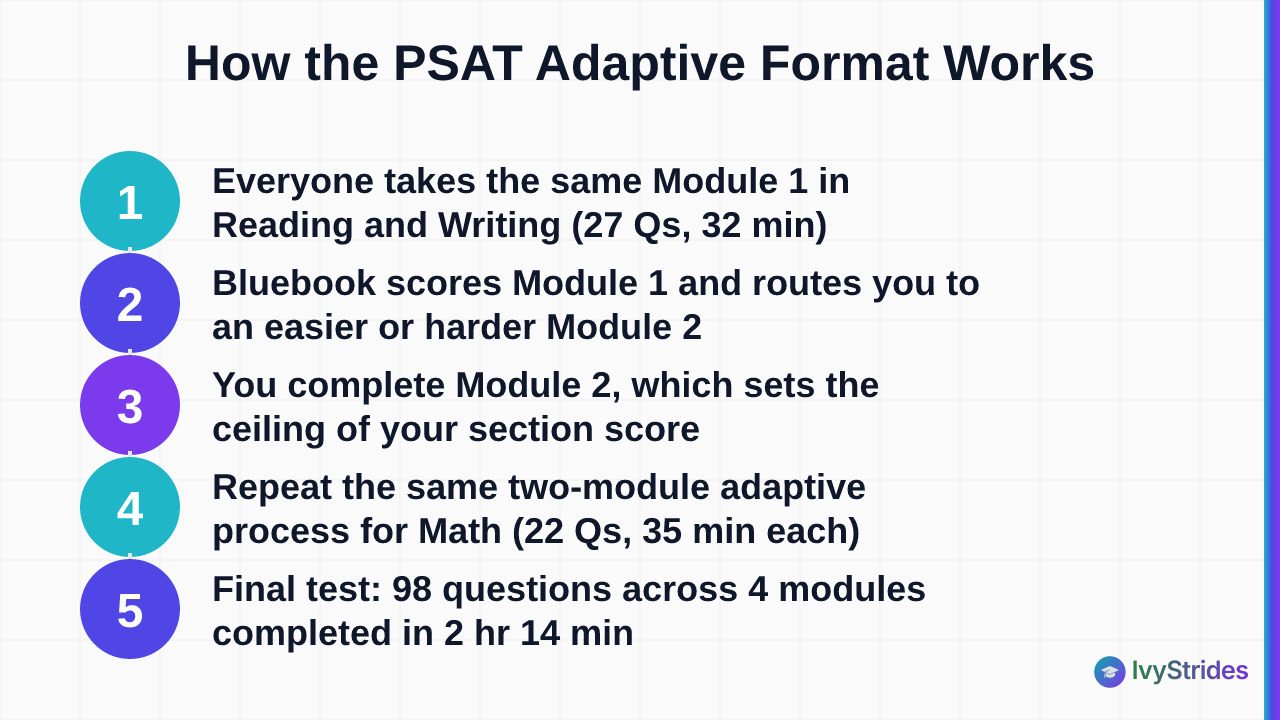
The PSAT/NMSQT is a two-section, two-module adaptive test delivered in Bluebook. Here's the exact structure, per College Board's PSAT/NMSQT page:
| Section | Modules | Questions | Time |
| Reading and Writing | 2 | 54 total (27 per module) | 64 minutes (32 per module) |
| Math | 2 | 44 total (22 per module) | 70 minutes (35 per module) |
| Total | 4 | 98 | 2 hr 14 min |
Source line: module counts and per-module timing are College Board figures; the 2 hr 14 min headline is College Board's published total, which folds in the section break.
The adaptive piece is what makes this test different from paper-era PSATs. Everyone gets the same Module 1 in Reading and Writing. Based on how you perform, Bluebook routes you into either an easier or a harder Module 2. Math works identically. Your Module 2 assignment determines the ceiling of your possible section score, which is why the first module carries outsized weight.
A few format details worth memorizing:
- No penalty for wrong answers. Guess on every question you can't solve.
- A built-in Desmos graphing calculator is available for the entire Math section, and you may also bring an approved handheld calculator.
- Reading and Writing passages are short, one question each, covering literature, history/social studies, science, and grammar/rhetoric.
- Math covers algebra, advanced math, problem-solving and data analysis, and geometry/trigonometry.
Because the PSAT/NMSQT and Digital SAT share the same two-module adaptive structure, strong PSAT prep is also direct SAT prep. If you want to see the SAT side of the equation, our guide to how the Digital SAT adaptive modules work covers scoring logic in depth. For students who want scored, full-length reps, our PSAT practice tests library mirrors the Bluebook interface.
One 2026 update to watch: College Board is releasing additional full-length Bluebook practice tests for the PSAT/NMSQT and PSAT 10 in late summer 2026, expanding the pool of officially released digital forms.
Which PSAT Should You Take by Grade, and When Does It Count?
Three PSATs exist, not one, and they're not interchangeable. Grade level determines which version your student takes and whether the score has stakes beyond practice.
| Version | Grades | Score Range | Window | National Merit? |
| PSAT 8/9 | 8, 9 | 240-1440 | Mar 2 - Apr 30, 2026 | No |
| PSAT 10 | 10 | 320-1520 | Mar 2 - Apr 30, 2026 | No |
| PSAT/NMSQT | 10, 11 | 320-1520 | October 2026 | Yes, 11th grade only |
PSAT 8/9 is the entry point. Shorter, easier, and scored on a compressed 240-1440 scale, it introduces middle schoolers and freshmen to the digital adaptive format without high stakes. Use the result as a baseline, not a verdict. For a standalone breakdown, see our PSAT 8/9 guide for 8th and 9th graders.
PSAT 10 is administered in the spring of sophomore year and uses the same format and score scale as the PSAT/NMSQT. It doesn't qualify for National Merit. Its value is diagnostic: a scored dress rehearsal roughly a year before most students take their first SAT. The PSAT 10 guide for 10th graders covers sophomore strategy in depth.
PSAT/NMSQT is the one that matters most. Taken in October of junior year, it's the only PSAT that opens the National Merit door. A 10th grader can also sit the PSAT/NMSQT, but their score won't count for National Merit no matter how high it is. Only the junior-year administration qualifies.
Registration is handled by the school, not by the family directly through College Board. If your student's school doesn't administer the PSAT, ask the counselor whether a nearby school will accept outside registrants. For date-specific planning, see our PSAT test dates and registration for 2026 guide. Our year-by-year breakdown of PSAT strategy by grade is the companion piece for prep planning, and our PSAT 8/9 vs. PSAT 10 vs. PSAT/NMSQT differences piece drills further into each version.
Whether you are in 9th, 10th, or 11th grade, the right PSAT strategy looks different, and starting with a diagnostic score is the fastest way to close the gap.
The National Merit Pathway: Why the Junior-Year PSAT/NMSQT Actually Matters
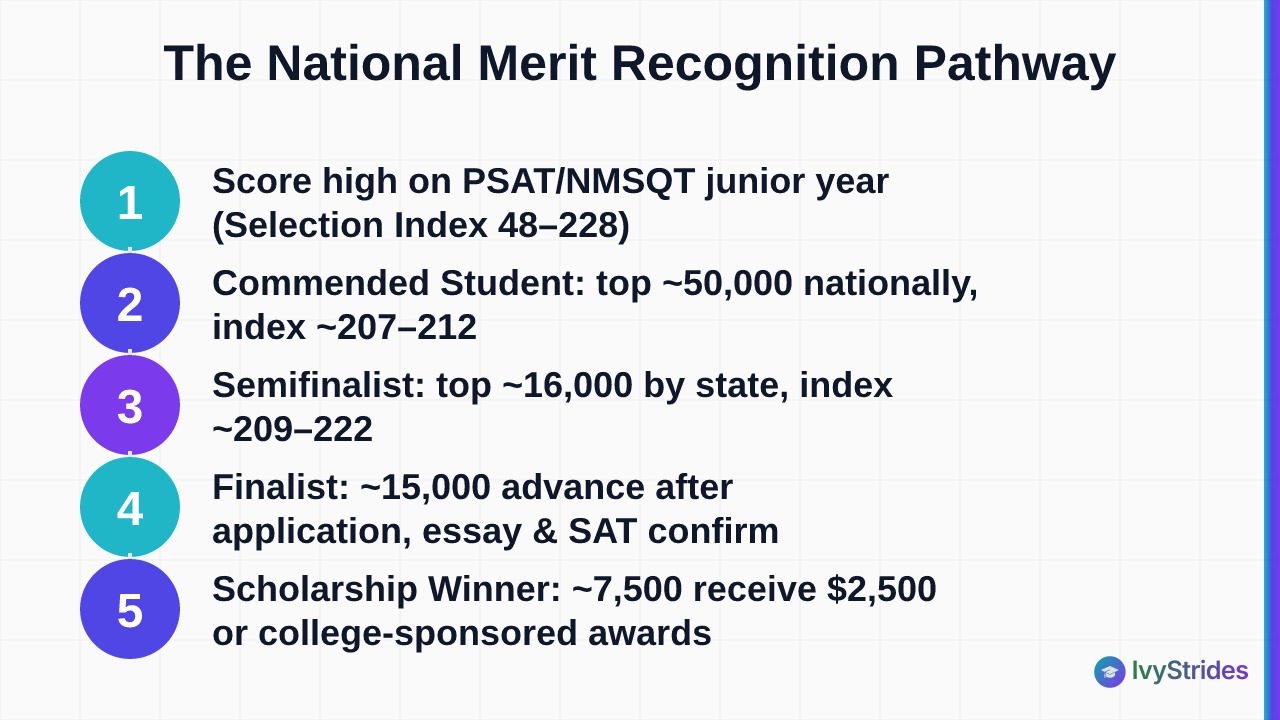
For juniors aiming at National Merit recognition, the PSAT/NMSQT is the only qualifying test, and the Selection Index cutoff in most states sits between roughly 209 and 222.
Here's how the pathway works, sourced from College Board's PSAT/NMSQT information and the National Merit Scholarship Corporation guidelines that College Board publishes alongside it.
The Selection Index is a separate number from the 320-1520 total score. Add your Reading and Writing and Math section scores (each on a 160-760 scale), double the sum, and divide by 10. The result lands on a 48-228 range, with 228 as the maximum. National Merit uses this index because it weights the two sections equally rather than blending them into a single scaled total. For a deeper walkthrough with worked examples, see how the PSAT Selection Index is calculated.
Recognition tiers, in ascending order:
- Commended Student. Roughly the top 50,000 scorers nationally. The Commended threshold has landed around 207-212 in recent years, and it's a single national cutoff.
- Semifinalist. Roughly the top 16,000 scorers, allocated by state. Semifinalist cutoffs vary by state, typically in the 209-222 range, with high-density states like New Jersey, Massachusetts, and California at the top of that band.
- Finalist. About 15,000 of the 16,000 Semifinalists advance after submitting an application, essay, transcript, and confirming SAT score.
- Scholarship winner. Roughly 7,500 Finalists receive awards: a one-time $2,500 National Merit Scholarship, corporate-sponsored awards, or college-sponsored awards that can reach full tuition at participating universities.
State cutoffs are released after each October's test administration, so any figure published now reflects recent historical ranges. For a state-by-state view, see our National Merit cutoffs by state tracker and our step-by-step guide to how to qualify for National Merit.
A caveat worth stating plainly: no specific PSAT score guarantees Semifinalist status. Cutoffs shift year to year, sometimes by three or four Selection Index points. A student in the 1470-1500 band should treat National Merit as reachable but not assured, and plan accordingly.
In our coaching with juniors targeting National Merit, the students who cross their state's Semifinalist line reliably are the ones who started structured PSAT prep coaching by the spring of sophomore year, not the ones who cram in September of junior year. The runway matters more than the intensity.
Is the PSAT Harder Than the SAT? An Honest Difficulty Comparison
Short answer: the PSAT/NMSQT is slightly easier than the SAT and has a lower ceiling. The PSAT tops out at 1520, and the SAT tops out at 1600.
Same number of questions (98 total), same section structure, same adaptive Bluebook interface. What differs is the top end of question difficulty. The SAT's Module 2 hard track pushes into content the PSAT doesn't test as aggressively, particularly in advanced math and inference-heavy Reading and Writing items. That 80-point gap at the ceiling reflects those harder items, not a different test design.
For most students, that means the PSAT feels like the SAT with the final 15 percent of the difficulty curve trimmed off. It's the same test with a lower maximum.
In our coaching, students who score around 1200 on the PSAT/NMSQT typically score in the 1200-1280 range on their first SAT attempt without additional prep. The delta closes further with focused work between October and the March or May SAT.
Two resources drill into this comparison in more depth: our PSAT vs. SAT differences explained piece walks the format side by side, and our is the PSAT harder than the SAT analysis covers difficulty by section and question type.
What Is a Good PSAT Score, and What Does It Predict for the SAT?
A "good" PSAT score depends entirely on your grade and your goal. Here's the honest framework.
The College Board benchmark scores are 460 Reading and Writing and 510 Math for the PSAT/NMSQT, per College Board's score documentation. Those benchmarks indicate on-track performance for college readiness, not competitive scores.
For a scaled sense of what different score bands mean at each grade level, using recent College Board percentile tables:
| Percentile (11th grade) | PSAT/NMSQT Total |
| 50th | roughly 920-970 |
| 75th | roughly 1010-1060 |
| 90th | roughly 1150-1180 |
| 99th | roughly 1370-1400 |
| National Merit Semifinalist range | roughly 1460-1520 |
For 10th graders on the PSAT 10, add about 40-60 points at each percentile to arrive at the equivalent sophomore band. For 9th graders on the PSAT 8/9 (240-1440 scale), the 75th percentile lands around 950-1000.
A 1200 on the PSAT/NMSQT corresponds roughly to a 1200-1250 on the SAT, making your PSAT score a reliable starting point for setting an SAT target. That doesn't mean the SAT is easier; it means the tests are scaled to be directly comparable within their overlap range.
Practical read: a junior who scores 1200 can typically aim for around a 1350 SAT with roughly 60-80 hours of focused prep. A 1400 makes National Merit and a 1500+ SAT both live goals. A 950 shifts the priority to closing to the College Board benchmarks first, then building toward around 1150 on the SAT.
For a deeper walkthrough by grade and percentile, see what is a good PSAT score by grade and percentile. To convert scores between tests, use our PSAT to SAT score conversion guide. To translate the number into an actual plan, how to use your PSAT score to set an SAT goal walks through the mapping step by step.
PSAT Cost, Registration, and What to Expect on Test Day
Is the PSAT free? For most students, yes. Schools handle registration, and many absorb the cost entirely. When schools do charge, fees typically fall in the $18-$35 range, and fee waivers are available for eligible students through the school counselor's office.
Students can't register directly with College Board for the PSAT/NMSQT, PSAT 10, or PSAT 8/9. Everything runs through the school. If your school doesn't administer the test, contact your counselor to ask about nearby schools that accept outside registrants; policies vary.
On test day, expect the following:
- Arrive with a fully charged laptop, tablet, or school-issued device with Bluebook installed. Some schools provide devices.
- Bring an approved handheld calculator if you prefer it to the built-in Desmos tool.
- Bring a photo ID if your school requires one (many don't for in-school administrations).
- Total time in the testing room, including check-in and the break, runs about 3 hours.
- The break comes between the Reading and Writing and Math sections.
Score release for the PSAT/NMSQT typically happens in mid-December, roughly six to eight weeks after the October administration. Students access their scores through their College Board account. For exact timing this cycle, see when PSAT scores come out in 2026 and our companion guide to how to read your PSAT score report.
Scores aren't sent to colleges. They're visible to the student, the family, and the school. If a student wants to opt into scholarship search programs or connect with colleges through Student Search Service, that's a separate choice made during registration.
For students who want prep materials before test day, our free SAT, ACT, and PSAT downloads library includes released question sets and study guides at no cost.
How to Use Your PSAT Score as a Launchpad for SAT Prep
Here's the part most students miss. The PSAT score report isn't just a number. It's the most detailed diagnostic College Board will ever give you for free.
A full PSAT/NMSQT score report includes:
- Total score (320-1520) and two section scores (160-760 each)
- Domain-level performance in Reading and Writing across four skill areas: Information and Ideas, Craft and Structure, Expression of Ideas, Standard English Conventions
- Domain-level performance in Math across four skill areas: Algebra, Advanced Math, Problem-Solving and Data Analysis, Geometry and Trigonometry
- A benchmark indicator showing whether you met the College Readiness Benchmark
- Question-level review inside Bluebook showing which items you missed and why
That domain-level breakdown is the diagnostic. A student scoring 1100 with a 520 Math and 580 Reading and Writing has a very different prep path from one scoring 1100 with a 580 Math and 520 Reading and Writing. Identical total, different plan.
In our coaching, students who review their PSAT subscores and target their two weakest domains first see the fastest SAT score gains. Students who ignore the breakdown and grind generic practice tests see the slowest.
A realistic timeline for a junior:
- October (11th grade): PSAT/NMSQT
- December: Score release, diagnostic review, target-setting
- January-April: Structured prep, roughly 4-8 hours per week
- March or May (11th grade): First SAT attempt
- June-August: Targeted work on remaining weaknesses
- August or October (12th grade): SAT retake
In our coaching with students starting around 1100 on the PSAT/NMSQT, a realistic SAT target sits in the 1200-1300 range with about 60-80 hours of focused prep. Higher starting scores compress the timeline; lower starting scores extend it. The IvyStrides methodology stays the same across bands: diagnostic testing, targeted weakness work, spaced retesting, and section-specialist coaching where SAT Reading and Writing and SAT Math are taught by different specialists rather than one generalist tutor.
For grade-specific plans, our how to study for the PSAT guide and PSAT strategy for juniors piece cover the tactical detail. For 1-on-1 coaching, our live online PSAT prep coaching pairs students with section-specialist tutors. For 11th and 12th graders thinking beyond scores, our college counseling for grades 11-12 team integrates test strategy with essay planning and school list building.
Frequently Asked Questions About the PSAT
Does the PSAT matter for college admissions?
Colleges don't receive PSAT scores unless the student explicitly shares them, so the PSAT doesn't directly affect admissions decisions. Its value is as SAT practice for all students and as the National Merit qualifying test for juniors. A strong PSAT indicates SAT readiness, which becomes an admissions factor once the SAT is taken and submitted. PSAT and SAT scores are one part of a holistic application: admissions essays, AP scores, and GPA all contribute to the final decision.
Should I take the PSAT in 10th grade?
Yes. The PSAT 10 hands sophomores a scored, full-length preview of the SAT format roughly 12-18 months before their first SAT attempt. The score report identifies the two weakest domains early enough to close them before junior year. It doesn't qualify for National Merit, but as a diagnostic it's one of the most useful free tools available to a 10th grader.
What is a good score for the PSAT?
For 11th graders, a score around the 75th percentile (roughly 1010-1060 on the PSAT/NMSQT) is a solid benchmark. For National Merit Semifinalist recognition, most states require a score in the 1460-1520 range. Sophomores on the PSAT 10 land above average with a total above 1000. Ninth graders on the PSAT 8/9 (240-1440 scale) should target the 75th percentile for that grade, which sits around 950-1000.
Is the PSAT harder than the SAT?
No. The PSAT is slightly easier and caps at 1520 rather than the SAT's 1600. Both tests use the same adaptive two-module Bluebook format and cover the same Reading and Writing and Math skills. PSAT preparation builds SAT skills directly.
Is the PSAT free?
For most students, yes. Schools administer the test, and many cover the cost entirely. When schools do charge a fee, it typically falls in the $18-$35 range, and fee waivers are available through the school counselor for eligible students. Students can't register or pay through College Board directly.
What does PSAT stand for?
PSAT stands for Preliminary SAT. The full name of the version taken in 10th and 11th grade is PSAT/NMSQT: Preliminary SAT/National Merit Scholarship Qualifying Test. The College Board also offers the PSAT 10 and PSAT 8/9 as part of the same SAT Suite of Assessments.
Do colleges see your PSAT scores?
No. Colleges don't receive PSAT scores automatically. Your score is visible only to you and your school unless you choose to share it, which differs from the SAT where you can send official score reports to colleges. Even at test-optional schools, a strong SAT score built on a solid PSAT foundation can strengthen an application, though policies vary by institution and year.
What is the PSAT out of?
The PSAT/NMSQT and PSAT 10 use a 320-1520 scale. The PSAT 8/9, taken by 8th and 9th graders, uses a 240-1440 scale. Neither reaches the SAT's maximum of 1600, reflecting the lower difficulty ceiling of the PSAT tests.
Where can I find PSAT practice tests?
Official Bluebook practice tests are free through College Board and simulate the exact digital interface used on test day. New full-length practice tests for both the PSAT/NMSQT and PSAT 10 are scheduled for release in late summer 2026. For a curated review of the strongest official and unofficial options, see best PSAT practice tests in 2026 and our PSAT practice tests library.
The PSAT isn't decorative. In 9th and 10th grade it's your best free diagnostic. In 11th grade it's the door to National Merit and the runway for your SAT. Treat the score report as a plan, not a grade.

Award-winning author (South Asian Book Award) and graduate of BITS Pilani and UCLA Luskin School of Public Affairs. Brings a published writer's eye to Common App essays and grammatical precision to SAT and ACT R&W instruction.