
PSAT Test Dates 2026: When the PSAT Is, How to Register, and the Cost
On this page
- Quick Answer: Every 2026 PSAT Test Date at a Glance
- Which PSAT Version Should You Take in 2026? A Grade-by-Grade Guide
- How PSAT Registration Works in 2026 (and What to Do If You Are Not Sure Your School Is Testing)
- How Much Does the PSAT Cost in 2026 (and How to Get a Fee Waiver)
- What Is a Good PSAT Score in 2026 (and What Does It Mean for National Merit)?
- Is the PSAT Harder Than the SAT? What to Expect on Test Day
- After the PSAT: How to Turn Your Score into an SAT Prep Plan
- FAQ
- When can I take the PSAT in 2026?
- Is a 1490 PSAT score good enough for National Merit?
- Does a 1400 PSAT score qualify for National Merit?
- What is a perfect PSAT score in 2026?
- Can I take the PSAT online or at home?
- When do PSAT scores come out after the October 2026 test?
- Is there a PSAT 11 test?
- What happens if I miss the PSAT registration deadline at my school?
- The Bottom Line
The PSAT/NMSQT testing window for 2026 runs October 1 to October 30, 2026, with a primary Saturday date of October 17, 2026. The PSAT 10 and PSAT 8/9 share a spring window of March 2 to April 30, 2026. Registration goes through your school, not directly with College Board. Fees typically run about $18 to $30, and fee waivers are available for eligible students.
These dates come from the College Board PSAT/NMSQT Test Dates page. The harder question is which version fits your grade and what to do with the score once it lands in December, which is where the next sections start.
Quick Answer: Every 2026 PSAT Test Date at a Glance
Your school picks the exact day within the College Board window, so treat this table as the outer boundary and confirm the specific date with your test coordinator.
| Version | Eligible Grades | 2026 Testing Window | Saturday Anchor | Score Scale |
| PSAT/NMSQT | 10th and 11th | October 1–30, 2026 | Saturday, October 17, 2026 | 320–1520 |
| PSAT 10 | 10th | March 2–April 30, 2026 | School-chosen weekday | 320–1520 |
| PSAT 8/9 | 8th and 9th | March 2–April 30, 2026 | School-chosen weekday | 240–1440 |
A few things worth noticing. The PSAT/NMSQT is the only version with a widely used Saturday administration; most schools that offer weekend testing pick October 17. The PSAT 10 and PSAT 8/9 are almost always given on a school day during regular hours. All three are digital, delivered through the Bluebook app, and use the same adaptive two-module structure as the Digital SAT.
Source: College Board SAT Suite. Dates are subject to College Board's final confirmation; we refresh this page whenever the official schedule updates.
Which PSAT Version Should You Take in 2026? A Grade-by-Grade Guide
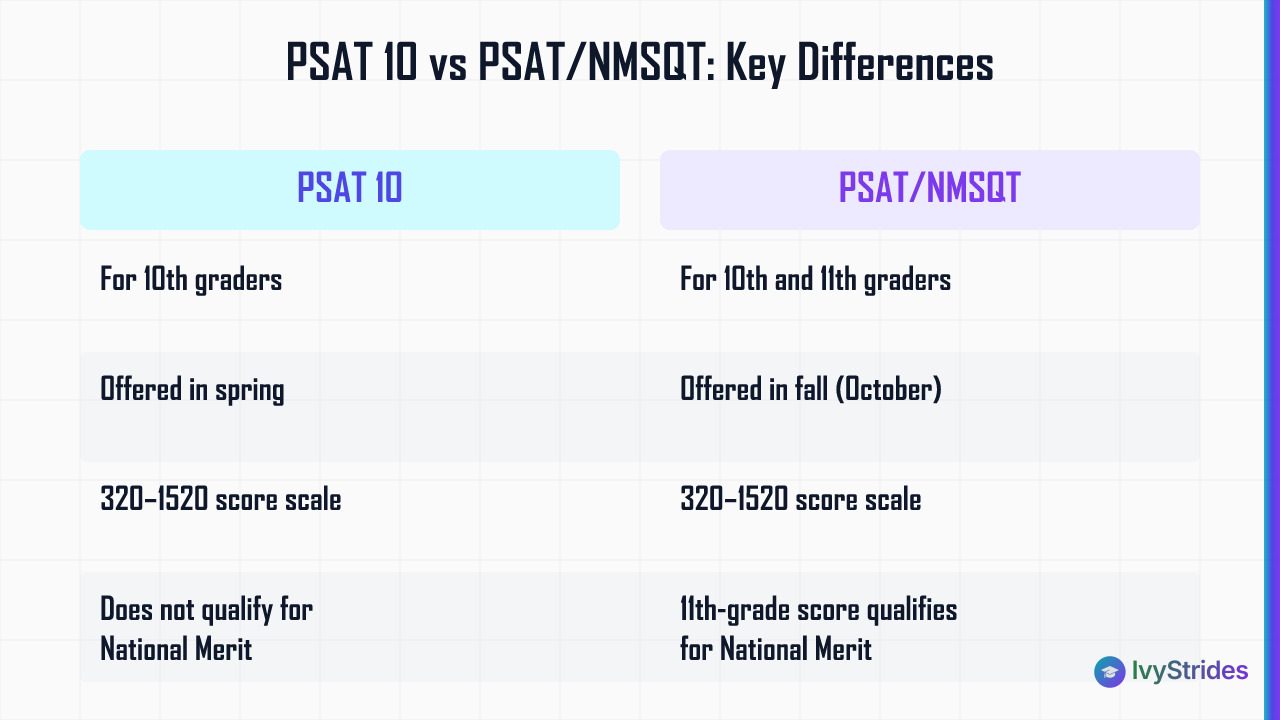
Grade level determines which PSAT you take, and for one specific version, it also determines whether the score can qualify you for a scholarship.
PSAT 8/9 is for 8th and 9th graders. It uses a 240–1440 scale and functions as an early college-readiness baseline. It doesn't feed into National Merit and it isn't a strong SAT predictor yet, but it flags reading and math gaps early enough to act on.
PSAT 10 is for 10th graders. Same 320–1520 scale as the PSAT/NMSQT, same digital adaptive format, same Reading and Writing and Math sections. It's a diagnostic. It does not qualify for National Merit under any circumstance.
PSAT/NMSQT is for 10th and 11th graders. This is the National Merit Scholarship Qualifying Test, and here's the part most families miss: only your 11th-grade PSAT/NMSQT score counts for National Merit. A 10th grader can sit for the October PSAT/NMSQT, and many do, but that score is treated as practice. It's a realistic dress rehearsal a full year before the sitting that matters.
Can a student take both PSAT 10 in spring 2026 and PSAT/NMSQT in fall 2026? Yes. Two data points beat one, and the spring PSAT 10 gives roughly eight months of prep runway before the fall PSAT/NMSQT.
For a deeper look at grade-specific benchmarks, see what is a good PSAT score for a 10th grader. If you're still working out how the PSAT and SAT relate, this breakdown of the difference between SAT and PSAT explains what changes.
How PSAT Registration Works in 2026 (and What to Do If You Are Not Sure Your School Is Testing)
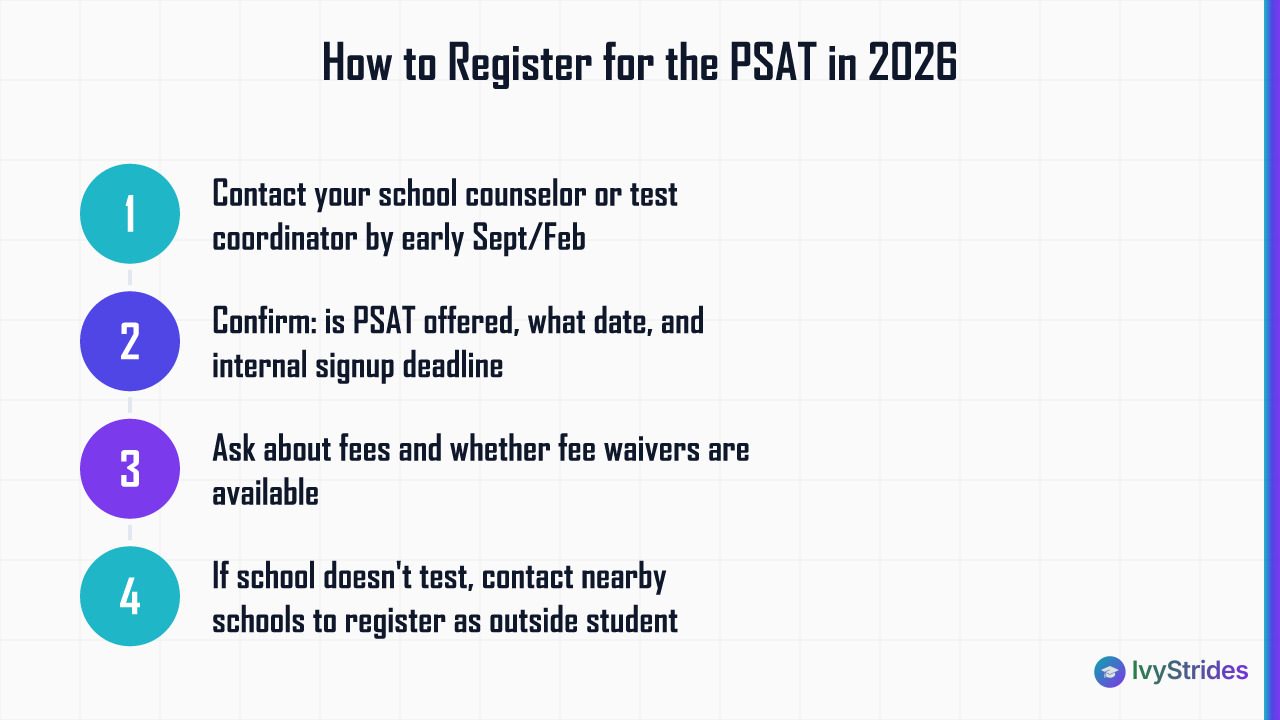
Here's the piece that trips up the most families: you don't register for the PSAT yourself. Not through College Board. Not through a testing center. Your school's test coordinator orders materials, chooses the date within the College Board window, and signs students up internally. That's the entire process.
What you actually need to do:
-
Email or visit your school counselor or test coordinator by early September 2026 (for the fall PSAT/NMSQT) or by early February 2026 (for the spring PSAT 10 or PSAT 8/9).
-
Confirm three things: is our school administering the PSAT this year, what date did we pick, and what is our internal signup deadline.
-
If there's a fee, ask how it's collected and whether fee waivers are available.
If your school doesn't offer the PSAT, you're not out of options, but you have to move quickly. Per College Board's guidance, contact nearby schools directly and ask whether they'll accept an outside student for their administration. This isn't guaranteed and depends entirely on the receiving school's policy. There's no College Board hotline that will place you at a test site.
Homeschool students should contact local public or private schools in their district. International students should confirm PSAT availability with their school, since not every international school in the College Board network offers all three versions.
One caveat worth stating plainly: if your school's internal registration deadline has passed, there's no College Board makeup sitting for the PSAT. Missing a school deadline usually means waiting until the next testing window, which for 11th graders considering National Merit can mean losing eligibility entirely (only the fall 11th-grade PSAT/NMSQT qualifies).
For students who want to sharpen up before test day, our PSAT practice tests library mirrors the digital adaptive format.
How Much Does the PSAT Cost in 2026 (and How to Get a Fee Waiver)
College Board sets a base fee, and schools may add a small administrative charge on top. In practice, families pay roughly $18 to $30 per student. That number varies because the school, not College Board, controls the final price. Confirm the exact amount with your school counselor before assuming any figure.
Fee waivers are available and worth asking about. Students who qualify for free or reduced-price lunch, students in foster care, students whose families receive public assistance, and students living in federally subsidized housing generally qualify. Your school counselor processes the waiver through College Board; no separate application is required from the student.
Some states cover the PSAT entirely at no cost to students. Colorado, Illinois, and Michigan have historically funded PSAT administration for public school students in specific grades, though state programs change year to year. If you're in a state that funds testing, you won't see a bill; the school simply administers the test.
For students who prefer self-directed preparation, our free downloads page has strategy references you can use before test day at no cost.
What Is a Good PSAT Score in 2026 (and What Does It Mean for National Merit)?
A "good" PSAT score depends on what you're measuring against: national percentiles, your own SAT target, or the National Merit cutoff in your state. All three matter, and they aren't the same benchmark.
On the 320–1520 scale used by the PSAT/NMSQT and PSAT 10, a score of roughly 1270 or higher places a student in about the top 10% of test takers. A perfect score is 1520. On the PSAT 8/9's 240–1440 scale, the top 10% starts closer to 1200.
For National Merit consideration, the relevant number isn't your total score. It's your Selection Index, which equals the sum of your Reading and Writing section score and your Math section score, multiplied by 2. Selection Index runs from 48 to 228. The Commended Student threshold has historically landed near 207 nationally, and Semifinalist cutoffs vary by state, typically between roughly 209 and 222 based on prior years.
A 1490 PSAT/NMSQT score converts to a Selection Index of about 223. That's competitive for Semifinalist in nearly every state, though the highest-competition states (California, New Jersey, Massachusetts, Maryland) have historically required scores at or above roughly 220. A 1400 PSAT/NMSQT converts to a Selection Index of about 210, which is near or below the Semifinalist cutoff in most competitive states based on prior years, though it typically clears the Commended threshold.
These cutoffs are estimates based on prior years. Actual 2026 cutoffs are set after scores release and announced by College Board and the National Merit Scholarship Corporation the following September. Verify before making any planning decision that depends on a specific number.
Once you know your test date, the next question is what score to aim for; see our breakdown of what is a good PSAT score by grade in 2026. If your target sits closer to the middle of the scale, this piece on is 1280 a good PSAT score walks through the specific percentile and SAT implications.
Is the PSAT Harder Than the SAT? What to Expect on Test Day
Students often wonder whether the PSAT is harder than the SAT before they sit for the first time; the short answer is that the SAT covers slightly more advanced content, but the formats are nearly identical.
Both the Digital PSAT/NMSQT and the Digital SAT run in the Bluebook app. Both use a two-module adaptive Reading and Writing section followed by a two-module adaptive Math section. Both give you approximately the same time per question. If you've prepared for one, you've effectively prepared for the format of the other.
The difference lives in the math content. The SAT Math section pulls from a slightly wider set of question types, including a small number of items from advanced algebra and early precalculus that the PSAT/NMSQT doesn't test. In Reading and Writing, the difference is closer to zero: the passage types, question stems, and pacing rules are the same.
Per the College Board PSAT/NMSQT Student Guide, the PSAT/NMSQT gives you 64 minutes for Reading and Writing (split across two 32-minute modules) and 70 minutes for Math (split across two 35-minute modules), for a total testing time of about 2 hours and 14 minutes.
Look, the PSAT is the cheapest, lowest-stakes rehearsal of Digital SAT test-day conditions you'll ever get. In our coaching, students who treat the PSAT as a full-effort diagnostic (not a casual sit-through) consistently produce more actionable SAT prep plans afterward.
For a deeper comparison, see is the PSAT harder than the SAT.
After the PSAT: How to Turn Your Score into an SAT Prep Plan

Photo by cottonbro studio on Pexels
Your PSAT score maps directly onto the SAT scale, making it the most reliable starting point for setting a SAT target and building a prep timeline.
PSAT/NMSQT scores are typically released in December, accessible through your College Board student account. When they hit, you get more than a total score: you get section scores, subscores by skill domain, and question-level feedback showing which problems you missed. That's your diagnostic. Don't skim it.
A student scoring 1200 on the PSAT/NMSQT projects to a starting SAT range of roughly 1200 to 1250 before any focused prep. That's a starting range, not a prediction. In our coaching, students at the 1000–1150 PSAT band who put in structured prep typically see meaningful movement toward the 1200+ SAT range over the following months. Students at the 1150–1300 PSAT band who target 1400+ typically need a longer runway. The methodology behind those outcomes is the same regardless of starting score: diagnostic practice test, section-specialist weakness targeting, and spaced retesting.
If you have eight or more weeks before your test date, a structured PSAT study plan can meaningfully move your score before the window opens. See how to study for the PSAT for a week-by-week structure.
Two other planning points. PSAT scores translate almost directly to SAT projections because both tests share the same digital adaptive format and score architecture; the details of that conversion live in our PSAT to SAT conversion guide. The PSAT also fits into a broader high school testing calendar alongside AP exams and eventual SAT or ACT sittings; mapping all three together prevents scheduling conflicts. Our AP, SAT, and ACT testing plan for high school shows how to sequence them by grade.
One pattern worth naming. In our coaching, many students discover their PSAT score understates their SAT potential because they walked in cold. A single diagnostic practice test taken a few weeks before the PSAT can typically raise the baseline meaningfully, which gives 11th graders a real shot at pushing above the National Merit Semifinalist cutoff in their state. If you're reading this before October 2026 and you're in 11th grade, that window is still open.
FAQ
When can I take the PSAT in 2026?
The PSAT/NMSQT testing window runs October 1 to October 30, 2026, with a primary Saturday date of October 17. The PSAT 10 and PSAT 8/9 are offered March 2 to April 30, 2026. Your school chooses the specific date within each window, so confirm with your school's test coordinator before assuming any particular day.
Is a 1490 PSAT score good enough for National Merit?
A 1490 PSAT/NMSQT converts to a Selection Index of about 223, which is competitive for Semifinalist status in most states based on prior years' cutoffs. High-competition states like California, New Jersey, and Massachusetts have historically required Selection Index scores of roughly 220 or higher, so a 223 sits comfortably above those. Verify current cutoffs with College Board after scores are released in December.
Does a 1400 PSAT score qualify for National Merit?
A 1400 PSAT/NMSQT converts to a Selection Index of about 210, which is near or below the Semifinalist cutoff in most competitive states based on prior years. It typically qualifies for Commended Student recognition, which has historically required a Selection Index of roughly 207 nationally. In lower-competition states it may reach Semifinalist; confirm current cutoffs with College Board.
What is a perfect PSAT score in 2026?
The maximum score on the PSAT/NMSQT and PSAT 10 is 1520 on a scale of 320 to 1520. The PSAT 8/9 has a maximum of 1440 on a scale of 240 to 1440. A perfect 1520 on the PSAT/NMSQT would place a student well above the Semifinalist cutoff in every state and comfortably above the Commended threshold nationally.
Can I take the PSAT online or at home?
No. All PSAT versions are administered in person at schools or approved testing sites. The test format is digital (students use a laptop or tablet with the Bluebook app), but the test must be taken at a supervised school location. There's no at-home PSAT option.
When do PSAT scores come out after the October 2026 test?
PSAT/NMSQT scores from the fall 2026 administration are typically released in December 2026 through a student's College Board account. The exact release date is announced by College Board closer to the test window; check satsuite.collegeboard.org for the official schedule as it approaches.
Is there a PSAT 11 test?
There's no test officially called the PSAT 11. The test for 11th graders is the PSAT/NMSQT, which is also the National Merit Scholarship Qualifying Test. You may see the informal term "PSAT 11" used online, but the official College Board name is PSAT/NMSQT. Only 11th-grade PSAT/NMSQT scores count toward National Merit eligibility.
What happens if I miss the PSAT registration deadline at my school?
Because registration is managed by your school, missing the internal deadline usually means you can't test at that school during the window. Contact your test coordinator immediately; some schools have flexibility for late additions in the first few days. If your school's window has fully passed, you can try nearby schools that may still accept outside students, but this isn't guaranteed, and College Board doesn't offer individual makeup PSAT sittings.
The Bottom Line
Confirm your school's chosen date with your test coordinator by early September 2026 for the fall PSAT/NMSQT, or by early February for the spring PSAT 10 and PSAT 8/9. Then use the score you receive in December as the diagnostic it's designed to be: not a verdict, but the first real data point in a plan that ends with your target SAT score and the college list that follows from it.

Award-winning author (South Asian Book Award) and graduate of BITS Pilani and UCLA Luskin School of Public Affairs. Brings a published writer's eye to Common App essays and grammatical precision to SAT and ACT R&W instruction.