
PSAT Strategy for Juniors: The Complete 2026 Guide for Students and Parents

On this page
- What the 2026 PSAT/NMSQT Actually Looks Like: Format, Timing, and Scoring
- Does the PSAT Actually Matter for Juniors? The National Merit Stakes
- What Is a Good PSAT Score for a Junior in 2026?
- Why Juniors Who Skip PSAT Prep Often Regret It (and What to Do Instead)
- Not Sure Where Your PSAT Score Stands? Find Out in 15 Minutes.
- Your 8-Week PSAT Prep Timeline for Juniors
- Section-by-Section Tactics: Reading and Writing vs. Math
- Reading and Writing
- Math
- The adaptive module reality
- The no-penalty rule
- How PSAT Prep Connects to Your SAT Score
- When and How to Get Help: Choosing the Right PSAT Prep Approach
- FAQ
- What is a good guessing strategy for the PSAT?
- Is it worth taking the PSAT as a junior if my target colleges are test-optional?
- Can a junior take both the PSAT and SAT in the same year?
- How realistic is it to improve a PSAT score significantly in 8 weeks?
- How do I find out my state's National Merit Selection Index cutoff?
- Ready to Build Your PSAT Prep Plan for 2026?
The 2026 PSAT/NMSQT is a 2-hour 14-minute digital exam scored on a 320-1520 scale, split into a Reading and Writing section (54 questions, 64 minutes) and a Math section (44 questions, 70 minutes), each delivered in two adaptive modules. It is the only sitting that qualifies a junior for the National Merit Scholarship Program. Competitive juniors typically target a composite of roughly 1450 or above, with state Selection Index cutoffs historically falling between about 207 and 222. The highest-use prep plan: take a full diagnostic practice test this week, identify your weakest question types by section, and run about 8 focused weeks of targeted work before October.
Those format details are verified against the College Board PSAT/NMSQT resources, which we cite throughout this guide. The harder question is how to fit real prep into a junior year already carrying three or four AP courses, and that's what the rest of this article walks through.
What the 2026 PSAT/NMSQT Actually Looks Like: Format, Timing, and Scoring
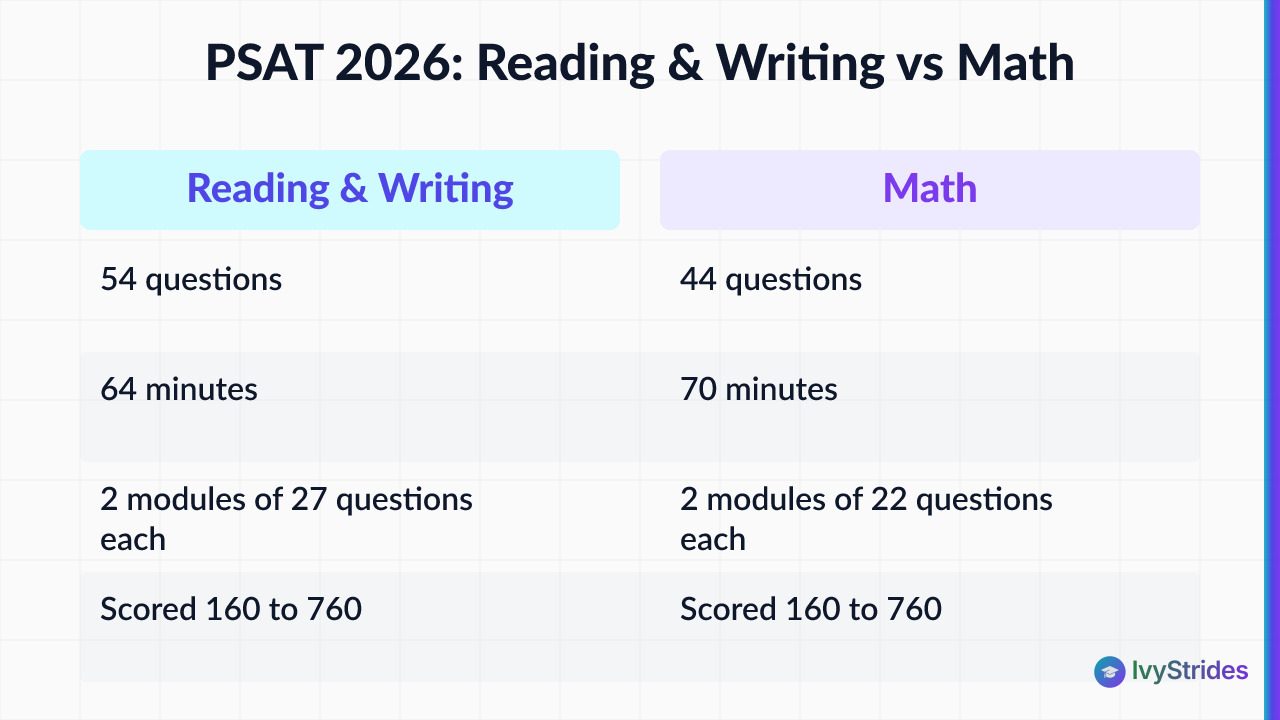
The PSAT/NMSQT has been fully digital and adaptive since October 2023. Here is the current format, per the College Board PSAT/NMSQT specifications:
- Reading and Writing section: 54 questions, 64 minutes, delivered in two adaptive modules of 27 questions each
- Math section: 44 questions, 70 minutes, delivered in two adaptive modules of 22 questions each
- Total testing time: 2 hours and 14 minutes
- Score range: 320 to 1520 (each section scored 160 to 760)
- No penalty for wrong answers: every unanswered question is a wasted point
The adaptive piece matters more than most students realize. Module 1 in each section is standard difficulty for all test-takers. Your performance on Module 1 determines whether Module 2 serves you the harder or easier question pool. You cannot access the top score bands without routing into the harder Module 2. So the first 27 R&W questions and the first 22 Math questions aren't just "the first half," they're the gate.
One logistical note that trips up families every fall: you do not register for the PSAT through College Board directly. Your high school administers it. Check with your counselor by early September to confirm your school is offering it and on what date. If your school doesn't offer the PSAT, you can contact nearby schools to request a seat, but you have to do this well before October.
For a deeper walkthrough of scoring mechanics, see our post on how is the PSAT scored. If you're weighing whether the digital PSAT truly mirrors the digital SAT, our breakdown of the difference between SAT and PSAT covers the content and score-scale differences in detail.
Does the PSAT Actually Matter for Juniors? The National Merit Stakes
Short answer: yes, if you have any realistic shot at National Merit recognition or if you want a low-stakes SAT diagnostic. Your junior-year PSAT score is the only score that counts toward National Merit eligibility, which means October is a one-time window with real scholarship stakes.
Here's how the National Merit pipeline works. The National Merit Scholarship Corporation (NMSC) uses a metric called the Selection Index, calculated by adding your Reading and Writing section score to your Math section score and multiplying by 2 (approximate formula; verify against your official score report). The Selection Index maxes out at approximately 228 on the digital PSAT.
There are two recognition tiers:
- Commended Scholar: a single national threshold, historically around 207 to 209
- Semifinalist: a state-specific cutoff, historically ranging from about 207 in lower-competition states to roughly 222 in states like California, New Jersey, Massachusetts, and Washington DC
For your 2026 PSAT sitting, the scores feed the class-of-2028 National Merit cycle. Semifinalists advance in the fall of senior year and must submit essays, transcripts, recommendations, and a confirming SAT or ACT score to reach Finalist status. Scholarship dollar amounts vary by sponsor and year, so check NMSC directly for current figures.
One caveat parents ask about constantly: test-optional college admissions policies do not affect National Merit eligibility. National Merit is a separate program administered by NMSC, not by colleges. Even if every school on your list is test-optional, a strong PSAT can still unlock National Merit scholarships and institutional merit aid tied to the recognition. A strong PSAT score doesn't replace a compelling college essay, but it can open scholarship doors that reduce the financial pressure on the rest of your application.
For score-band context, our post on what is a good PSAT score breaks down the composite ranges by grade. Merit scholarships aren't exclusive to the PSAT either; our guide on how ACT scores affect merit scholarships covers the parallel pathway.
What Is a Good PSAT Score for a Junior in 2026?
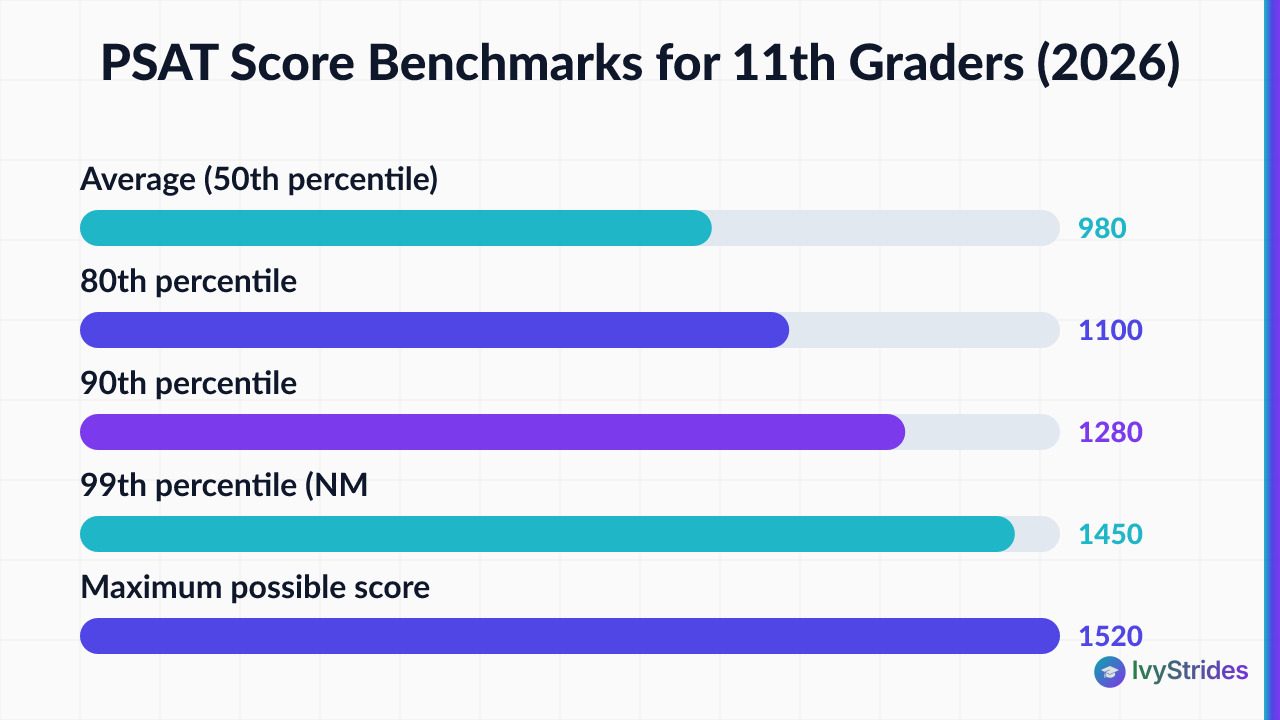
"Good" depends entirely on your goal. Here are the reference points juniors and parents actually need, drawn from College Board's published percentile data:
- 980: roughly the average PSAT score for 11th graders (around the 50th percentile)
- 1100: around the 80th percentile, solidly above average and in the neighborhood most selective schools want to see as an SAT baseline
- 1280: around the 90th percentile, a strong indicator you can reach a 1400+ SAT with structured prep
- 1450: roughly the 99th percentile and the entry point for competitive National Merit consideration in most states
- 1520: the maximum possible score, achieved by a small fraction of test-takers each year
At the section level, hitting around the 99th percentile means roughly 700 R&W and about 740 Math on the current digital scale. If you're already in the 1400+ band, the last 50-100 points are the hardest, and that's usually where section-specialist coaching starts to matter more than volume practice.
A quick note on interpretation. If you're a junior sitting at 1180 today, closing a roughly 200-point gap to 1380 in about 8-10 weeks is realistic with targeted work, based on typical patterns we see in coaching. Closing a 340-point gap to 1520 in the same window is not. Set your target based on your current diagnostic, not on what score sounds impressive.
For deeper score-band reads, see our analyses on good PSAT scores, is 1280 a good PSAT score, and the current average PSAT score benchmarks.
Why Juniors Who Skip PSAT Prep Often Regret It (and What to Do Instead)
Here's the part most students miss. The most common regret we hear from juniors after October scores drop isn't "I wish I had studied more." It's more specific: "I missed Semifinalist by four Selection Index points." Or: "My PSAT gave me a false baseline, so I underestimated what I needed to do for the SAT."
Both are avoidable. A 3-5 point Selection Index gap translates to roughly 15-25 composite points on the 320-1520 scale. That's the exact size of gap that targeted work on two or three question types typically closes.
The "I'll just study for the SAT later" trap is worse than it sounds. Because the PSAT and SAT share the same content domains, question types, and adaptive format, an underprepared PSAT gives you a distorted baseline. You walk out thinking you're a 1200 student when, with light targeted work, you're actually a 1320 student. That distortion warps every SAT prep decision you make for the next six months.
In our coaching with juniors, students who complete at least one full-length diagnostic practice test before October consistently enter the exam with sharper pacing and question-type awareness than those who walk in cold. And the biggest score gains we see typically come from fixing 2-3 specific question-type weaknesses, not from broad content review.
The realistic effort floor is modest: roughly 8-10 weeks at about 3-5 hours per week. That adds up to about 30-50 total hours of focused work spread across a summer-to-fall runway. Most juniors can carry that alongside AP coursework if they schedule it deliberately.
Two self-directed starting points: our library of PSAT practice tests for diagnostic work. Our post on whether your PSAT results are good enough for SAT success once your score arrives.
Not Sure Where Your PSAT Score Stands? Find Out in 15 Minutes.
Book a free strategy call with an IvyStrides coach. We will review your diagnostic score, identify your highest-leverage weaknesses, and recommend a personalized prep plan before October.
Your 8-Week PSAT Prep Timeline for Juniors
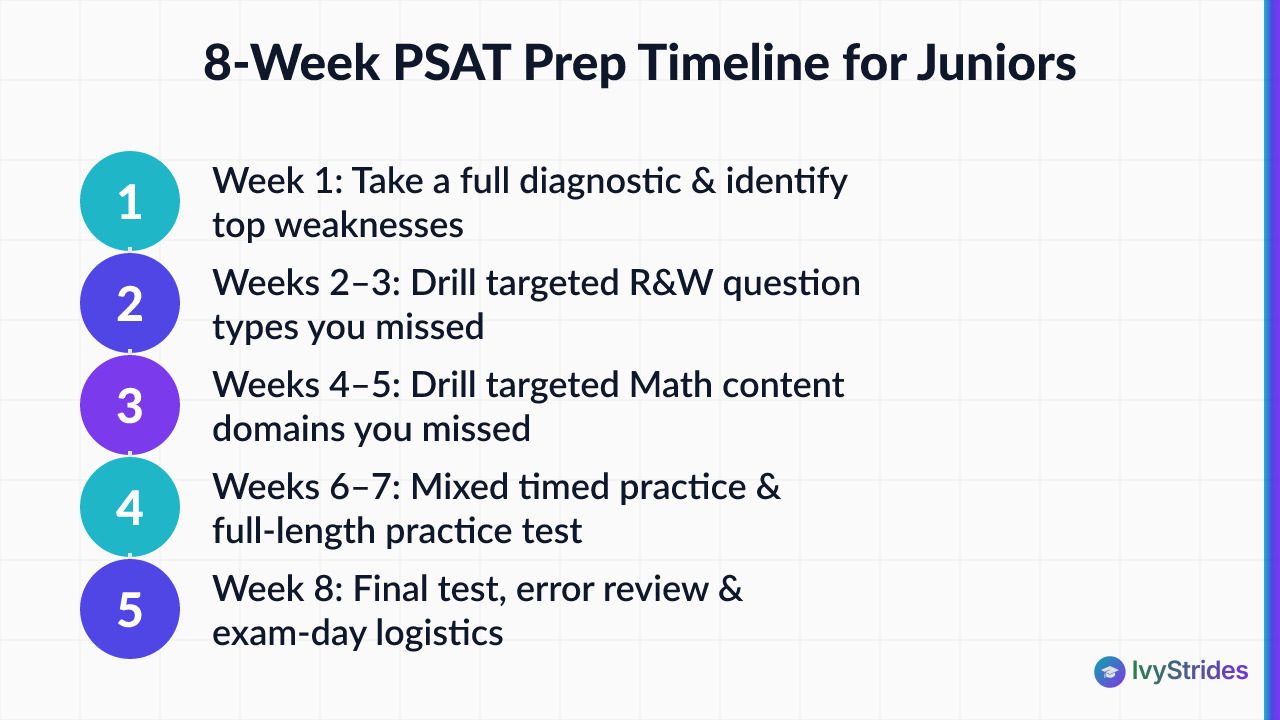
In our coaching with juniors, the students who improve most before October are the ones who take a full diagnostic practice test first and build their prep plan around the specific question types they're missing. Here is the phased timeline we typically use.
Week 1: Diagnostic and gap analysis. Take one full-length PSAT diagnostic under real timing conditions. Score it by section, by module difficulty, and by question type. Identify your top 2-3 failing question types in R&W and your top 2-3 failing content domains in Math. Don't skip this step and don't shortcut it. Everything downstream depends on it.
Weeks 2-3: Targeted R&W weakness work. Spend both weeks drilling only the R&W question types you missed most in the diagnostic. For most juniors, that's transitions, rhetorical synthesis, and information-and-ideas questions. Do about 20-30 targeted questions per session, review every error, and keep a running list of the rule or pattern behind each miss.
Weeks 4-5: Targeted Math weakness work. Same structure, applied to Math. The most common content domains where juniors leak points are linear equations and systems, quadratics, and problem-solving with data analysis. Translate every word problem into an equation before you touch the calculator.
Weeks 6-7: Mixed practice and pacing. Now blend the sections. Do timed module simulations (32 minutes for a full R&W module, 35 minutes for a full Math module). Focus on pacing, on the transition from Module 1 to Module 2, and on ensuring you fill in every bubble. Take one additional full-length practice test in this window.
Week 8: Final practice test, error review, exam-day logistics. Take your final timed full-length roughly 5-7 days before the exam. Don't cram new content in the final 3 days. Review your error patterns, confirm your test-day logistics (device, location, arrival time), and rest.
If you're carrying three or more AP courses this fall, block your PSAT prep sessions before AP homework rather than after, when cognitive fatigue is highest. A tired 20-minute session at 10pm is worth less than a focused 40-minute session at 4pm. Parents can help here by protecting a consistent time slot in the family schedule.
Because the PSAT and SAT share the same content domains and adaptive format, every hour you invest in PSAT prep this fall translates directly into SAT readiness for spring.
For self-directed juniors, start with our free downloads library. Parents looking for the supportive-role playbook should read our guide on how to support your child's SAT prep; the same principles apply to PSAT work.
Section-by-Section Tactics: Reading and Writing vs. Math
Generic advice ("read carefully, manage your time") won't move your score. Here's the section-specific tactical layer.
Reading and Writing
The digital PSAT R&W section has four question categories, per College Board content specifications: information and ideas, craft and structure, expression of ideas, and standard English conventions. Each passage is short (roughly 25-150 words) and paired with a single question. That format rewards a different skill than the old paper SAT.
Tactical rules that consistently move scores:
- Read the question stem before the passage. You'll know what to look for and cut wasted reading time.
- Treat transitions and rhetorical synthesis questions as pattern-based, not intuitive. These appear frequently and are highly learnable. Transitions test the logical relationship (contrast, cause, example, sequence) between two ideas. Synthesis questions test whether you can extract the specific fact that satisfies a stated goal. Both reward practice more than instinct.
- Grammar questions are rule-based. Standard English Conventions questions test subject-verb agreement, pronoun-antecedent clarity, punctuation between clauses, and modifier placement. If you're guessing on grammar, you're leaving learnable points on the table.
Math
Math has four content domains, also per College Board's specifications: algebra, advanced math, problem-solving and data analysis, and geometry and trigonometry. Algebra alone typically accounts for the largest single share of questions.
Tactical rules for Math:
- Translate before you compute. Word problems in data analysis and algebra become significantly easier when you rewrite them as equations before you calculate anything.
- Check units in every data analysis question. The most common wrong answer is the right computation on the wrong units (dollars vs. cents, hours vs. minutes, per-item vs. total).
- Use the built-in Desmos calculator strategically. For systems of equations and function graphs, plotting is often faster than algebra. For simple arithmetic, the calculator is slower than mental math.
- Linear equations and systems are worth over-preparing. They account for a large share of the algebra domain and appear across both modules.
The adaptive module reality
Because Module 2 difficulty is set by Module 1 performance, you can't afford to coast through Module 1. If you route into the easier Module 2, your section score is capped below the top bands regardless of how many questions you get right. Play Module 1 like it's the whole test.
The no-penalty rule
There is no wrong-answer penalty on the digital PSAT. Answer every single question. If you're stuck, use process of elimination to remove one or two clearly wrong options, which raises your guessing probability from 25% to roughly 33-50%. Never leave a bubble blank.
For a deeper comparison of PSAT and SAT difficulty, see our post on is the PSAT harder than the SAT. Students who plateau on Math specifically often benefit from working with an online SAT Math tutor between the PSAT and their first SAT sitting.
How PSAT Prep Connects to Your SAT Score
The connection is stronger than most families assume. PSAT and SAT share the same four R&W categories, the same four Math domains, the same adaptive module structure, and the same digital delivery. The only substantive differences: the SAT has a slightly harder ceiling on question difficulty and tops out at 1600 instead of 1520.
That has practical implications. A 1400 PSAT is roughly equivalent to a 1450-1480 SAT in raw difficulty terms, because the 80-point scale difference is calibrated to the harder question pool the SAT can access. In our coaching with students moving from PSAT to SAT, those who address their PSAT diagnostic weaknesses before their first SAT sitting typically see a smaller gap between the two scores than students who don't.
For most juniors, the pathway looks like this:
-
October: PSAT (National Merit qualifier plus diagnostic)
-
December through February: address PSAT weaknesses
-
March or May: first SAT sitting
-
August or October senior year: second SAT sitting if needed
If you're in the 1280-1450 PSAT band, that first SAT sitting typically lands in the 1300-1450 range with continued structured prep. Higher isn't out of reach, but it takes deliberate work on the specific weaknesses your PSAT surfaced.
For the full comparison, see our post on PSAT vs SAT. Our guidance on interpreting psat results 2026 covers what to do once your October score arrives.
When and How to Get Help: Choosing the Right PSAT Prep Approach
Not every junior needs 1-on-1 coaching. Here's how to think about the choice honestly.
Self-directed prep works well when: you're within roughly 100 points of your target, you have a clean diagnostic showing 2-3 clear weaknesses, and you have the discipline to keep a 3-5 hour weekly schedule for about 8 weeks. If that's you, our PSAT practice tests and free downloads library cover the core resources.
Coached prep is worth the investment when: you've plateaued after self-study, you're targeting National Merit and need to close a specific Selection Index gap, you have a section weakness (usually Math) that self-review hasn't fixed, or the family wants a professional layer of accountability on top of a busy junior-year schedule.
What IvyStrides does differently: every plan starts with a full diagnostic and a section-by-section error analysis before any content review begins. R&W and Math are coached by separate section specialists, not a single generalist tutor. The lowest-risk first step is a free 15-minute strategy call. We'll look at your current diagnostic score, identify your highest-use weaknesses, and give you a recommended path, whether that's self-directed prep, a targeted practice-test package, or 1-on-1 coaching. If you'd prefer a longer conversation, start with the free 30-min SAT consultation.
Sophomores reading this in advance: our post on good PSAT scores for 10th graders covers the PSAT 10 pathway.
FAQ
What is a good guessing strategy for the PSAT?
The digital PSAT has no wrong-answer penalty, so answer every single question, including ones you're unsure about. Use process of elimination to remove at least one or two clearly wrong choices before guessing; that raises your probability from 25% to roughly 33-50%. Never leave a question blank, and don't waste time hunting for a "trick" letter pattern. There isn't one.
Is it worth taking the PSAT as a junior if my target colleges are test-optional?
Yes, for two reasons. First, test-optional admissions policies apply to SAT and ACT scores submitted with college applications; they don't affect National Merit eligibility, which is determined solely by your junior-year PSAT. Second, a strong PSAT gives you a reliable SAT baseline and can qualify you for merit scholarships that are separate from admissions decisions. Test-optional policies vary by school and year, so check each college's current policy directly.
Can a junior take both the PSAT and SAT in the same year?
Yes, and in our coaching this is a common and effective approach. The PSAT in October serves as a low-stakes diagnostic and National Merit qualifier; the SAT in the spring of junior year or fall of senior year is the admissions-relevant sitting. Because both exams share the same content domains and adaptive format, PSAT prep directly accelerates SAT readiness.
How realistic is it to improve a PSAT score significantly in 8 weeks?
In our coaching with juniors, students who start from a diagnostic, focus on their top 2-3 question-type weaknesses, and complete at least two full timed practice tests in the 8-week window typically see meaningful score improvement. The size of the gain depends on the starting score band, the consistency of practice, and whether the student is working on the right weaknesses. Typical outcomes are exactly that, typical, not guaranteed.
How do I find out my state's National Merit Selection Index cutoff?
State Selection Index cutoffs are published by the National Merit Scholarship Corporation each year after scores are released. Historical cutoffs range from about 207 to 222, with higher-competition states like California, New Jersey, and Massachusetts at the upper end. Check the NMSC website or the College Board PSAT/NMSQT resources page for the current figures after your score report is released. Cutoffs shift annually, so use last year's numbers as a rough target, not a hard line.
Junior year is the only shot at National Merit and the last low-stakes chance to calibrate your SAT baseline before it matters for admissions. The path isn't complicated: diagnose first, target 2-3 real weaknesses, run about 8 focused weeks, and go into October knowing exactly what your Module 2 needs to look like.
Ready to Build Your PSAT Prep Plan for 2026?
Our section-specialist coaches work with juniors worldwide. Start with a free 15-minute strategy call: diagnostic snapshot, score-band analysis, and a clear next step. No pressure, no obligation.

Award-winning author (South Asian Book Award) and graduate of BITS Pilani and UCLA Luskin School of Public Affairs. Brings a published writer's eye to Common App essays and grammatical precision to SAT and ACT R&W instruction.