
The Best PSAT Practice Tests in 2026: What to Look For and How to Choose Wisely
On this page
- The Short Answer: Which PSAT Practice Tests Are Worth Your Time in 2026
- Official vs. Unofficial PSAT Practice Tests: Why Format Fidelity Is the Only Criterion That Matters
- The Best Free PSAT Practice Tests Available Right Now
- The Right Way to Use a PSAT Practice Test (Most Students Skip This Step)
- How to Read Your Practice Test Score: Benchmarks That Actually Matter
- How Many Practice Tests Do You Actually Need Before the PSAT?
- When Free Practice Tests Are Not Enough: What 1-on-1 PSAT Prep Adds
- FAQ
- What is the best way to practice for the PSAT?
- What is a top 1% PSAT score, and what does it mean for National Merit?
- Is a 740 a bad PSAT score?
- Is a 1480 on the PSAT a good score?
- Is a 1200 a bad PSAT score?
- Where can I find a free PSAT practice test PDF with answers?
- Does practicing for the PSAT significantly improve scores?
The best PSAT practice tests in 2026 are the official full-length digital adaptive tests available through the College Board's Bluebook app. They're free, they replicate the exact two-module adaptive structure of the real exam, and they produce the most accurate score estimate you'll get outside of test day itself. After you've worked through the official tests, aligned free question practice from College Board partners covers targeted skill work. Third-party providers add question volume but vary widely in adaptive fidelity. For most students, two to four official full-length tests, used diagnostically, beat a large library of lower-fidelity material.
Those specs come from the College Board PSAT/NMSQT page, which is the reference standard for format, scoring, and Selection Index mechanics. The harder questions, how to pick materials, how to read a score, how many tests you actually need, are what the rest of this article covers.
The Short Answer: Which PSAT Practice Tests Are Worth Your Time in 2026
Here's the tier list, ranked by how closely each resource mirrors the real exam.
Tier 1: College Board Bluebook app. Bluebook is the digital testing platform students use on the real PSAT/NMSQT, and it hosts official full-length practice tests in the same two-module adaptive format. It's a free download. Score reports break performance down by content domain, which is what you need for the diagnostic workflow later in this article. The 2026 PSAT/NMSQT runs about 2 hours and 14 minutes, with a Reading and Writing section split into two adaptive modules and a Math section of 70 minutes and 44 questions across two adaptive modules, per the College Board PSAT/NMSQT specifications. Bluebook practice tests match those specs.
Tier 2: Free supplementary question practice aligned to College Board content. Useful between full-length tests for targeted skill practice on Craft and Structure questions, Advanced Math, or whichever domain your error log flagged. Not a replacement for a full-length adaptive simulation.
Tier 3: Our own PSAT practice tests. IvyStrides publishes full-length digital adaptive PSAT tests used as a diagnostic baseline before 1-on-1 coaching begins. Section-specialist scoring for Reading and Writing versus Math.
Tier 4: Third-party paid materials from major test-prep publishers. Appropriate only after official tests are exhausted, and only for extra question volume. The score range is 320 to 1520, and only tests that replicate the adaptive scoring model can produce a defensible score estimate against that scale.
That's the short version. The rest of this article explains why format fidelity matters more than any other criterion and how to squeeze real score improvement out of the tests you take.
Official vs. Unofficial PSAT Practice Tests: Why Format Fidelity Is the Only Criterion That Matters
The 2026 PSAT/NMSQT is fully digital and adaptive. That single fact reshapes what "a good practice test" even means. Because the PSAT and SAT share the same digital adaptive structure and overlapping content domains, a strong PSAT practice test score is one of the most reliable early signals of where a student will land on the SAT without additional prep, and you can dig deeper into how the two exams compare in our post on is the PSAT harder than the SAT.
Here's the mechanic that matters. On the real exam, Module 1 of each section serves a mix of easy, medium, and hard questions. Your performance on Module 1 determines whether Module 2 is a harder or easier module, and your final section score depends heavily on which Module 2 you unlock. A non-adaptive test can't replicate this. It gives you the same questions regardless of how you did on the first half, which means the score it produces is not calibrated the way the real one is. That's the reason a PDF practice test, even a well-written one, can't fully substitute for a Bluebook session.
PDFs still have a place. They work for content review, for slow, untimed practice on a specific question type, and for accommodations users who take the exam in a paper format. But if your goal is a realistic score estimate, the practice test has to be adaptive, and the score has to be generated by an engine that models Module 2 selection the same way the real one does. For a broader breakdown of how these two exams relate, see our guide on the difference between SAT and PSAT.
Two more distinctions worth making. First, a question bank is not a practice test. A bank of 500 Reading and Writing questions is useful for drills, but it doesn't teach you how to pace two consecutive adaptive modules or how to handle the mental fatigue of a full 2-hour-14-minute session. Second, third-party publishers vary. Some have released digital simulations that mirror the Bluebook interface reasonably well. Others still ship paper-style tests rebranded as "digital PSAT prep." Look at how a practice test administers Module 2 before you trust the score.
The Best Free PSAT Practice Tests Available Right Now

Photo by RDNE Stock project on Pexels
If you're starting from zero, this is the order to work through free resources.
College Board Bluebook app (primary). Download Bluebook from the College Board site and sign in with a College Board account. The app hosts official full-length digital adaptive PSAT/NMSQT practice tests at no cost, along with SAT and PSAT 10 practice tests. Score reports include question-level feedback broken down by content domain, which is what makes these tests useful diagnostically, not just as score generators. As of the most recent College Board update, multiple official full-length PSAT practice tests are available in Bluebook; verify the current count in the app, since College Board adds tests periodically.
Free supplementary question practice aligned to College Board content. Official partner practice content, accessible free through the College Board website, offers question-by-question drills on Reading and Writing and Math domains. It isn't a fully adaptive simulation, so don't use it to estimate your score. Use it between full-length tests to work on the specific skills your error log flags.
College Board accommodations portal. Students approved for assistive technology can access PSAT/NMSQT and PSAT 10 practice materials in Microsoft Word format through the accommodations portal. This is also where a PSAT practice test PDF with answers legitimately exists, though again, the PDF format doesn't replicate adaptive scoring.
PSAT 10. Sophomores taking the PSAT 10 in spring 2026 should use PSAT 10 practice tests, which are also available in Bluebook. Content overlap between PSAT/NMSQT and PSAT 10 is heavy but not identical, so grab the right one. And if you're mapping your timeline, our overview of when is the PSAT in 2026 walks through the test window for both exams.
One thing to note. "Best free PSAT practice tests online" searches surface a lot of blogspam and third-party lead-gen forms. If the site asks for your email before showing you the test, it isn't a free official resource. Bluebook doesn't gate practice tests behind a form.
The Right Way to Use a PSAT Practice Test (Most Students Skip This Step)
Look. Taking a practice test is the easy part. Turning that test into a score improvement is where almost every student stalls.
In our coaching with students at the 1100 to 1300 score band, the most common mistake is taking multiple practice tests without reviewing errors, which produces flat score trajectories. Students who take three tests in three weekends and check only their composite score improve by almost nothing. Students who take one test, spend the next two to three weeks working the error log, and then retest tend to move meaningfully. That's the whole methodology in two sentences: diagnostic baseline, targeted weakness work, spaced retesting.
Here's what that looks like in practice.
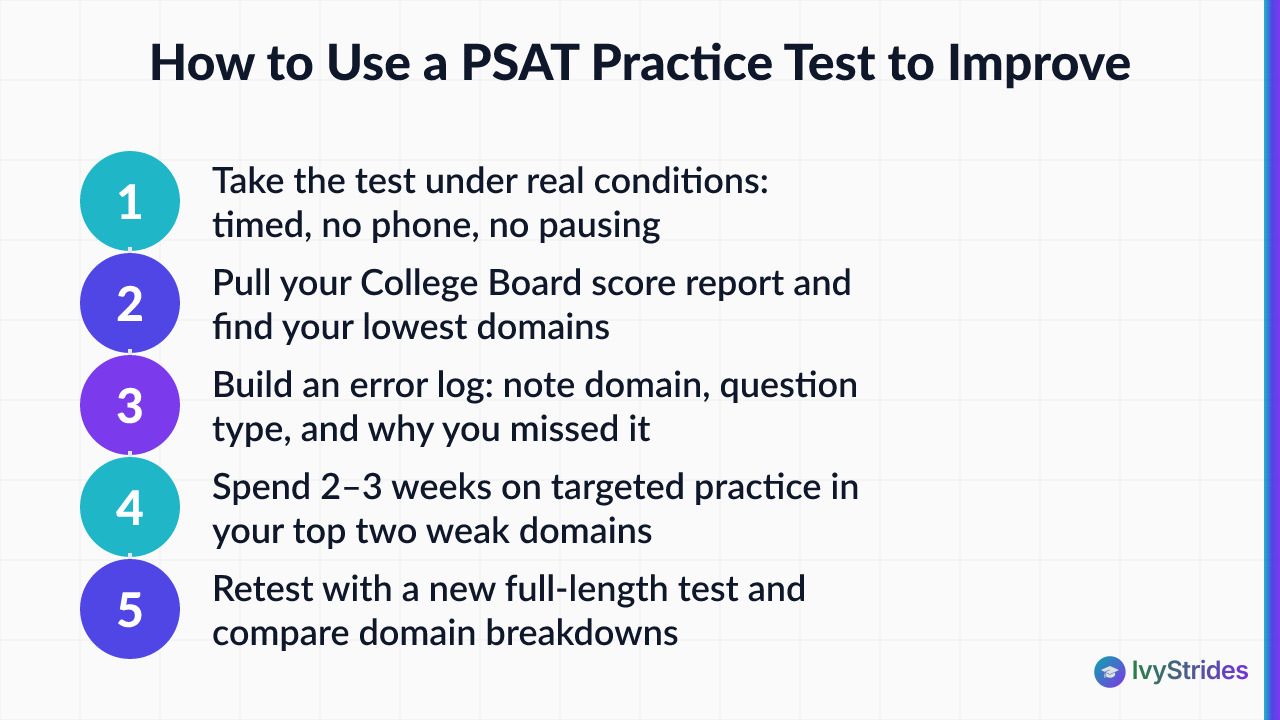
Step one: take the test under real conditions. Same time limits, same breaks, no phone, no dictionary, no pausing. If you cheat the conditions you cheat the diagnostic, and the score is fiction.
Step two: pull the College Board score report from Bluebook. It breaks Reading and Writing performance down into four content domains (Craft and Structure, Information and Ideas, Standard English Conventions, Expression of Ideas) and Math into four domains (Algebra, Advanced Math, Problem-Solving and Data Analysis, Geometry and Trigonometry). This is the map. Ignore the composite score for a minute and look at where your accuracy is lowest.
Step three: build an error log. For every wrong or skipped question, write down the domain, the question type, and, in one sentence, why you missed it. "Misread the transition question." "Didn't know the vocabulary in context." "Set up the linear equation wrong." Careless errors and knowledge gaps get treated differently, so the "why" matters.
Step four: spend two to three weeks on targeted skill practice. Attack your top two domains, not all eight. Roughly 10 to 15 hours of focused work on Advanced Math will typically move the needle further than 30 hours of mixed review.
Step five: retest. Not the same test, ideally, but another full-length official test. Compare the domain breakdowns, not just the composite. If your Advanced Math accuracy jumped from around 55 percent to 75 percent, the plan is working, even if the composite only moved 40 points.
Students who use PSAT practice tests diagnostically, identifying their weakest question types before moving to targeted drills, tend to carry that same habit into SAT prep and see compounding gains across both exams. It's the same methodology, applied to a longer test with higher stakes. For the score context on where you're headed, our guides on what is a good PSAT score and when do PSAT scores come out fill in the rest of the picture.
One pacing note that surprises students. On the digital PSAT Reading and Writing section, most students at the 1100 to 1400 band aren't losing points to time pressure. They're losing them to careless reads, especially on transition and rhetorical synthesis questions. Slow down on the last four questions of each module. In our coaching, that single behavioral change is typically worth 20 to 40 points for students at this band.
How to Read Your Practice Test Score: Benchmarks That Actually Matter
Once you have a practice test score in hand, understanding what that number actually means, whether a 1280 puts you on track for National Merit consideration or whether a 1200 signals a specific skill gap, is the next step in building a focused prep plan.
The PSAT/NMSQT composite score runs 320 to 1520. Each section (Reading and Writing, Math) is scored 160 to 760. Here's what the key benchmarks mean.
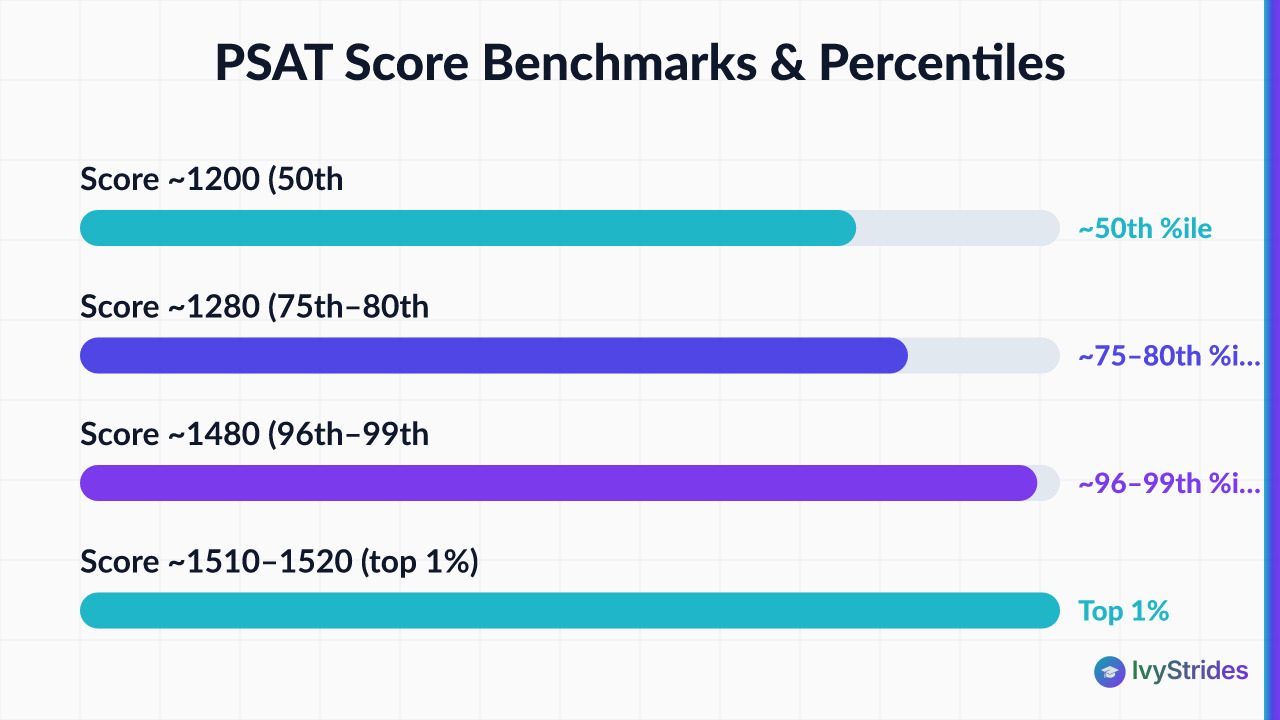
Around 1200. Roughly the 50th percentile for 11th graders, based on College Board percentile data (verify against the current year's tables). This is an average score, not a bad one. It isn't competitive for National Merit, but it also signals real room to move before the SAT. Students at 1200 who complete a structured 8 to 12 week prep plan typically see roughly 60 to 150 points of movement, depending on hours invested and starting skill profile.
Around 1280. Approximately the 75th to 80th percentile range for 11th graders. Solid, above average, and a signal that with targeted work a strong SAT is in reach. Our deep dive on whether 1280 is a good PSAT score unpacks the SAT projections in more detail.
Around 1480. Approximately the 96th to 99th percentile range. At this level, you're within striking distance of National Merit Semifinalist consideration in most states, though the Selection Index (not the composite) is what actually determines eligibility. A 1480 also signals strong SAT readiness; a 1500-plus SAT with focused prep is a realistic target.
Around 1510 to 1520. Roughly the top 1 percent nationally. This is the ceiling of the exam.
740 as a section score. A 740 on either Reading and Writing or Math is a strong single-section result, sitting near the top of the 160 to 760 section range. If the number "740" is your composite (out of 1520), that's below the 50th percentile and signals significant room to improve.
Now the National Merit piece, which trips almost everyone up. The composite score is not what National Merit uses. National Merit uses the Selection Index, calculated from your three test scores (Reading, Writing, Math) on a scale of 48 to 228. If National Merit recognition is part of your goal, the Selection Index score on your practice test is the number to watch, not just the composite, because state cutoffs vary widely and a few points on the Selection Index can determine Semifinalist eligibility. The Commended threshold is national and has hovered around 207 to 209 in recent years; Semifinalist cutoffs are state-specific and typically run higher, ranging from about 209 in lower-cutoff states to 223-plus in the highest. For current numbers, check our National Merit cutoffs by state guide and verify against the current year's data from College Board.
Also note: only the October PSAT/NMSQT in 11th grade qualifies students for National Merit. Sophomore-year PSAT scores don't count, no matter how high. If you're a 10th grader trying to gauge where you stand, our good PSAT scores for 10th graders benchmarks are the right reference point.
One bigger-picture caveat. A strong PSAT score, combined with a rigorous AP course load, sends a consistent academic signal to admissions readers, which is why families who treat PSAT prep as an isolated task often miss the bigger picture of how test scores and coursework interact. The PSAT is a diagnostic and a National Merit pathway. It isn't, on its own, a college admissions determinant.
How Many Practice Tests Do You Actually Need Before the PSAT?
Fewer than you think. Here's the honest breakdown.
Score band 1100 to 1300, targeting a 100-plus point gain. In our coaching, two to three full-length official tests, spaced roughly 3 to 4 weeks apart, with about 10 to 20 hours of targeted skill practice between each, produces the most consistent score movement.
Score band 1300 to 1400, targeting National Merit consideration. Three to four full-length tests. Students in this band typically need roughly 10 to 15 hours of targeted skill practice between each full-length test to see meaningful movement, and pacing work on adaptive Module 2 becomes more important than raw content review.
Score band 1400-plus, chasing 1500. Two to three full-length tests, spaced further apart, with the bulk of prep time going to hard-question tactics and error-elimination on the toughest Module 2 questions. Volume of tests matters less than precision of review.
Notice what's not on this list: taking five or six practice tests in rapid succession. In our coaching observations, students who take a full-length test every weekend without meaningful review in between show minimal score gains and a lot of burnout. Diminishing returns kick in fast when tests replace targeted work rather than pace it.
Sequence matters too. Use the official Bluebook tests first. They're the ones calibrated against the real scoring engine. Save third-party materials for extra question volume after you've exhausted the official pool, and treat any third-party score with skepticism. It's an approximation, not a projection.
The same "diagnose, target, retest" cadence transfers directly to SAT prep, which is why students who build the habit early carry an advantage later. If you're already thinking about the SAT side, our breakdown of how to raise your SAT score 200 points uses the same methodology at a larger scale.
When Free Practice Tests Are Not Enough: What 1-on-1 PSAT Prep Adds
Free resources are excellent at one job: giving you exposure to the content and format. They're not built to do the harder job of diagnosing why you specifically miss the questions you miss and then designing the shortest path to fix it.
That's the gap 1-on-1 coaching fills. A section-specialist coach for PSAT Math works exclusively on the four Math content domains tested on the exam, not general math tutoring, and can tell within roughly 15 minutes of reviewing your error log whether your Advanced Math misses are conceptual (you don't know the material) or procedural (you know the material but make setup errors under time pressure). Those two problems require completely different fixes, and no free resource is going to make that distinction for you.
In our coaching, students who arrive at 1-on-1 sessions with two or more completed practice tests and a scored error log make faster progress, because the coach can immediately target the highest-use skill gaps rather than spending the first three sessions gathering data. The diagnostic work you do with the free Bluebook tests isn't wasted; it's the input that makes coaching efficient. Students in the 1100 to 1300 band who complete a diagnostic-led 1-on-1 program typically see roughly 80 to 150 points of score movement, for students completing the program.
Book your diagnostic before test day gets close. That single decision, taking a real Bluebook test 8 to 12 weeks out, is what separates students who move 100 points from students who arrive at October with the same score they had in July.
FAQ
What is the best way to practice for the PSAT?
Start with one official full-length digital adaptive practice test from the College Board Bluebook app, taken under timed conditions. Score it, categorize every error by content domain and question type using the score report, and spend two to three weeks on targeted skill practice before taking a second full-length test. Repeat the diagnostic-study-retest cycle two to three times. This is far more effective than taking many tests without structured review in between.
What is a top 1% PSAT score, and what does it mean for National Merit?
A top 1 percent PSAT/NMSQT score is approximately 1510 to 1520 on the 320 to 1520 scale (verify against current College Board percentile tables). For National Merit purposes, though, the relevant number is the Selection Index, not the composite. A composite near the top 1 percent typically corresponds to a Selection Index well above the Commended threshold, which has been around 207 to 209 in recent years, but Semifinalist eligibility depends on state-specific cutoffs released each fall.
Is a 740 a bad PSAT score?
A 740 is a section score on the PSAT, not a composite. Each section (Reading and Writing, Math) is scored 160 to 760, and a 740 on a single section is a strong result near the top of that range. If the question refers to a composite 740 out of 1520, that would be below the 50th percentile for 11th graders and would signal significant room to improve before the SAT.
Is a 1480 on the PSAT a good score?
Yes, 1480 is an excellent PSAT/NMSQT score, placing a student in approximately the 96th to 99th percentile range. At this level, a student is within range of National Merit Semifinalist consideration in most states, though the exact cutoff depends on the state and the year and is determined by the Selection Index, not the composite. A 1480 also signals strong SAT readiness; a 1500-plus SAT is a realistic target with focused prep.
Is a 1200 a bad PSAT score?
A 1200 is near the 50th percentile for 11th graders, which makes it an average score, not a bad one. It isn't competitive for National Merit, and it signals meaningful room to improve before the SAT. Students at 1200 who complete a structured diagnostic-led prep plan typically see roughly 60 to 150 points of movement, depending on hours invested and starting skill profile.
Where can I find a free PSAT practice test PDF with answers?
The College Board provides official PSAT/NMSQT practice materials in Microsoft Word and PDF format through the accommodations portal for students using assistive technology. For everyone else, the Bluebook app is the better choice because it replicates the adaptive scoring engine. PDF versions are useful for untimed content review, but they can't produce a realistic score estimate.
Does practicing for the PSAT significantly improve scores?
Yes, but method matters more than volume. In our coaching, students who complete a diagnostic baseline, identify their top two or three skill gaps, and do targeted practice in those areas before retesting consistently outperform students who take test after test without review. Realistic improvement for a student completing a structured 8 to 12 week program typically ranges from roughly 60 to 150 points, depending on starting score, hours invested, and consistency.

Award-winning author (South Asian Book Award) and graduate of BITS Pilani and UCLA Luskin School of Public Affairs. Brings a published writer's eye to Common App essays and grammatical precision to SAT and ACT R&W instruction.