
How to Study for the PSAT in 2026: A Plan to Hit National Merit Range
On this page
- What the 2026 PSAT Actually Looks Like (Format, Scoring, and What Is New)
- Step 1: Take a Full-Length Bluebook Practice Test Before You Study Anything
- What Score Should You Be Aiming For? Benchmarks by Grade and Goal
- Building Your PSAT Study Timeline: From 1 Week to 3 Months
- Not Sure How Much Time You Need or Where to Start?
- How to Study for PSAT Reading and Writing: Section-Specific Tactics
- How to Study for PSAT Math: What the Section Actually Tests
- What Your PSAT Score Is Really Telling You (and How to Use It)
- The Week Before and the Night Before the PSAT: What to Do (and What to Skip)
- FAQ
- What is the best way to prepare for the PSAT?
- What should an 11th grader score on the PSAT?
- Is a 1270 a bad PSAT score?
- What is a top 1% PSAT score?
- How many hours should you study for the PSAT?
- Can I study for the PSAT in a week?
- How does a PSAT score translate to an SAT score?
- Ready to Build a PSAT Plan That Actually Moves Your Score?
To study for the PSAT, take a free full-length practice test in the Bluebook app to set a baseline score, then build a targeted plan around your weakest question types in Reading and Writing and Math. Most students need roughly 4 to 12 weeks of focused prep. For 11th graders chasing National Merit, a Selection Index of about 207 to 222 (state-dependent) corresponds to a composite score of 1400 to 1520.
Those benchmarks come from College Board's PSAT/NMSQT documentation and 2025 state cutoff data released by the National Merit Scholarship Corporation. What that guidance leaves out is the actual mechanics: how to diagnose your gap, how many hours to put in, and which question types deserve your time. That's what the rest of this article covers.

What the 2026 PSAT Actually Looks Like (Format, Scoring, and What Is New)
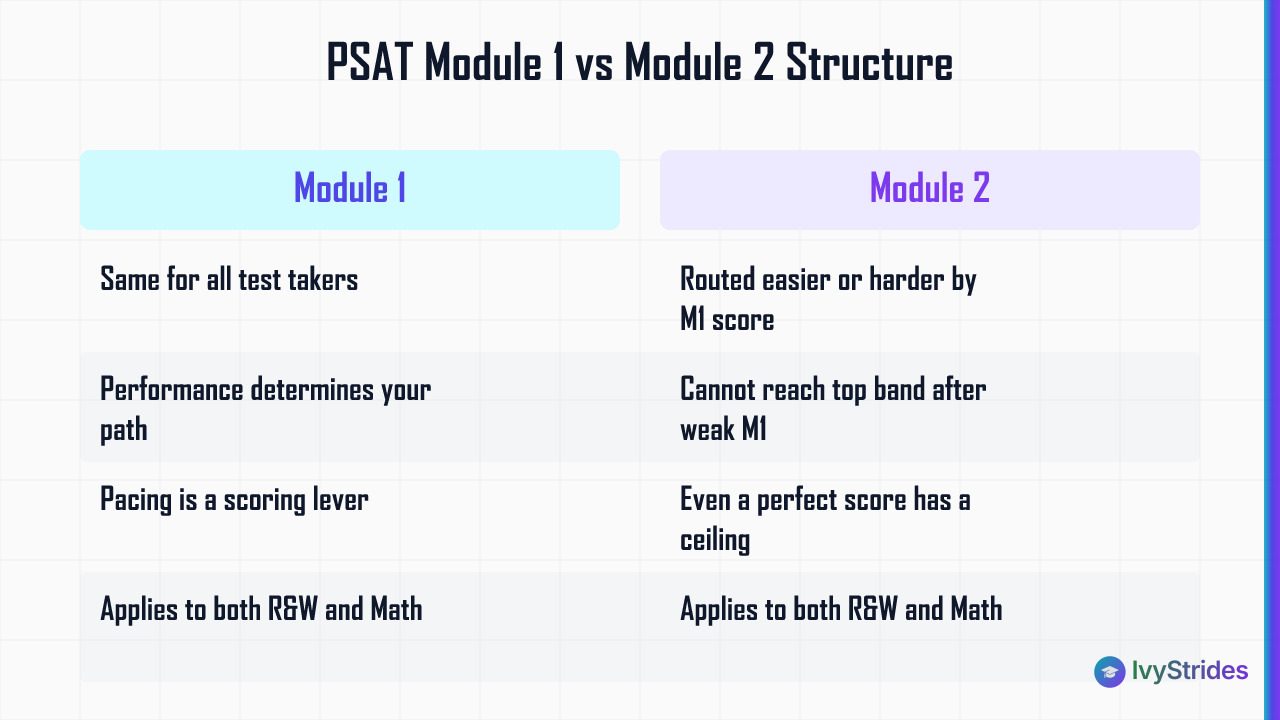
The PSAT/NMSQT is a digital adaptive exam delivered through the Bluebook app, College Board's official testing platform. Total testing time is 2 hours 14 minutes, split into two sections: Reading and Writing, then Math. The score range is 320 to 1520, with each section scored 160 to 760.
Both sections use the same adaptive structure. You take Module 1, and your performance routes you into an easier or harder Module 2. That routing matters more than most students realize. If you underperform Module 1, you cannot reach the highest score band even with a perfect Module 2. Pacing on the first module is a scoring lever, not just a time-management concern.
The Math section runs 70 minutes with 44 questions, averaging roughly 1 minute 35 seconds per question. Calculator use is permitted throughout, and the Desmos graphing calculator is built into the interface. There is no separate no-calculator section.
For 2026, College Board has announced new full-length PSAT/NMSQT and PSAT 10 practice tests arriving in Bluebook in late summer 2026. Until those release, use the currently available Bluebook practice tests, which mirror the same adaptive structure.
One useful clarification before you start: the PSAT is not used for college admissions directly. It's a diagnostic tool and, for 11th graders, the qualifying exam for the National Merit Scholarship Program. If you're new to the format, the difference between SAT and PSAT is a useful primer on how the two exams relate.
Step 1: Take a Full-Length Bluebook Practice Test Before You Study Anything
Here's the part most students skip and later regret: you can't build a study plan without a real diagnostic. Not a vibes-based estimate. Not last year's PSAT 8/9 score. A full-length, timed practice test in Bluebook, sitting quietly for the full 2 hours 14 minutes.
The Bluebook app is free and available at bluebook.app.collegeboard.org. The included practice tests use the same adaptive routing as the real exam, so your baseline score reflects how you'd actually perform in October. In our coaching, students who skip this step and jump straight into content review typically spend roughly 30 to 40 percent of their prep time on skills they already have. That's four to six wasted weeks for a typical junior.
After the test, sort every error into one of these buckets: Words in Context, Command of Evidence, Rhetorical Synthesis, Transitions (for R&W), and Algebra, Advanced Math, Problem-Solving and Data Analysis, Geometry and Trigonometry (for Math). This is your error log. It replaces guesswork with a study list.
Your PSAT score is the most accurate early predictor of your SAT starting point, so the same diagnostic gaps you find here will shape your SAT study plan. The PSAT and SAT share the same digital adaptive format and question types, so every hour you invest in PSAT prep carries directly into your SAT preparation. If you want more Bluebook-style questions, our PSAT practice tests library extends what College Board provides. And if you're wondering how the two exams compare in difficulty, is the PSAT harder than the SAT breaks it down.
What Score Should You Be Aiming For? Benchmarks by Grade and Goal
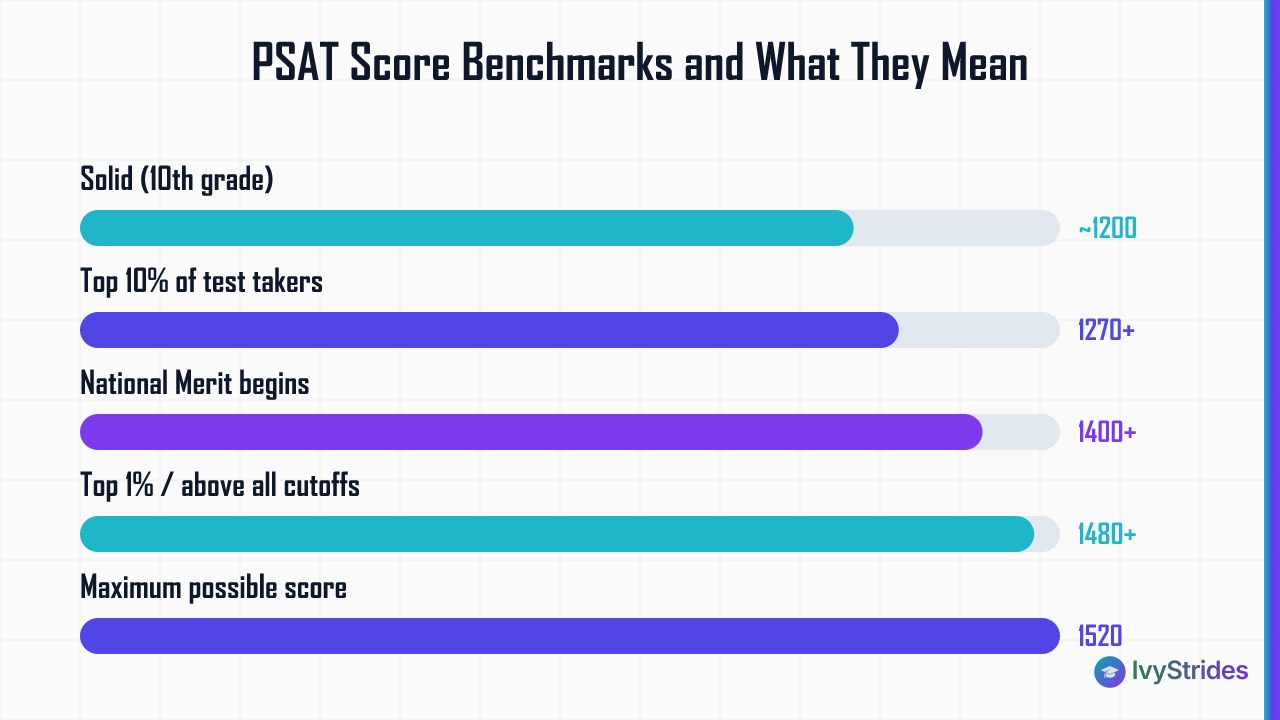
Before you build a study plan, you need a clear target score, and what counts as a strong score depends on your grade and whether National Merit is a realistic goal.
Here's how the numbers land, based on recent College Board percentile data:
- 1270+ places a student in roughly the top 10 percent of test takers. Strong score. Typically below National Merit Semifinalist range in most states.
- 1400+ is where National Merit Semifinalist territory generally begins, depending on your state's cutoff.
- 1480+ is approximately top 1 percent. Comfortably above the Semifinalist threshold in every state.
- 1520 is the maximum possible score.
For 10th graders, a score of roughly 1100 to 1200 is solid, and 1300 or higher is excellent. The PSAT in 10th grade is a lower-stakes diagnostic; it does not qualify for National Merit. Use it to identify skill gaps early. For a fuller picture of what strong looks like at that stage, see good PSAT scores for 10th graders.
For 11th graders targeting National Merit, aim for 1400 or higher on the composite and a Selection Index at or above your state's historical cutoff. In 2025, state Semifinalist cutoffs ranged roughly from 207 to 222 on the Selection Index. The 2026 cutoffs will not be published until September 2026, so treat the 2025 range as directional, not confirmed.
The Selection Index itself is calculated from your section scores (not the composite) and ranges 48 to 228. Two students with the same 1400 composite can have different Selection Indexes depending on how their R&W and Math scores are distributed. That distinction matters. If National Merit is your goal, you can't just aim for a composite; you have to check the index math.
The Commended Student threshold sits below the Semifinalist cutoff, typically around a Selection Index of 207 in recent cycles. Commended is a real recognition worth listing on applications.
One caveat worth surfacing: a strong PSAT score, especially one that earns National Merit recognition, is one signal in a holistic application that also includes your essays, GPA, and course rigor. It does not replace them. For context on how the PSAT score sits alongside SAT expectations, what is a good PSAT score walks through the ranges. And if you're specifically wondering about a mid-range score, is 1280 a good PSAT score has the direct answer.
Building Your PSAT Study Timeline: From 1 Week to 3 Months
How much time do you need? It depends on your score gap. Here's how it typically breaks down:
50 to 100 point gap: roughly 4 to 6 weeks, 3 to 4 sessions per week at 30 to 45 minutes each. About 15 to 25 total hours.
100 to 150 point gap: roughly 6 to 10 weeks. Similar session structure, but with a mid-cycle full-length practice test to re-diagnose and re-prioritize.
150+ point gap toward National Merit range: about 10 to 14 weeks of structured prep. In our coaching, students targeting this level of gain typically put in around 40 to 60 total hours across the cycle.
College Board recommends at least 3 study days per week at 15 to 30 minutes minimum. That's a floor, not a target. Students hitting National Merit range usually double or triple that baseline.
For 11th graders: the PSAT is administered in October at participating schools. Starting in late July or August gives you roughly 8 to 10 focused weeks, which is the sweet spot for most students in the 1300 to 1450 range aiming to push into Semifinalist territory.
For 10th graders: about 2 to 4 weeks of light prep is sufficient unless you're targeting a strong benchmark score.
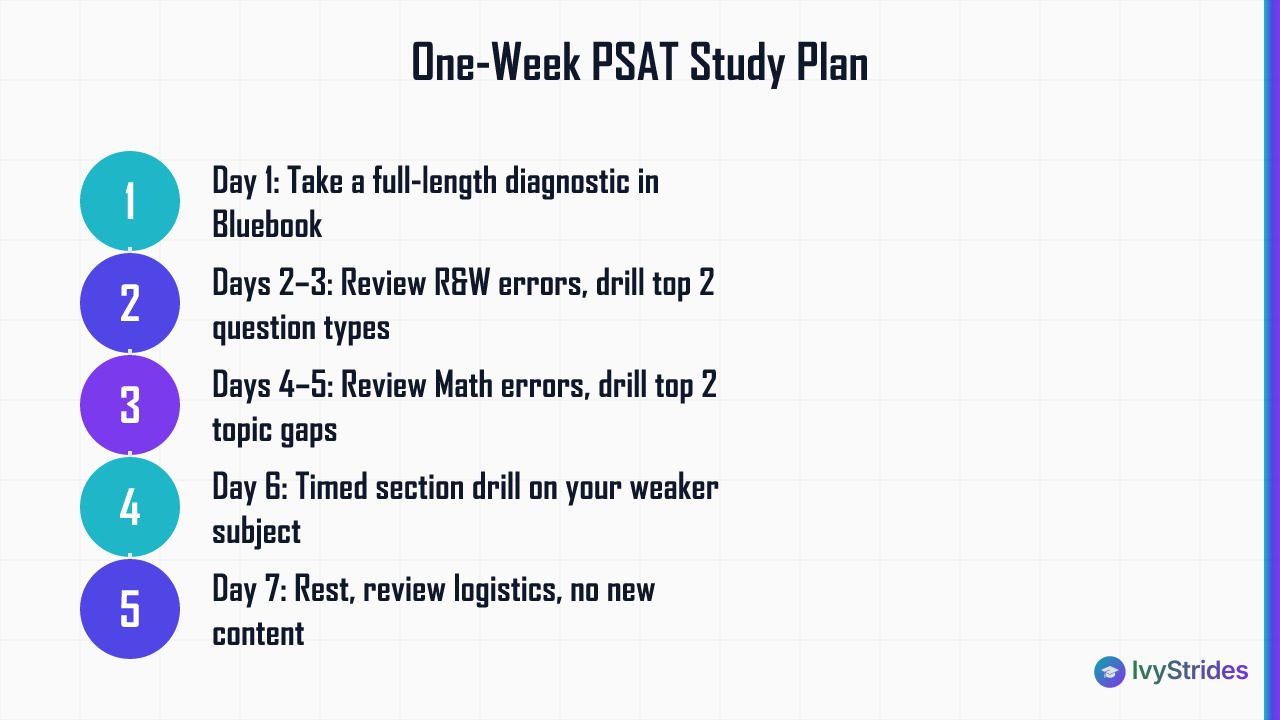
The one-week plan. Can you meaningfully prep in seven days? Yes, if you focus. Here's the structure:
- Day 1: Full-length diagnostic in Bluebook.
- Days 2 to 3: Review R&W errors. Drill your two most frequent question types.
- Days 4 to 5: Review Math errors. Drill your two most frequent topic gaps.
- Day 6: One timed section drill (either R&W or Math, whichever is weaker).
- Day 7: Rest. Review logistics. No new content.
Don't try to learn new material from scratch in a single week. The one-week plan is about tightening execution on skills you already have.
One more scheduling note: if you're also taking AP exams this year, coordinate your PSAT study blocks with your AP prep calendar so neither competes for the same high-focus weeks. The AP, SAT, and ACT testing plan for grades 9-12 lays out how these calendars typically stack.
Not Sure How Much Time You Need or Where to Start?
Book a free 15-minute strategy call with an IvyStrides coach. We will review your diagnostic score, identify your highest-priority gaps, and give you a concrete prep plan built around your actual test date.
How to Study for PSAT Reading and Writing: Section-Specific Tactics
R&W questions are grouped by type within each adaptive module, which means you can pace by question cluster rather than one question at a time. The four question types that matter most:
Words in Context. The correct answer fits the passage's specific meaning, not the most common dictionary definition. Students who first eliminate the answer that "sounds smartest" tend to improve accuracy quickly. If a word feels like the answer because it's a fancy synonym, it's probably wrong.
Command of Evidence (textual and quantitative). The quantitative version pairs a claim with a table or graph. Train yourself to read the data label first, then the claim, then the answer choices. Reading in the natural top-to-bottom order costs you time and accuracy.
Rhetorical Synthesis. You get three or four bullet notes and are asked which answer best combines them for a stated purpose. The trick: identify the stated purpose before you read any answer choice. If the question asks for an answer that "emphasizes a contrast," you can pre-filter answers that don't establish contrast.
Transitions. Only four transition relationships are tested: contrast, continuation, cause-effect, and example. Memorize those four categories and the signal words in each. This alone shaves seconds off every transition question.
Pacing target: roughly 1 minute 10 seconds per R&W question on average. Faster on short items, slower on Rhetorical Synthesis.
In our coaching with students in the 550 to 650 R&W score band, the highest-yield improvement typically comes from Rhetorical Synthesis and Transitions, not vocabulary. Students at this band often assume they need to memorize word lists. They don't. They need to practice reading question structure. If you're curious how PSAT R&W performance translates to SAT readiness, PSAT results and SAT readiness walks through the mapping.
How to Study for PSAT Math: What the Section Actually Tests
The Math section is 44 questions in 70 minutes, so roughly 1 minute 35 seconds per question. Algebra and advanced math together account for the majority of questions. Problem-Solving and Data Analysis and Geometry and Trigonometry are secondary categories, but they still show up on every test.
Desmos is built into the interface. In our coaching, students who practice with Desmos before test day typically save around 30 to 60 seconds per graphing question. If you've never used it, spend an hour on it this week. Learn how to graph, how to set sliders, and how to solve equations by plotting both sides.
Algebra and linear equations are the largest single content bucket. If your baseline Math score is under 600, this is where you spend most of your time. Systems of two linear equations, slope-intercept manipulation, and word problems that translate into linear equations are the pattern-heavy items.
Advanced math covers quadratics, exponentials, and nonlinear functions. Quadratic formula errors, especially sign errors and discriminant mistakes, are among the most common point-loss patterns in the 550 to 650 Math band. Quadratic formula mistakes that cost SAT points covers the exact error patterns worth memorizing.
Problem-solving and data analysis questions use tables, scatterplots, and two-way frequency tables. Same rule as R&W quantitative Command of Evidence: read the axis labels before the question stem. Half the difficulty on these questions is misreading what's being asked.
Geometry and trigonometry shows up in smaller volume: circle equations, right triangle trig, and angle relationships. If you're targeting 700+ in Math, this is where late-stage prep pays off. Below 600, don't spend time here until algebra is solid.
Look, the pattern is repetition on the biggest content bucket, not exotic topics. In our coaching, students in the 500 to 600 Math band who drill about 10 algebra questions per session for roughly 3 weeks typically see the most consistent Math score gains. For additional practice sets, our free SAT resources library includes PSAT-relevant math drills at no cost.
What Your PSAT Score Is Really Telling You (and How to Use It)
Once you get your PSAT score report back, most students look at the composite and stop reading. That's a mistake. The composite is the least useful number on the page.
The score report breaks your performance down by question type and skill area. That breakdown is the actionable data. A 1400 composite with 720 R&W and 680 Math is a different problem than a 1400 composite with 680 R&W and 720 Math. Different section-specialist priorities, different study hours, different tactics.
The Selection Index also warrants attention. It's calculated from your section scores, not the composite, and it's what NMSC uses for National Merit qualification. Two students with the same composite can have different indexes. If National Merit is on the table, check your index against your state's historical cutoff before assuming you're clear.
For SAT translation: a PSAT of 1470 typically maps to an SAT of roughly 1480 to 1520. A 1270 PSAT places a student in approximately the top 10 percent, but usually below National Merit Semifinalist range. Because the PSAT ceiling is 1520 and the SAT ceiling is 1600, very high PSAT scores compress slightly when projected upward.
In our coaching, students who review their score report at the question-type level before starting SAT prep typically save roughly 2 to 3 weeks of SAT prep time. They don't re-diagnose skills they've already proven. If a PSAT-to-SAT jump is your next move, how to improve your SAT score on a retake covers the retake methodology in more detail.
The Week Before and the Night Before the PSAT: What to Do (and What to Skip)
The last seven days are about sharpening execution, not learning new content. Here's the sequence that works:
Final week (Days 7 to 2 before the test): One timed section drill per day. Not full-length tests. Review your error log daily. Add zero new topics. If you haven't learned a concept by now, learning it this week won't help; it'll just eat sleep.
Night before (Day 1): Twenty minutes maximum on your two or three highest-frequency error types. Then close the books. Lay out your ID and any materials your school requires. Charge your device. Confirm your test location and start time.
Bring: an acceptable photo ID (school-issued or government-issued, per your school's policy), a pencil for scratch work if the school provides paper, and any approved backup calculator your school allows. Desmos is built into Bluebook, so a physical calculator is optional in most cases. Verify with your school proctor.
Sleep: Eight hours the night before beats an extra two hours of cramming. This is a cognitive-performance question, not a motivational one. A tired brain can't execute pacing strategy on adaptive Module 1, which is where the score routing happens.
Do not: take a full-length practice test the night before. Do not start a new content area. Do not skip breakfast. Arrive early enough to log into Bluebook and complete the check-in process without rushing.
That's it. The final week isn't where scores are made. It's where prepared students avoid losing points to fatigue or logistics.
FAQ
What is the best way to prepare for the PSAT?
The most effective preparation starts with a full-length Bluebook practice test to identify your specific weak question types, followed by targeted practice on those areas using official College Board materials. Spaced sessions of roughly 30 to 45 minutes, three to four times per week, outperform marathon cramming. For students with 8 or more weeks before the test, adding a second full-length practice test midway through your prep lets you measure progress and re-prioritize.
What should an 11th grader score on the PSAT?
For 11th graders, a score of about 1270 or above places you in roughly the top 10 percent of test takers, which is a strong result. To be competitive for National Merit Semifinalist recognition, you typically need a Selection Index of around 207 to 222 depending on your state, which corresponds to a composite score in the 1400 to 1520 range. The exact 2026 cutoffs will be announced by the National Merit Scholarship Corporation in September 2026.
Is a 1270 a bad PSAT score?
No. A 1270 places a student in approximately the top 10 percent of test takers and is a good score. It is typically below the National Merit Semifinalist threshold in most states, which usually requires a composite of 1400 or higher. Whether 1270 is "good enough" depends on your grade, your target colleges, and whether National Merit recognition is a goal.
What is a top 1% PSAT score?
A top 1 percent PSAT score is approximately 1480 or above on the 320 to 1520 scale, based on College Board percentile data. The maximum possible score is 1520. Scores in this range are well above the National Merit Semifinalist threshold in every state and signal strong SAT readiness.
How many hours should you study for the PSAT?
Hours depend on your score gap. Students aiming for a 50 to 100 point improvement typically need roughly 15 to 25 total hours spread over 4 to 6 weeks. Students targeting a 150+ point gain toward National Merit range typically need around 40 to 60 hours over 10 to 14 weeks in our coaching. Consistent, targeted sessions beat long unstructured blocks.
Can I study for the PSAT in a week?
Yes, one focused week can produce a meaningful improvement, especially if you concentrate on your two or three highest-frequency error types rather than trying to review everything. A practical plan: diagnostic on Day 1, R&W error work on Days 2 to 3, Math error work on Days 4 to 5, a timed section drill on Day 6, and rest plus logistics on Day 7. Don't try to learn new content from scratch in a single week.
How does a PSAT score translate to an SAT score?
The PSAT and SAT share the same digital adaptive format and question types, and College Board publishes concordance data showing how the two scales relate. A PSAT of 1400 typically corresponds to an SAT in the roughly 1400 to 1450 range. Because the PSAT ceiling is 1520 and the SAT ceiling is 1600, very high PSAT scores compress slightly when projected upward. Use your PSAT section scores, not just the composite, to identify which SAT prep areas deserve the most attention.
The PSAT is the exam where diagnostic-first prep pays the biggest dividend. Every hour you spend targeting your actual weak question types compounds into SAT readiness and, for juniors, National Merit consideration. If you want a coach reading your score report with you and building the plan from there, our coaching team works 1-on-1 with students in every score band. To learn more about how we approach test prep, read about IvyStrides.
Ready to Build a PSAT Plan That Actually Moves Your Score?
IvyStrides coaches work 1-on-1 with students worldwide, starting from a real diagnostic test and targeting the exact question types holding your score back. Students and parents: book your free 15-minute call today and leave with a clear next step.

Award-winning author (South Asian Book Award) and graduate of BITS Pilani and UCLA Luskin School of Public Affairs. Brings a published writer's eye to Common App essays and grammatical precision to SAT and ACT R&W instruction.