
Digital PSAT Format: Sections, Timing, and the Adaptive Structure (2026)
On this page
- The 2026 Digital PSAT at a Glance: Sections, Questions, and Total Time
- Inside the Reading and Writing Section: What Each Module Tests
- Inside the Math Section: Domains, Question Types, and the Calculator Rule
- How the Adaptive Structure Works (and Why It Changes How You Should Prep)
- How the PSAT Is Scored: Scale, Sections, and What the Numbers Mean
- PSAT 8/9 vs. PSAT 10 vs. PSAT/NMSQT: Same Structure, Different Stakes
- PSAT vs. SAT: Format Differences That Actually Matter for Your Prep
- The National Merit Connection: Why the PSAT/NMSQT Format Matters Beyond Practice
- What to Expect on Test Day: Pacing, Tools, and the Bluebook Experience
- FAQ
- What are all the sections of the PSAT/NMSQT?
- Is a 1470 PSAT score enough for National Merit?
- What does a 1200 on the PSAT equal on the SAT?
- Is the PSAT all multiple choice?
- Is the PSAT the same length as the SAT?
- Should I take the PSAT before the SAT?
- What is the pattern of the PSAT exam?
The 2026 digital PSAT/NMSQT runs 2 hours and 14 minutes and has two sections: Reading and Writing (54 questions, 64 minutes) and Math (44 questions, 70 minutes). Each section splits into two timed modules, and the test is adaptive: your Module 1 performance decides whether Module 2 gets harder or easier. Total questions: 98. Score scale: 320–1520. A built-in Desmos calculator is available for every Math question, and the whole exam is delivered through College Board's Bluebook app.
These numbers come from the College Board PSAT/NMSQT structure page, which we cite throughout. The harder question, and the one most students walk into test day without a real answer to, is what "adaptive" actually means for pacing and score ceiling. The next section starts there.

The 2026 Digital PSAT at a Glance: Sections, Questions, and Total Time
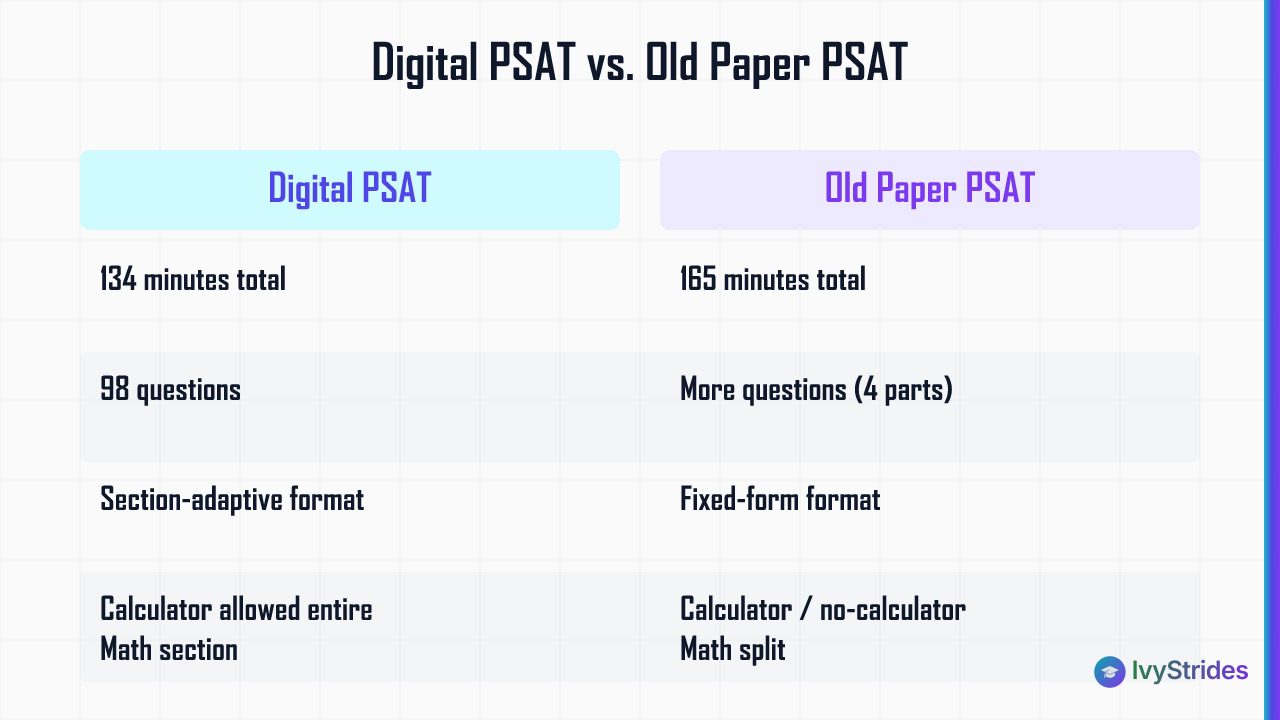
Here is the full structure in one view.
| Section | Modules | Questions per module | Time per module | Section total |
| Reading and Writing | Module 1, Module 2 | 27 each | 32 minutes each | 54 questions, 64 min |
| Math | Module 1, Module 2 | 22 each | 35 minutes each | 44 questions, 70 min |
| Full test | 4 modules | 98 questions | plus one 10-minute break | 2 hr 14 min |
A few points worth locking in.
The section order is fixed: Reading and Writing first, then a 10-minute break, then Math. There's no break between Module 1 and Module 2 inside a section. The test is delivered on the Bluebook app, which handles adaptive routing automatically and includes a built-in Desmos graphing calculator for the entire Math section. There's no separate no-calculator module on the digital PSAT.
Historical context: the old paper PSAT ran 165 minutes with four parts and a calculator/no-calculator Math split. The digital PSAT is shorter (134 minutes), has fewer questions, and is section-adaptive rather than fixed-form. If you're reading older prep material referencing "Evidence-Based Reading and Writing" or a "no-calculator section," it's out of date.
Once you have the format down, the natural next question is what score to aim for. Our guide to what is a good PSAT score breaks down percentile benchmarks by grade so you can set a concrete target.
Inside the Reading and Writing Section: What Each Module Tests
The Reading and Writing section is 54 questions across two 32-minute modules. Every question is tied to a short discrete passage of roughly 25 to 150 words, and each passage has exactly one question attached. No long passages with five or six questions stacked underneath. That's a real departure from the old paper test.
College Board organizes the section into four content domains, with roughly these distributions:
- Information and Ideas (about 26% of questions): reading comprehension, main idea, inference, quantitative evidence, textual evidence.
- Craft and Structure (about 28%): word-in-context, text structure, cross-text connections between paired short passages.
- Expression of Ideas (about 20%): rhetorical synthesis, transitions, and using notes to accomplish a goal.
- Standard English Conventions (about 26%): grammar, punctuation, sentence boundaries, subject-verb agreement, modifier placement.
Module 1 mixes easy, medium, and hard questions across all four domains. Module 2 tests the same domains but shifts the difficulty distribution based on how you performed in Module 1. The domains don't disappear; the questions in the harder Module 2 just demand more precise reading and tighter grammar judgment.
The section is dominated by four-option multiple choice. So to answer a common student question directly: yes, Reading and Writing is functionally all multiple choice. Math is where the format broadens.
If you're figuring out which PSAT applies to your grade, the PSAT versions difference breakdown covers that in detail.
Inside the Math Section: Domains, Question Types, and the Calculator Rule
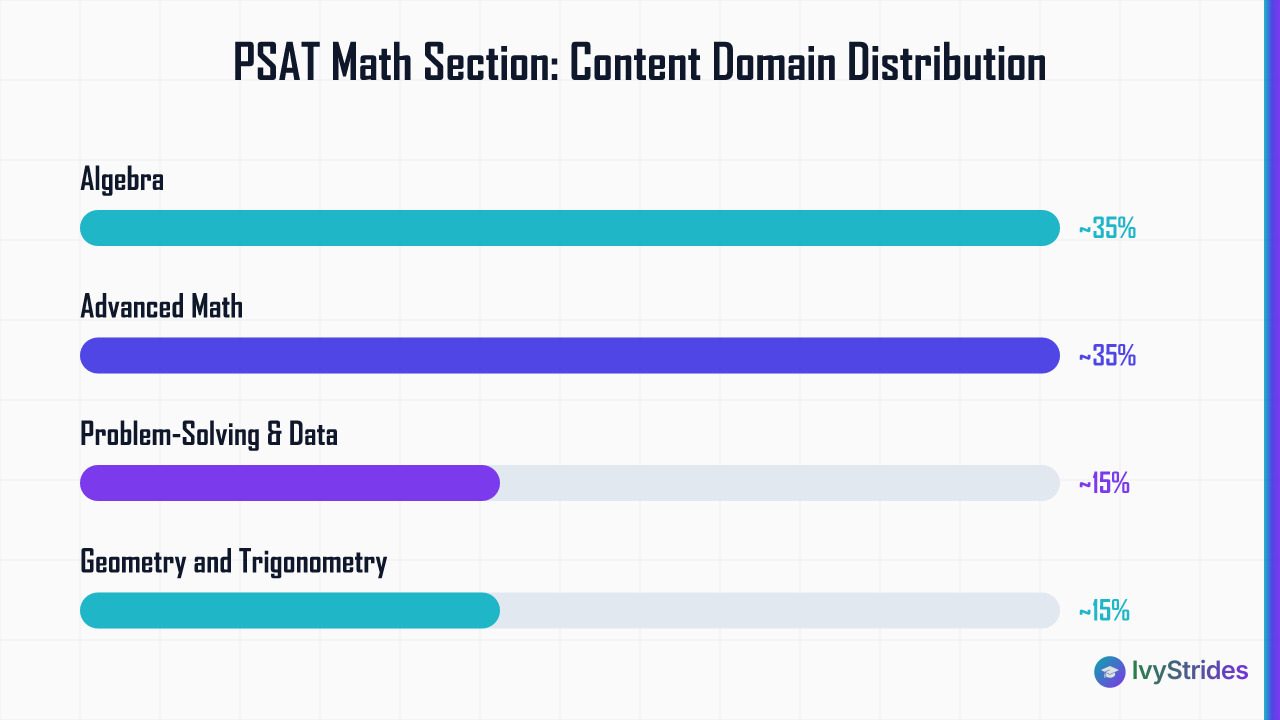
The Math section is 44 questions across two 35-minute modules. Calculator use is permitted on every question, and Bluebook has a built-in Desmos graphing calculator on-screen the whole time. You can also bring an approved handheld calculator if you prefer.
The four content domains, with approximate distribution:
- Algebra (about 35%): linear equations, linear inequalities, systems of two linear equations, linear functions.
- Advanced Math (about 35%): quadratics, exponential functions, polynomials, nonlinear equations and systems.
- Problem-Solving and Data Analysis (about 15%): ratios, rates, percentages, one-variable data, two-variable data, probability, sample statistics.
- Geometry and Trigonometry (about 15%): area and volume, triangles, right triangles and trigonometry, circles.
Question format matters here. Roughly three-quarters of Math questions are four-option multiple choice. The remaining quarter, about 4 questions per module or 8 total, are student-produced response (SPR) questions where you type your own numerical answer instead of picking a choice. Fractions and decimals are both accepted. There's no penalty for wrong answers on any question type, so guessing on an SPR you can't finish is always better than leaving it blank.
Compared to the SAT, PSAT Math has a lower ceiling. You'll see fewer of the hardest Advanced Math items (complex numbers, the trickiest nonlinear systems), and Geometry and Trigonometry questions tend to sit at the easier end of the SAT range. That's a design choice tied to grade-level alignment, not a bug.
Trying to figure out where you currently stand? Is 1280 a good PSAT score walks through what that number means at each grade level.
How the Adaptive Structure Works (and Why It Changes How You Should Prep)
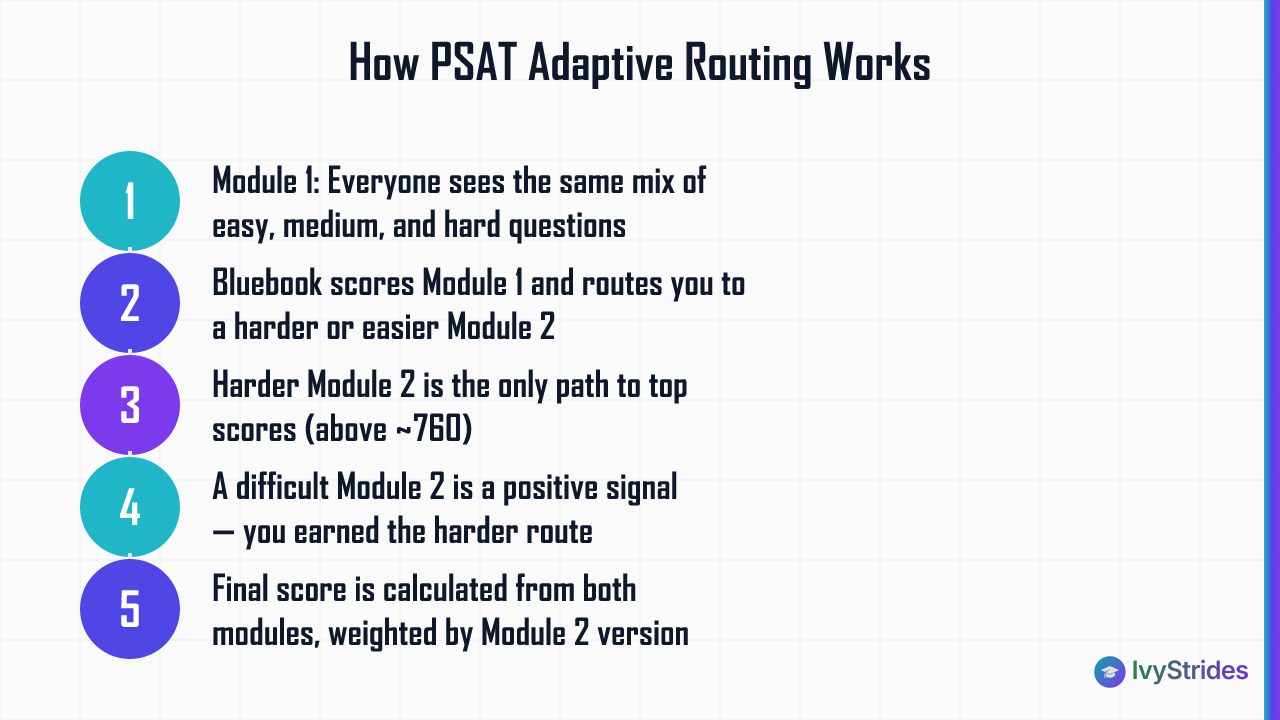
This is the mechanic most students misunderstand, and it's the single most consequential thing on test day.
The PSAT uses adaptive multistage testing. Module 1 in each section is fixed: everyone sees the same mix of easy, medium, and hard questions. Bluebook then scores your Module 1 performance and routes you to one of two Module 2 versions. A harder one if you did well, an easier one if you didn't. Your total section score is calculated from both modules together, weighted by which Module 2 you saw.
Here's the part most students miss: the harder Module 2 is the only path to the top of the score range. If you're routed to the easier Module 2, your section score is capped well below 760, even if you answer every question correctly. That means Module 1 consistency, not Module 2 heroics, is what determines your ceiling.
There's a second implication. When Module 2 feels genuinely difficult, that's a positive signal. You made it into the harder route. In our coaching with students in the 1100 to 1300 band, the most common self-inflicted score loss comes from a student who sees a hard Module 2 question, panics, assumes they're bombing, and rushes the remaining questions. They were doing well. They just didn't recognize it.
The adaptive routing is invisible during the test. You won't see a message telling you which version of Module 2 you received. You find out only when scores release, and even then, only indirectly through the score itself.
Concrete example: a student who scores in the top half of Module 1 Reading and Writing gets routed to a Module 2 with more Craft and Structure and Expression of Ideas questions at higher complexity, including trickier rhetorical synthesis items and denser word-in-context passages. Same domains, harder application.
How aggressively you prep depends heavily on your grade. A 9th grader building baseline familiarity has a very different priority than an 11th grader targeting a National Merit cutoff. Our PSAT strategy by grade guide breaks this out year by year.
In our coaching with students targeting the top score bands, the adaptive module structure is the single most important thing to train for. If Module 1 performance is inconsistent, the student never reaches the harder Module 2 questions that unlock the highest scores. That's why our 1-on-1 PSAT prep builds Module 1 accuracy first and Module 2 difficulty tolerance second.
How the PSAT Is Scored: Scale, Sections, and What the Numbers Mean
Total score: 320 to 1520. Section scores: 160 to 760 for Reading and Writing, 160 to 760 for Math. Add them for the composite.
The PSAT/NMSQT tops out at 1520 rather than 1600 because it's scaled to the SAT but capped below the SAT ceiling. It's not a different test structure or question style; it's a lower difficulty band on the same scale. Practically, a 1520 PSAT and a 1520 SAT represent the same demonstrated skill. What differs is the harder content the SAT can test above 1520.
Approximate PSAT-to-SAT concordance, based on College Board's published data:
- 1200 PSAT is roughly a 1200 to 1230 SAT.
- 1350 PSAT is roughly a 1360 to 1400 SAT.
- 1470 PSAT is roughly a 1500 to 1520 SAT.
These are directional, not guarantees. Individual results vary based on prep between tests, test-day conditions, and how much of your PSAT score came from the harder Module 2 versus the easier one.
For National Merit, the Selection Index has its own formula: (Reading and Writing test score + Math test score) × 2, using the 8-to-38 test-score scale reported alongside your PSAT results (not the 160-to-760 scale). The maximum Selection Index is 228. Cutoffs come in the next section.
One trust point worth stating plainly: PSAT scores are not sent to colleges. They don't appear on college applications. Test-optional policies at colleges don't apply to the PSAT, because the PSAT is never submitted to admissions offices in the first place. The only external body that uses PSAT scores directly is the National Merit Scholarship Corporation.
Once you understand the scale, our benchmarks guide to good PSAT scores will help you set a target. If you're specifically chasing National Merit, we also have a dedicated National Merit Scholarship breakdown.
PSAT 8/9 vs. PSAT 10 vs. PSAT/NMSQT: Same Structure, Different Stakes
Three tests sit inside the SAT Suite of Assessments below the SAT itself.
| Test | Grades | Score scale | Total time | National Merit? |
| PSAT 8/9 | 8–9 | 240–1440 | 2 hr 14 min | No |
| PSAT 10 | 10 | 320–1520 | 2 hr 14 min | No |
| PSAT/NMSQT | 10–11 | 320–1520 | 2 hr 14 min | Yes, 11th grade only |
All three use the same two-section adaptive-module structure, run through Bluebook, and last 2 hours 14 minutes. The differences that matter:
The PSAT 8/9 tops out at 1440 because it's scaled to grade-appropriate content for 8th and 9th graders. It's not a scoring error and it's not a "lower-quality" version of the test. The Math content simply excludes some Advanced Math and trigonometry topics, so the difficulty ceiling is capped accordingly.
Only the PSAT/NMSQT taken in 11th grade counts for National Merit. A 10th grader who scores 1520 on the PSAT/NMSQT gets a great data point and nothing else; they still need to take the PSAT/NMSQT again as a junior to enter the National Merit pool. The PSAT 10, despite the same 320–1520 scale, doesn't qualify at all.
To the "is the PSAT all multiple choice" question: no version is fully multiple choice. Reading and Writing is multiple choice across all three tests, but Math on all three includes roughly 8 student-produced response questions across the two modules.
For grade-specific benchmarks, see good PSAT score for 10th graders.
PSAT vs. SAT: Format Differences That Actually Matter for Your Prep
The two tests are more similar than most students expect. Both run 2 hours 14 minutes. Both have 98 questions. Both use Bluebook, both are section-adaptive, both share the same four Reading and Writing domains and four Math domains, and both allow calculator use throughout Math.
What differs:
- Score scale: PSAT 320 to 1520, SAT 400 to 1600. Section scores cap at 760 on the PSAT and 800 on the SAT.
- Difficulty ceiling: the SAT includes harder Advanced Math items (more complex nonlinear systems, occasionally complex numbers), tougher Craft and Structure questions in Reading and Writing, and denser Expression of Ideas synthesis tasks. The PSAT's Module 2 hard track approximates the SAT's medium-to-hard band but doesn't reach the SAT's ceiling.
- Stakes: the SAT gets sent to colleges. The PSAT doesn't.
The practical takeaway: a strong PSAT score is a reliable predictor of SAT readiness, but the transition still requires targeted work at the top end. In our coaching with students who score 1350+ on the PSAT/NMSQT, the move to SAT prep typically takes about 6 to 10 weeks of focused practice on the harder Advanced Math and Reading and Writing question types that only appear on the SAT.
If you're weighing whether to prioritize PSAT prep or jump straight to SAT prep, the difference between SAT and PSAT goes deeper than just the score scale, and understanding it shapes your junior-year timeline. For the difficulty question specifically, see is the PSAT harder than the SAT.
The National Merit Connection: Why the PSAT/NMSQT Format Matters Beyond Practice
For 11th graders, the PSAT/NMSQT isn't just a practice run. The National Merit Scholarship program uses your Selection Index from this single test, which is why knowing the format and targeting a specific score band matters more than most students realize.
The mechanics:
- Selection Index formula: (Reading and Writing test score + Math test score) × 2, using the 8-to-38 scale, maximum 228.
- Semifinalist cutoffs vary by state each year. Historically they've ranged from roughly 207 in less competitive states (a composite of about 1370 to 1400) up to about 222 in the most competitive states like California, New Jersey, Massachusetts, and Washington DC (a composite of roughly 1480 to 1520).
- Commended Scholar threshold has sat nationally around 207 to 209 in recent years.
- Cutoffs are published annually by the National Merit Scholarship Corporation, not by College Board, and they shift year to year.
A 1470 PSAT is competitive for Semifinalist in most states but falls short of recent cutoffs in the toughest ones. National Merit Semifinalist status is one factor in scholarship consideration; final awards depend on additional criteria including academic record, an application essay, and school endorsement.
In our coaching with students targeting National Merit Semifinalist status, the adaptive Module 2 performance in both Reading and Writing and Math is the critical variable. Students who consistently reach and perform well on the harder Module 2 land in the 1460+ range. Students who plateau in the easier Module 2 rarely clear the cutoff regardless of raw effort.
Your PSAT timeline also fits inside a larger college application calendar. Knowing when the October PSAT falls relative to SAT registration windows and early-decision deadlines helps you sequence prep without overlap. For students in that top band, our guides to how to prep for National Merit and is free PSAT prep enough cover what actually moves the needle at this level.
What to Expect on Test Day: Pacing, Tools, and the Bluebook Experience
Logistics matter more than students expect. Pacing errors and tool unfamiliarity account for a real chunk of avoidable score loss.
Pacing math:
- Reading and Writing: 32 minutes ÷ 27 questions ≈ 71 seconds per question.
- Math: 35 minutes ÷ 22 questions ≈ 95 seconds per question.
Those averages hide variance. In Reading and Writing, most questions take roughly 45 to 60 seconds, but Craft and Structure and Expression of Ideas questions with denser passages can eat 90+ seconds. In Math, easier Algebra items should take about 30 to 45 seconds, saving time for the Advanced Math and multi-step Geometry problems that can run past two minutes.
Bluebook tools worth practicing with before test day:
- The Desmos graphing calculator, embedded on every Math question. If you use it, learn to type equations correctly and read the graph output. Fumbling Desmos live on the test costs roughly 30 to 60 seconds per question.
- The flag tool for marking a question to revisit.
- The annotation tool for highlighting passage text in Reading and Writing.
- The reference sheet in Math, with common formulas.
Break structure: one 10-minute break between Reading and Writing and Math. No break between Module 1 and Module 2 inside a section, so plan bathroom timing accordingly.
What to bring: your testing device (school-issued or personal, per your school's protocol), a charger, an approved photo ID for older students, and an approved backup calculator if you want one. Snacks and water for the break.
Score release: typically about 6 to 8 weeks after the October test date.
Accommodations: extended time, extra breaks, and other accommodations are available through College Board for students with documented IEPs, 504 plans, or medical needs. Requests go through your school's SSD coordinator and should be initiated well in advance of your test date.
Students we've coached report noticeably less friction on test day when they practice with Bluebook itself, not paper practice tests. The interface, the calculator, the flagging tool all behave differently on screen than on paper. Our full-length PSAT practice tests in the actual digital format are the closest thing to a real test-day rehearsal. You can also grab section drills from our free downloads library.
FAQ
What are all the sections of the PSAT/NMSQT?
The PSAT/NMSQT has two sections: Reading and Writing (54 questions, 64 minutes) and Math (44 questions, 70 minutes). Each section is divided into two adaptive modules. There's no separate Science section and no standalone Writing test. The full exam runs 2 hours and 14 minutes.
Is a 1470 PSAT score enough for National Merit?
A 1470 PSAT/NMSQT score is competitive for National Merit Semifinalist status in most U.S. states, but it can fall short in the most competitive states such as California, New Jersey, Massachusetts, and Washington DC, where recent cutoffs have reached roughly the 1480 to 1520 range. Cutoffs are published annually by the National Merit Scholarship Corporation and vary year to year. Only the PSAT/NMSQT taken in 11th grade counts.
What does a 1200 on the PSAT equal on the SAT?
A 1200 PSAT/NMSQT is approximately equivalent to a 1200 to 1230 on the SAT, based on College Board's concordance data. The two tests share the same content domains and adaptive structure, so PSAT scores are a reliable directional predictor of SAT performance. Individual results still vary based on preparation between tests and test-day conditions.
Is the PSAT all multiple choice?
No. Reading and Writing is entirely four-option multiple choice. Math is mostly multiple choice but includes roughly 8 student-produced response (SPR) questions across the two modules, where you type in your own numerical answer instead of picking from options.
Is the PSAT the same length as the SAT?
Yes. Both the digital PSAT/NMSQT and the Digital SAT run 2 hours and 14 minutes and contain 98 questions total. The key differences are the score scale (PSAT 320–1520 vs. SAT 400–1600) and the difficulty ceiling: the SAT includes harder question types in both Math and Reading and Writing that don't appear on the PSAT.
Should I take the PSAT before the SAT?
For most students, yes. The PSAT/NMSQT is a low-stakes diagnostic in the same digital adaptive format as the SAT, so your score reveals section-level weaknesses before they show up on the real thing. For 11th graders, the PSAT/NMSQT also opens the National Merit pathway, which makes it worth taking seriously rather than as throwaway practice.
What is the pattern of the PSAT exam?
The PSAT follows a fixed sequence: Reading and Writing Module 1, Reading and Writing Module 2, a 10-minute break, Math Module 1, and Math Module 2. Module 1 in each section contains a fixed mix of difficulty. Module 2 is adaptively routed based on Module 1 performance: strong performance leads to a harder Module 2, weaker performance to an easier one. The routing is automatic and invisible during the test.
Knowing the format is step one. Turning that knowledge into a section-by-section prep plan matched to your current score and target is the harder step, and it's the one worth getting right.

Award-winning author (South Asian Book Award) and graduate of BITS Pilani and UCLA Luskin School of Public Affairs. Brings a published writer's eye to Common App essays and grammatical precision to SAT and ACT R&W instruction.