
What to Bring to the PSAT? A Clear, Complete Guide for Students and Parents

On this page
- The Required PSAT Test-Day Items: Your Non-Negotiable Checklist
- What NOT to Bring to the PSAT and Why It Matters
- Nice-to-Have PSAT Items That Reduce Test-Day Friction
- Why Getting PSAT Test Day Right Actually Matters for Your Score
- FAQ: What to Bring to the PSAT
- What do I need to bring to the PSAT?
- Can I bring my phone to the PSAT?
- Can you bring a backpack to the PSAT?
- Do I need No. 2 pencils or can I use mechanical ones on the PSAT?
- Your Next Step Before the PSAT Window
Bring a fully charged laptop or Chromebook with the Bluebook app set up, a valid photo ID, an approved calculator, and pencils for scratch work. A power cord and an analog watch help. Leave your phone powered off in your bag.
You do not need a printed admission ticket for the PSAT. The PSAT/NMSQT is a digital exam you take on the Bluebook app during a school-day window in October, so your device and its charge matter more than any other item you pack. The rules below trace to College Board's own testing-rules and what-to-bring pages, cited in each section. One caveat up front: ID requirements depend on where you test, and your school may run its own procedures.
The Required PSAT Test-Day Items: Your Non-Negotiable Checklist
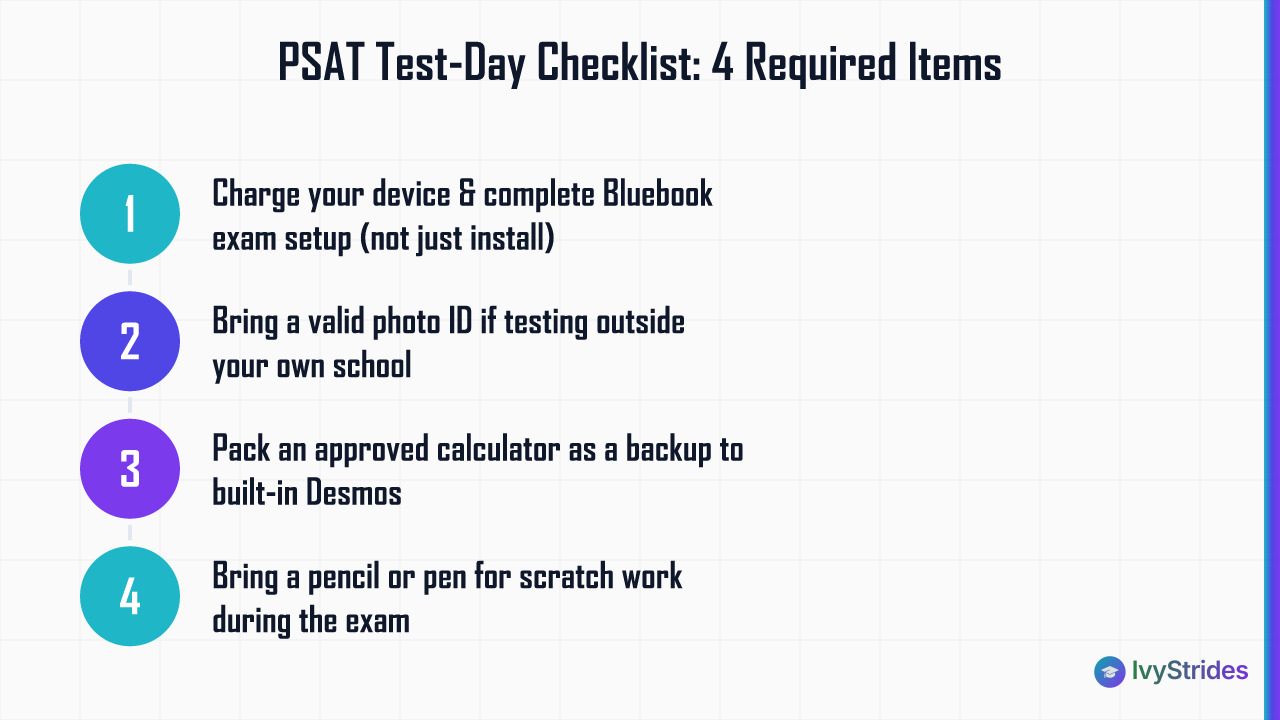
The PSAT/NMSQT requires four things to sit the exam without interruption: a fully charged testing device with Bluebook set up, a valid photo ID when required, an approved calculator, and a pencil for scratch work. The College Board In-School Assessments what-to-bring page is the authoritative list, not any third-party checklist.
Installed is not set up. The Bluebook app is College Board's official digital testing application, and it runs the whole exam. Here's the distinction most students miss: installing Bluebook is not the same as completing exam setup. Setup is a separate step inside the app that downloads your specific test and confirms your device is ready. In our coaching, students who install the app but skip exam setup are the most common device-related disruption we see the morning of the test.
Photo ID, when you need it. You need a school-issued or government-issued photo ID only if you test outside your own school, per College Board. Testing in your own building with teachers who know you? Usually no ID needed. Bring the physical card, not a photo of it on your phone.
The calculator question comes up constantly. Bluebook includes a built-in Desmos graphing calculator for the whole Math section, so a physical calculator is a backup, not a requirement. In our coaching, students who bring a familiar physical calculator as a backup report less Math-section anxiety, even when they end up using Desmos anyway.
Because the PSAT runs on Bluebook's two-module adaptive structure, a dead device mid-test is not a minor inconvenience; it ends your session. That is why the power cord and a portable charger sit in the required column, not the optional one. For the full section-by-section picture, our Digital PSAT format and sections breakdown continues where this stops. First-timers who want a quick orientation can start with what is the PSAT.
| Item | Requirement | Key Detail |
| Testing device | Required | Fully charged laptop or Chromebook; school may supply one |
| Bluebook app | Required | Installed AND exam setup complete before test day |
| Power cord / charger | Strongly advised | Permitted by College Board; prevents a dead battery |
| Photo ID | Conditional | Needed only when testing outside your own school |
| Approved calculator | Optional backup | Desmos built into Bluebook; physical calculator permitted |
| Pencil or pen | Required | For scratch work only; no bubbling on paper |
Source: College Board In-School Assessments and PSAT/NMSQT Testing Rules.
What NOT to Bring to the PSAT and Why It Matters
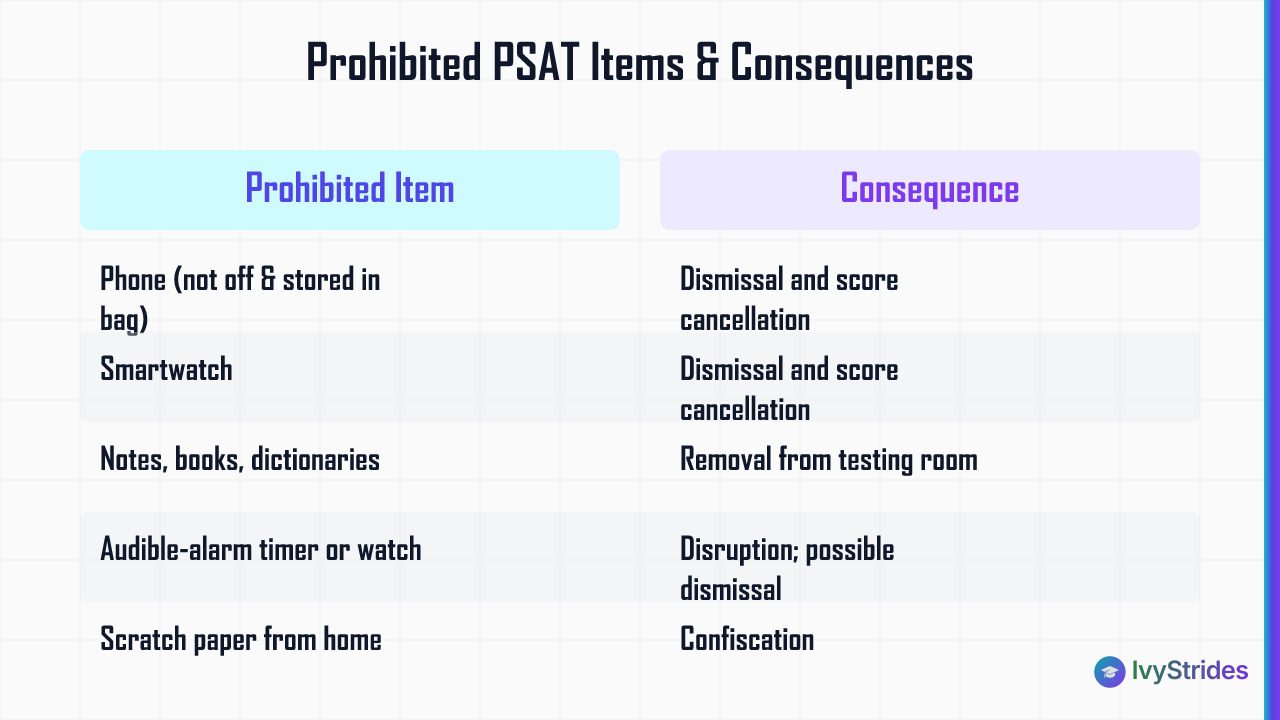
Your phone is the single item most likely to cost you a PSAT score. Per the College Board PSAT/NMSQT testing rules, your phone must be powered completely off and stored in your bag, not silenced and not in your pocket. A phone that is visible, rings, or gets used during testing can lead to immediate dismissal and score cancellation.
That last point is the one to sit with. College Board does not say a visible phone "might" cause a problem; the rules state it can end your test. Smartwatches carry the same risk, so leave the smartwatch home. An analog watch without an audible alarm is fine, which we cover next.
The prohibited list is short and strict. No notes, books, or dictionaries. No digital timers with audible alarms. No separate scratch paper from home, because your proctor provides scratch paper. Anything that could feed you information or disrupt the room is out.
One point of confusion worth clearing: the SAT test-day checklist is nearly identical, with one key difference. The SAT requires a printed or digital admission ticket, while the PSAT does not. If a friend told you to print a ticket, they were describing the SAT.
| Item | Rule | Consequence If Violated |
| Phone | Off and stored, not silenced | Dismissal and score cancellation |
| Smartwatch | Prohibited entirely | Dismissal and score cancellation |
| Notes, books, dictionaries | Not allowed | Removal from testing room |
| Audible-alarm timer or watch | Not allowed | Disruption; possible dismissal |
| Scratch paper from home | Not allowed; provided at test | Confiscation |
Source: College Board PSAT/NMSQT Testing Rules and In-School Assessments.
Nice-to-Have PSAT Items That Reduce Test-Day Friction
The PSAT permits several optional items that improve comfort and pacing without being required. An analog watch, a snack, a portable charger, extra calculator batteries, and an external mouse all fall in this group. College Board's testing rules explicitly permit the power cord, portable charger, external mouse and mouse pad, and a pen or pencil for scratch work.
Why the watch earns a spot. Bluebook shows a timer you can hide, and some students pace better glancing at a wrist. The watch must have no audible alarm and no smart features. Smartwatches, again, are prohibited.
Water and snacks: yes, with a rule. You can pack a snack and water, but you consume them during the designated break only, not at your desk during testing. Keep them in your bag.
That bag is allowed, too. A backpack is permitted in the testing room but must be stored away from your desk during the exam, per College Board. You won't reach it while testing, only during breaks, so anything you might want at the break goes in an outside pocket you can grab fast.
Once your bag is packed, the natural next question is what score to aim for, and our PSAT score range and percentiles guide bridges from logistics to planning.
- Analog watch, Paces you without Bluebook's on-screen timer; no audible alarm.
- Snack and water, Refuels you at the break; stored in your bag during testing.
- Extra calculator batteries, Cheap insurance if you rely on a physical calculator.
- External mouse and mouse pad, Faster than a trackpad on Desmos graphing.
- Backpack, Holds everything above; stored away from your desk while you test.
Why Getting PSAT Test Day Right Actually Matters for Your Score

Photo by cottonbro studio on Pexels
A checklist error on the PSAT is not just inconvenient; for a junior, it can close the National Merit pathway for the year. The PSAT/NMSQT is the National Merit qualifying test, per College Board, and juniors have one sitting per year that counts for eligibility. A dead device, a cancelled session from a visible phone, or a missing ID can end that one chance before it starts.
Here's the mechanism. The National Merit Scholarship Corporation uses the PSAT/NMSQT Selection Index to screen entrants to its scholarship programs. The College Board score-meaning page sets the total score range at 320 to 1520 and the Selection Index scale at 48 to 228. That 228 ceiling follows directly from the formula: double your Reading and Writing section score, add Math, divide by 10, so (2 × 760 + 760) / 10 lands at 228 (IvyStrides).
Cutoffs are not College Board's to publish. NMSC sets qualifying scores per state and per year, and it is the only authority for them. Don't trust any blog quoting a fixed national number as this year's cutoff. A smooth, distraction-free test day is the first step toward the Selection Index score that opens the National Merit pathway.
None of this guarantees a score. Preparation reduces friction; it does not determine the outcome. What it does mean is that a wasted sitting has real downstream cost for juniors, so a structured prep plan mapped to your school's October date is worth building now.
| Element | Figure | Why It Matters |
| Total score range | 320 to 1520 | The full PSAT/NMSQT scale |
| Section score range | 160 to 760 | Feeds the Selection Index |
| Selection Index scale | 48 to 228 | What NMSC screens on |
| Qualifying sitting | One per year, junior year | The chance you can't repeat |
Source: College Board score-meaning page and National Merit Scholarship Corporation.
For juniors who want to know what score the pathway asks of them, our National Merit cutoffs by state explainer is the next step. If you'd rather build the prep itself, our PSAT prep coaching starts from a diagnostic baseline and sequences the work against the October window.
FAQ: What to Bring to the PSAT
What do I need to bring to the PSAT?
Bring a fully charged device with Bluebook installed and exam setup complete, a valid photo ID if you're testing outside your own school, an approved calculator, and pencils for scratch work. A power cord and an analog watch are useful extras, and you can skip the printed admission ticket the SAT asks for.
Can I bring my phone to the PSAT?
You can carry it into the building, but it must be powered completely off and stored in your bag during the exam. A phone that is visible, rings, or gets used while testing can lead to immediate dismissal and score cancellation, per College Board rules. Silencing it is not enough; power it all the way down.
Can you bring a backpack to the PSAT?
Yes. A backpack is allowed in the testing room but must be stored away from your desk during the exam. Keep your phone, snacks, and extra supplies inside it. You'll only reach the bag during designated breaks, so pack anything you might want at the break where you can grab it fast.
Do I need No. 2 pencils or can I use mechanical ones on the PSAT?
The PSAT is digital, so you use pencils only for scratch work on the paper your proctor provides. College Board permits any pen or pencil for that purpose, and mechanical pencils are completely fine. You never bubble in answers on paper, so the old No. 2 rule doesn't apply here.
Your Next Step Before the PSAT Window
Pack the bag tonight so the morning is boring, which is exactly what you want on test day. The rules above come from College Board's own testing pages, and those pages can change, so check the official version if your test is more than a few weeks out.
- Charge your device fully and open Bluebook to confirm exam setup is complete, not just installed.
- Set out your photo ID if you're testing outside your own school.
- Pack an approved calculator as a Desmos backup, plus pencils and a power cord.
- Power your phone off and store it in your bag; leave the smartwatch home.
- Skip the printed ticket. The PSAT doesn't require one.

Award-winning author (South Asian Book Award) and graduate of BITS Pilani and UCLA Luskin School of Public Affairs. Brings a published writer's eye to Common App essays and grammatical precision to SAT and ACT R&W instruction.