
PSAT 8/9 vs. PSAT 10 vs. PSAT/NMSQT: The Differences Explained (2026)
On this page
- The Short Answer: Three PSAT Versions, Three Different Purposes
- Side-by-Side Comparison: PSAT 8/9, PSAT 10, and PSAT/NMSQT
- Is the PSAT 10 the Same Test as the PSAT/NMSQT?
- Which PSAT Version Qualifies for National Merit, and What Score Do You Need?
- How the Three PSAT Score Scales Compare (and What Your Score Predicts)
- Which PSAT Version Should You Take, and When?
- How to Use Your PSAT Score to Build a Stronger SAT Plan
- FAQ
- What are the three versions of the PSAT and who takes each one?
- Is the PSAT 10 the exact same test as the PSAT/NMSQT?
- Does a 1400 PSAT score qualify for National Merit?
- Can a 10th grader take the PSAT/NMSQT, and does it count for National Merit?
- What is a 1470 PSAT score equivalent to on the SAT?
- Are PSAT scores sent to colleges?
- Turn the Right PSAT Version Into a Real Plan
There are three versions of the PSAT. The PSAT 8/9 is for 8th and 9th graders and scores on a 240 to 1440 scale. The PSAT 10 is for 10th graders in the spring and scores on a 320 to 1520 scale, but it doesn't qualify for National Merit. The PSAT/NMSQT is taken primarily in October of 11th grade, uses the same 320 to 1520 scale, and is the only version that qualifies students for National Merit Scholarship consideration. All three are now fully digital and share the same adaptive two-module structure as the Digital SAT.
These facts come from the College Board SAT Suite of Assessments. The harder questions sit downstream: whether a strong PSAT 10 score is wasted for National Merit, whether a 10th grader can sit for the PSAT/NMSQT, and how to turn any of these scores into a real SAT plan. The next sections work through each one. Content is current as of 2026 and reviewed annually for College Board updates.
The Short Answer: Three PSAT Versions, Three Different Purposes
Think of the PSAT versions as a vertically aligned progression inside the College Board SAT Suite of Assessments. Each one is calibrated to a specific grade band, with a score scale set to grade-appropriate difficulty.
- PSAT 8/9: for 8th and 9th graders. Score range 240 to 1440. Baseline diagnostic, not National Merit qualifying. Administered fall or spring, depending on the school.
- PSAT 10: for 10th graders. Score range 320 to 1520. Administered in the spring (roughly February through April). Identical in content to the PSAT/NMSQT, but doesn't qualify for National Merit under any score.
- PSAT/NMSQT: for 10th and 11th graders, though only the 11th-grade sitting counts for National Merit. Score range 320 to 1520. Administered in October each year.
All three moved to a fully digital adaptive format starting in the 2023 to 2024 school year, per the College Board SAT Suite. None of these scores go to colleges. Their value is diagnostic and, in one specific case, scholarship-qualifying.
Once you know which version applies, the next practical question is what is a good PSAT score at that grade level.
Side-by-Side Comparison: PSAT 8/9, PSAT 10, and PSAT/NMSQT
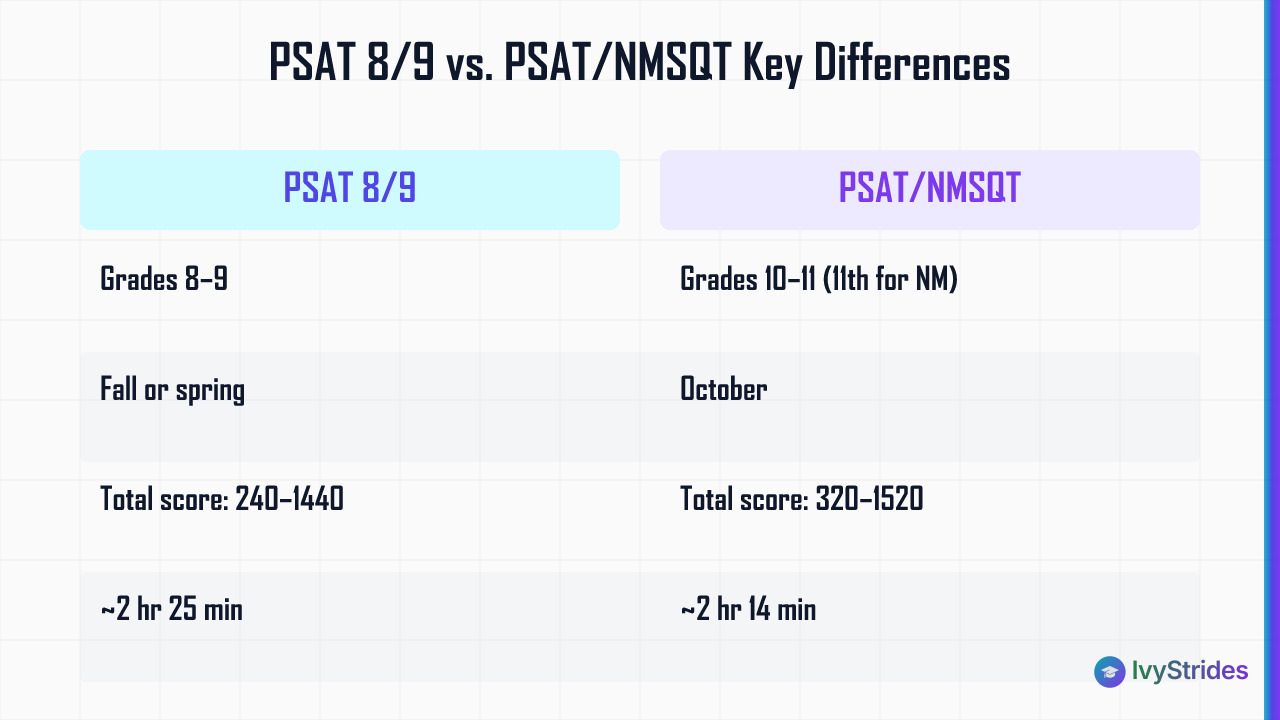
Here's what actually differs across the three versions.
| Attribute | PSAT 8/9 | PSAT 10 | PSAT/NMSQT |
| Grade level | 8th and 9th | 10th | 10th and 11th (only 11th counts for NM) |
| When administered | Fall or spring | Spring (Feb–Apr) | October |
| Total testing time | ~2 hr 25 min | ~2 hr 14 min | ~2 hr 14 min |
| Reading and Writing section | 160–760 | 160–760 | 160–760 |
| Math section | 160–760 | 160–760 | 160–760 |
| Total score range | 240–1440 | 320–1520 | 320–1520 |
| Format | Digital adaptive, 2 R&W modules + 2 Math modules | Same | Same |
| National Merit eligible | No | No | Yes (11th grade only) |
| Score sent to colleges | No | No | No |
The R&W section runs two adaptive modules (Module 1 sets the difficulty of Module 2 based on performance). Math works the same way. On the PSAT/NMSQT and PSAT 10, the Math section is 70 minutes across 44 questions, per the College Board PSAT/NMSQT comparison documentation.
The PSAT 8/9 shares the same adaptive skeleton, but with a lower difficulty ceiling. Fewer advanced algebra and data analysis questions. Less complex reading passages. That's why its score scale tops out at 1440 rather than 1520.
For students building a prep foundation, our PSAT practice tests library gives full-length digital sittings on the current adaptive format. For registration windows and school-by-school administration timing, see our PSAT test dates 2026 guide.
Is the PSAT 10 the Same Test as the PSAT/NMSQT?
Short answer: yes, in every way that shows up on the test itself. Same question types. Same adaptive two-module structure. Same score scale of 320 to 1520. Same difficulty. Screen by screen, a student wouldn't be able to tell them apart.
Two things differ:
-
Timing. PSAT 10 is administered in the spring of 10th grade. PSAT/NMSQT is administered in October, primarily for 11th graders.
-
National Merit eligibility. Only the 11th-grade PSAT/NMSQT score feeds into the National Merit Selection Index. A PSAT 10 score of 1520 (perfect) doesn't qualify for National Merit. Neither does a 10th-grade PSAT/NMSQT score.
This is the most common confusion we see. In our coaching with students preparing for the 11th-grade PSAT/NMSQT, families often assume a strong 10th-grade score, whether on the PSAT 10 or an early PSAT/NMSQT, will carry forward. It won't. National Merit resets each year and only counts the junior-year October sitting.
The PSAT 8/9 sits one tier below both. Fewer advanced math topics (less trigonometry, less complex data analysis), simpler R&W passages, and a lower score ceiling. It's a genuine on-ramp, not a shorter version of the same test.
For a broader difficulty comparison, see our article on is the PSAT harder than the SAT. If you're also weighing how the PSAT stacks up against the SAT itself, the difference between PSAT and SAT guide covers format and purpose side by side. Source: College Board Help Center.
Which PSAT Version Qualifies for National Merit, and What Score Do You Need?
Only the 11th-grade PSAT/NMSQT. That's the entire rule. No PSAT 8/9 score qualifies. No PSAT 10 score qualifies. No 10th-grade PSAT/NMSQT score qualifies. If a student misses the October PSAT/NMSQT in 11th grade, they can't qualify for National Merit that year, and there is no makeup sitting for scholarship purposes.
The National Merit Selection Index is calculated from the two section scores on the PSAT/NMSQT. On the digital format, the R&W section score (160 to 760) and the Math section score (160 to 760) sum to a total between 320 and 1520. The National Merit Scholarship Corporation (NMSC) uses this total as the Selection Index for the current class year. Historically, the paper PSAT used a 48 to 228 Selection Index; the digital transition has moved this to the total score scale. Verify against the current NMSC announcement for your student's class year, since NMSC finalizes methodology after scores release.
Semifinalist cutoffs vary by state. Approximate ranges based on recent years:
- High-competition states (California, Massachusetts, New Jersey, Maryland, Virginia): typically require roughly 1470 to 1480.
- Mid-competition states (most of the country): typically around 1430 to 1460.
- Lower-competition states (Wyoming, Montana, North Dakota, West Virginia): may require approximately 1400 to 1420.
Nationally, the Commended Student threshold typically lands around 1400 to 1410. These figures are approximate and set after scores release each year. Verify against the current NMSC announcement.
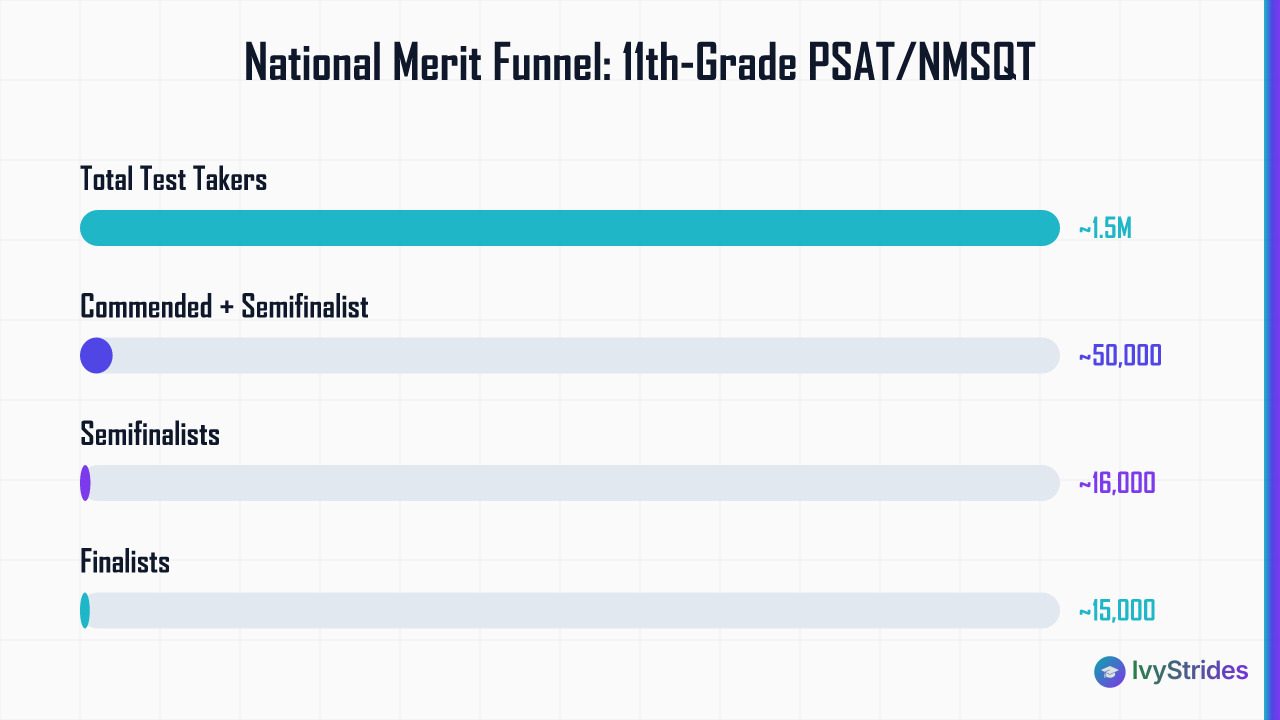
Here's the part most students miss. Roughly 50,000 students qualify as Commended or Semifinalist nationally each year, out of about 1.5 million test takers. Around 16,000 advance to Semifinalist, and about 15,000 become Finalists. It's a real distinction, and it opens doors to college-specific scholarships beyond the NMSC awards themselves.
For a full grade-by-grade prep calendar that maps each PSAT version to the right preparation window, see our PSAT strategy by grade guide. If your 11th-grade PSAT/NMSQT score puts you near the Semifinalist cutoff for your state, our dedicated guide to the National Merit Scholarship walks through the Selection Index calculation and next steps in detail.
How the Three PSAT Score Scales Compare (and What Your Score Predicts)
The three PSAT versions and the SAT sit on related but distinct scales:
- PSAT 8/9: 240 to 1440 (each section 160 to 760 on the current digital scale)
- PSAT 10 and PSAT/NMSQT: 320 to 1520 (each section 160 to 760)
- SAT: 400 to 1600 (each section 200 to 800)
The 80-point gap between the PSAT/NMSQT ceiling (1520) and the SAT ceiling (1600) exists because the PSAT doesn't test the hardest math topics on the SAT and uses slightly less complex reading passages. The tests are vertically aligned, meaning a reported score on the PSAT/NMSQT means roughly the same thing as the identical number on the SAT, but the SAT can go higher.
A rough directional guide, based on current College Board concordance: a PSAT/NMSQT score of 1200 predicts an SAT range of roughly 1200 to 1280 without additional prep. A 1400 on the PSAT/NMSQT typically corresponds to an SAT range of about 1400 to 1470. A 1470 on the PSAT/NMSQT concords to an SAT range of roughly 1470 to 1530. These are approximate directional benchmarks, not guarantees. Actual SAT scores depend on prep effort, methodology, and the specific weaknesses a student closes. The PSAT is slightly easier than the SAT, particularly in advanced math, which is why the score scales differ; for a detailed difficulty comparison, see our article on whether the PSAT is harder than the SAT.
PSAT 8/9 scores are on a different scale and can't be directly compared to PSAT 10 or PSAT/NMSQT scores without a College Board concordance table. A 1200 on the PSAT 8/9 is not the same as a 1200 on the PSAT/NMSQT, because the test items themselves are calibrated to a different difficulty.
Two facts to hold onto: PSAT scores of any version aren't sent to colleges (source: College Board SAT Suite), and score prediction is directional, not deterministic. If you're also wondering how the PSAT compares to the SAT itself, our guide on the difference between SAT and PSAT covers format, scoring, and purpose side by side.
Once you know which version you're taking, the next question is what score to aim for. See our full breakdown of good PSAT scores for 10th graders or the specific-target guide on is 1280 a good PSAT score.
Which PSAT Version Should You Take, and When?
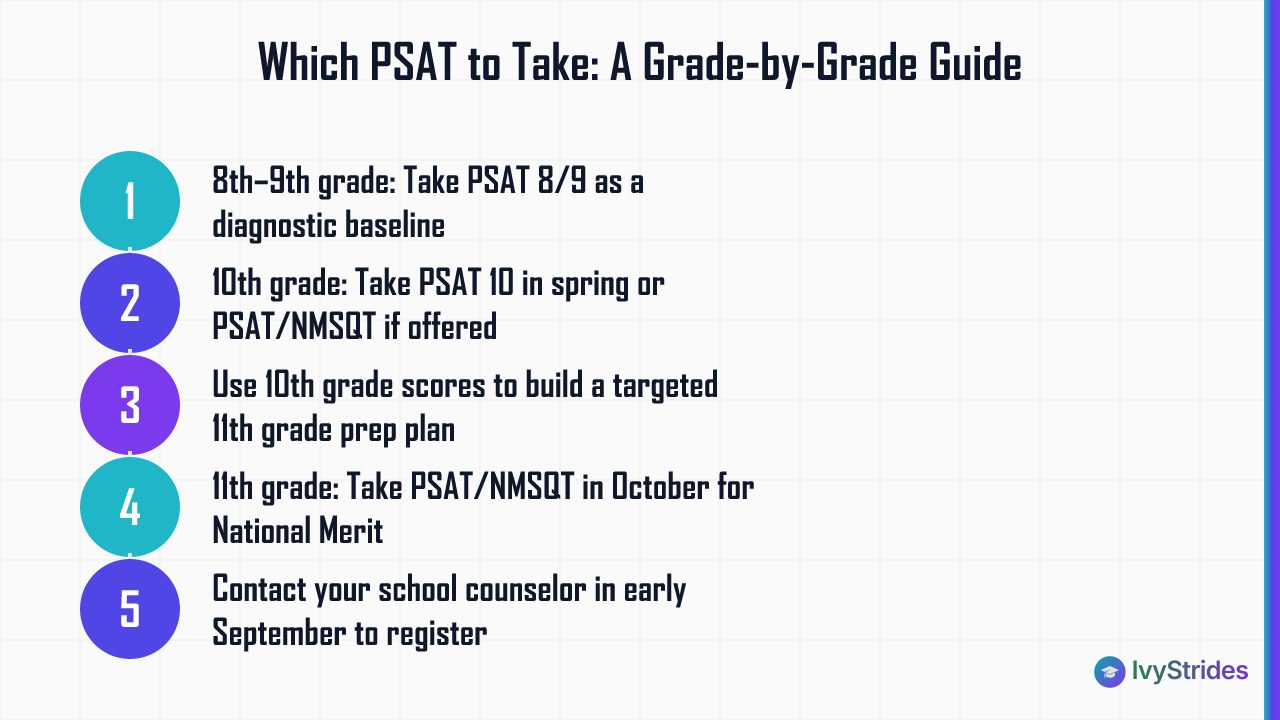
The version is largely decided for you by grade level and by what your school offers. Here's the practical decision tree.
8th and 9th graders: PSAT 8/9 if your school offers it. This is a baseline diagnostic. Use the section scores to spot early gaps in R&W or Math and start building foundational skills. Don't stress the total score. It's data, not a stakes exam.
10th graders: two paths.
- If your school administers the PSAT/NMSQT in October and lets sophomores sit for it, the score doesn't count for National Merit but does give you an early benchmark on the same 320 to 1520 scale you'll see in junior year.
- More commonly, sophomores take the PSAT 10 in the spring. Same content, same difficulty, just a different sitting.
In our coaching, sophomores who treat their PSAT 10 score as a diagnostic (not a verdict) tend to enter 11th grade with a targeted prep plan already built around their two weakest question types, rather than a generic full-course rerun. The section scores show exactly where to start.
11th graders: PSAT/NMSQT in October. This is the only National Merit qualifying sitting. Miss it and there's no second chance for that class year. If your school doesn't offer it, contact a nearby school as soon as the summer before junior year to arrange to test there; NMSC accepts alternate-school administration when the student's own school doesn't offer the test.
Registration works differently from the SAT. Students don't sign up individually through College Board. Schools order and administer PSAT sittings. Contact your school counselor in early September to confirm the October PSAT/NMSQT date and your student's registration status.
For a grade-by-grade prep calendar that maps each PSAT version to the right preparation window, see our PSAT strategy by grade guide. For exact administration windows and school registration deadlines for each version, see our PSAT test dates 2026 guide.
How to Use Your PSAT Score to Build a Stronger SAT Plan
A PSAT score is only useful if you do something with it. The section scores (160 to 760 in R&W and Math) tell you exactly where to focus. A student scoring 1200 with a 640 R&W and 560 Math has a completely different prep plan than a student at the same 1200 total with 560 R&W and 640 Math.
The IvyStrides diagnostic-driven methodology starts with a full practice test, isolates the weakest module (R&W Module 1, R&W Module 2, Math Module 1, or Math Module 2), and assigns a section-specialist coach: one tutor for SAT Math, a different tutor for SAT R&W. Not one generalist across both.
In our coaching with students at the 1100 to 1200 PSAT/NMSQT band, a targeted prep plan of roughly 12 to 16 weeks starting in the spring of 11th grade typically produces meaningful SAT score improvement (200+ points is a typical outcome for students completing the program) before the fall SAT sittings. Students at higher bands (1300+) tend to need shorter, more surgical prep focused on their two or three weakest question types.
A note on parallel tracks. For students aiming at competitive colleges, AP courses run alongside PSAT and SAT prep as a connected admissions strategy. Strong AP scores demonstrate rigor that test-optional policies can't erase. Our AP courses online program pairs per-subject specialists with a schedule designed around junior-year testing loads. Once your PSAT results are back, our guide on translating PSAT results 2026 into SAT targets walks through the numbers.
Test-optional policies vary by school and year, but a strong PSAT and SAT score remains strategically valuable at nearly every competitive college.
FAQ
What are the three versions of the PSAT and who takes each one?
The College Board offers three PSAT versions. The PSAT 8/9 is for 8th and 9th graders and scores on a 240 to 1440 scale. The PSAT 10 is for 10th graders in the spring and scores on a 320 to 1520 scale. The PSAT/NMSQT is taken primarily in 11th grade each October, also scores on a 320 to 1520 scale, and is the only version that qualifies students for National Merit Scholarship consideration.
Is the PSAT 10 the exact same test as the PSAT/NMSQT?
In terms of content, format, difficulty, and score scale, yes, the PSAT 10 and PSAT/NMSQT are identical. The differences are timing and eligibility. PSAT 10 is administered in the spring of 10th grade. PSAT/NMSQT is administered in October. Only the 11th-grade PSAT/NMSQT score counts for National Merit, regardless of how high a PSAT 10 or 10th-grade PSAT/NMSQT score climbs.
Does a 1400 PSAT score qualify for National Merit?
It depends on the state and the class year. A 1400 on the 11th-grade PSAT/NMSQT typically qualifies for Commended Student status nationally and may reach Semifinalist cutoffs in lower-competition states such as Wyoming, Montana, or North Dakota. In higher-competition states like California, Massachusetts, or New Jersey, Semifinalist cutoffs are typically around 1470 to 1480. Cutoffs are set by NMSC after scores release, so treat these as approximate. And the score must come from the junior-year PSAT/NMSQT; PSAT 10 scores don't count.
Can a 10th grader take the PSAT/NMSQT, and does it count for National Merit?
Some schools allow sophomores to sit for the October PSAT/NMSQT. The score you receive is on the 320 to 1520 scale and is useful as an early diagnostic. But it doesn't count for National Merit. Only the 11th-grade PSAT/NMSQT score qualifies for scholarship consideration.
What is a 1470 PSAT score equivalent to on the SAT?
A 1470 on the PSAT/NMSQT (320 to 1520 scale) is approximately equivalent to a score in the 1470 to 1530 range on the SAT (400 to 1600 scale), based on current College Board concordance. The exact correspondence depends on the student's specific strengths and prep trajectory. The PSAT has a lower ceiling because it doesn't test the most advanced SAT math topics. Use the score as a directional benchmark, not a guaranteed SAT prediction.
Are PSAT scores sent to colleges?
No. PSAT scores of any version (8/9, 10, or NMSQT) aren't reported to colleges. Their value is diagnostic and, for the 11th-grade PSAT/NMSQT, scholarship-qualifying through National Merit. Students control their own PSAT score reports, and there's no mechanism to send them to college admissions offices. If you're curious how the PSAT compares to the SAT itself, see our PSAT vs SAT guide.
Turn the Right PSAT Version Into a Real Plan
Knowing which version your student is taking is step one. The higher-use move is what you do with the score afterward: which sections to prioritize, how to time SAT prep, whether National Merit is realistically in play, and how AP courses fit into the same window.

Award-winning author (South Asian Book Award) and graduate of BITS Pilani and UCLA Luskin School of Public Affairs. Brings a published writer's eye to Common App essays and grammatical precision to SAT and ACT R&W instruction.