
What Is the Digital SAT? The Complete 2026 Guide for Students and Parents

On this page
- What Is the Digital SAT? The Short Answer Every Student and Parent Needs First
- Digital SAT Format in 2026: Sections, Modules, Timing, and Question Counts
- How the Digital SAT Adaptive Format Works: Module 1, Module 2, and Your Score Ceiling
- Digital SAT vs. Paper SAT: What Actually Changed and What Stayed the Same
- Is the Digital SAT Harder Than the Paper SAT? The Honest Answer
- How the Digital SAT Is Scored: What the 400-1600 Scale Actually Measures
- Do Colleges Accept the Digital SAT? What Every Applicant Needs to Know
- How to Prepare for the Digital SAT: Diagnostic First, Then Targeted Practice
- Digital SAT Registration in 2026: How and When to Sign Up
- Frequently Asked Questions About the Digital SAT
- Can the digital SAT be taken at home?
- Is the digital SAT all multiple choice?
- What calculator is on the digital SAT?
- Is a 1200 a good digital SAT score?
- Can you get a 1600 on the digital SAT?
- Is the SAT fully digital now?
- How is the digital SAT different from the PSAT?
- What's the difference between the digital SAT and the old paper SAT?
The digital SAT is a fully computerized college admissions test administered by the College Board, scored on a 400-1600 scale. It runs 2 hours 14 minutes across two sections: Reading and Writing (64 minutes, two modules) and Math (70 minutes, two modules). The test uses multistage adaptive testing, so your performance on Module 1 determines whether Module 2 gets harder or easier. It's delivered through the College Board's Bluebook app at approved test centers worldwide. Every US college that accepts the SAT accepts it. The paper SAT is no longer offered to US students.
Every format and scoring figure in this guide traces to College Board's SAT Suite documentation, verified as of 2026. The next sections cover what the adaptive routing actually does to your score, and how to build a prep plan that fits it.
What Is the Digital SAT? The Short Answer Every Student and Parent Needs First
The digital SAT is the current version of the SAT, taken on a laptop or tablet inside the College Board's Bluebook app at an approved test center. It replaced the paper SAT for US students after the January 2024 administration; international students moved to the digital format in March 2023.
Here's the test at a glance:
| Attribute | Digital SAT |
| Total time | 2 hours 14 minutes (plus a 10-minute break) |
| Sections | 2 (Reading and Writing, Math) |
| Modules | 4 total (2 per section) |
| Scored questions | 98 (54 R&W, 44 Math) |
| Score scale | 400-1600 |
| Delivery | Bluebook app at an approved test center |
| Adaptive? | Yes, at the module level |
| Colleges that accept it | Every US college that accepts the SAT |
It's not a home test, not shorter because it's easier, and not a different test for different score ranges. It's the SAT, delivered on a screen, with an adaptive engine sitting between Module 1 and Module 2 in each section. For a minute-by-minute test-day schedule, see how long is the SAT.
Digital SAT Format in 2026: Sections, Modules, Timing, and Question Counts
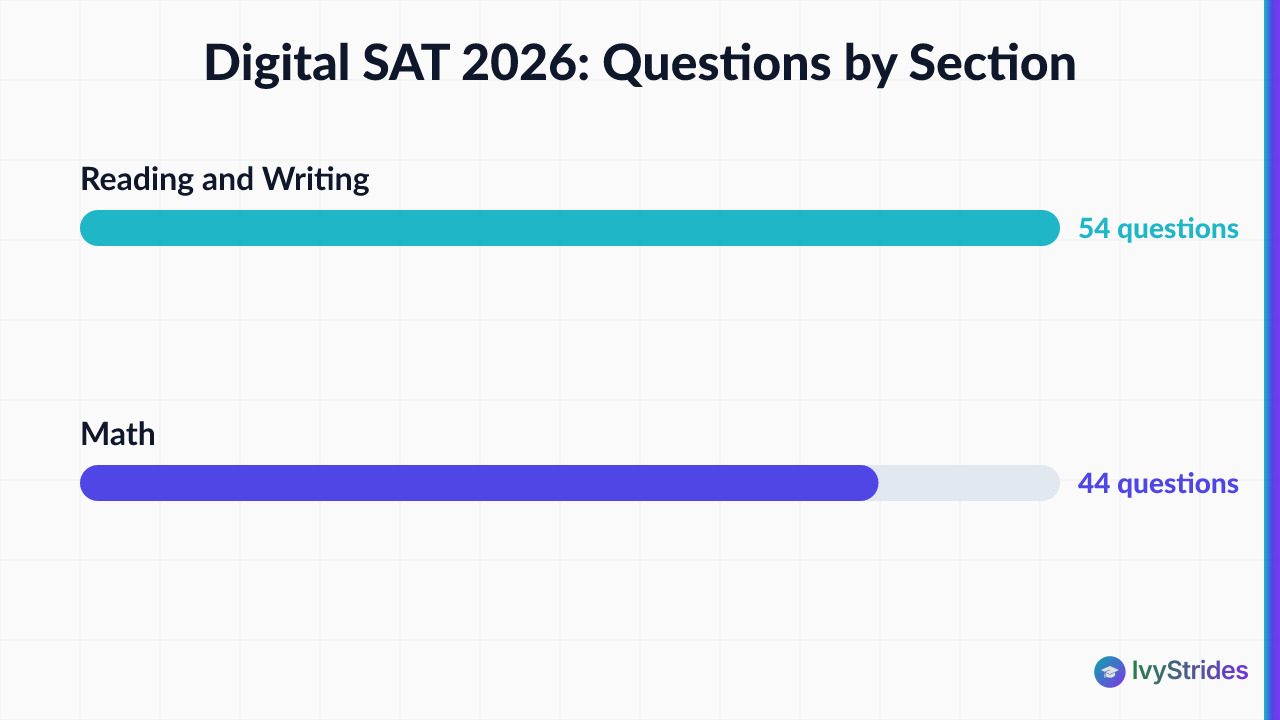
Two sections, four modules, 98 scored questions. Here's the breakdown from College Board's official test structure page:
| Section | Modules | Questions per module | Time per module | Section total |
| Reading and Writing | 2 | 27 | 32 minutes | 64 minutes, 54 questions |
| Math | 2 | 22 | 35 minutes | 70 minutes, 44 questions |
A single 10-minute break separates the two sections. That works out to about 1 minute 11 seconds per Reading and Writing question and roughly 1 minute 35 seconds per Math question. Tight, but manageable once pacing is trained.
Reading and Writing questions cover four domains, always in this order inside a module: Information and Ideas, Craft and Structure, Expression of Ideas, and Standard English Conventions. Each question is tied to one short passage (roughly 25-150 words), not to the long 500-750 word passages of the paper era. Every question is multiple choice with four options.
Math questions cover four content domains: Algebra, Advanced Math, Problem-Solving and Data Analysis, and Geometry and Trigonometry. About 75 percent of Math questions are multiple choice; the remaining roughly 25 percent are student-produced response questions, where you type in a numeric answer. A geometry reference sheet sits inside the app for every Math question, and a built-in Desmos graphing calculator is available on every Math question. Students may also bring an approved personal calculator as a backup.
A small number of items per module are unscored pretest questions the College Board uses to calibrate future tests. You can't tell which are which, so treat every question as if it counts.
For counts across the full SAT Suite, see how many questions are on the SAT. For a domain-level Math walkthrough, see SAT math topics.
How the Digital SAT Adaptive Format Works: Module 1, Module 2, and Your Score Ceiling
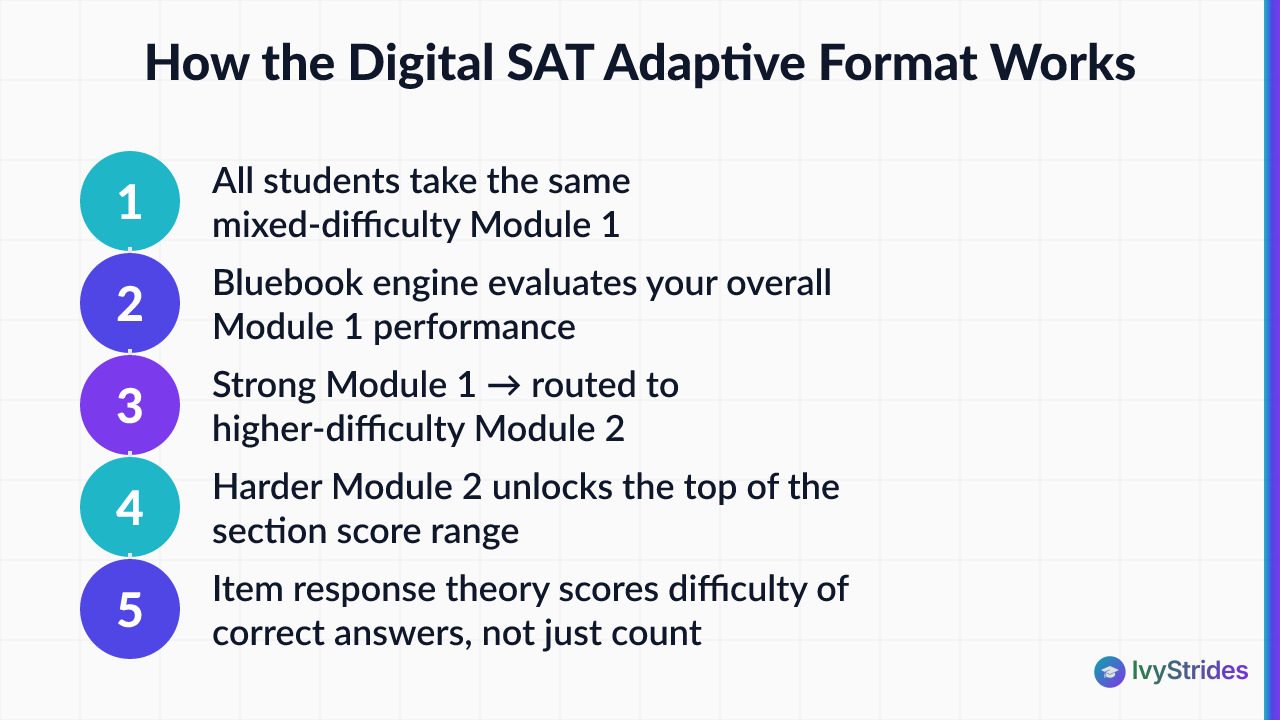
Understanding how the adaptive modules work is the single most important thing a student can do before test day, because Module 1 performance sets the ceiling for the entire section score.
Here's what actually happens. Every student, regardless of ability, sees the same Module 1 for Reading and Writing and the same Module 1 for Math. Both Module 1s are mixed difficulty. When Module 1 ends, the Bluebook engine looks at your overall Module 1 performance and routes you to one of two Module 2 forms:
- Higher-difficulty Module 2: served to students who performed strongly on Module 1. This form unlocks the top of the section score range.
- Lower-difficulty Module 2: served to students who struggled on Module 1. This form's score ceiling is lower, roughly capping the section around a mid-band result.
Routing happens once per section, between modules, not question by question. Within any given module, questions don't adjust to what you just answered. The strategic question isn't "should I skip this hard question," it's "am I building enough Module 1 accuracy to unlock the harder Module 2."
Can you game it by tanking Module 1 to see easier questions in Module 2? No. The easier Module 2 has a lower score ceiling by design. Intentionally missing questions is how students accidentally cap themselves around a 600 section score.
Scoring uses item response theory, not a raw right-answer count. The difficulty of the questions you got right factors into your final score. Two students can get the same number of items correct and receive different section scores if one saw the harder Module 2 and the other saw the easier one. For a deeper walkthrough, see how the digital SAT adaptive format works and digital SAT Module 1 score ceiling.
The coaching implication is direct. In our coaching, students at the 1000-1200 band who spend all their prep on Module 2-style hard questions often stall, because they never fix the Module 1 accuracy that would route them to the harder form in the first place. The most common student fear, that one bad question in Module 1 tanks the whole test, isn't how the routing works. It's overall Module 1 performance that determines the routing, not any single question.
Digital SAT vs. Paper SAT: What Actually Changed and What Stayed the Same
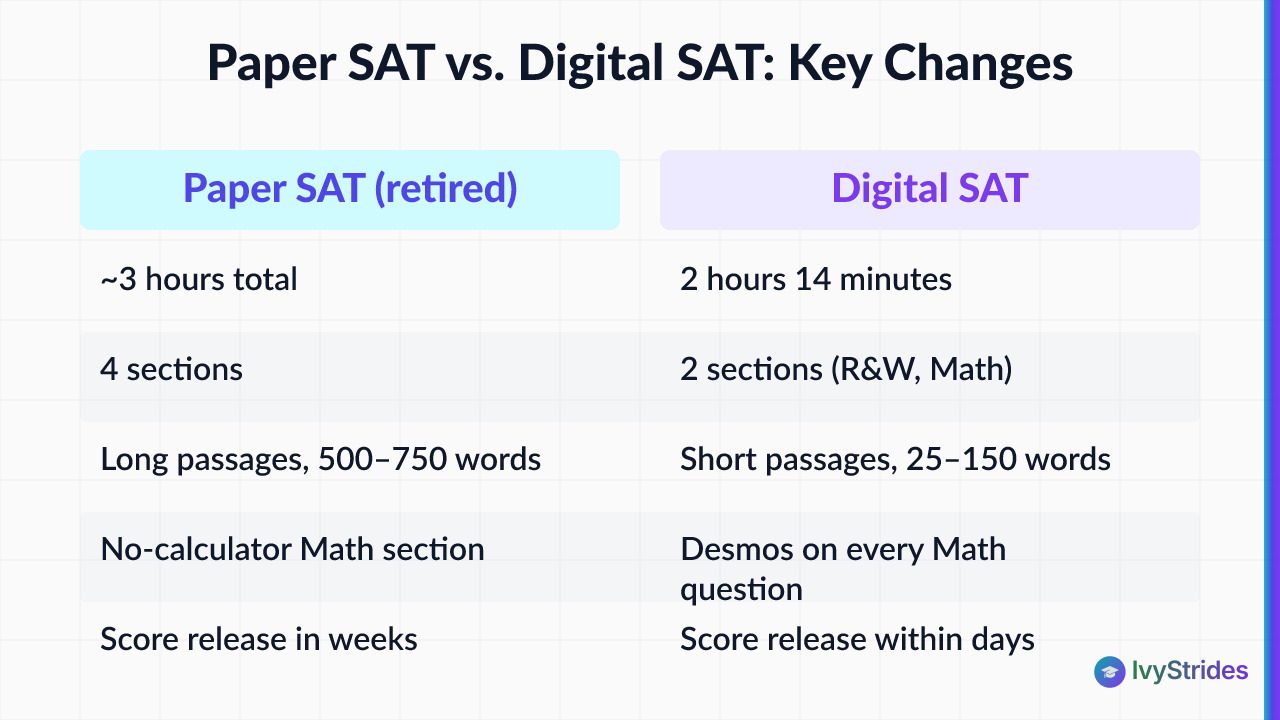
The most common question students ask is whether the digital SAT is a different test or just the same test on a screen, and the honest answer is: same skills, meaningfully different experience.
| Feature | Paper SAT (retired) | Digital SAT |
| Total time | About 3 hours | 2 hours 14 minutes |
| Sections | 4 (Reading, Writing & Language, Math no-calc, Math calc) | 2 (R&W, Math) |
| R&W passages | Long, 500-750 words | Short, 25-150 words each |
| Calculator | No-calc Math section existed | Desmos on every Math question |
| Delivery | Paper booklet | Bluebook app |
| Score release | Weeks | Typically within days |
| Score scale | 400-1600 | 400-1600 |
| Skills tested | Reading, writing, math | Reading, writing, math |
| Colleges accept it | Yes | Yes |
What changed: the timing, the number of sections, the length of Reading passages, the calculator policy. What stayed the same: the score scale, the underlying skill domains, and universal college acceptance.
The essay was retired from the paper SAT in 2021, so both formats now end without an essay. Students weighing a different test entirely can start with ACT vs SAT differences.
Is the Digital SAT Harder Than the Paper SAT? The Honest Answer
Neither. The College Board calibrates the digital SAT to assess the same knowledge and skills at the same difficulty level as the paper SAT. A 1400 on the digital SAT reflects the same ability level as a 1400 on the paper SAT.
But the experience feels different, and the difference is worth naming.
Shorter passages sound easier. They usually aren't. When a passage is 90 words long and asks you to identify the main claim, there's nowhere to hide. On the paper SAT, a student could sometimes triangulate the answer from surrounding paragraphs. On the digital SAT's discrete-passage format, the answer either follows from the 90 words in front of you or it doesn't.
In our coaching, students who over-relied on process-of-elimination reading strategies on long paper passages sometimes struggle with the digital format's discrete inference questions, particularly in Craft and Structure. The skill gap is real. It just isn't a difficulty gap in the College Board's calibration sense.
The adaptive format adds another layer. A student who does well on Module 1 will see a harder Module 2, and that Module 2 will feel harder, because it is. That isn't the test being harder overall, it's the test doing its job. For how section scores translate into national percentiles, see SAT score scale and percentiles.
Prepare for the digital SAT on its own terms. Don't assume your parent's paper SAT strategy transfers, and don't assume the shorter runtime means fewer prep hours.
How the Digital SAT Is Scored: What the 400-1600 Scale Actually Measures
The digital SAT isn't scored by counting right answers. The College Board uses item response theory, which means the difficulty of the questions you answered correctly matters as much as the count.
Every student receives:
- A Reading and Writing section score on a 200-800 scale
- A Math section score on a 200-800 scale
- A total score on a 400-1600 scale (the sum of the two)
Approximate national percentile benchmarks, drawn from College Board's percentile tables:
| Total score | Approximate national percentile |
| 1010-1020 | Around the 50th (national average) |
| 1200 | Roughly the 74th |
| 1400 | Approximately the 95th |
| 1500 | About the 98th |
| 1550+ | Roughly the top 1 percent |
Because Module 2 difficulty is adaptive, two students who get the same number of items correct can end at different section scores. The student routed to the harder Module 2 has access to the upper end of the 200-800 range; the student routed to the easier Module 2 does not.
Scores typically release within days of the test rather than weeks. Superscoring is a college policy, not a College Board policy: many colleges take your highest Math score and your highest R&W score across separate test dates and combine them. Policies vary by school, so check each target college's admissions page.
For the full percentile chart and score-band interpretation, see how the digital SAT is scored and SAT grading scale and percentiles.
Do Colleges Accept the Digital SAT? What Every Applicant Needs to Know
Yes. Every US college and university that accepts the SAT accepts the digital SAT. There's no separate paper-versus-digital acceptance policy, because the paper SAT is no longer offered to US students. If a school takes SAT scores, it takes digital SAT scores.
Even at test-optional schools, a digital SAT score in the top quartile of a school's admitted-student range can strengthen an application, particularly for students whose GPA is at or below the median. Test-optional doesn't mean test-blind. A strong score submitted to a test-optional school is still a positive signal.
Two caveats belong in every conversation about test-optional policy:
-
Policies vary by school and by year. FairTest maintains a tracker, and each college publishes its own policy on its admissions page. Verify before deciding whether to submit.
-
Admissions outcomes depend on the full application, not test scores alone. Course rigor, GPA, essays, recommendations, and extracurriculars all matter. A strong SAT score is one lever, not the whole application.
International students applying to US colleges submit digital SAT scores the same way domestic students do. For a broader take on how the SAT fits into current admissions strategy, see is the SAT still relevant. For what top-band scores look like at selective schools, see 1540 SAT score and top college ranges.
How to Prepare for the Digital SAT: Diagnostic First, Then Targeted Practice
Knowing the format is step one. Building a diagnostic-driven prep plan is step two, and the two are inseparable, because the adaptive structure means your weakest module determines your score ceiling.
Here's the sequence we run for every student:
Step 1: Take a full-length official Bluebook practice test. The College Board publishes a set of official full-length digital SAT practice tests inside Bluebook, and they're the closest thing to the real exam. Score it. Don't skip this step, and don't substitute a third-party test.
Step 2: Analyze results by domain, not by section. A student scoring 560 R&W and 590 Math doesn't need "more R&W practice." That student needs to know whether the R&W gap is in Information and Ideas, Craft and Structure, Expression of Ideas, or Standard English Conventions, and the same for Math across Algebra, Advanced Math, Problem-Solving and Data Analysis, and Geometry and Trigonometry. In our coaching, students who skip this step often spend six weeks strengthening a domain that was already their strongest.
Step 3: Build a targeted plan around the weakest one or two domains. A section-specialist coach matters here. R&W and Math are different enough that a specialist for each section catches patterns a generalist misses. Our online SAT Math tutor roster is built this way.
Step 4: Retest with spacing. Take a second full-length Bluebook test every 3-4 weeks to verify improvement, not just perceived improvement.
Realistic timeline: in our coaching with students at the 1000-1200 band who complete a diagnostic-driven plan across roughly 3-6 months of consistent weekly sessions, 100-200 point total-score improvements are typical. Higher-band students (1350+) usually see smaller absolute gains, because they're closer to the ceiling.
A common student question: should I take the ACT instead? Students who are unsure whether to take the digital SAT or the ACT should compare both formats before committing to a prep plan, since the two tests reward different skill sets. A short diagnostic on both is the fastest way to know.
Study resources: our SAT study plan walks through a week-by-week sequence. Our official SAT practice tests support the diagnostic-and-retest loop. Students with a spring test date can look at SAT winter batch enrollment.
One coaching pattern worth naming: students at the 1000-1200 band who get routed to the easier Module 2 sometimes feel relieved mid-test. That relief is a signal, not a good sign. It means Module 1 accuracy is the next lever to pull.
Digital SAT Registration in 2026: How and When to Sign Up
Register directly through the College Board at satsuite.collegeboard.org. Registration deadlines fall roughly 4-5 weeks before each test date, with late-registration windows carrying an additional fee.
The College Board publishes seven US test dates per academic year (August, October, November, December, March, May, June), with a slightly different international calendar. Confirm the current 2026 dates on the College Board site before choosing a sitting; the calendar is time-sensitive and this article is refreshed annually.
Fees: as of 2025 the US domestic registration fee sits at about $68, with an additional international surcharge for testing outside the US. Fee waivers are available for eligible US students, and the College Board publishes eligibility criteria on its site. Verify the current fee before you register; pricing changes.
Before test day, download the Bluebook app on the device you plan to bring, run the readiness check, and complete the exam setup at least 5 days before your test date. This isn't optional. Students who skip it sometimes can't start on time. The app works offline after check-in, so a spotty test-center connection won't interrupt your exam.
Two flavors of the SAT exist for scheduling purposes. Weekend SATs are what most students take, at a public test center on a Saturday morning. Some high schools also offer a school-day SAT, administered inside the school on a weekday, sometimes at no cost to the student. Ask your counselor.
For a step-by-step registration walkthrough, see SAT exam registration. For a full cost breakdown, see how much does the SAT cost.
Frequently Asked Questions About the Digital SAT
Can the digital SAT be taken at home?
No. The digital SAT must be taken at a College Board-approved test center or a participating school. There's no at-home option. You use the Bluebook app on a device at the test site, and the app runs offline after check-in so a shaky connection won't affect your exam.
Is the digital SAT all multiple choice?
Almost. Reading and Writing is entirely multiple choice with four answer options per question. Math is mostly multiple choice, but roughly a quarter of Math questions are student-produced responses where you type in your own numeric answer.
What calculator is on the digital SAT?
A built-in Desmos graphing calculator is available for every Math question inside Bluebook. You can also bring an approved personal calculator as a backup. The no-calculator Math section from the paper SAT no longer exists.
Is a 1200 a good digital SAT score?
A 1200 places a student around the 74th percentile nationally, higher than roughly three-quarters of test-takers. Whether it's a good score depends on the target school. Highly selective universities typically expect scores in the 1400-1550 range, so 1200 is a strong starting point for a targeted improvement plan rather than a finished application number.
Can you get a 1600 on the digital SAT?
Yes, a perfect 1600 is possible. Scoring above 1500 already places a student in roughly the top 1 percent of all test-takers. Reaching 1600 requires near-perfect accuracy across both sections and both modules, including the harder Module 2 in each section.
Is the SAT fully digital now?
Yes, everywhere. The paper SAT was discontinued for US test-takers after January 2024, and international students moved to the digital format in March 2023. All students now test through Bluebook at approved test centers.
How is the digital SAT different from the PSAT?
The PSAT/NMSQT uses the same digital adaptive format as the SAT, so strong PSAT prep is also direct SAT prep. The PSAT is scored on a 320-1520 scale rather than 400-1600, is slightly shorter, and doubles as the qualifying test for the National Merit Scholarship Program. For juniors thinking about the National Merit pathway, see PSAT strategy for juniors. Students preparing from outside the US can start with how to prep for the SAT from abroad.
What's the difference between the digital SAT and the old paper SAT?
The digital SAT runs 2 hours 14 minutes versus the paper SAT's roughly 3 hours. It uses short discrete passages (25-150 words) in Reading and Writing instead of long 500-750 word passages. A built-in Desmos calculator is available for all Math questions, replacing the old no-calculator section. Skills tested and the 400-1600 score scale remain the same.
Adaptive modules, discrete passages, a built-in Desmos, and a two-hour runtime aren't cosmetic changes. They change how you prepare, which is why generic paper-era study plans no longer work. The single largest lever a student can pull before test day is Module 1 accuracy in whichever section is weaker.

Two decades teaching quantitative and verbal aptitude on standardized tests. Rare dual expertise across Math and Verbal — particularly effective for students with gaps on both sides. Senior AP Mentor for our Calculus and English tracks.