
When Do PSAT Scores Come Out in 2026: Exact Timing, Deadlines, and How to Plan Ahead

On this page
- The Short Answer: When PSAT Scores Come Out in 2026
- Exact 2026 PSAT Score Release Dates by Test Window
- What Time of Day Do PSAT Scores Drop? (Not Midnight)
- How to Check Your PSAT Score: Step-by-Step for Students and Parents
- Your Score Is Out. Now What? The Most Common Mistake Students Make
- What Your PSAT Score Actually Means: Benchmarks by Grade Level
- National Merit and the Selection Index: What the Score Report Tells You
- How to Turn Your PSAT Score Into an SAT Prep Plan
- FAQ
- What hour do PSAT scores come out during the day?
- Does a 1400 PSAT score qualify for National Merit?
- What PSAT score puts a student in the top 1 percent?
- Why are my PSAT scores delayed past the expected release date?
- How does a parent find their child's PSAT score?
- Is the PSAT 10 score released on the same date as the PSAT/NMSQT score?
PSAT scores are released roughly 2 to 4 weeks after your test date. For fall 2026, students who took the PSAT/NMSQT in October can expect scores on October 22, November 5, or November 12, depending on which day their school administered the exam. Scores post in rolling batches throughout the day starting around 8 AM ET, not at midnight. You view them by logging in to your College Board student account at satsuite.collegeboard.org.
These dates come from College Board's official score-release calendar, which occasionally shifts, so confirm your specific window the week it opens. The harder question isn't when the score arrives. It's what to do the moment it does, and that's what the rest of this piece walks through.
The Short Answer: When PSAT Scores Come Out in 2026
If your school administered the PSAT/NMSQT in October 2026, your score release date falls into one of three windows: October 22, November 5, or November 12. Which one applies depends on the specific day your school ran the exam, not when you registered. Schools that tested earlier in October see earlier releases; schools that tested later see the later dates.
The general rule holds across every PSAT variant: scores appear in your College Board student account roughly 2 to 4 weeks after test day. That rule covers the fall PSAT/NMSQT (grades 10 and 11), the spring PSAT 10, and the PSAT 8/9 (grades 8 and 9), which schools administer in a school-selected window during the academic year. Paper score reports arrive from your school about 4 to 6 weeks after online scores go live. If you also want the test dates themselves, we keep a live-updated schedule of when is the PSAT in 2026.
One caveat worth stating up front: College Board can shift these dates. Always confirm the specific day against the official score-release calendar the week your window opens.
Exact 2026 PSAT Score Release Dates by Test Window
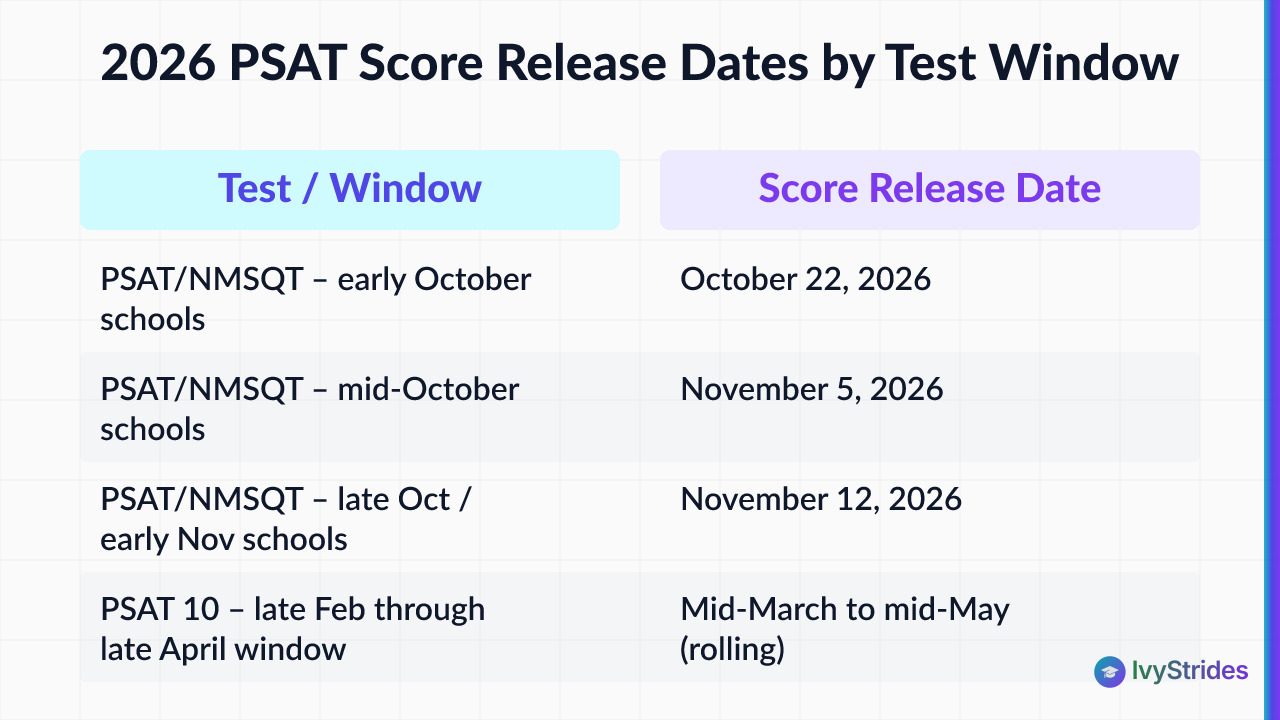
Here's the breakdown by test type and window.
Fall 2026 PSAT/NMSQT (10th and 11th grade):
- Schools testing in early October: scores post October 22, 2026
- Schools testing mid-October: scores post November 5, 2026
- Schools testing late October or into early November: scores post November 12, 2026
Spring 2026 PSAT 10: Scores are released on a rolling basis roughly 2 to 4 weeks after the school's testing window closes. Because the PSAT 10 window runs from late February through late April, most students see scores between mid-March and mid-May.
PSAT 8/9: This exam has the widest administration window (fall through spring). Scores follow the same 2 to 4 week rule after the school's specific test day.
Your school's testing coordinator can confirm which date applies to you. If you registered through your school and don't know the exact day of your administration, ask the counselor's office. That answer tells you which of the three fall release dates to circle. For students building a testing timeline, our PSAT practice tests library mirrors the digital adaptive format so you can gauge readiness before the next sitting.
Before you lock in a calendar reminder, cross-check the official score-release calendar one more time. College Board is the single authoritative source, and the calendar can move.
What Time of Day Do PSAT Scores Drop? (Not Midnight)
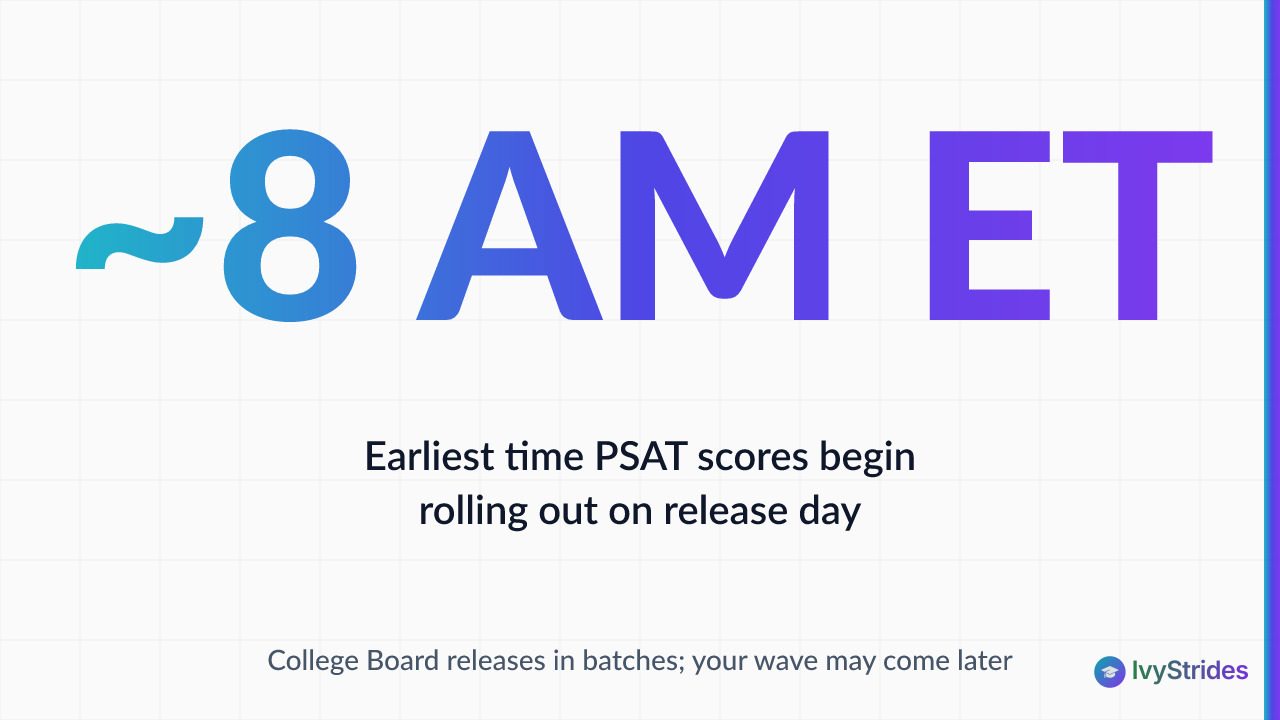
Look, this is the question that generates the most anxiety, so let's settle it. PSAT scores do not release at 12:01 AM. Staying up won't help.
College Board pushes scores out in rolling batches throughout the day, typically beginning around 8 AM Eastern Time on the release date. Some students in the same school see their scores at 9 AM; others in the same room see them at 2 PM. The batching is a server-load management choice, not a regional or alphabetical rollout. There's no way to predict which wave you're in.
A few practical notes. Scores appear on the web portal at satsuite.collegeboard.org, not inside the Bluebook app you used to take the test. Bluebook is the test-delivery software; the score report lives on the College Board Student Portal. If you're in Pacific Time and check at 8 AM local, that's 11 AM ET, so scores may already be flowing by then. And if 5 PM ET arrives on your release day and nothing has posted, check again in the morning. Same-day rollouts have been known to spill into the following business day for a small share of students.
The right rhythm: check once in the morning, once at lunch, once after school. Don't refresh every four minutes.
How to Check Your PSAT Score: Step-by-Step for Students and Parents
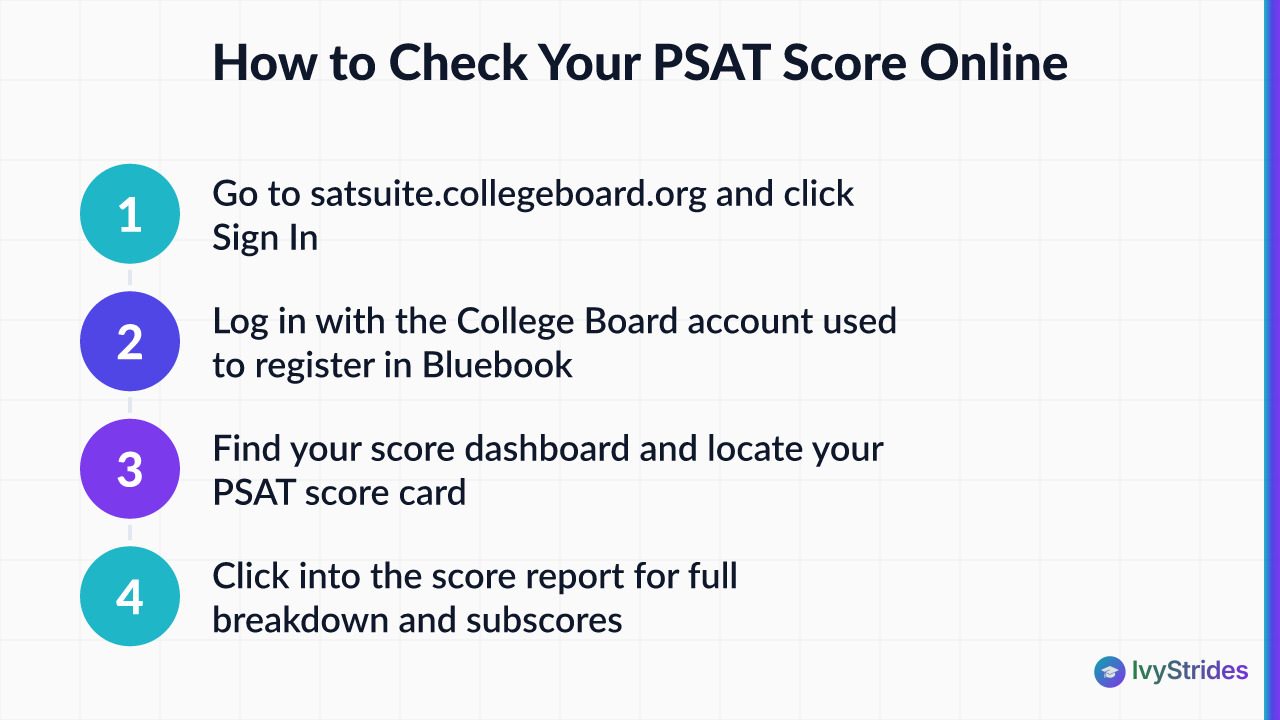
For students:
-
Go to satsuite.collegeboard.org and click Sign In (top right).
-
Log in with the same College Board account you used to register in Bluebook. If you don't remember which account, try the Gmail or school email you used on test day.
-
Once inside, look for your score dashboard. Your PSAT/NMSQT (or PSAT 10 or PSAT 8/9) score appears as a card with your composite, section scores, and percentiles.
-
Click into the score report for the full breakdown: subscores, cross-test scores, question-level review, and, for 11th graders, your Selection Index.
For parents:
If your student has shared their College Board login with you, follow the steps above. If not, you have two options. First, ask your student to link their College Board account to a parent account. College Board supports this through Family Connections, and the student has to authorize the link. Second, wait for the paper score report your school distributes roughly 4 to 6 weeks after online release.
Your score report contains six things worth understanding: the composite (320 to 1520), the Reading and Writing section score (160 to 760), the Math section score (160 to 760), subscore performance by skill area, percentile ranks (both national user and nationally representative sample), and, for 11th graders, the Selection Index used for good PSAT scores evaluation and National Merit qualification.
Your Score Is Out. Now What? The Most Common Mistake Students Make
Here's the part most students miss. The score arrives, the family reacts (relief, panic, or somewhere in between), and then nothing happens for roughly six weeks. In our coaching with students at the 1100 to 1300 PSAT band, this delay is the single most common pattern after score release, and it costs students their best prep window before the next SAT.
The score report is not a verdict. It's a diagnostic.
Every PSAT score report includes subscores that flag exactly which skill areas dragged your composite down. If your Words in Context subscore is weak, that's a vocabulary-in-passage-context problem, not a general reading problem. If your Problem Solving and Data Analysis subscore lags, you need targeted work on ratios, percentages, and data interpretation, not another block of hours on algebra review. A student who lost points on Heart of Algebra needs a fundamentally different plan than one who struggled on Passport to Advanced Math, even if both scored the same composite.
The IvyStrides methodology is simple to describe, harder to execute: diagnostic first, targeted weakness work second, spaced retesting third. The PSAT score report IS the diagnostic. Skipping it and jumping straight to "I need to study more SAT vocab" wastes weeks. If you're weighing whether the digital PSAT and SAT feel equivalent, our take on is the PSAT harder than the SAT covers the practical differences. For students asking whether their current number puts them on track, PSAT results and SAT readiness walks through the band-by-band picture.
In our coaching, students who use their PSAT subscores to identify their two or three weakest skill areas and address those first typically see faster composite gains than students who review all sections equally. The score report tells you where to start. Use it.
What Your PSAT Score Actually Means: Benchmarks by Grade Level
Once your score is in hand, the next question most students ask is whether it is actually good, and the answer depends on your grade level, your target college, and whether you are tracking toward National Merit.
Here's the honest breakdown by grade.
8th and 9th grade PSAT 8/9: A composite around 1000 to 1100 is roughly on track for on-grade-level college readiness. A 1200 on PSAT 8/9 places a student in approximately the 88th percentile, which is strong for the grade level.
10th grade PSAT 10 or PSAT/NMSQT: A composite of roughly 1050 to 1200 is around or above the 50th percentile, which is solid. The top 1% for 10th graders sits around 1420 to 1520, with 1520 being the maximum possible score.
11th grade PSAT/NMSQT: This is the score that matters for what is a good PSAT score evaluations and National Merit. A composite of roughly 1150 to 1210 places a junior in about the top 25% nationally. A 750 composite for an 11th grader falls near the 12th percentile, a signal that a diagnostic-driven plan matters more than ever, since the SAT is only months away. For a deeper look at what strong 10th grade numbers signal, see good PSAT scores for 10th graders.
A number to remember: the perfect PSAT score is 1520, not 1600. The PSAT ceiling is lower than the SAT ceiling because the PSAT doesn't include the hardest question tiers you'll see on the actual SAT.
National Merit and the Selection Index: What the Score Report Tells You
If you are an 11th grader, your Selection Index on this score report is the number that determines whether you advance in the National Merit Scholarship Program, and the qualifying cutoff varies significantly by state.
The Selection Index formula: (2 × Reading and Writing section score + Math section score) ÷ 10, producing a value on a 48 to 228 scale. Notice the weighting. Reading and Writing counts twice as heavily as Math. A student with a 700 R&W and a 700 Math has a Selection Index of 210. A student with a 750 R&W and a 650 Math also totals 1400 but scores 215 on the Selection Index. Same composite, different National Merit outcome.
Whether a 1400 qualifies depends entirely on this section balance and on your state's cutoff, which typically falls somewhere between roughly 207 and 222 Selection Index points. High-cutoff states (New Jersey, Massachusetts, California, DC, Virginia) generally require the top of that range. Lower-cutoff states may qualify students closer to 210. The national Commended threshold sits below the state Semifinalist cutoffs. For state-by-state figures, see our detailed piece on National Merit cutoffs by state.
Two hard rules worth stating clearly. Only the 11th grade PSAT/NMSQT counts for National Merit. PSAT 10 and PSAT 8/9 do not qualify students, regardless of how high the score. And cutoffs shift year to year based on cohort performance, so historical numbers are directional, not guaranteed.
How to Turn Your PSAT Score Into an SAT Prep Plan
Your PSAT composite is also a reliable early predictor of your SAT starting point, which makes the score report the right moment to set a target SAT score and map out a prep timeline.
The PSAT and the SAT now share the same digital, adaptive format, so the skills your score report flags as weak translate directly into the sections you need to prioritize on the SAT. The scoring scale is essentially aligned too. A 1470 PSAT typically corresponds to a starting SAT in roughly the 1470 to 1500 range. A 1200 PSAT in 11th grade usually means you're starting SAT prep somewhere around 1200 to 1250. From there, in our coaching with students at the 1100 to 1300 band, a 200+ point SAT improvement is typical across roughly 12 to 20 weeks of diagnostic-driven, section-specialist prep.
Section specialists matter here. SAT R&W and SAT Math are genuinely different disciplines. The tactics that unlock R&W gains (evidence-pairing logic, main-idea question anchoring, transition-word discipline) have almost nothing to do with the tactics that unlock Math gains (question-type recognition, calculator strategy on the Desmos-integrated interface, algebraic manipulation speed). A generalist coach across both sections tends to be strong in one and average in the other. That's why we split them.
A note on test-optional policies. Even at schools that are currently test-optional, a strong PSAT that predicts a competitive SAT score is worth pursuing, because submitting a high score almost always strengthens an application. Policies vary by school and by application year, so verify current status at each of your target colleges through the FairTest tracker and each school's admissions site before deciding not to submit.
For a full comparison of format, timing, and difficulty, see the difference between SAT and PSAT. If your composite lands specifically in the 1280 zone, we've written on whether is a 1280 a good PSAT score in more detail. And when you're ready to build a real plan around your score report, our PSAT 1-on-1 prep pairs students with section specialists based on the exact subscores that need work.
FAQ
What hour do PSAT scores come out during the day?
PSAT scores are not released at a single fixed hour. College Board posts them in rolling batches throughout the day, typically starting around 8 AM Eastern Time. Some students see their scores in the morning; others may not see them until the afternoon. Checking your College Board account periodically from 8 AM ET onward on your release date is the most reliable approach.
Does a 1400 PSAT score qualify for National Merit?
A 1400 composite is a strong PSAT score, but National Merit qualification is determined by the Selection Index, not the composite total. The Selection Index weights the Reading and Writing section more heavily than Math, so two students with identical 1400 composites can have different Selection Index values. Whether a 1400 qualifies depends on section balance and on your state's cutoff, which typically ranges from roughly 207 to 222. A 1400 skewed toward Math may fall short in high-cutoff states; the same total skewed toward R&W may qualify in lower-cutoff states.
What PSAT score puts a student in the top 1 percent?
For 10th graders, a composite between roughly 1420 and 1520 places a student in about the 99th percentile nationally, per College Board percentile data. The perfect PSAT score is 1520. For 11th graders taking the PSAT/NMSQT, the top 1 percent threshold is similar, though exact percentile tables shift slightly by grade and test year.
Why are my PSAT scores delayed past the expected release date?
Occasional delays happen when a school submits test materials late or when College Board's processing queue is larger than usual. If your expected release date has passed and your score is not visible, log in to your College Board account and check for any notification. If no score appears within about a week of the posted release date, contact College Board directly through the SAT Suite help center.
How does a parent find their child's PSAT score?
Parents can access PSAT scores by linking their College Board account to their child's account, which the student must authorize through Family Connections. Alternatively, the school distributes paper score reports to students roughly 4 to 6 weeks after scores go live online. The College Board help center at satsuite.collegeboard.org provides step-by-step instructions for linked account setup.
Is the PSAT 10 score released on the same date as the PSAT/NMSQT score?
No. The PSAT/NMSQT is administered in October and scores are released in October and November. The PSAT 10 is a spring exam, and its scores follow a separate 2 to 4 week release window after each school's spring testing period. Check the College Board score-release calendar for the specific dates in your test year.
The score report you're about to see (or just saw) is the most useful diagnostic tool you'll get before the SAT. Read it carefully. Identify the two or three subscore areas that cost you the most points. Build a plan around those, not around a general "study more" instinct. If you want expert eyes on the report and a concrete map from where you are to where you want to be, that's what our team does every day. You can learn more about our approach. You can also meet the coaches who work with students at your score band.

Award-winning author (South Asian Book Award) and graduate of BITS Pilani and UCLA Luskin School of Public Affairs. Brings a published writer's eye to Common App essays and grammatical precision to SAT and ACT R&W instruction.