
National Merit Cutoffs by State: The Complete 2026 Guide for Students and Parents
On this page
- What the Selection Index Is and How It Differs from Your PSAT Score
- National Merit Cutoffs by State for the Class of 2026: The Full Table
- Why Cutoffs Vary So Much from State to State
- Does a 1400 or 1470 PSAT Score Qualify for National Merit?
- Not Sure If Your PSAT Score Is Competitive for Your State?
- Your State's Cutoff Is Close: What to Do Next
- What Happens After You Hit the Cutoff: Semifinalist, Finalist, and Scholar
- Which States Have the Most National Merit Scholars?
- Predicted Cutoffs for the Class of 2027: What to Expect
- FAQ
- What is the National Merit cutoff score for 2026?
- Does a 1400 PSAT score qualify for National Merit?
- Is a 1470 PSAT score good enough for National Merit?
- Which state has the most National Merit Scholars?
- What is the difference between a Commended Scholar and a Semifinalist?
- Can National Merit Scholarship status lead to a full college scholarship?
- Why is the cutoff different in my state compared to a neighboring state?
- The Bottom Line
- Ready to Build a PSAT Plan Around Your State's Cutoff?
National Merit Semifinalist cutoffs for the Class of 2026 range from a Selection Index (SI) of 210 in the lowest-competition states to 225 in Massachusetts and New Jersey. The Selection Index is calculated as 2 × (your PSAT Reading and Writing score + your Math score), then divided by 10, on a scale that tops out at 228. The national Commended Scholar cutoff for Class of 2026 is 210 SI. Because the National Merit Scholarship Corporation allocates Semifinalist spots to represent roughly the top 1% of each state's 11th-grade test takers, high-population and academically dense states set noticeably higher thresholds than smaller ones.
State cutoffs below are aggregated from Compass Prep's historical tracking and McElroy Tutoring's post-announcement Class of 2026 analysis; the College Board PSAT/NMSQT documentation confirms the underlying scoring formula. NMSC does not publish cutoffs before its September announcement, so the harder question is what a student who is 3 to 5 SI points short should actually do in the roughly eight to twelve weeks before the next PSAT. The rest of this guide answers that.

What the Selection Index Is and How It Differs from Your PSAT Score
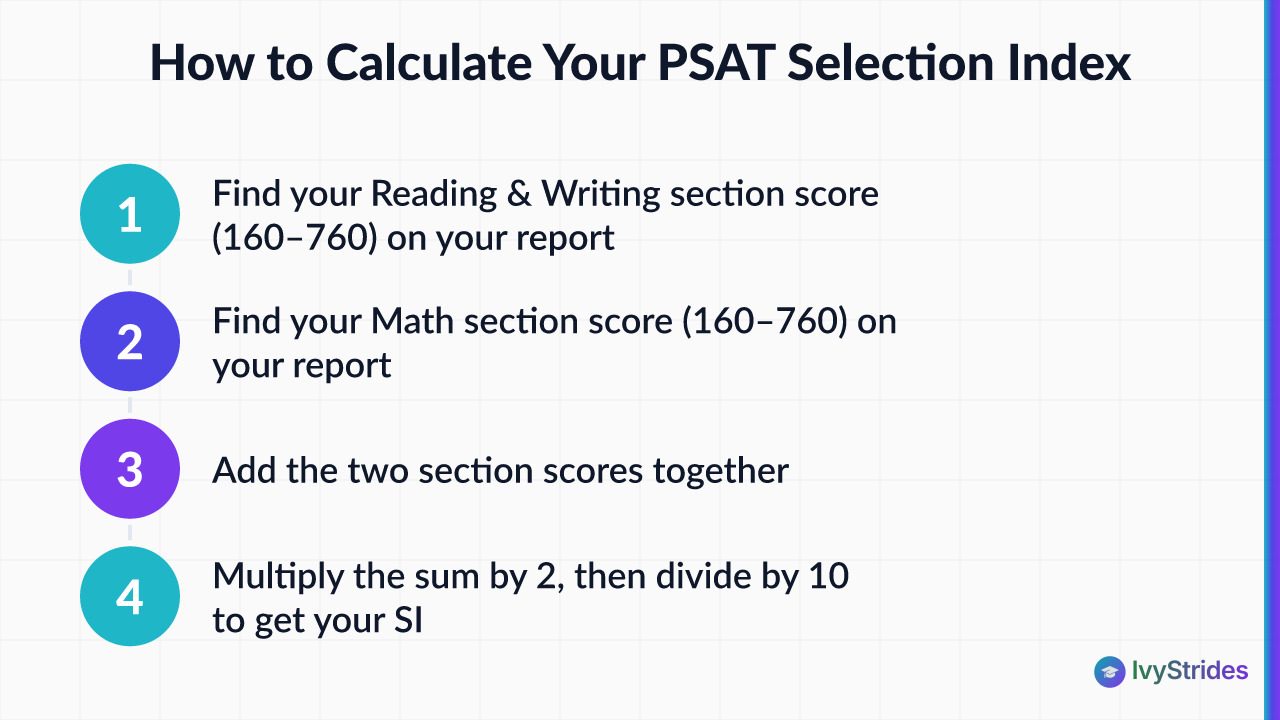
Your PSAT composite score, the 320 to 1520 number, is not the number NMSC uses. Before you can assess your National Merit odds, you need to understand how your PSAT composite converts to a Selection Index, which is the figure NMSC actually applies. The two live on different scales, and confusing them is the single most common mistake we see in the initial coaching call.
Here's the formula, per College Board's PSAT/NMSQT scoring documentation. Take your Reading and Writing section score (160 to 760). Add your Math section score (160 to 760). Multiply that sum by 2. Divide by 10. That's your SI.
Worked example. A student scores 680 Reading and Writing and 700 Math. The composite is 1380. Applied to the formula: (680 + 700) = 1380, multiplied by 2 = 2760, divided by 10 = 276. That result exceeds the SI cap of 228, which tells you the shortcut formula on the reported 160-760 scale is not the operative one. The official College Board SI is computed on the underlying test scores (8 to 38 per test) printed on your score report, not on the rescaled section scores.
The working shortcut most families use for quick estimates: SI ≈ composite × 0.15, which places a 1380 composite around SI 207. For a precise number, use the official College Board formula on the 8-to-38 test scores from your score report.
A few implications matter for planning:
- The maximum SI is 228, corresponding to the maximum composite of 1520.
- SI is used only for National Merit qualification. It's not reported to colleges.
- Section-score distribution matters. Two students with a 1400 composite can land on different SIs depending on whether the split is 700/700 or 760/640.
For a broader frame on what your composite means outside of National Merit, see what is a good PSAT score.
National Merit Cutoffs by State for the Class of 2026: The Full Table
The table below reflects Class of 2026 Semifinalist Selection Index cutoffs, aggregated from Compass Prep and McElroy Tutoring's confirmed data following NMSC's September announcement. The Commended Scholar cutoff, which is national and not state-specific, is 210 SI for the Class of 2026.
| State | Class of 2026 SI Cutoff |
| Alabama | 214 |
| Alaska | 213 |
| Arizona | 219 |
| Arkansas | 213 |
| California | 223 |
| Colorado | 220 |
| Connecticut | 223 |
| Delaware | 221 |
| District of Columbia | 224 |
| Florida | 219 |
| Georgia | 220 |
| Hawaii | 218 |
| Idaho | 214 |
| Illinois | 221 |
| Indiana | 216 |
| Iowa | 214 |
| Kansas | 217 |
| Kentucky | 215 |
| Louisiana | 214 |
| Maine | 215 |
| Maryland | 223 |
| Massachusetts | 225 |
| Michigan | 219 |
| Minnesota | 220 |
| Mississippi | 211 |
| Missouri | 216 |
| Montana | 211 |
| Nebraska | 215 |
| Nevada | 216 |
| New Hampshire | 219 |
| New Jersey | 225 |
| New Mexico | 210 |
| New York | 222 |
| North Carolina | 219 |
| North Dakota | 210 |
| Ohio | 218 |
| Oklahoma | 213 |
| Oregon | 220 |
| Pennsylvania | 220 |
| Rhode Island | 218 |
| South Carolina | 214 |
| South Dakota | 211 |
| Tennessee | 219 |
| Texas | 221 |
| Utah | 215 |
| Vermont | 216 |
| Virginia | 223 |
| Washington | 222 |
| West Virginia | 210 |
| Wisconsin | 216 |
| Wyoming | 210 |
Quick takeaways. Twenty-one states hit record cutoffs for the Class of 2026, with an average state cutoff increase of roughly 1.8 SI points over the prior year (per McElroy Tutoring's confirmed analysis). Massachusetts and New Jersey tied for the highest threshold at 225. Wyoming, North Dakota, West Virginia, and New Mexico share the floor at 210, which is also the national Commended cutoff.
NMSC does not publish cutoffs before its September announcement, and figures for any current junior class are projections until then. If you want to see how mid-band PSAT composites map to these cutoffs, our breakdown of whether is 1280 a good PSAT score puts it in context. For structured practice at your target SI, our PSAT practice tests library is built for score-band work.
Why Cutoffs Vary So Much from State to State
Here's the part most students miss. NMSC does not pick the top 16,000 SI scores nationally and call them Semifinalists. It allocates Semifinalist slots to each state in proportion to that state's share of national 11th-grade enrollment, then draws the line at whatever SI captures roughly the top 1% of PSAT takers in that state.
The mechanics create predictable geography. California has a very large 11th-grade cohort and a dense population of high-scoring students, so filling its proportional slot requires an SI of 223 for Class of 2026. Wyoming has a small cohort with a thinner tail at the top end, so the same proportional slot fills at SI 210. A student with an identical PSAT score can be a Semifinalist in one state and Commended in another. That's not unfair; it's how the top-1%-per-state allocation is designed to work.
Year-to-year variation comes from cohort performance, not policy change. When a state's junior class posts stronger PSAT results overall, that state's cutoff rises. The Class of 2026 saw 21 states hit new records because that cohort's performance was unusually strong. Compass Prep's post-announcement analysis attributes this partly to the digital PSAT format stabilizing and partly to a stronger high-scoring tail in several large states.
For context on how the PSAT relates to the SAT you'll take later, see our comparison of psat vs sat difficulty.
Does a 1400 or 1470 PSAT Score Qualify for National Merit?
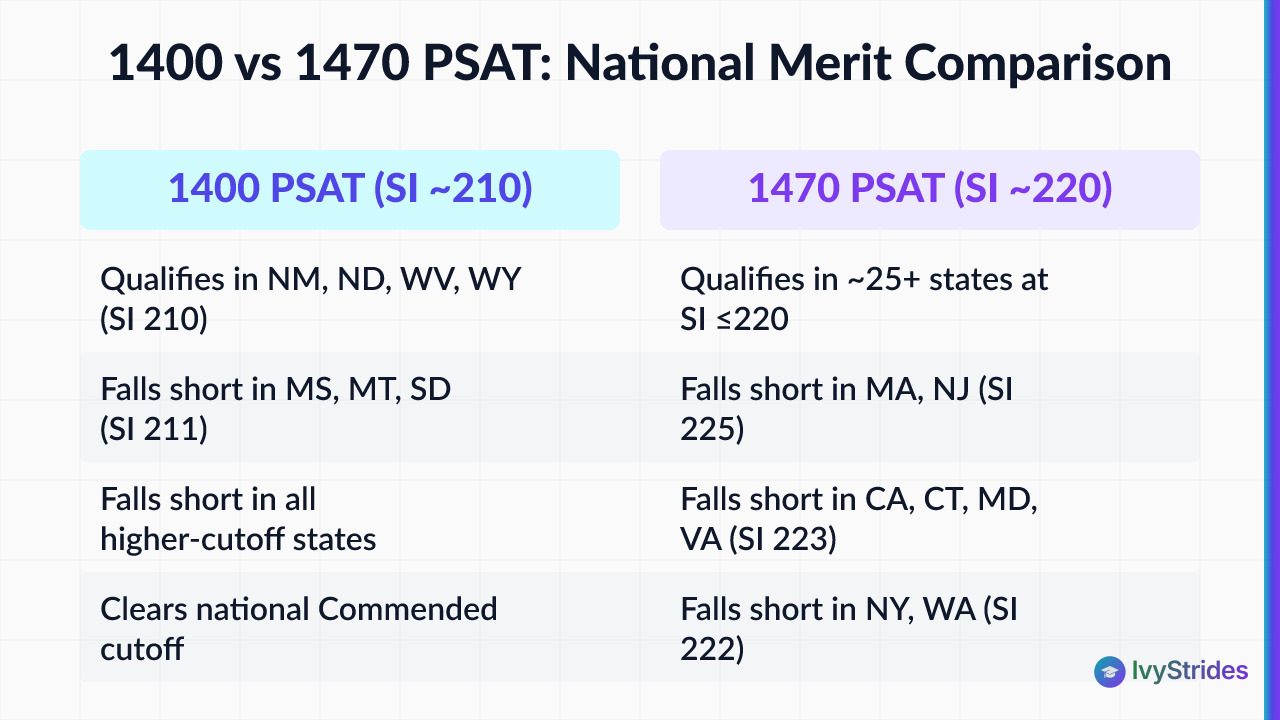
Short answer: a 1400 qualifies in the lowest-cutoff states and falls short in most of the rest. A 1470 qualifies in the majority of states but is not enough in the top tier. The precise answer depends on your section-score split.
1400 PSAT composite. Split evenly at 700 RW and 700 Math, this yields an SI of approximately 210. That number qualifies for Semifinalist status in New Mexico, North Dakota, West Virginia, and Wyoming (all at 210), and clears the national Commended cutoff. It falls short of Mississippi, Montana, and South Dakota (all 211), and every other state. An uneven split can shift the SI slightly, but not enough to move you into a 215+ state.
1470 PSAT composite. Split evenly at 735 RW and 735 Math, this yields an SI of roughly 220. That's competitive in a broad middle band including Colorado, Georgia, Oregon, Pennsylvania, Minnesota, and around 25 other states with cutoffs at 220 or below for Class of 2026. It is not enough in Massachusetts (225), New Jersey (225), District of Columbia (224), California (223), Connecticut (223), Maryland (223), Virginia (223), New York (222), Washington (222), Illinois (221), Delaware (221), or Texas (221).
A key nuance: because the SI weights RW and Math equally, a 1470 split as 760 Math / 710 RW produces a slightly different SI than 730/740. If you're within a couple of points of your state's cutoff and one section is dragging, that section is where prep hours pay back fastest.
Roughly the top 1% of PSAT takers nationally score in the 1420-1520 composite range, per College Board's national percentile data. Being in that top 1% nationally does not, on its own, guarantee Semifinalist status in a high-cutoff state. It's a necessary condition, not a sufficient one.
For sophomore benchmarks, our guide to what is a good PSAT score for a 10th grader sets earlier targets. For broader score context, see good PSAT scores.
Not Sure If Your PSAT Score Is Competitive for Your State?
Book a free 15-minute strategy call. We'll calculate your Selection Index, compare it to your state's cutoff, and tell you exactly how many points you need and about how long it will realistically take to close the gap. Students and parents both welcome.
Your State's Cutoff Is Close: What to Do Next

Photo by cottonbro studio on Pexels
If your current Selection Index sits within 3 to 5 points of your state's cutoff, a targeted PSAT prep plan built around a diagnostic test can close that gap before the October test date. This is the score band where prep hours produce the highest return, because you're not rebuilding fundamentals; you're eliminating a specific set of missed-question types.
Start with a full-length diagnostic. Not a section quiz, not a topic drill. A full digital PSAT under timed conditions. What you're looking for isn't the composite; it's the pattern. In our coaching with students targeting National Merit, we typically see the SI gap concentrate in one of three places: a specific RW question type (usually rhetorical synthesis or transitions), a specific Math domain (usually advanced math or problem-solving and data analysis), or a pacing issue on the second adaptive module that leaves 3 to 5 questions rushed.
Once the pattern is identified, section-specialist work does the closing. A student weak in Math works with a Math specialist; a student leaking points on RW works with a Reading and Writing specialist. In our coaching with students at this band, a 3 to 5 SI point gap is typically closeable in roughly 8 to 12 weeks when the diagnostic reveals concentrated weaknesses in one section, rather than diffuse weakness across both.
Here's what that looks like in practice. A student in Texas (Class of 2026 cutoff: 221) walks in at SI 217. That's roughly two additional correct answers per section on the operational modules. That's a well-defined project: identify the two most-missed question types in each section, run targeted sets against them, and re-time full modules until the pacing is stable.
Timeline matters. The PSAT/NMSQT is offered once per year, in October. The Class of 2027 qualifying test is the October 2025 administration (per the College Board PSAT/NMSQT page). If you're a rising junior reading this in the spring, you have a full summer to work. If you're reading this after taking the October PSAT and you've missed by a few points, there's no retake for National Merit purposes, but the same prep converts directly into SAT gains for spring test dates.
Students who pair a strong PSAT score with a rigorous AP course load signal academic readiness on two fronts, which is why many families plan PSAT prep and AP prep on the same timeline. Our full walkthrough of the qualification process lives at how to qualify for National Merit. For targeted practice sets aligned to score bands, use our PSAT practice tests. Because PSAT prep converts almost directly into SAT readiness, students often continue with 1-on-1 SAT prep after the October PSAT.
What Happens After You Hit the Cutoff: Semifinalist, Finalist, and Scholar
Hitting your state's SI cutoff makes you a Semifinalist, not a Scholar. There are three tiers, and each one narrows.
Semifinalist. Around 16,000 students are named in September of senior year, drawn from roughly 1.5 million PSAT takers. This is the tier the state cutoff determines.
Finalist. Semifinalists advance to Finalist by completing the NMSC application: a self-descriptive essay, a school endorsement, a transcript, and a confirming SAT score that supports the PSAT result. About 15,000 Semifinalists advance to Finalist. The confirming SAT step is where a small number of students stumble; if your SAT is materially below your PSAT, that raises a flag. Our post on PSAT to SAT score conversion walks through the concordance.
Scholar. Around 7,500 Finalists receive a monetary award. The base National Merit Scholarship is a $2,500 one-time award. Corporate-sponsored and college-sponsored awards vary widely; some universities have historically offered near-full-tuition packages to Finalists who enroll and name them their first-choice school. Because these institutional awards change year to year, verify current offers directly with each university's financial aid office before making enrollment decisions.
National Merit Semifinalist status strengthens a college application, but it works alongside, not instead of, a strong SAT score, AP record, and admissions essays. Even at test-optional schools, National Merit recognition is typically reported and considered, so earning Semifinalist status has value regardless of whether a school requires test scores. Test-optional policies vary by school and by year; check each college's current stance rather than assume.
For a full breakdown of what recognition unlocks financially, see what are the National Merit scholarship benefits. Students building a competitive junior and senior year alongside PSAT prep should also look at our ap courses online.
Which States Have the Most National Merit Scholars?
Two different answers depending on how you count.
In absolute numbers, Texas, California, New York, and Florida produce the most Semifinalists each year. That's a direct consequence of the proportional-allocation mechanism: large 11th-grade cohorts get more Semifinalist slots. Texas alone typically produces well over 1,000 Semifinalists in a given cycle.
Per capita, the picture flips. Massachusetts and New Jersey, tied at the top cutoff of 225 for Class of 2026, have the highest density of top-scoring PSAT takers relative to their populations. Connecticut, Maryland, and Virginia also cluster at the top. If you're a strong student in one of those states, you're not competing against a random cross-section; you're competing against a dense field.
Perennially strong schools also appear on third-party lists of Semifinalist production, mostly selective public magnet schools in Texas, Florida, and California. NMSC does not publish an official school ranking; any list you see is compiled from press releases and school announcements, and it varies year to year.
Predicted Cutoffs for the Class of 2027: What to Expect
Compass Prep's post-Class-of-2026 projection is that the record spike will not repeat: no new state records are expected for the Class of 2027, though most states will likely hold at or near their current thresholds. Use each state's Class of 2026 cutoff as a planning floor, not a ceiling.
The October 2025 PSAT/NMSQT is the qualifying test for the Class of 2027, per NMSC. The Commended cutoff for Class of 2027 hasn't been announced. For context: it was 207 for Classes of 2023 and 2024, rose to 208 for Class of 2025, and stepped up to 210 for Class of 2026. A conservative planning assumption is a Commended cutoff of roughly 208 to 210 for Class of 2027.
Practical planning target: aim for at least your state's Class of 2026 cutoff. If you're in a top-tier state (MA, NJ, DC, CA, CT, MD, VA), plan for about 1 to 2 points above the 2026 number as a safety margin. All Class of 2027 numbers are estimates until NMSC's official September announcement, roughly 11 months after your qualifying PSAT.
If your PSAT prep will continue directly into SAT prep, the SAT test dates 2026 calendar lets you plan the confirming SAT sitting. Our approach to how to improve your SAT score covers the methodology.
FAQ
What is the National Merit cutoff score for 2026?
The Class of 2026 Commended Scholar cutoff is 210 Selection Index, a single national threshold. Semifinalist cutoffs vary by state, ranging from 210 in Wyoming, North Dakota, West Virginia, and New Mexico to 225 in Massachusetts and New Jersey. The average state cutoff rose by roughly 1.8 SI points over Class of 2025, with 21 states hitting record highs.
Does a 1400 PSAT score qualify for National Merit?
A 1400 PSAT composite translates to an approximate Selection Index around 210, depending on section-score distribution. That range qualifies for Semifinalist status in the lowest-cutoff states (Wyoming, North Dakota, West Virginia, New Mexico, all at 210 for Class of 2026) and clears the national Commended cutoff. It falls short in every other state.
Is a 1470 PSAT score good enough for National Merit?
A 1470 PSAT composite corresponds to an SI of roughly 220 with an even section split. That's competitive for Semifinalist status in around 30 states for Class of 2026, including Colorado, Georgia, Oregon, Pennsylvania, and Minnesota. It falls short in Massachusetts and New Jersey (225), DC (224), California, Connecticut, Maryland, Virginia (all 223), New York, Washington (222), and several other high-cutoff states. In those states, students typically need a composite closer to 1490 to 1520.
Which state has the most National Merit Scholars?
By raw count, Texas, California, New York, and Florida produce the most Semifinalists each year, because NMSC allocates Semifinalist slots proportionally to each state's 11th-grade enrollment. By competitiveness, Massachusetts and New Jersey consistently require the highest Selection Index scores, reflecting the density of high-scoring test takers in those states.
What is the difference between a Commended Scholar and a Semifinalist?
The Commended Scholar cutoff is a single national threshold, 210 SI for Class of 2026, that recognizes roughly the top 2% to 3% of PSAT takers nationwide. Commended Students receive recognition but do not advance to Finalist or Scholar status and are not eligible for the monetary awards tied to those tiers. Semifinalists are chosen from the top 1% of each state's test takers using state-specific cutoffs and can advance to Finalist and Scholar with monetary awards.
Can National Merit Scholarship status lead to a full college scholarship?
The base National Merit Scholarship is a one-time $2,500 award. Some universities offer substantially larger college-sponsored awards, including full-tuition or near-full-tuition packages, to National Merit Finalists who enroll and name that university as their first choice. These institutional awards vary widely by school and change year to year, so verify current offers directly with each university's financial aid office. National Merit status alone doesn't guarantee any specific scholarship amount or admission decision.
Why is the cutoff different in my state compared to a neighboring state?
NMSC allocates Semifinalist spots to represent roughly the top 1% of each state's 11th-grade PSAT takers. States with larger populations or higher concentrations of high-scoring students require a higher Selection Index to land in that top 1%; states with smaller or less concentrated test-taking populations have lower thresholds. That's why a student in Wyoming can qualify at SI 210 while a student in Massachusetts needs SI 225 to hit the same tier.
The Bottom Line
Find your state in the table. Calculate your Selection Index from your actual PSAT test scores on the 8-to-38 scale, not from the composite estimate. If you're at or above the cutoff, focus on the Finalist application and a strong confirming SAT. If you're within 3 to 5 SI points, you have a well-defined project: diagnostic first, then section-specialist prep against the specific question types costing you points. If you're further out, the same prep still converts directly into SAT readiness and a stronger overall application.
For more on how we structure coaching, see the IvyStrides about page. You can also meet the expert online SAT tutors who work with students at each score band.
Ready to Build a PSAT Plan Around Your State's Cutoff?
Our section-specialist coaches start with a full diagnostic, identify exactly where your Selection Index is leaking points, and build a targeted plan to close the gap before October. Students and parents are both welcome on the call.

Award-winning author (South Asian Book Award) and graduate of BITS Pilani and UCLA Luskin School of Public Affairs. Brings a published writer's eye to Common App essays and grammatical precision to SAT and ACT R&W instruction.