
How Many Supplemental Essays Will You Write? The Honest, Data-Backed Answer for 2026
On this page
- The Direct Answer: How Many Supplemental Essays Will You Write in 2026
- How Per-School Essay Counts Break Down: A Prompt-by-Prompt Look at Selective Colleges
- The Real Reason Students Run Out of Time: Why the Essay Count Surprises Everyone
- How Long Do Supplemental Essays Actually Take to Write
- Which Supplemental Essays Can You Reuse and Which Ones Cannot
- Why Colleges Use Supplemental Essays and How Much They Matter
- How to Build a Realistic Supplemental Essay Plan Before You Write a Single Word
- Do You Have to Write All 7 Common App Essay Prompts?
- A Note on AI, Academic Integrity, and Your Supplemental Essays
- FAQ
- What is the 10% rule in essay writing?
- What are the 5 D's of college essays?
- How many supplemental essays should I write for a balanced college list?
- Do colleges care about supplemental essays?
- How many drafts do students usually write per supplemental essay?
- Is 2 weeks enough time to write supplemental essays?
Most students applying to 8-12 colleges in 2026 write roughly 15 to 30 supplemental essays, plus one Common App personal statement of up to 650 words. The exact count depends on your list: MIT, Yale, and the Ivies each typically require 3-5 prompts, while a growing number of schools require none. Budget about 2-4 hours per supplemental prompt and at least 5 hours for the personal statement.
Those ranges come from each school's official admissions page and the Common App, cross-checked against our essay coaching across the last two application cycles. The rest of this article breaks the number down by school, prompt type, and calendar week. It reflects the 2025-2026 and 2026-2027 cycles; verify each school's current prompts on its official admissions page before you draft.

The Direct Answer: How Many Supplemental Essays Will You Write in 2026
For a balanced list of 8-12 schools, expect roughly 15 to 30 supplemental essays. For a list heavy in selective privates, 25 to 40 is common once short-answer prompts and character-limited items are counted. One student on Reddit's ApplyingToCollege forum reported around 38 total pieces across 17 applications last cycle. That isn't an outlier when the list includes multiple Ivies plus MIT.
The Common App personal statement is separate. You choose one of seven prompts for the 2025-2026 cycle and submit a single 650-word essay to every Common App school on your list. You don't write seven essays. You write one.
The Additional Information section also sits outside the supplemental count. It's optional. As of August 1, 2025, its word limit was reduced from 650 to 300 words per the Common App's own announcement. That change matters for students who used to treat it as an extra essay slot; the space for context is now tighter.
Which schools drop the workload? A handful of institutions eliminated supplementals for the 2026-27 cycle, and Inside Higher Ed has been tracking the shift. Which schools multiply it? The most selective privates, plus any public system with its own application. The UC system requires four Personal Insight Questions at 350 words each, submitted separately from the Common App.
If you're still assembling your list, start with our guide on how to brainstorm college essay ideas so your topics and your school list develop together.
How Per-School Essay Counts Break Down: A Prompt-by-Prompt Look at Selective Colleges
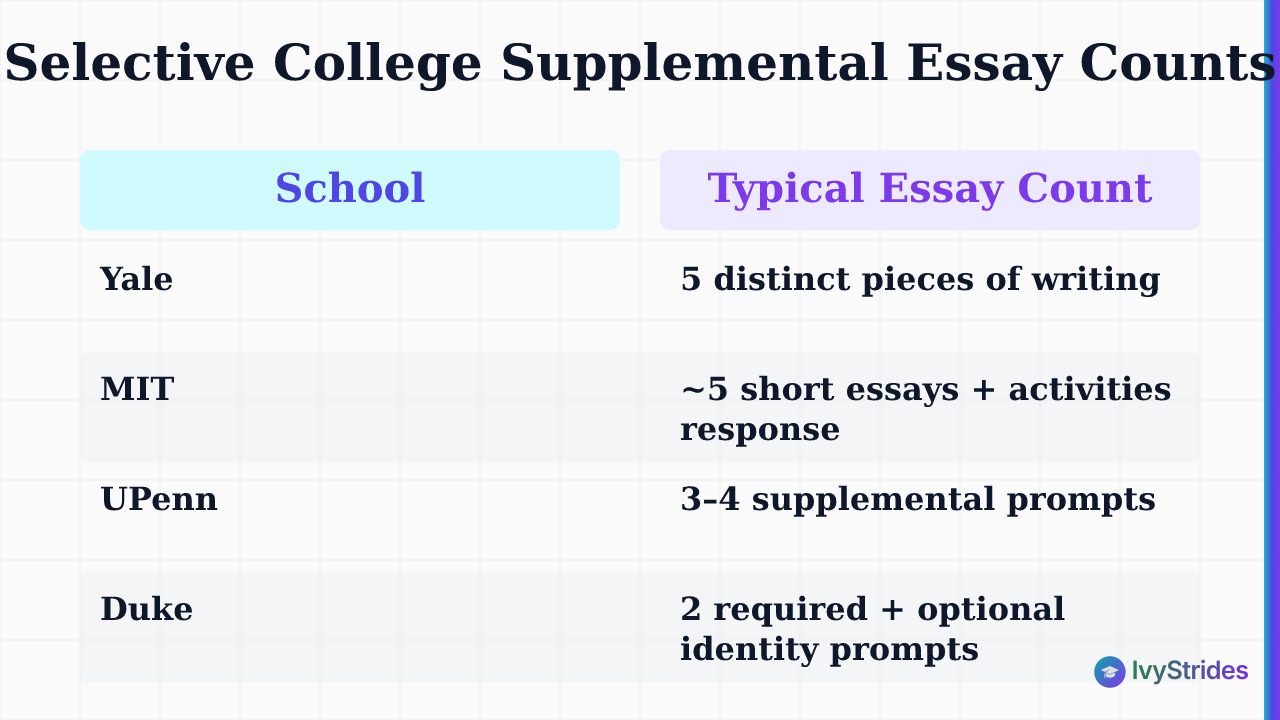
Abstract numbers don't plan a calendar. School-by-school counts do.
Here's what the workload typically looks like at named selective colleges for the 2026-27 cycle. Verify each against the school's current admissions page before drafting; prompts change annually.
- Yale: one required short-answer response at roughly 200 words, three short-take questions at around 200 characters each, plus one longer essay. Effectively five distinct pieces of writing for one school.
- MIT: approximately five short essays plus an activities-based response. MIT doesn't use the Common App, so this sits in its own portal with its own deadlines.
- UPenn: typically three to four supplemental prompts, including a Why Penn and a program-specific response.
- Duke: typically two required prompts plus optional identity-based prompts that most competitive applicants complete.
- Northwestern: typically two prompts, including a Why Northwestern.
Six prompt types show up over and over, each with a characteristic word range:
- Why Us: roughly 150-300 words. School-specific. Zero reuse.
- Why Major: roughly 150-250 words. Partially reusable if your intended major is consistent.
- Activity or extracurricular: roughly 150-300 words. Highly reusable core.
- Community or diversity: roughly 250-400 words. Reusable core with school-specific hook.
- Short-answer: roughly 25-150 words. Sometimes reusable, often not.
- Creative or open-ended: roughly 200-650 words. Rarely reusable.
If Duke or Northwestern is on your list, our fit analyses on should you apply to Duke University and should you apply to Johns Hopkins University walk through how each school's supplementals fit into the broader application read.
The Real Reason Students Run Out of Time: Why the Essay Count Surprises Everyone
Here's the part most students miss. The essay count doesn't feel real until you build the inventory. Until then, "I'm applying to twelve schools" sounds manageable. It isn't.
One parent on CollegeConfidential last cycle counted more than 20 supplemental essays for an 11-school list. A Reddit thread titled "Wait hold on, how many essays do we have to write?" surfaces every August because the shock is universal: the list grew organically over junior year, and nobody counted the prompts.
Adding two reach schools rarely means adding two essays. It usually means adding six to ten, because the most selective schools ask the most. The Why Us prompt is the compounding factor. It can't be recycled. Every Why Penn, Why Duke, Why Chicago requires roughly 30 to 60 minutes of research on specific programs, professors, courses, or traditions before you even open a document.
The workload doesn't just make students tired. It quietly lowers the quality of the essays that matter most. A first draft isn't a submission-ready draft. In our coaching, submission-ready supplementals typically go through three to four revision rounds. Students who start in June complete that cycle. Students who start in September submit after one rushed round, and it shows on the schools they cared about most.
If drafting help would compress those cycles, we offer one-on-one help for the common app essay and supplementals, matched to your specific school list.
How Long Do Supplemental Essays Actually Take to Write
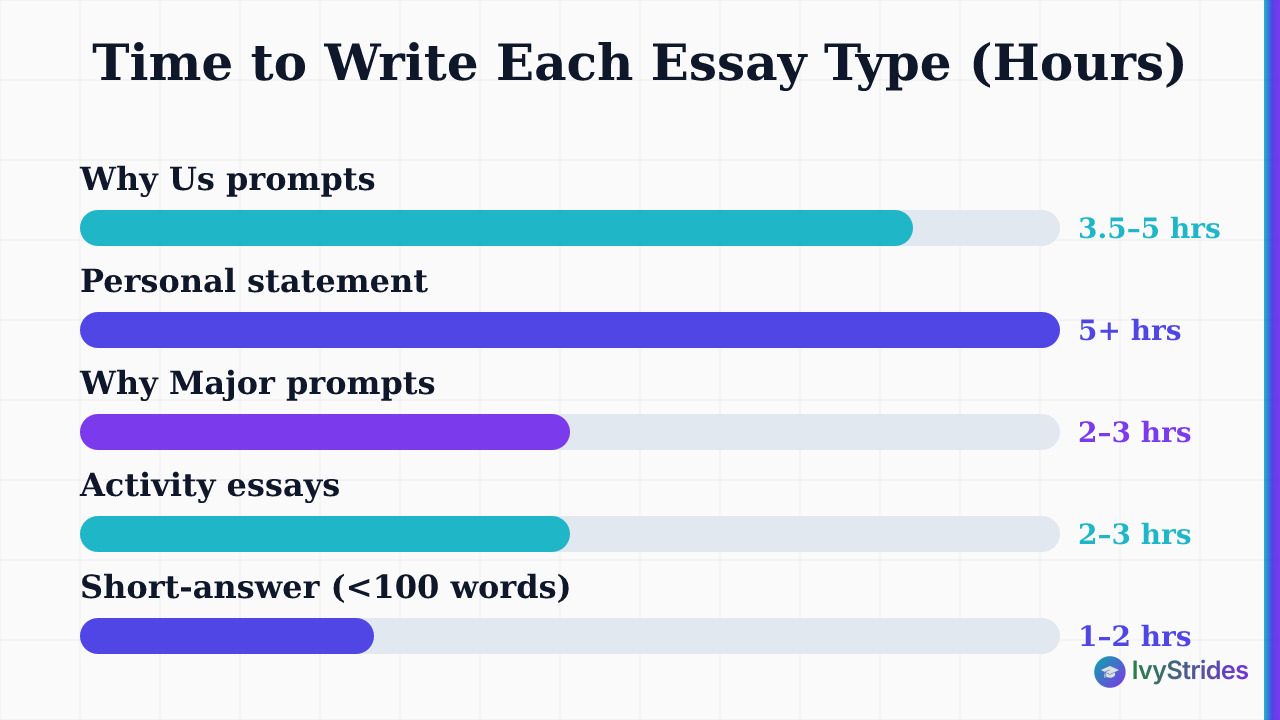
Time-per-essay benchmarks are the second variable families underestimate. The Common App personal statement takes at least five hours from brainstorm to submission-ready draft. Each supplemental takes roughly two to four hours. That's the working benchmark, and it lines up with what we see across essay coaching.
Break it down further:
- Why Us prompts: add roughly 30 to 60 minutes of school-specific research before writing. Actual writing and revision then runs about three to four hours. Total: roughly 3.5 to 5 hours per school.
- Why Major prompts: about two to three hours if your major and rationale are already articulated.
- Activity essays: roughly two to three hours for the first version. Adaptations for other schools typically run 45 to 75 minutes each.
- Short-answer prompts (under 100 words): still about one to two hours. Precision at low word counts is harder than it looks. Cutting a good idea from 180 to 90 words is where most students burn an afternoon.
Do the math on a ten-school list averaging three supplementals per school. That's 30 prompts, at roughly 2-4 hours each, or about 60 to 120 hours of drafting and revision across the fall. Add the personal statement. Add school research. Add the Additional Information section if you use it.
In our coaching, students working with a coach on their two or three highest-priority schools typically cut one full revision round, because the first-draft diagnostic surfaces issues that would otherwise take two more passes to catch. If you already have drafts, our essay review service works on completed drafts rather than starting from a blank page.
Reuse is the other big lever. Our full breakdown of how to reuse essays across applications covers exactly which prompt types transfer and which require a fresh draft.
Which Supplemental Essays Can You Reuse and Which Ones Cannot
Reuse isn't copy-paste. It's strategic adaptation. And the rules are cleaner than most students think.
Reusable with adaptation:
- Activity and extracurricular essays. The core narrative (what you did, what you learned, why it mattered) stays. The last two sentences shift to connect to the specific school.
- Community essays. Same structure. New school-specific hook.
- Diversity and identity essays. Highly reusable; the reflection is about you, not the school.
- Intellectual curiosity prompts. The story of what fascinates you doesn't change from school to school.
Not reusable, ever:
- Why Us essays. By definition. If your Why Duke could be dropped into your Why Vanderbilt with a name swap, both are weak.
- Program-specific prompts (Why this major at this school). Same problem. These require named courses, professors, or research groups.
One warning on reuse. Word-limit variation is the trap. The same activity essay might need to be 150 words for one school and 300 for another. That's substantive editing, not trimming. A 300-word essay cut to 150 loses roughly half its content, and the half you cut has to be the least essential half. In our coaching, students who build a master essay bank of four to six core narratives can cover roughly 80 percent of supplemental prompts across a 10-school list. The remaining 20 percent, mostly Why Us and program-specific, has to be written fresh.
If Northwestern is on your list, our fit analysis on should you apply to Northwestern University in 2026 covers what its supplementals typically ask for.
Why Colleges Use Supplemental Essays and How Much They Matter
Here's the honest read. At a school receiving tens of thousands of applications for a couple thousand seats, thousands of applicants have similar GPAs, similar course rigor, and similar test scores. Supplemental essays are the tiebreaker.
They do two things for the admissions reader. First, they signal genuine interest and fit; a specific, researched Why Us separates you from an applicant who submitted a template. Second, they surface texture that grades and scores can't: how you think, what you notice, what you care about.
Test-optional context matters here. FairTest tracks hundreds of institutions with test-optional policies still in effect. At those schools, admissions officers have stated that essays and course rigor carry more explicit weight when a score isn't part of the file. Supplemental quality isn't a small variable in that scenario.
What hurts you in a supplemental? Three patterns show up repeatedly:
-
A generic Why Us that could be pasted into any application with a name swap.
-
A restatement of your resume in essay form.
-
Prose that reads as AI-generated, with no specific personal voice.
The counter-pattern is what works. In our coaching, the most effective supplementals demonstrate specific knowledge of the school (a named course, a research center, a tradition, a professor whose work you actually engaged with) and connect it to a concrete aspect of your story. That specificity is unforgeable.
One caveat worth naming. Not every school treats supplementals the same way. Several institutions dropped them for 2026-27, per Inside Higher Ed reporting. Supplementals are one component of the full application; admissions outcomes depend on grades, rigor, scores where required, extracurriculars, recommendations, and fit alongside them. No essay strategy overcomes a weak academic record.
How to Build a Realistic Supplemental Essay Plan Before You Write a Single Word
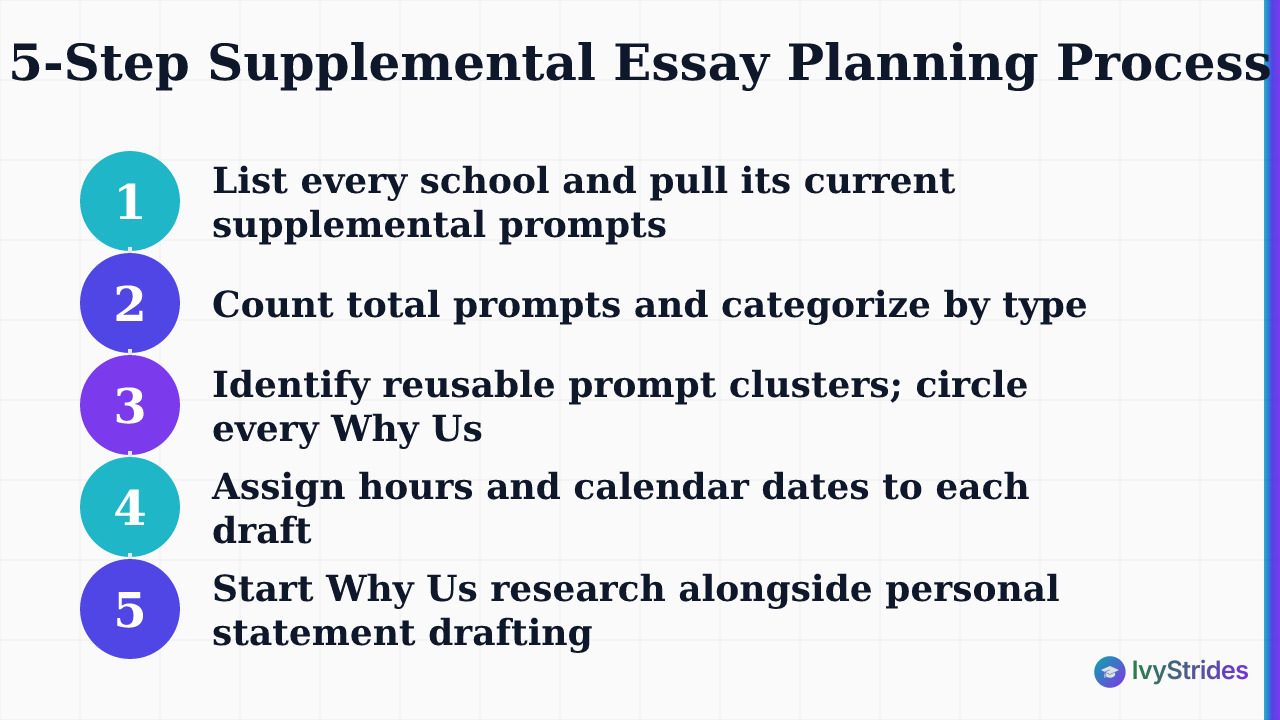
Plan the workload before you draft. This is the single biggest lever most families miss.
Five steps:
-
List every school and pull its current supplemental prompts. Do this in a spreadsheet. Columns: school, prompt text, word limit, prompt type (Why Us, Why Major, Activity, Community, Short-answer, Creative). Most schools release or confirm prompts by late July or early August each year; some are available earlier.
-
Count total prompts and categorize by type. The number will be higher than you estimated. That's the point of the exercise.
-
Identify reusable prompt clusters. Group the activity, community, and diversity prompts across schools. Circle every Why Us; those can't be grouped.
-
Assign hours and calendar dates to each draft. Use the 2-4 hour benchmark per supplemental, plus 30-60 minutes of research per Why Us. Reverse-engineer from your earliest deadline.
-
Start Why Us research in parallel with personal statement drafting. Research doesn't require finished prose; note-taking on programs and courses can happen during the personal statement's revision weeks.
The recommended calendar for fall applicants: personal statement brainstorming in May and June, supplemental drafts in July and August, revision in September and October. Early Action and Early Decision deadlines are typically November 1 or November 15. That makes October the last safe revision window for EA/ED schools.
Students who are also managing AP exam prep often find the spring semester of junior year the most compressed period, which is one reason starting supplemental drafts in June, right after AP exams end, rather than August makes a measurable difference in final essay quality. If AP scheduling is part of your junior year picture, our ap courses online run through the school year with per-subject specialists.
In our coaching, students who complete a school-by-school essay inventory in June submit noticeably stronger final drafts than those who discover the full workload in September. The difference isn't talent. It's calendar.
Do You Have to Write All 7 Common App Essay Prompts?
No. You pick one.
The Common App offers seven personal statement prompts for the 2025-2026 cycle. You select the one that best fits your story and write a single essay of up to 650 words. That one essay is submitted to every Common App school on your list simultaneously. It doesn't change from school to school.
The confusion usually comes from conflating three separate things:
- The personal statement (one essay, 650 words, submitted to all Common App schools)
- Supplemental essays (school-specific, in addition to the personal statement, varying by school)
- The Additional Information section (optional, now 300 words as of August 1, 2025, separate from both)
Only the first is universal. The second scales with your list. The third is optional and shrank this cycle.
If you're mid-draft and want a second read on the personal statement, our common app essay tutor works one-on-one on the 650-word draft as its own project, separate from supplementals.
A Note on AI, Academic Integrity, and Your Supplemental Essays
This section exists because the question comes up in almost every intake call, and the answer matters.
Colleges have gotten clearer. Submitting AI-generated prose as your own work may violate the Common App applicant honor code and the academic integrity policy of the institution you're applying to. That isn't a legal risk. It's an admissions risk, which is worse. Applications can be withdrawn or admissions rescinded when AI-generated writing is flagged. Policies vary by institution and are changing quickly, so check each school's honor code before using AI tools.
There's a real distinction between two uses of AI:
- Brainstorming, outlining, grammar checks. These are tools, similar to a thesaurus or a spellchecker. Most schools don't object.
- Generating essay prose and submitting it as your writing. This is the line.
The tell is voice. General-purpose AI produces prose that sounds capable but not specific. It can't invent the detail that your grandmother repaired watches at the kitchen table, or that you spent three weeks debugging one line of Python in your robotics team's autonomous code. The unforgeable specifics are what admissions readers are trained to look for. In our coaching, the most effective supplementals contain named experiences, concrete detail, and a voice that couldn't be replicated by prompting a chatbot.
If you want a human read on drafts you've already written, our essay review service works on completed drafts and doesn't generate replacement prose.
FAQ
What is the 10% rule in essay writing?
The 10% rule is an editing guideline: cut roughly 10 percent of your word count on each revision pass to tighten prose and remove filler. For tightly limited supplementals at 150-300 words, this discipline is especially useful. Draft freely, then cut 10 percent and check whether the essay sharpens. It isn't an admissions standard, just a practical editing habit that coaches use to force precision.
What are the 5 D's of college essays?
Some essay coaches use a "5 D's" framework to evaluate draft quality: Distinctive (does it sound like you specifically?), Detailed (concrete specifics over generalities), Direct (does it get to the point?), Deep (reflection, not just description?), and Differentiated (does it add something not already visible elsewhere in your application?). It isn't a universal standard, but supplementals that work almost always score high on all five.
How many supplemental essays should I write for a balanced college list?
For a balanced list of 10-12 schools (2-3 reach, 4-5 match, 3-4 likely), expect roughly 20 to 35 total supplemental responses plus your Common App personal statement. Adding two Ivy-level reach schools can add 8-10 prompts on its own. Build the school list first, count the prompts in a spreadsheet, then decide whether the workload is realistic before you commit.
Do colleges care about supplemental essays?
Yes, particularly at selective schools. When applicants have similar academic profiles, supplementals often give an admissions reader a reason to advocate for one student over another. At test-optional schools, essay weight increases further. A generic Why Us is a missed opportunity; a specific, researched response signals genuine fit.
How many drafts do students usually write per supplemental essay?
In our coaching, a submission-ready supplemental typically goes through three to four revision rounds. Draft one captures the core idea. Draft two tightens structure and specificity. Draft three refines voice and cuts to the word limit. A final pass proofreads. Students who start in June complete that cycle; students starting in September typically get through one or two rounds.
Is 2 weeks enough time to write supplemental essays?
For one or two schools, yes, if your personal statement is already strong and your story is clear. For a full 10-12 school list, no. At roughly 2-4 hours per prompt with three to four revision rounds, a list of that size represents about 60 to 120 hours of work. Two weeks before a deadline produces first drafts, not polished essays. Start earlier.
Count the prompts. Build the calendar. Start in June, not September. That is the single decision that most consistently separates strong final drafts from rushed ones.

Award-winning author (South Asian Book Award) and graduate of BITS Pilani and UCLA Luskin School of Public Affairs. Brings a published writer's eye to Common App essays and grammatical precision to SAT and ACT R&W instruction.