
'Why This College' Essay: 3 Examples That Worked (and Why They Did)

On this page
- What a Why-This-College Essay Is (and What It Is Not)
- What Makes a Why-This-College Essay Actually Work
- Example 1: A 100-Word Why-This-College Essay That Earned Its Place
- Example 2: A 250-Word Why-This-College Essay for a STEM Applicant
- The Part Most Students Get Wrong: Why Generic Essays Get Ignored
- Not Sure If Your Why-This-College Essay Is Specific Enough?
- Example 3: A 500-Word Why-This-College Essay With a Why-This-Major Layer
- How to Research Any School Well Enough to Write This Essay
- Writing the Essay: A Three-Part Structure That Works at Any Word Count
- Your Next Step: Turning This Framework Into Your Own Essay
- FAQ
- How do I write a why-this-college essay in 150 words or fewer?
- What is the difference between a why-this-college and a why-this-major essay?
- How specific do why-us essays actually need to be?
- Should I mention a school's rankings or reputation in my why-this-college essay?
- Can I reuse the same why-this-college essay for multiple schools?
- Ready to Write a Why-This-College Essay That Actually Gets Read?
A strong why-this-college essay names at least two or three specific programs, courses, professors, or campus resources and connects each one to something the student has already done or plans to pursue. Generic praise ("I love your diverse community") doesn't work. Specificity does. The three annotated examples below show what that looks like at 100 words, 250 words, and 500 words.
These word-count conventions and the supplemental essay system itself come from Common App's official documentation, current for the 2025-2026 application cycle. The harder question, what counts as "specific enough" to a reader who has seen 200 essays this week, is where the next section starts.
What a Why-This-College Essay Is (and What It Is Not)
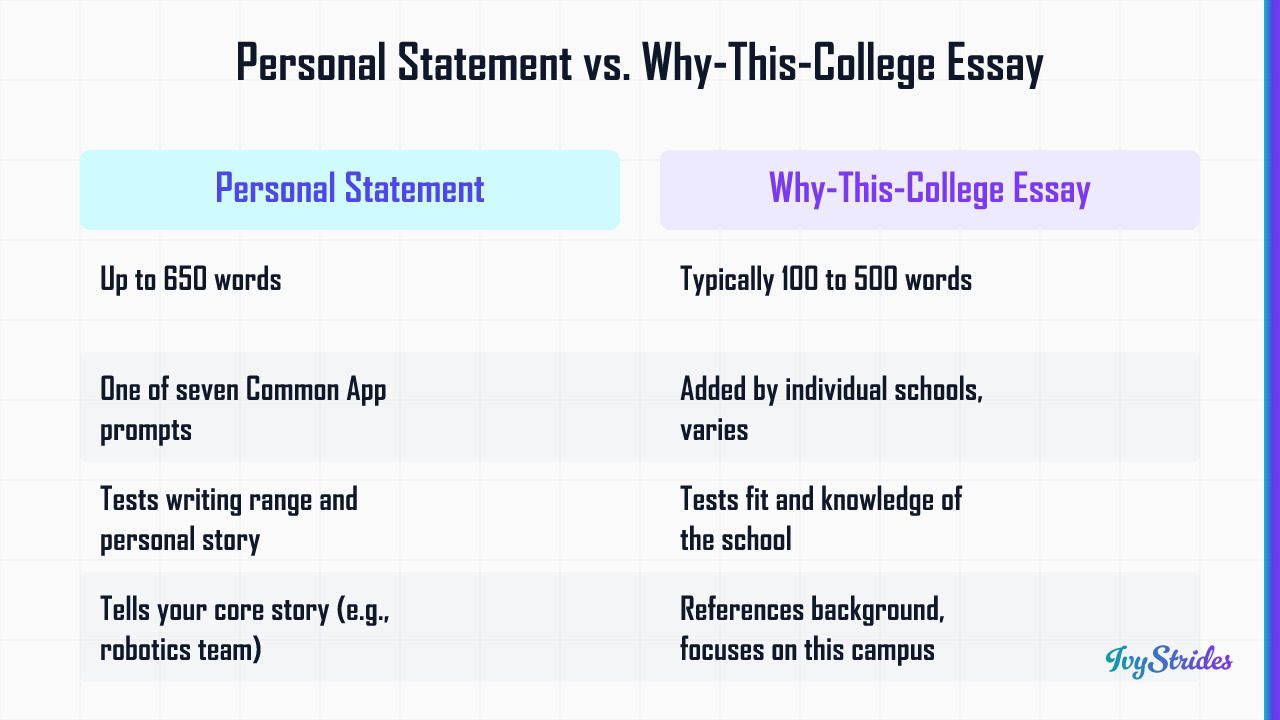
A why-this-college essay is a short supplemental essay, typically 100 to 500 words, in which a college asks you to explain why you want to attend that specific school. It sits inside the Common App alongside your 650-word personal statement. Per Common App, the personal statement uses one of seven prompts and runs up to 650 words; the supplements are added by individual schools and vary widely in length and number.
What's the prompt actually testing? Whether you did real research, and whether what you found genuinely fits your goals. Admissions readers use this essay as a fit demonstration and, at many schools, as one signal of demonstrated interest. They aren't testing your writing range. They're testing whether you understand the place well enough to belong there.
Word counts shift the writing problem considerably. A 100-word prompt forces you to pick one specific anchor and one personal connection. A 250-word prompt, the most common length, gives you room for three. A 500-word prompt, used at schools like UPenn and Georgetown, often folds in a why-this-major layer and rewards a short opening scene. Some schools ask for both a why-this-college and a why-this-major prompt in the same application; when they do, the two essays must cover different ground.
One more distinction. The why-school supplement isn't a place to repeat what you already wrote in your Common App essay prompts response. If your personal statement is about your robotics team, your why-school essay shouldn't retell that story. It should reference robotics as background and spend its words on what you'll do at this specific campus.
What Makes a Why-This-College Essay Actually Work

Three pillars. Program-specific detail, personal connection, forward-looking fit. Miss any of the three and the essay sounds like it was written for a different school.
Program-specific detail means named courses, named professors, named research labs, clinics, student-run publications, or initiatives. Not "your strong engineering program." The course code. The lab name. The professor whose paper you actually read. Here's the contrast that decides essays:
- Generic, fails: "I love Northwestern's collaborative culture and world-class faculty."
- Specific, works: "Professor Brennan's lab on computational linguistics maps directly onto the NLP sentiment-classifier I built in AP Computer Science A last spring."
The first sentence could appear in any student's essay for any school. The second couldn't. That's the test admissions readers run, often within the first two sentences.
Personal connection is the bridge. A named professor on its own is just trivia. Pair that professor with a project you've already built, a class you've already taken, or a question you've already chased, and the detail earns its place. Your why-this-college essay and your Common App personal statement are read together, so the supplement should introduce a new dimension of your story rather than repeating what the 650-word essay already covers.
Forward-looking fit is the close most students forget. Don't end on "I want to learn from your faculty." End on what you'll contribute. The reader is deciding whether you'll be a productive member of the community, not a grateful guest.
One more piece of context that changes the stakes. At schools where test scores are optional, the supplemental essays, including the why-school prompt, often carry additional weight in the admissions review. The current test-optional landscape is tracked by FairTest. If you're applying to schools on that list, treat every supplement as if it's doing extra work. For the broader writing approach across all essays, our guide on how to write a college essay walks through voice, drafting, and revision. Still deciding on testing strategy? See do colleges require SAT in 2026 for the current picture.
Example 1: A 100-Word Why-This-College Essay That Earned Its Place
In our coaching with students applying to schools with short supplements, the 100-word format is the one that breaks the most drafts. There's no room to warm up. The first sentence is the hook, and rankings are dead weight.
Here is an illustrative 100-word example, anonymized from coaching work with a student applying to a STEM-focused program:
Professor Lin's Computational Imaging Lab caught my attention because her 2023 paper on lensless cameras solves the same blur problem I hit on my AP Physics C optics project. I want to take 6.S058, Introduction to Computational Imaging, and join the Undergraduate Research Opportunities Program early. Beyond the lab, the Edgerton Center's student-led robotics workshops would let me extend the autonomous-driving prototype I built last summer. I'm coming here to build, not just to study, and these are the rooms where I want to do that.
What works, sentence by sentence. Sentence one anchors on a named professor and her actual research, tied directly to the student's own AP Physics C project. Sentence two names a specific course number and a specific research program. Sentence three names a specific campus center and connects it to a documented prior project. Sentence four is the contribution close.
What's missing, deliberately. No ranking mention. No "diverse community." No campus-beauty paragraph. The student also didn't name a second professor, because at 100 words the math doesn't work: two specific details, each personally connected, is the realistic ceiling. At this length, every adjective costs a noun.
If you're aiming at schools like MIT, Caltech, or certain UC campuses with short supplement prompts, this is the model. For draft-level review of supplements like this, our essay review service gives sentence-by-sentence feedback.
Example 2: A 250-Word Why-This-College Essay for a STEM Applicant
The 250-word format is the workhorse of the supplemental essay system. Long enough for three pillars, short enough to demand prioritization. Here's an illustrative 250-word essay from coaching work with a student applying to a STEM-focused program:
When I read about the Cornell Initiative for Digital Agriculture, I recognized the problem I had been trying to solve in my own backyard for two years. My family runs a small orchard in central California, and last summer I built a Raspberry Pi soil-moisture sensor network that cut our water use by roughly 18 percent. The Initiative's work on precision irrigation through Professor Bauerle's lab is the next version of what I was trying to build with $80 of hardware and a Python script. I took AP Computer Science A and AP Calculus BC in junior year, partly because I knew the orchard project needed real numerical methods to scale. CS 4780, Machine Learning for Intelligent Systems, would give me the modeling foundation I'm missing. I'd also want to join the Cornell University Sustainable Design team, where the agricultural systems subteam is already prototyping the kind of distributed sensing platform I've been sketching. What I bring back to campus is two years of field data, a working prototype, and a clear question: how do you make precision agriculture cheap enough that a 40-acre family farm can afford it? I want to spend four years answering that with people who care about the same thing.
Paragraph one is the specific hook, anchored on a named initiative and a named professor, tied to a documented past project with a concrete result (the 18 percent figure). If you're taking rigorous AP courses in your intended major area, naming that coursework in your why-this-college essay can reinforce the intellectual fit you're claiming. Paragraph two does that: AP Computer Science A is named not as a credential but as evidence the student already chose this path, alongside the AP Calculus BC track.
Paragraph three is the contribution close. Notice what's there: data, a prototype, a question. Notice what's absent: gratitude, reputation, generic excitement. At 250 words, you can fit three or four specific details, but each must be connected to the student's story. Listed as a catalog, they read as research; integrated into a narrative, they read as fit.
The Part Most Students Get Wrong: Why Generic Essays Get Ignored
Here's the part most students miss. The five phrases below are the ones that flag a generic essay to an admissions reader, often before they finish the first paragraph:
-
"Your world-class faculty…"
-
"Your vibrant campus community…"
-
"Your strong alumni network…"
-
"I have always dreamed of attending…"
-
"Your prestigious reputation…"
If any of those phrases appear in your draft, cut them. Every one. They aren't bad writing in isolation. They're bad because they could appear in an essay for any of the 50 schools your reader has reviewed this week.
In our essay coaching work, the most common revision we make is replacing a paragraph of reputation praise with two sentences naming a specific course or professor the student actually researched. The trade is almost always worth it. Reputation praise is filler; named detail is signal.
Here's the self-editing tool we hand every student. Call it the swap test. Read each sentence in your draft and ask: could this sentence appear in my essay for a different school on my list? If the answer is yes, replace it. The sentence isn't earning its place. Admissions readers at schools like UChicago, Duke, and Northwestern have publicly noted that they identify generic why-school essays within the opening lines, and once a reader is in skimming mode, you don't get them back.
The other failure mode is more subtle. Restating your Common App personal statement. A junior we worked with last fall opened her Penn supplement with three sentences about debate, which was also the subject of her personal statement. Her admissions reader saw debate twice and learned nothing new about her on the second pass. We moved the debate reference to a single phrase and used the freed-up space for a named seminar in the Political Science department.
Research gaps cause most of this. Students who write their why-school essay from the school's homepage produce generic essays. Students who spend time in the course catalog, the faculty directory, and the student organization list produce specific ones. There's no shortcut.
Not Sure If Your Why-This-College Essay Is Specific Enough?
Book a free 15-minute strategy call. An IvyStrides essay coach will review your draft angle, tell you exactly what is generic and what is working, and recommend a clear revision path. For parents: this is also the right time to get one-on-one help for common app essay scoped before deadlines compress.
Example 3: A 500-Word Why-This-College Essay With a Why-This-Major Layer
The 500-word format gives you room for a scene. Schools that use this length, UPenn's College of Arts and Sciences, Georgetown, Tufts, and several others, usually expect a why-this-major layer folded into the why-this-college structure. Here's an illustrative example from coaching work with a student applying to a humanities program:
The first time I read a Supreme Court dissent, I was fifteen, sitting in the back of my mother's law office because the school bus had stranded me there. The dissent was Justice Ginsburg in Shelby County v. Holder, and I read it twice before I understood that a dissent is not a loss. It is an argument written for a future court. That was the moment I decided I wanted to study how legal arguments travel across time. Three years later, I'm applying to Penn because the Andrea Mitchell Center for the Study of Democracy is where that question gets taken seriously by undergraduates. Professor Rogers Smith's work on civic ideologies and Professor Anne Norton's seminars on political theory both intersect with the constitutional history I've been reading on my own since freshman year. PSCI 1180, American Political Thought, would give me the systematic foundation I've been assembling piecemeal from library books. I want to major in Political Science with a minor in History because the two fields read the same texts with different questions, and I want both questions. The undergraduate research opportunities through the Center for Undergraduate Research and Fellowships would let me pursue an independent project on dissent-as-argument across the Warren and Roberts courts. I have already drafted a proposal; I just need a faculty advisor who works in this space, and Penn has three. Beyond coursework, the Penn Political Review is where I'd want to write. I've spent two years as opinion editor at my school paper, and the Review's long-form pieces on judicial appointments are closer to the writing I want to be doing in college than anything I could pitch elsewhere. The Penn Undergraduate Law Journal, which my older cousin worked on, would be the second home I'd seek out. What I bring to campus is a 40-page annotated index of every major dissent from the Roberts court that I've built across junior and senior year, a working argument about how dissents shape future majorities, and the discipline to read a 90-page opinion in one sitting without losing the thread. I'm coming to Penn because the people who could disagree with my argument productively are here, in the Andrea Mitchell Center, in Professor Smith's office hours, in the seminar rooms where political theory and constitutional history meet. That is the room I've been trying to find since I was fifteen.
Opening scene, 50 words. Why-this-major origin, 100 words. Three school-specific fit pillars (the Mitchell Center and named faculty, the major-minor logic and named course, the publications), roughly 250 words. Contribution close, 100 words. The arc works because every named resource connects back to the opening scene; the Ginsburg dissent at fifteen becomes the 40-page annotated index at eighteen, and Penn is the only school on the list where the next chapter could plausibly be written.
For students researching specific schools at this length, our guide on should you apply to Duke University covers the surrounding application context. The same applies to our University of Chicago SAT requirements breakdown.
How to Research Any School Well Enough to Write This Essay
A repeatable five-step protocol. We hand this to every student before they draft a single supplement.
-
Course catalog search by department. Find the department that houses your intended major. Read course descriptions for the 2000-level and 3000-level offerings, not just intro classes. Note three courses you'd actually take, with course codes.
-
Faculty page scan for research alignment. Read faculty bios in your department. Find two or three professors whose recent work intersects with something you've done, read, or want to learn. Skim one paper or one interview from each. You don't need to understand every word; you need to be able to write one true sentence about why it matters to you.
-
Student organization directory review. Look for clubs that extend your current extracurricular record, not ones you'd join from scratch. A student who has run a robotics team at school is more credible joining a robotics club than a debate club they've never tried.
-
Undergraduate research, honors programs, or clinical programs. These are high-value specificity sources because most applicants don't dig this deep. Named programs (a research initiative, an honors college, a public-interest clinic) signal serious research.
-
Recent news and the admissions blog. Many schools publish their own essay advice on their admissions blogs. Johns Hopkins and Tufts both publish examples and commentary. Reading the school's own guidance is a legitimate research step and shows up in the draft.
In our coaching, students who spend 45 minutes on a school's course catalog and faculty pages before drafting consistently produce more specific essays than students who rely on the school's main admissions page. The 45 minutes isn't optional. It's the work.
One filter to run on everything you collect: the "so what" filter. For every specific detail you find, ask why it matters to you specifically. If the answer is "it sounds impressive," cut it. If the answer is "it connects to the project I built last spring," keep it. The Common App doesn't set a minimum specificity standard, but at schools with acceptance rates below roughly 20 percent, the volume of applications effectively requires it. For broader essay structure across all prompts, see our common app essay prompts guide.
Writing the Essay: A Three-Part Structure That Works at Any Word Count
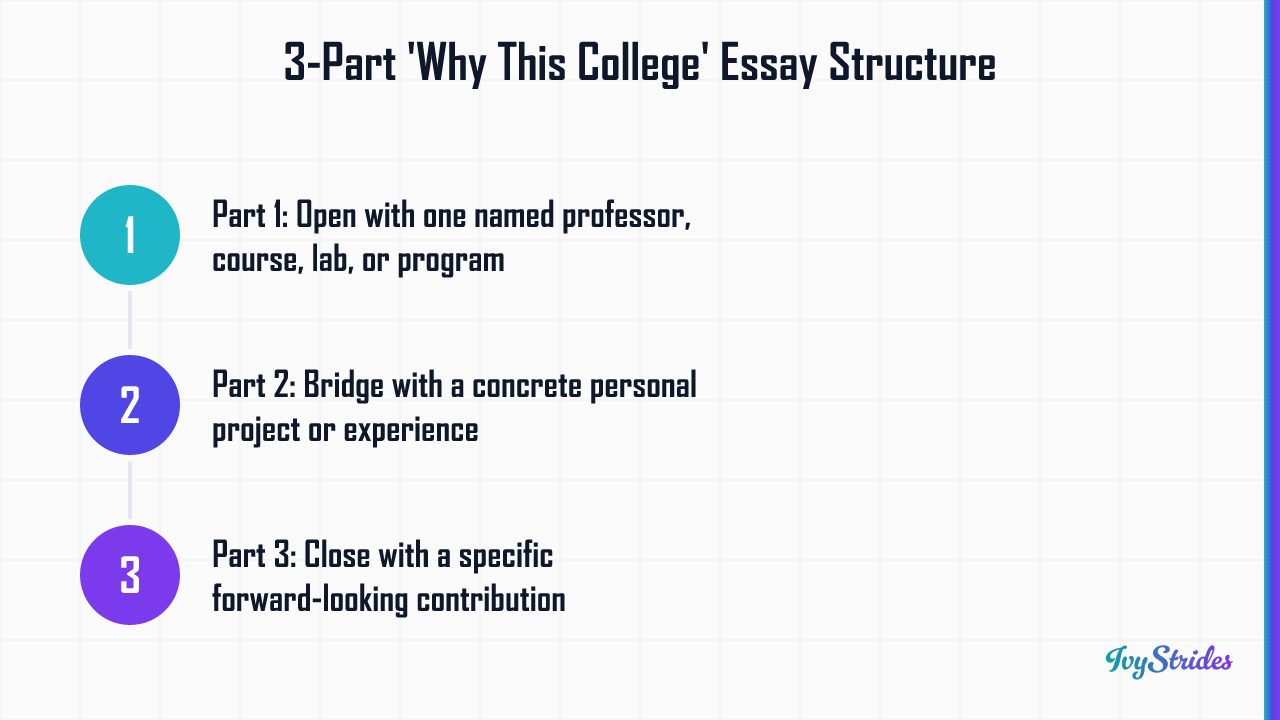
The framework, distilled to its minimum viable architecture.
Part 1: Specific hook on one named resource. Not a thesis. Not a ranking mention. One named professor, course, lab, program, or publication, dropped into the first sentence. At 100 words, this is one sentence. At 250 words, it's a short paragraph. At 500 words, it's a scene.
Part 2: Personal connection bridge. What in your background makes this resource genuinely relevant? A project, a class, a question, a job, a competition. Whatever it is, name it concretely. "I've always been interested in coding" isn't a connection. "The Raspberry Pi soil-moisture network I built for my family's orchard" is.
Part 3: Forward-looking contribution close. What will you do at this school? Not what you'll receive. In our coaching, the contribution close is the element most students omit. Ending with "I want to learn from your faculty" reads as passive. Ending with "I plan to bring my robotics competition experience into Professor Lin's lab and contribute to the team's work on lensless imaging" reads as a peer, not a supplicant.
Word-count scaling: at 100 words, one sentence per part. At 250 words, one paragraph per part with two or three named details in the middle. At 500 words, expand the opening into a scene and add a second specific pillar in the middle. The structure doesn't change. Only the resolution does.
A note on what this framework is and isn't. It's not a rigid template. It's the minimum viable architecture that prevents the two most common failures: a generic opening and a missing personal connection. Past that, your voice should drive the writing. If you want a coach to help calibrate, our common app essay tutor team works on supplements alongside the personal statement so the two essays don't overlap.
Your Next Step: Turning This Framework Into Your Own Essay
Three pillars, applied at three word counts, backed by 45 minutes of real research per school. That's the framework.
Applying it school by school is where per-school research and our supplemental essay coaching come in. In our supplemental essay coaching, the first draft almost always has the right instincts but the wrong order: students bury their most specific detail in paragraph three. Coaching moves it to sentence one. Most of what a coach does isn't adding content. It's reorganizing what's already there and cutting the parts that don't earn their place.
IvyStrides essay coaches work 1-on-1, not in group classes, and we work on the why-school supplements alongside the Common App personal statement so the two essays cover different ground. For draft-level review with sentence-by-sentence feedback, our essay review service is the right place to start.
One caveat we owe every family reading this. No essay coach can guarantee admission. The essay is one component of an application that also includes grades, test scores, extracurriculars, and recommendations. Supplemental essay prompts and word limits change each cycle; always verify the current prompt on the school's official admissions page before submitting. This article reflects the 2025-2026 application cycle.
FAQ
How do I write a why-this-college essay in 150 words or fewer?
At 150 words, you have room for exactly one specific named resource, a course, professor, or program, plus one sentence connecting it to your background and one forward-looking sentence. Cut every ranking mention, every line about campus culture, and any sentence that could appear in an essay for a different school. Prioritize the single most specific and personally relevant detail you found in your research, and write the contribution close last so it lands as the final beat the reader remembers.
What is the difference between a why-this-college and a why-this-major essay?
A why-this-college essay focuses on what this specific school offers that matches your goals: named courses, faculty, labs, or programs. A why-this-major essay focuses on your intellectual journey toward this field: the experience or question that sparked your interest and how it has developed through coursework or projects. Some schools ask for both in the same application cycle. When they do, the two essays shouldn't repeat the same anecdotes; split your strongest material so each essay carries new weight.
How specific do why-us essays actually need to be?
Specific enough that the essay couldn't be submitted to a different school without rewriting it. The practical test: read each sentence and ask whether it could appear in an essay for your second-choice school. If the answer is yes, the sentence isn't earning its place. Admissions readers at selective schools, particularly those with acceptance rates below roughly 20 percent, flag essays that pass the swap test as low-effort and read them accordingly.
Should I mention a school's rankings or reputation in my why-this-college essay?
No. Rankings and reputation are things the school already knows about itself, and mentioning them signals that you haven't done real research. Replace every ranking mention with a named course, named professor, or named program. The shift takes 30 minutes of research and changes how the essay reads from the first sentence.
Can I reuse the same why-this-college essay for multiple schools?
No. A why-this-college essay is by definition school-specific. You can reuse the three-part structure across all your essays, but every named detail must be researched and written fresh for each school. Submitting a recycled essay, especially one that accidentally references the wrong school's program, is one of the most damaging mistakes in the supplemental essay process and is usually fatal at the school whose name got swapped in.
You have the framework, the three annotated examples, the research protocol, and the swap test. The next move is a draft.
Ready to Write a Why-This-College Essay That Actually Gets Read?
IvyStrides essay coaches work 1-on-1 with students on every supplemental essay, from the first research session to the final draft. For parents and students: book a free 15-minute call to see if we are the right fit for your application.

Award-winning author (South Asian Book Award) and graduate of BITS Pilani and UCLA Luskin School of Public Affairs. Brings a published writer's eye to Common App essays and grammatical precision to SAT and ACT R&W instruction.