
Do Freshman PSAT Scores Matter? The Straight Answer for 2026 (and What to Do Next)
On this page
- Do Freshman PSAT Scores Matter for College Admissions? The Direct Answer
- Why Freshman PSAT Scores Do Not Count for National Merit (and Which Year Does)
- What Is a Good PSAT Score for a Freshman? Grade-Level Benchmarks for 9th Graders
- Is Your Freshman PSAT Score Trying to Tell You Something? How to Read the Gap
- Not Sure What Your Freshman PSAT Score Means for Your Path to Junior Year?
- What a 9th Grader Should Do After Getting Their PSAT Score
- How the Freshman PSAT Connects to Your SAT and ACT Strategy
- Frequently Asked Questions About Freshman PSAT Scores
- Is a 740 a bad PSAT score for a freshman?
- Is 940 a good PSAT score for a freshman?
- Is 1210 a good PSAT score for a freshman?
- Is 1400 a good PSAT score for a freshman?
- Do colleges look at PSAT scores?
- Does the PSAT matter if you are not a junior?
- What is a top 1% PSAT score?
- What PSAT score should a 9th grader have?
- The Bottom Line on Freshman PSAT Scores
- Ready to Turn Your Freshman PSAT Score Into a Junior-Year Plan?
Freshman PSAT scores do not matter for college admissions or National Merit. Colleges never receive PSAT scores from any grade level, and the only PSAT that feeds National Merit eligibility is the PSAT/NMSQT taken in 11th grade. What a 9th-grade score does matter for is diagnostic: it locates a student on the 320-1520 scale two years before the qualifying test, and that gap is workable with a plan.
Format and eligibility rules cited below come from the College Board PSAT/NMSQT official documentation. The rest of this article covers what a good freshman score actually looks like by grade-level percentile, how to read the score report as a gap map, and what a 9th grader should do in the months after receiving results.

Do Freshman PSAT Scores Matter for College Admissions? The Direct Answer
No. Colleges don't see PSAT scores at any grade level. The College Board PSAT/NMSQT program does not transmit PSAT results to college admissions offices, and students have no mechanism to send them. The only test scores an admissions officer reviews are SAT, ACT, and AP scores that a student chooses to submit.
A freshman PSAT score is a private data point between the student, the family, and (in most cases) the high school counselor. That's true whether the score is 720 or 1480.
So what is the score for? Three things:
-
A diagnostic baseline on the 320-1520 scale that reveals section-level and subscore-level strengths and weaknesses.
-
An early SAT projection that lets a family set a realistic junior-year target.
-
A checkpoint that tells you whether the student needs light foundational work, structured prep beginning in 10th grade, or a more intensive plan such as 1-on-1 SAT prep once the SAT itself is on the horizon.
If you are new to the test itself, our overview of what is the PSAT walks through the format from scratch. The difference between SAT and PSAT covers why the two tests share DNA but require separate score-interpretation frameworks.
Why Freshman PSAT Scores Do Not Count for National Merit (and Which Year Does)
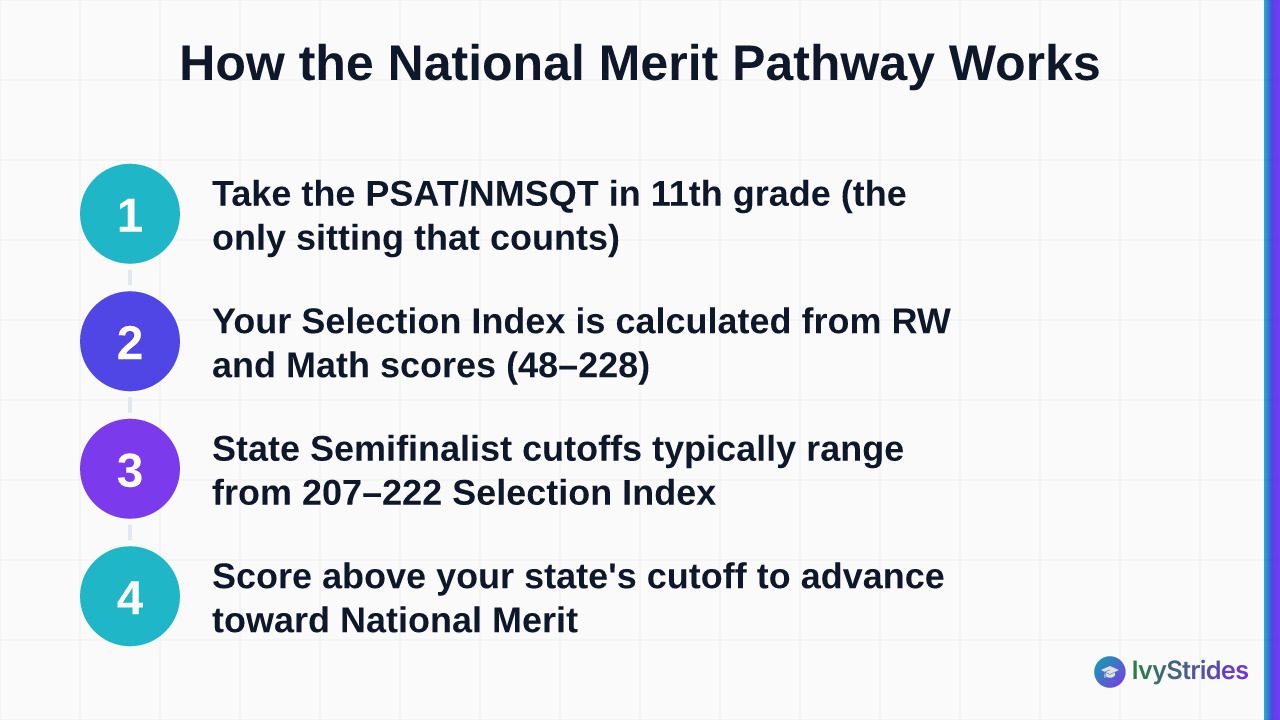
The National Merit Scholarship Program uses one test, taken in one year: the PSAT/NMSQT administered in 11th grade. A 9th grader could score a perfect 1520, and it would earn zero points toward National Merit consideration. The eligibility rule is not about score; it is about the sitting.
Here's how the pathway actually works. The National Merit Selection Index is calculated from the junior-year PSAT/NMSQT, not the total score alone. The Selection Index is a weighted number derived from the Reading and Writing and Math section scores, and it ranges from 48 to 228. State-level Semifinalist cutoffs typically fall roughly between 207 and 222 Selection Index points, depending on the state and the year. Cutoffs shift annually.
That last point is important. National Merit cutoffs are re-set each year based on the pool of test-takers, so any number you read online is approximate until the official release. For state-by-state context, see our National Merit cutoffs by state guide. If you are aiming at the scholarship pathway itself, How to Qualify for National Merit in 2026 covers the full sequence from Semifinalist to Finalist to Scholar.
One more clarification, because it comes up constantly: a 1400 freshman PSAT score is exceptional, but it does not qualify for National Merit. It's a strong signal that the student is on track to compete for the scholarship, nothing more. What matters is showing up in October of junior year with a Selection Index above the state's cutoff.
What Is a Good PSAT Score for a Freshman? Grade-Level Benchmarks for 9th Graders
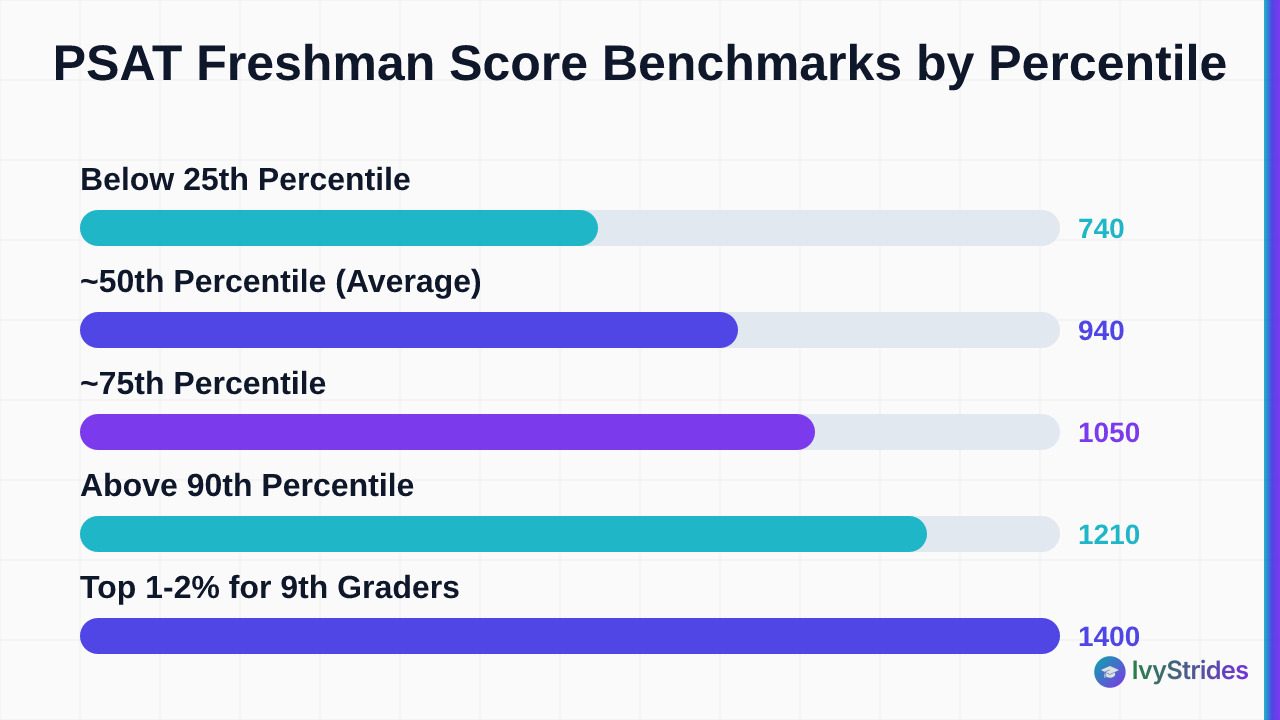
A good PSAT score for a freshman is roughly 1100 or above on the 320-1520 scale, which places a 9th grader in approximately the top 25% for their grade level. The average 9th-grade PSAT score sits around 920 to 950, per grade-level percentile tables published by the College Board.
Before you compare a score to these benchmarks, check which test the student took. If your school administers the PSAT 8/9 rather than the full PSAT/NMSQT in 9th grade, the score scale is slightly different (240-1440 vs 320-1520), so check which version you took before comparing your score to the benchmarks below. Some schools give the PSAT/NMSQT to 9th graders as early practice; others use the PSAT 8/9. The score report will name the test at the top.
Here's how the common 9th-grade score bands stack up against grade-level percentiles for the PSAT/NMSQT:
| Freshman PSAT Score | Approximate 9th-Grade Percentile | What It Means |
| 740 | Below 25th | Below average for a 9th grader. Two full years remain before the qualifying test, so the gap is workable. |
| 940 | Near 50th | Roughly average for a freshman. A neutral starting point, not a verdict. |
| 1050 | Near 75th | Above average; strong foundation for junior-year prep. |
| 1210 | Above 90th | Strong freshman score. Well-positioned for a competitive junior-year target. |
| 1400 | Top 1-2% for 9th graders | Exceptional. Does not qualify for National Merit as a freshman, but a very strong indicator. |
Percentile bands are derived from the grade-level tables the College Board publishes each year. Verify against the current-year release when using them for planning.
Two things matter here. First, the comparison group is 9th graders, not the full test-taking pool. A 940 as a freshman is a very different score than a 940 as a junior, because the freshman is being compared to other freshmen. Second, subscore data on the score report is more actionable than the total. A 1050 with a lopsided 620 Math / 430 Reading and Writing split is a different diagnostic than a balanced 525/525.
For deeper score-band context, see what is a good PSAT score, the grade-level breakdown in PSAT percentiles by grade, and pool-wide context in average PSAT score.
Is Your Freshman PSAT Score Trying to Tell You Something? How to Read the Gap
A freshman PSAT score is most useful when you stop asking "is this good?" and start asking "how far is this from where it needs to be?" The number is a starting coordinate, not a grade.
Here's what the score report actually contains:
- Total score on the 320-1520 scale.
- Two section scores: Reading and Writing (160-760) and Math (160-760).
- Percentile rank, usually shown against both a grade-level cohort and a nationally representative sample.
- Question-type performance across areas like Information and Ideas, Craft and Structure, Expression of Ideas, and Standard English Conventions on the Reading and Writing side, and Algebra, Advanced Math, Problem-Solving and Data Analysis, and Geometry and Trigonometry on the Math side.
- Knowledge and skills insights flagging specific weak areas.
The subscore data is where the plan starts. In our diagnostic work with 9th graders, the Reading and Writing section is where most freshmen leave the most points, specifically on Command of Evidence and Craft and Structure question types, which reward skills that develop steadily with practice rather than intensive cramming.
Now, the gap math. Once you have your freshman PSAT score in hand, the most productive next step is converting it into a realistic SAT target range, a process covered in detail in our guide to how to use your PSAT score to set an SAT goal. Two useful rules of thumb:
-
Unprepped, students typically gain roughly 80 to 120 points between their 9th-grade and 11th-grade PSAT sittings from natural academic growth alone.
-
In our coaching with students at the 900-1100 freshman band, structured prep beginning in 10th grade typically adds 100 to 200+ points above that natural growth by the junior-year test.
So a student who scores 940 as a freshman is looking at a natural projection into roughly the 1020-1060 range as a junior. To reach a National Merit-competitive junior-year score in most states (roughly 1400-1460), that student needs to close a 200 to 250 point gap through structured prep, and there are two years to do it. That's the actionable framing.
The PSAT and SAT share the same question types and adaptive digital format, but the PSAT has a lower score ceiling (1520 vs 1600) and slightly less time pressure, which is why the two tests require separate score-interpretation frameworks. Our guide on how to read your PSAT score report walks through the subscore section by section.
Parents often ask whether a 940 freshman score means their child is "not a test taker." Honestly, that score band at 9th grade tells us almost nothing about junior-year potential. The students who improve the most are the ones who treat the freshman score as a gap map, not a label. Families who want expert eyes on that gap map can also work with our SAT tutors on a targeted diagnostic before committing to a full prep plan.
Not Sure What Your Freshman PSAT Score Means for Your Path to Junior Year?
Book a free 15-minute strategy call. An IvyStrides coach will review your score report, identify your biggest gaps, and map out a realistic prep plan from 9th grade to the junior-year qualifying test. Both students and parents welcome.
What a 9th Grader Should Do After Getting Their PSAT Score
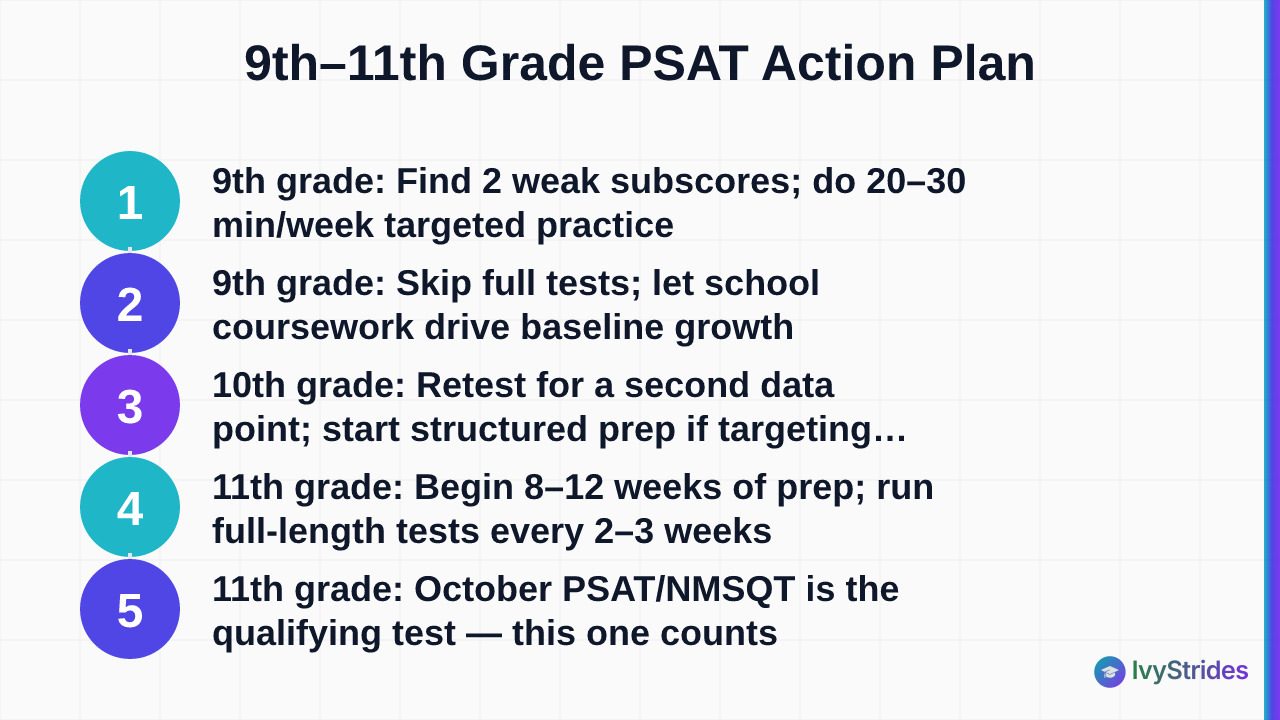
Nothing dramatic. The freshman year of the PSAT sequence is deliberately low-intensity, because there are two more sittings ahead and the qualifying test is still two Octobers away. Here's the grade-by-grade framing we use with families.
9th grade (right now):
- Read the score report with the student. Identify the two weakest subscore areas.
- Do light foundational work: roughly 20-30 minutes a week of targeted practice on the weakest question types.
- No full-length practice tests yet. Save those for the escalation phase.
- Keep up with school math and reading. The single biggest driver of unprepped PSAT growth from 9th to 10th grade is the coursework the student is already taking.
10th grade:
- Sit for the PSAT 10 or PSAT/NMSQT in October for a second data point.
- If the freshman-to-sophomore trajectory is on pace for junior-year targets, continue light prep.
- If targeting National Merit specifically, this is when structured prep begins. Students who begin structured prep in 10th grade typically see larger junior-year gains than those who start in September of 11th grade, in our coaching.
11th grade:
- The October PSAT/NMSQT is the qualifying test. This is the one that counts.
- Roughly 8 to 12 weeks of targeted prep before the October date is the typical window.
- Full-length practice tests every 2 to 3 weeks, with score-band gap analysis after each.
If you want a grade-by-grade prep timeline from 8th through 11th grade, our guide on how early to start PSAT prep maps out exactly when to begin each phase.
For scheduling and administration details, see PSAT test dates 2026. When you are ready for full-length practice, the best PSAT practice tests breakdown covers which resources are worth the time.
One caveat. The plan above assumes National Merit is on the table. If a student is scoring 900 as a freshman and there is no specific interest in the scholarship, a more relaxed approach is entirely reasonable, and the freshman score becomes a projection tool for SAT target-setting rather than the first step of a Semifinalist campaign.
How the Freshman PSAT Connects to Your SAT and ACT Strategy
The freshman PSAT is the first data point in a three-year testing arc. Handled well, it makes every subsequent decision easier: which test to focus on, when to start prep, which APs to add, how to time official sittings.
Here's the connection to the SAT specifically. The PSAT/NMSQT uses the same 200-800 section scale as the SAT (capped at 760 on the PSAT), which means the score projects to an SAT range with roughly 60 to 80 points of natural uplift by junior year without prep. Structured prep typically adds another 100 to 200+ points on top of that raw projection. A student with a 940 freshman PSAT projects to roughly a 1000-1020 SAT unprepped; with structured prep, a 1200+ SAT is a realistic target for many students in this band, typical for students completing the program.
Whether to focus on the SAT or the ACT is a separate question, one that most families should not decide before 10th grade. The is the PSAT harder than the SAT breakdown covers the format overlap. For the full multi-year testing calendar, our AP, SAT, and ACT testing plan for grades 9-12 sequences everything from freshman PSAT through senior-year retakes.
Two caveats worth surfacing. First, test-optional is not test-blind. Test-optional policies vary by school and by year, and a strong SAT score above a target school's 75th percentile still strengthens an application at nearly every test-optional college. Second, admissions decisions depend on the full application: GPA, course rigor, APs, essays, activities, and context, not test scores alone.
The freshman PSAT doesn't decide anything. What it does is give a family two full years of runway to build a coordinated plan across test scores, AP coursework, and admissions essays. For context on how IvyStrides structures that coordinated work, see the about IvyStrides page.
Frequently Asked Questions About Freshman PSAT Scores
Is a 740 a bad PSAT score for a freshman?
A 740 sits below average for a 9th grader, but it's not a crisis. Two full years remain before the junior-year qualifying test, which makes the gap closeable through structured prep. Students starting in this range who begin prep in 10th grade typically see gains of roughly 150 to 250 points by junior year, in our coaching.
Is 940 a good PSAT score for a freshman?
A 940 lands near the 50th percentile for 9th graders, roughly the grade-level average. It's not a strong score for National Merit purposes as a projection, but as a freshman baseline it's a workable starting point. A student at 940 who begins structured prep in 10th grade can realistically target a 1200 to 1300 range by the junior-year test.
Is 1210 a good PSAT score for a freshman?
Yes. A 1210 places a 9th grader above the 90th percentile for their grade level, which is a strong freshman result. It doesn't guarantee National Merit eligibility as a junior, since most state cutoffs correspond to a junior-year score around 1400 to 1460, but it's a solid foundation to build from over the next two years.
Is 1400 a good PSAT score for a freshman?
A 1400 is exceptional for a 9th grader, in the top 1-2% for the grade. It still does not qualify for National Merit, because eligibility is tied to the PSAT/NMSQT taken in 11th grade only. A student scoring 1400 as a freshman is well-positioned to compete for the scholarship if they maintain and build on that performance through junior year. For nearby-band context, see Is 1280 a Good PSAT Score.
Do colleges look at PSAT scores?
No. Colleges do not receive PSAT scores from any grade level. The College Board does not send PSAT results to admissions offices, and students have no mechanism to submit them. The only test scores colleges see are those the student sends: SAT, ACT, and AP.
Does the PSAT matter if you are not a junior?
It matters as a diagnostic, not as an official qualifying score. Only the junior-year PSAT/NMSQT feeds the National Merit Selection Index. For 9th and 10th graders, the PSAT is most valuable as a free practice run that reveals section-level weaknesses and sets a realistic SAT target two to three years before applications are due. Related score-band context: Is 1050 a Good PSAT Score.
What is a top 1% PSAT score?
Across all test-takers, a top 1% PSAT score is roughly 1460 to 1520 on the 320-1520 scale. For 9th graders specifically, the top 1% threshold is lower, roughly 1380 to 1420, because the comparison group is younger. Always check the grade-specific percentile column when evaluating a freshman score.
What PSAT score should a 9th grader have?
There's no required score. The 9th-grade average is roughly 930 to 950. A score above 1100 puts a freshman in roughly the top quarter of their grade cohort. The more useful question is not "what should the score be" but "how far is this score from a competitive junior-year target, and how much time is there to close the gap."
The Bottom Line on Freshman PSAT Scores
A freshman PSAT score is a piece of information, not a verdict. It doesn't touch a college application, it doesn't qualify for National Merit, and it doesn't predict admission anywhere. What it does is give a 9th grader and their family a real, specific starting coordinate on a two-year path to the sitting that actually counts. Read it that way, and the number is useful. Read it as a grade, and it just creates anxiety.
Our coaching team works with 9th graders across this full range of freshman starting scores, and the students who make the biggest junior-year gains share one habit: they treat the freshman score as a map, not a scoreboard.
Ready to Turn Your Freshman PSAT Score Into a Junior-Year Plan?
In 15 minutes, an IvyStrides PSAT specialist will give your student a diagnostic snapshot, a target score, and a prep timeline built around their grade level and goals. Parents are welcome to join. No pressure, no pitch.

Award-winning author (South Asian Book Award) and graduate of BITS Pilani and UCLA Luskin School of Public Affairs. Brings a published writer's eye to Common App essays and grammatical precision to SAT and ACT R&W instruction.