
When Your Child's PSAT Results Arrive: What Parents Should Do Next
On this page
- How to Read Your Child's PSAT Score Report in Five Minutes
- What Your Child's PSAT Score Actually Means by Grade
- How to Check Your Child's National Merit Status After the PSAT
- How to Turn PSAT Domain Scores Into a Concrete SAT Prep Plan
- FAQ: Reading PSAT Scores and National Merit
- Is an 860 a bad PSAT score?
- Is 900 a bad PSAT score?
- What can you do with PSAT scores?
- What is a 1470 PSAT equivalent to on the SAT?
The PSAT/NMSQT score report is a diagnostic snapshot that tells you where to focus prep next, and PSAT scores are not sent to colleges. When the report arrives, do four things: open it with your child, read the eight domain progress bars to find the weakest skill, check the Selection Index on page 1 (only a junior's counts for National Merit), and pick a next step.
When it arrives depends on your child's school. College Board's fall 2026 schedule sets three student release dates for in-school testing, based on when the school submitted student answers:
| School submitted answers by | Scores available to students |
| October 9, 2026 | October 22, 2026 |
| October 23, 2026 | November 5, 2026 |
| October 30, 2026 | November 12, 2026 |
The counselor can tell you which date applies. For a state testing program, College Board says to check with the state.

How to Read Your Child's PSAT Score Report in Five Minutes

Photo by cottonbro studio on Pexels
The report reaches your family through your child. U.S. students age 13 and older who gave a mobile number during testing can view scores in the BigFuture School app. The school has a downloadable PDF called Your Score Report for every test taker, so your child or the counselor can get you a copy, and students 13 or older can sign in to a personal College Board account for extra insights.
The PSAT/NMSQT score report shows a total score on a 320 to 1520 scale, split into a Reading and Writing section score and a Math section score, each running 160 to 760.
The domain bars are the real map. The eight domain progress bars are the most actionable part of the document: they show which of the four Reading and Writing domains or four Math domains is pulling the total score down. Each filled bar shows level of mastery, not a score, and lists how many questions the domain covers. The online report adds seven performance score bands for each domain.
The test mirrors the Digital SAT in format, so how the PSAT is structured and timed tells you what the bars measure. The total says little until you place it against other students, so the full PSAT percentile breakdown by score range matters more than the raw number.
| Report element | Where to find it | What it tells you |
| Total score | Top of page 1 | Overall result, 320 to 1520 |
| Section scores | Under the total | Reading and Writing, Math, each 160 to 760 |
| Percentiles | Beside each score | Share of same-grade testers, past 3 years, at or below that score |
| Eight domain bars | Knowledge and Skills section | Which skills are strong or weak |
| Selection Index | Page 1, details on page 2 | National Merit screening number |
Start with the two lowest bars, then check how many questions those domains carry.
What Your Child's PSAT Score Actually Means by Grade
A PSAT score means little until you attach a grade to it. College Board's 2026 SAT Suite Annual Report puts the 2025-26 PSAT/NMSQT mean at 954, with grade means, across the PSAT/NMSQT and PSAT 10, of 917 for 10th graders and 1000 for 11th graders. So a 950 is above average for a sophomore and below average for a junior.
College Board's own yardstick is a pair of grade-level benchmarks, one per section, that mark a student as on track to be college ready. The bar rises each year, so what counts as a good PSAT score for a 10th grader differs from the National Merit calculus juniors face.
| Grade | Usual test | Mean total score, 2025-26 | Reading and Writing benchmark | Math benchmark | Met both, 2025-26 |
| 9th | PSAT 8/9 | 863 | 410 | 450 | 34% |
| 10th | PSAT/NMSQT or PSAT 10 | 917 | 430 | 480 | 36% |
| 11th | PSAT/NMSQT or PSAT 10 | 1000 | 460 | 510 | 41% |
Same scale, different ceiling. The SAT Suite uses a common scale from the PSAT 8/9 through the SAT, so the same score on the same day means the same level of achievement across tests. The PSAT 8/9 tops at 1440, the PSAT 10 and PSAT/NMSQT at 1520, and the SAT at 1600. The gap reflects grade-level content, not a different scoring system.
College Board's advice to families: compare each section score with its benchmark together, keep a student who meets it in rigorous courses, and work with the teacher of a student who does not. Whether a lower result matters depends on the target, so settle whether the PSAT carries weight beyond National Merit before you draw conclusions.
How to Check Your Child's National Merit Status After the PSAT
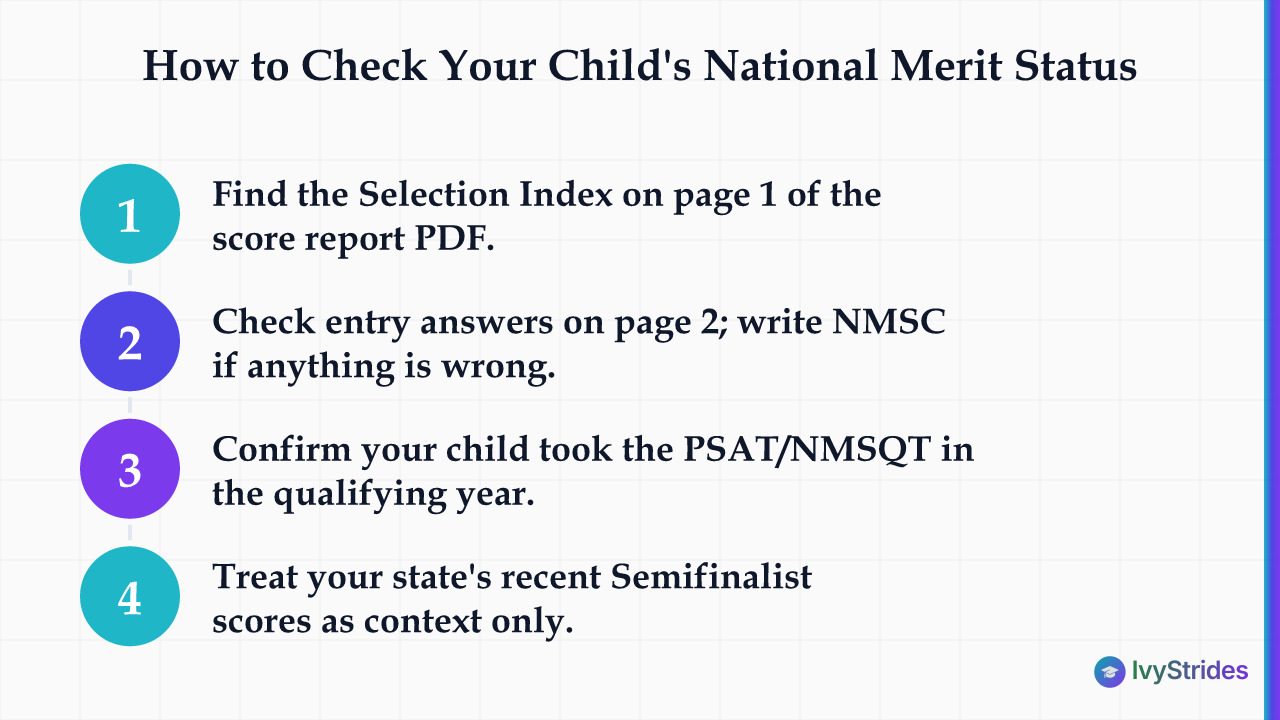
The NMSC Selection Index is National Merit's initial screen. NMSC counts only the PSAT/NMSQT, not the PSAT 10 or PSAT 8/9, and students on the usual four-year path must take it in grade 11. College Board publishes the formula: double the Reading and Writing section score, add the Math section score, and divide by 10. The scale runs 48 to 228.
IvyStrides' analysis of College Board's published Selection Index formula puts two maximum section scores of 760 at a top index of 228, from (2 × 760 + 760) ÷ 10; two minimum section scores of 160 give (2 × 160 + 160) ÷ 10, or 48. The index sits on page 1 of the score report PDF, with eligibility detail on page 2.
For parents: IvyStrides shares admissions timelines and counseling guidance on LinkedIn. Follow along for the questions families ask most.
Who sets the bar. The National Merit Scholarship Corporation, not College Board, sets qualifying scores: one nationally applied score for Commended Students and a separate Semifinalist score for each state, and they can change each year. Any cutoff you see before NMSC announces it is an estimate, because the Selection Index range each state requires shifts from one class to the next.
When you will know. The 2026 test is the qualifying test for the 2028 National Merit Scholarship Program. NMSC notifies students through their high schools: Semifinalists in early September 2027 and Commended Students in late September 2027.
A missed junior-year sitting does not automatically end the National Merit path. A student who missed the 2026 PSAT/NMSQT because of illness, an emergency or another extenuating circumstance may still be able to enter the 2028 program. With the testing window closed, the step is a written request to NMSC no later than April 1, 2027, for an alternate entry route.
-
Find the Selection Index on page 1 of the score report PDF and read the note beside it. An asterisk means the index will not be considered.
-
Check the entry answers on page 2. If one is inaccurate or has changed, the report says to write to NMSC immediately.
-
Confirm your child took the PSAT/NMSQT in the qualifying year. A sophomore on the four-year path needs the 2027 test.
-
Treat your state's recent Semifinalist scores as context only.
When a junior's Selection Index lands near a state's recent range, treat that as a signal to run a timed SAT or ACT diagnostic and work the weakest domain. No later PSAT/NMSQT counts for a junior on the usual path, and a Semifinalist must earn SAT or ACT scores that confirm the PSAT/NMSQT performance to become a Finalist.
How to Turn PSAT Domain Scores Into a Concrete SAT Prep Plan

Photo by https://kaboompics.com/ on Pexels
The eight domain progress bars are your prep priority list. Because the PSAT and SAT share a common scale and the same eight content domains, the two weakest bars are where SAT prep begins. On the Reading and Writing side those four domains are Information and Ideas, Craft and Structure, Expression of Ideas, and Standard English Conventions; on Math they are Algebra, Advanced Math, Problem-Solving and Data Analysis, and Geometry and Trigonometry.
No conversion table exists. Parents often ask what SAT number a PSAT score converts to. Nothing needs converting, because the PSAT and SAT report on one common scale: College Board's example is a 500 Math section score, which represents the same achievement on both tests taken the same day. There is no offset to add, and a later SAT score depends on what the student learns between the tests.
If the Reading and Writing bars run consistently stronger than the Math bars, a timed ACT diagnostic is worth running before committing to SAT prep: Math is half of the SAT total, while the ACT Composite averages English, Math and Reading, with Science optional and reported separately.
At IvyStrides, PSAT prep starts from a diagnostic that maps a student's actual domain scores against the eight content areas on the report. For a student with the junior-year PSAT/NMSQT still ahead, PSAT prep built around a timed diagnostic puts work on the weakest bars before the next test date.
College Board also offers free official full-length practice in the Bluebook app, and knowing which PSAT practice tests give the most accurate feedback on your two priority domains tells you where to spend that practice.
Watch the method, then try it: IvyStrides explains SAT and ACT question types on YouTube.
Work through this checklist with your child:
- Ask your child to open the score report with you, or ask the counselor for a copy of the PDF.
- Identify the two lowest domain progress bars.
- Juniors: find the Selection Index on page 1 and read the entry note beside it.
- Decide whether the pattern points to SAT, ACT, or more PSAT prep.
- Book a timed diagnostic to confirm the starting point.
- Set a target test date and work backward from it.
A sophomore's junior-year PSAT/NMSQT is the one that counts for National Merit, so set targets and timing around a junior-year PSAT strategy with an eight-week prep timeline.
FAQ: Reading PSAT Scores and National Merit
Is an 860 a bad PSAT score?
It depends on grade. In College Board's 2026 annual report, 860 sits just above the 11th-grade 25th percentile (850) and well below the 11th-grade 50th percentile (990). It is also below the 10th-grade 50th percentile (910). The PSAT 8/9, a different test, puts its 9th-grade 50th percentile at 850.
Is 900 a bad PSAT score?
Not by itself. In the same report, a 900 falls just under the 50th percentile of 910 for 10th graders and below the 990 for 11th graders, and it cannot meet both section benchmarks in either grade, since those add up to 910 and 970. The bars show which domains to address first.
What can you do with PSAT scores?
PSAT scores flag skill gaps through the eight domain bars, screen juniors for National Merit through the PSAT/NMSQT Selection Index, and set a starting point for SAT prep. They are not sent to colleges, so the result has no direct admissions consequence beyond National Merit recognition.
What is a 1470 PSAT equivalent to on the SAT?
The SAT Suite uses a common score scale, so a 1470 on the PSAT/NMSQT and a 1470 on the SAT taken the same day would reflect the same achievement. A later SAT score depends on what the student learns between the tests. For National Merit, what counts is the Selection Index, not the total.

Hemant is a seasoned entrepreneur, investor, and growth strategist with deep ground in education and technology-driven learning. His core training is in Mathematics and Physics — he authored Physics for IB Diploma: Ultimate Revision Guide, recognized as a top student resource.