
Is 1050 a Good PSAT Score? Percentile, College Implications, and Your Path to 1200+
On this page
- The Short Answer: What a 1050 PSAT Score Actually Means
- PSAT Score Percentiles by Grade: Where Does 1050 Rank?
- What Does a 1050 PSAT Score Mean for National Merit?
- Your Score Is Telling You Something: How to Read the Section Split
- Not Sure Which Section Is Holding You Back?
- What SAT Score Does a 1050 PSAT Predict?
- From 1050 to 1200+: A Realistic Prep Timeline by Grade
- Does a 1050 PSAT Score Affect College Admissions?
- Three Concrete Steps to Take After Scoring 1050
- FAQ
- What SAT score does a 1050 PSAT roughly correspond to?
- Is 1050 a good PSAT score for a sophomore?
- Is 1050 a good PSAT score for a junior?
- Does a 1050 PSAT score go on college applications?
- Is 1050 a good PSAT score for a freshman?
- What is a realistic score increase from PSAT to SAT?
- Ready to Turn Your 1050 Into a 1200+ PSAT or SAT Score?
A 1050 PSAT score sits near the 75th percentile for 9th graders, around the 50th percentile for 10th graders, and below the 75th percentile benchmark for 11th graders, where competitive scores start at roughly 1150. It does not qualify for National Merit recognition at any level. On the 320-1520 PSAT/NMSQT scale, 1050 is a solid starting point with measurable room to grow, and for most students aiming at selective colleges, a target of 1200 or higher is the realistic next step before the junior-year PSAT/NMSQT or the first SAT sitting.
These percentile figures come from the College Board PSAT/NMSQT documentation and reflect the current digital adaptive format used since fall 2023. The harder question is whether 1050 is on-track for your grade and your goals, and which section is quietly holding the composite under 1200. The sections below answer both.
The Short Answer: What a 1050 PSAT Score Actually Means
The PSAT/NMSQT uses a 320-1520 composite scale, split into two sections scored 160-760 each: Reading and Writing, and Math. A 1050 means you scored roughly in the middle of that range. Here is the grade-level reading:
- 9th grade (PSAT 8/9 context): ~75th percentile. Strong.
- 10th grade (PSAT 10 or PSAT/NMSQT): ~50th percentile. Average.
- 11th grade (PSAT/NMSQT): below the 75th percentile. The 75th percentile sits closer to 1150, and 1210-1230 is roughly the 90th percentile.
So the same number means three different things depending on when you took it. A freshman at 1050 has banked a strong baseline. A junior at 1050 has a gap to close, and the clock is shorter. For a broader framing of where any score lands, see our explainer on what is a good PSAT score.
PSAT Score Percentiles by Grade: Where Does 1050 Rank?
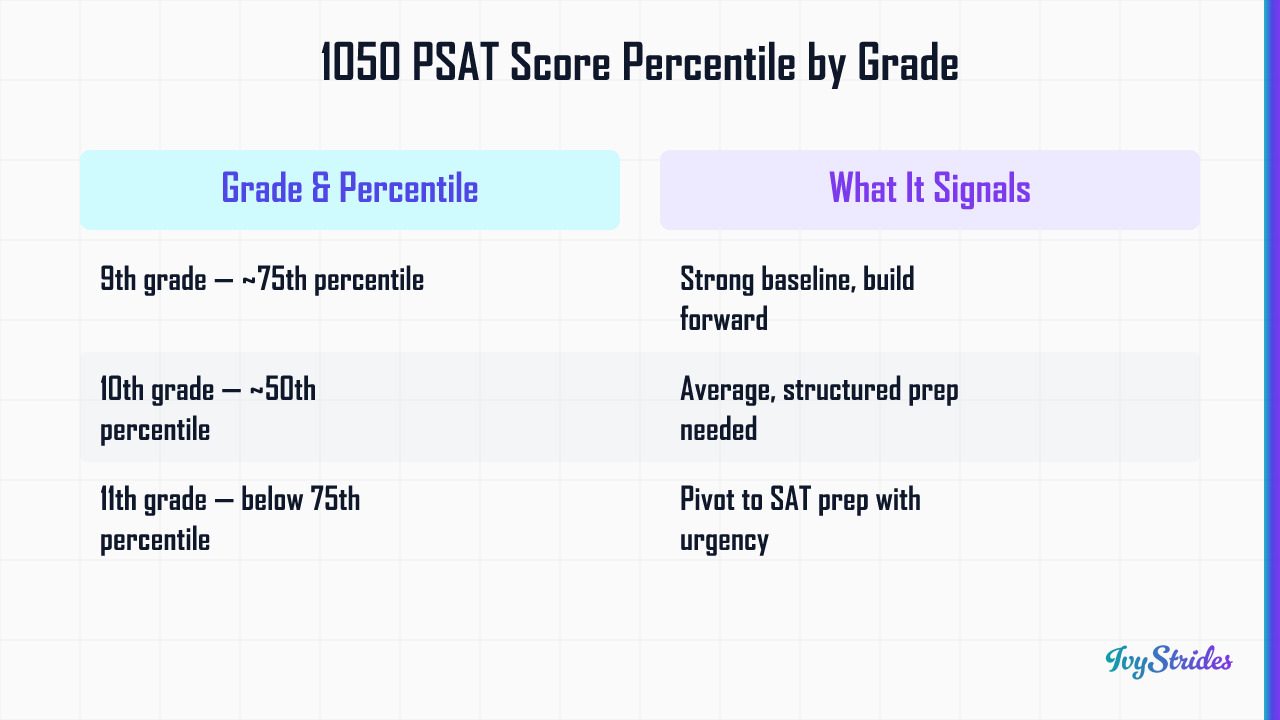
Percentile is the cleanest way to read a PSAT score, because raw composite values mean different things at different grades. Here is the breakdown for 1050.
9th grade. The PSAT 8/9 is the entry-point assessment. A 1050 puts a freshman near the 75th percentile, meaning the student scored higher than roughly three out of four test-takers in that grade. That's a strong launch. If you're asking is 1050 a good PSAT score for 9th grade, the answer is yes, with the caveat that the gap to a competitive junior-year score is still real and worth working on early.
10th grade. The PSAT 10 and the PSAT/NMSQT taken in 10th grade are scored on the same 320-1520 scale as the junior-year test. A 1050 here lands near the 50th percentile. Is 1050 a good PSAT score for a sophomore? It's average. Not a red flag, but a clear signal that meaningful prep across 10th and early 11th grade is required to reach the 1150-1200 zone counselors typically call competitive. Our deeper breakdown on good PSAT scores for 10th graders covers the sophomore-specific picture in detail.
11th grade. This is the consequential sitting, because the junior-year PSAT/NMSQT is what feeds the National Merit Scholarship pathway. At 1050, an 11th grader sits below the 75th percentile (~1150) and well below the 90th (~1210-1230). The honest read: 1050 in October of junior year means the immediate priority is pivoting to SAT prep before spring test dates. Working through full-length PSAT practice tests under timed conditions is the fastest way to confirm where the gap lives.
Percentile bands below typically follow the published College Board PSAT/NMSQT percentile tables:
| Grade | 1050 Percentile | What It Signals |
| 9th | ~75th | Strong baseline, build forward |
| 10th | ~50th | Average, structured prep needed |
| 11th | Below 75th | Pivot to SAT prep with urgency |
What Does a 1050 PSAT Score Mean for National Merit?
This is the question that drives the most anxiety for parents of juniors, and the answer is direct: a 1050 composite does not qualify for National Merit at any level, neither Semifinalist nor Commended Scholar. Here's why, with the math.
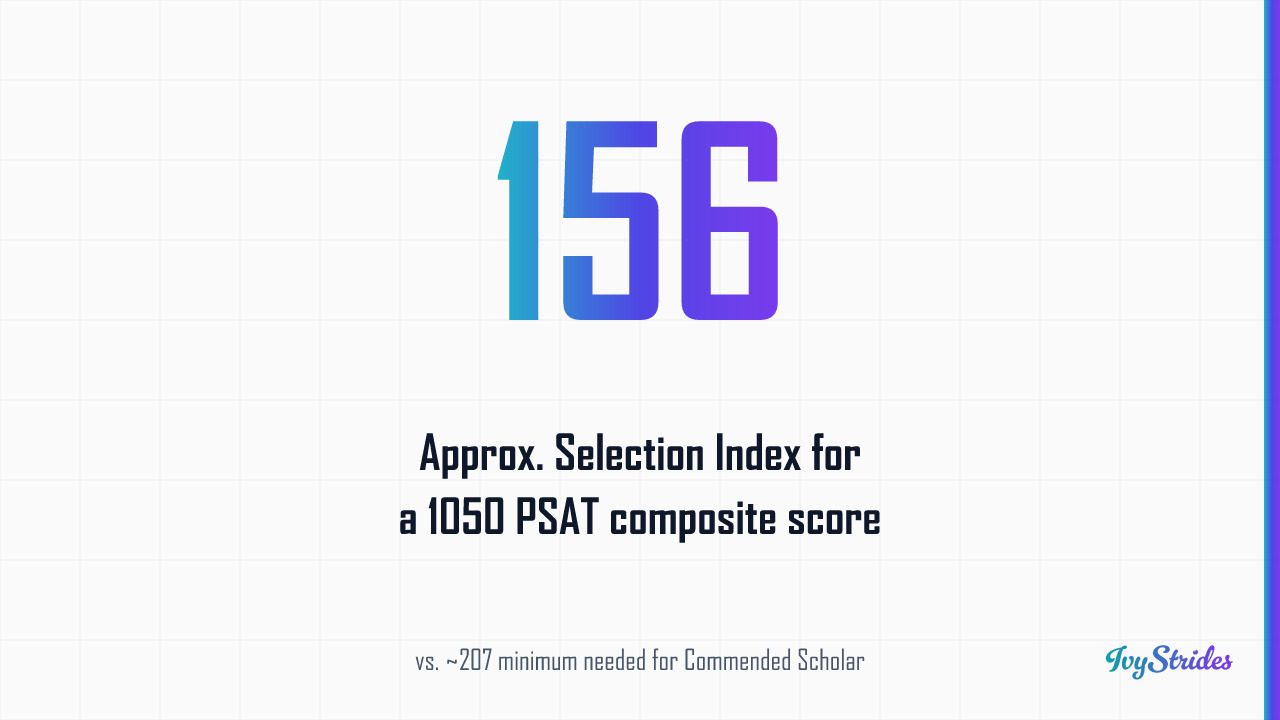
The National Merit Scholarship Corporation uses the Selection Index, not the composite. The Selection Index is calculated by adding your Reading Test Score, your Writing and Language Test Score, and your Math Test Score (each on an 8-38 scale), then doubling the sum. The Selection Index range is 48-228.
A 1050 composite typically breaks down to section test scores in the 25-27 range. A representative profile of 530 RW / 520 Math maps to roughly Reading 26, Writing 26, Math 26, producing a Selection Index of about (26 + 26 + 26) × 2 = 156.
Now compare to the cutoffs (figures approximate, subject to annual variation per NMSC):
- National Merit Commended Scholar: ~207 (single national cutoff)
- National Merit Semifinalist: ~207 to ~222 depending on state of residence
Because National Merit eligibility is determined by the Selection Index, not the composite score, a student at 1050 would need to raise their score by roughly 150-200 composite points to reach Semifinalist range in most states. That is achievable for a freshman or early sophomore. For a junior who has already sat the qualifying PSAT/NMSQT, the National Merit window has closed for this cycle, and the strategic move is to redirect prep effort toward the SAT.
For more on how the full psat score range maps onto realistic National Merit and college-application outcomes, the linked overview lays out each band.
Your Score Is Telling You Something: How to Read the Section Split
Here's the part most students miss. A 1050 composite is not one problem. It is two very different problems wearing the same number, and the fix depends entirely on which one you have.
We consistently see two profiles at the 1050 composite:
Profile A: 580 RW / 470 Math. Math is the primary lever. The targeted weakness work focuses on Algebra (linear equations, systems, inequalities), Advanced Math (quadratics, exponents, function notation), and Problem-Solving and Data Analysis (ratios, percentages, two-variable data). A student with this profile who improves Math by 80 points while holding RW steady reaches 1130. Add another 50 points of RW polishing, and 1200 is in range.
Profile B: 500 RW / 550 Math. Reading and Writing is the primary lever. The work centers on Information and Ideas (central ideas, command of evidence), Craft and Structure (cross-text connections, words in context), Expression of Ideas (rhetorical synthesis, transitions), and Standard English Conventions (subject-verb agreement, punctuation, modifier placement).
A sophomore we worked with last fall came in at exactly Profile B: 500 RW, 550 Math. Her mom had her doing nightly Khan-style mixed-section drills, which felt productive but wasn't moving RW. Once we cut the Math practice to twice a week and put four hours into Craft and Structure plus Standard English Conventions, her next full-length practice landed at 1180. Same student, same hours, different target.
These two students share the same composite. They need almost entirely different prep plans. A generalist tutor who teaches "PSAT prep" without diagnosing the split is solving the wrong problem.
There's a second mechanism that matters here: the adaptive module structure. The PSAT routes Module 1 at standard difficulty, then routes Module 2 to either an easier or harder set based on Module 1 performance. A student routed to the easier Module 2 has a score ceiling that caps below 1200 regardless of how many easy questions they answer correctly. The only way to break through is to get routed to the harder Module 2, which requires skill improvement on Module 1, not more practice on easier material.
In our coaching with students at the 1050 score band, those who address their weaker section first with a section-specialist tutor typically see 80-120 point composite gains within 8-12 weeks of targeted work. The methodology is consistent: diagnostic test, targeted weakness work, spaced retesting.
Not Sure Which Section Is Holding You Back?
In a free 15-minute strategy call, an IvyStrides coach will review your PSAT section scores, identify your primary gap, and give you a concrete plan to reach 1200 or higher. No commitment required.
What SAT Score Does a 1050 PSAT Predict?
A 1050 PSAT suggests a starting SAT range of approximately 1000-1100 without additional prep. The two tests use comparable but not identical scales, so treat this as a projection, not a precise conversion.
With 8-12 weeks of structured, section-specialist prep, students in this band typically reach 1200-1300 on the SAT in our coaching. The reason that range is realistic and not optimistic comes down to format overlap.
Because the PSAT and the Digital SAT share the same adaptive two-module structure and comparable question types, the skills you build raising your PSAT score from 1050 to 1200 transfer almost directly to SAT prep. Both tests use the same Reading and Writing domains (Information and Ideas, Craft and Structure, Expression of Ideas, Standard English Conventions) and the same Math domains (Algebra, Advanced Math, Problem-Solving and Data Analysis, Geometry and Trigonometry).
The PSAT is slightly easier than the SAT in content ceiling, but the question formats are nearly identical, which means a student who diagnoses their 1050 weaknesses now is already doing SAT prep. The depth comparison is covered in our piece on whether the PSAT is harder than the SAT.
For the mechanics of how the adaptive scoring engine generates the final number, see how the Digital SAT is scored. Both references draw on the official College Board Digital SAT documentation.
From 1050 to 1200+: A Realistic Prep Timeline by Grade
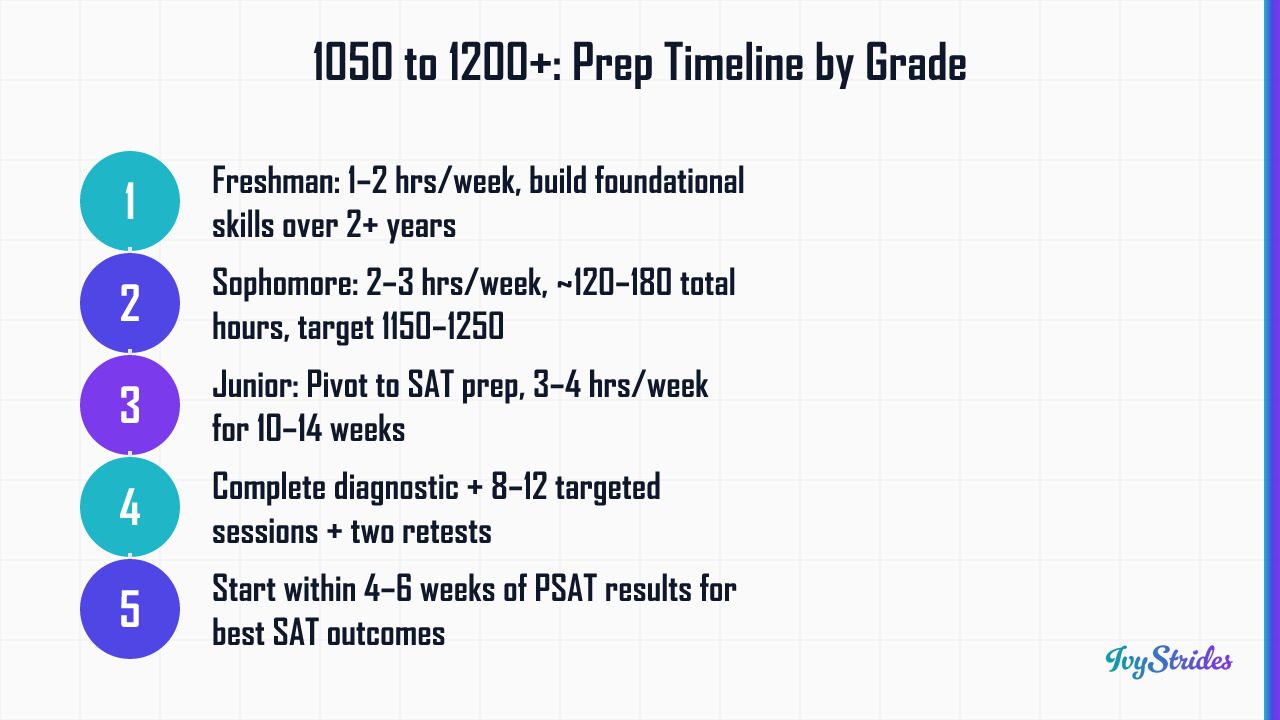
The right prep plan depends almost entirely on how much runway you have. Three scenarios.
Freshman at 1050. You have 2+ years before the junior PSAT/NMSQT. In our coaching, the right cadence is typically 1-2 hours per week of foundational skill work, focused on whichever section the diagnostic flagged. The goal at this stage isn't a sprint to 1200. It's building durable skills (algebraic fluency, close-reading habits, grammar reflexes) that will compound by 10th grade. Take one full-length practice test per quarter to track movement.
Sophomore at 1050. You typically have 12-18 months before the junior PSAT/NMSQT. In our coaching, the right step-up is 2-3 hours per week of targeted prep, one full-length practice test per month, and section-specialist coaching on the weaker section. Is 1050 a good PSAT score for a sophomore aiming at selective colleges? It's a starting point, not a finishing point. At 2-3 hours per week across roughly 60 weeks, that's a meaningful runway, around 120-180 total prep hours, which is enough to move most sophomores into the 1150-1250 range by the junior PSAT.
Junior at 1050. The PSAT/NMSQT is administered in October of 11th grade. If you've already taken it and scored 1050, the answer to is 1050 a good PSAT score for a junior is honest: it's below the competitive benchmark, and the National Merit window has effectively closed. Pivot immediately to SAT prep. The SAT is the score that goes on your college applications. In our coaching, juniors typically need 3-4 hours per week across 10-14 weeks of structured prep to reach 1200+ on the SAT before spring or summer test dates.
In our coaching with students at the 1050 score band, a typical full SAT program (one diagnostic, 8-12 targeted sessions, two spaced retests) produces 100-180 point gains on the SAT. Gains aren't guaranteed and vary with student effort and starting profile.
Juniors who start structured SAT prep within four to six weeks of receiving PSAT results have the best outcomes before spring test dates, based on our coaching patterns. The delay between scoring 1050 and starting prep is the biggest single predictor of whether the student lands at 1100 or 1250 on the SAT. For more on translating PSAT performance into SAT readiness, see are your PSAT results good enough for SAT success. For the broader scoring comparison, our piece on the difference between SAT and PSAT walks through every contrast.
Does a 1050 PSAT Score Affect College Admissions?
Short answer: no. PSAT/NMSQT scores aren't reported to colleges and don't appear on college applications. This is confirmed by College Board policy. The PSAT is a diagnostic and a National Merit qualifier. It's not part of your admissions file.
What does matter is the SAT (or ACT) score you earn after prep. For selective colleges (roughly the top 50 nationally), the middle 50% SAT range is typically 1350-1550. A student starting at 1050 PSAT has a realistic path to the lower end of that range with 6-12 months of structured prep, especially with section-specialist coaching on the weaker domain.
Two caveats families should hold in mind. First, test-optional policies vary by school and year. Check each college's current policy via FairTest or the college's own admissions page before deciding whether to submit scores. A strong SAT score is still an asset at test-optional schools, especially in competitive applicant pools. Second, college admissions outcomes depend on the full application, including GPA, course rigor, essays, recommendations, and activities. Test scores are one input, not the verdict.
For a comparison point at the higher end of the PSAT range, see our analysis of whether 1280 is a good PSAT score.
Three Concrete Steps to Take After Scoring 1050
How good is a 1050 PSAT score? Good enough to work with, not good enough to leave alone. Here is the action plan, in order.
Step 1: Pull the full score report and identify the section split. Log into the College Board student portal and open the detailed report. Look beyond the composite. You need the section scores (RW and Math) and the subscores by domain (Information and Ideas, Craft and Structure, Algebra, Advanced Math, Problem-Solving and Data Analysis, Geometry and Trigonometry). The subscores tell you which specific skills are below the score-band median. That's your prep target.
Step 2: Take a full-length practice test under timed conditions. A single PSAT score is a data point. A second test confirms whether 1050 reflects your true baseline or a bad-day result. Our PSAT practice tests replicate the adaptive two-module format under timed conditions. Juniors pivoting to the SAT can also pull from our free SAT resources library.
Step 3: Start targeted prep on the weaker section with a section-specialist coach. Honestly, this is where most students get stuck. A generalist tutor who teaches both sections rarely goes deep enough on the specific question types causing the loss. A section-specialist (an RW coach or a Math coach) can. If you want a tailored plan, book a free 30-minute SAT consultation and we'll map it out with you.
FAQ
What SAT score does a 1050 PSAT roughly correspond to?
A 1050 PSAT suggests a starting SAT range of approximately 1000-1100 without additional prep, since the two tests use comparable but not identical scales. With structured prep targeting your weaker section, students in this band typically reach 1200-1300 on the SAT in our coaching. The Digital SAT and PSAT share the same adaptive two-module format and question types, so PSAT prep directly builds SAT skills.
Is 1050 a good PSAT score for a sophomore?
For a 10th grader, 1050 typically lands near the 50th percentile on the PSAT/NMSQT per College Board scoring documentation, which means it's solidly average. It's not a cause for alarm, but it does signal that meaningful prep across 10th and early 11th grade is needed to reach the 1150-1200 range most counselors consider competitive. Sophomores typically have 12-18 months before the junior-year PSAT/NMSQT, which is enough time to close the gap with consistent, targeted work.
Is 1050 a good PSAT score for a junior?
For an 11th grader, 1050 is below the 75th percentile benchmark and doesn't qualify for National Merit consideration at any level. If you've already taken the junior PSAT/NMSQT and scored 1050, the most productive next step is to pivot to SAT prep immediately, since the SAT is the score that appears on college applications. In our coaching, juniors who start structured SAT prep within four to six weeks of receiving PSAT results have the best outcomes before spring test dates.
Does a 1050 PSAT score go on college applications?
No. PSAT/NMSQT scores aren't reported to colleges and don't appear on college applications, per College Board policy. The score that matters for admissions is the SAT (or ACT). Your 1050 PSAT is best used as a diagnostic: it tells you where you stand and which skills to build before you sit for the SAT.
Is 1050 a good PSAT score for a freshman?
Yes. For a 9th grader, 1050 is typically a strong result, near the 75th percentile on the PSAT 8/9 scale per College Board scoring documentation. Freshmen at this level have an excellent foundation and two to three years to build toward a competitive SAT score. The priority at this stage is identifying any section weaknesses early so they can be addressed gradually rather than in a last-minute sprint junior year.
What is a realistic score increase from PSAT to SAT?
Students who complete a structured, diagnostic-driven prep program typically see a 100-200 point increase from their PSAT baseline to their SAT score, in our coaching with students at the 1050 score band. The size of the gain depends on how many weeks of targeted prep are completed, whether a section-specialist coach addresses the weaker section, and how many full-length practice tests are taken under timed conditions. Gains vary by student effort and starting profile and aren't guaranteed.
A 1050 PSAT is data. Whether it becomes a stepping stone or a stalled number depends on what you do in the next four to six weeks. The students who turn 1050 into 1200+ share a pattern: they diagnose the section split early, they work with a coach who specializes in the weaker side, and they take spaced full-length retests to lock in progress.
Ready to Turn Your 1050 Into a 1200+ PSAT or SAT Score?
Book a free 15-minute call with an IvyStrides section-specialist coach. You'll leave with a diagnostic snapshot, a target score, and a week-by-week prep plan built around your actual score report.

Award-winning author (South Asian Book Award) and graduate of BITS Pilani and UCLA Luskin School of Public Affairs. Brings a published writer's eye to Common App essays and grammatical precision to SAT and ACT R&W instruction.