
Is the PSAT a Good Predictor of the SAT? The Straight Answer for 2026 (and What to Do Next)
On this page
- The Short Answer: How Well Does the PSAT Predict SAT Scores?
- Why the PSAT and SAT Are Structurally Similar Enough to Make Prediction Meaningful
- PSAT-to-SAT Score Conversion: Reference Points for Common Score Bands
- Why Your PSAT Score May Not Match Your SAT Score (The Honest Reasons)
- Not Sure What Your PSAT Score Means for Your SAT Target?
- What a 1470 PSAT Score Means for the SAT (and for National Merit)
- Is a 740 PSAT Section Score Good or Bad? What It Predicts for the SAT
- How to Turn Your PSAT Score Into a Concrete SAT Action Plan
- Frequently Asked Questions About the PSAT as a Predictor of SAT Performance
- If I get a 1230 on the PSAT, what is my predicted SAT score?
- What is a top 1% PSAT score?
- What is a 1470 PSAT equivalent to on the SAT?
- Is a 740 a bad PSAT score?
- Is your PSAT score a good indicator of your SAT score?
- What does a 1300 on the PSAT equal on the SAT?
- Does the PSAT predict the SAT equally well at all score bands?
- Do freshman PSAT scores matter for college admissions or National Merit?
- Ready to Turn Your PSAT Score Into an SAT Score You Are Proud Of?
Yes, the PSAT is a good predictor of SAT performance, but not a precise one. Both tests share the same adaptive two-module structure and measure the same core skills, so a PSAT score gives a reliable directional estimate of where a student will start on the SAT. In our coaching, students at mid-range bands typically land about 60 to 100 points higher on the SAT than their PSAT without additional prep, and meaningfully more with targeted work.
The catch lives in the scales. The PSAT/NMSQT runs 320 to 1520; the Digital SAT runs 400 to 1600. That ceiling difference is why you can't just read a PSAT score as an SAT score. Everything below walks through the conversion, the honest reasons your two scores may diverge, and how to turn a PSAT result into a concrete plan.

The Short Answer: How Well Does the PSAT Predict SAT Scores?
The PSAT/NMSQT predicts SAT performance well at the directional level and imperfectly at the exact-point level. A PSAT score tells you which score band you're starting from. It does not tell you where you'll finish, because prep effort between the two tests moves the needle far more than the raw conversion does.
Here's the structural reason it works. The PSAT/NMSQT and the Digital SAT both use a section-adaptive two-module design and test the same skill domains. So a PSAT result is measuring almost exactly what the SAT measures, just with a lower ceiling and slightly gentler content. That shared DNA is what makes prediction meaningful in the first place.
The scale gap matters most for interpretation. The PSAT tops out at 1520; the SAT tops out at 1600. That's why a strong PSAT score, once converted, usually lands about 60 to 100 points higher on the SAT scale even before a student studies. It's not a bonus. It's the scale correcting for its own compressed range.
One more thing worth stating plainly: the PSAT does not count for college admissions. Colleges never see it. The SAT does. So the PSAT's job is to be a diagnostic snapshot, a predictive benchmark you use to plan, not a score you send anywhere. For a full side-by-side, see our breakdown of the difference between SAT and PSAT.
| Feature | PSAT/NMSQT | Digital SAT |
| Score range | 320–1520 | 400–1600 |
| Sections | R&W (160–760), Math (160–760) | R&W (200–800), Math (200–800) |
| Structure | Adaptive, two modules per section | Adaptive, two modules per section |
| Counts for admissions? | No | Yes |
| When taken | October | Year-round |
Why the PSAT and SAT Are Structurally Similar Enough to Make Prediction Meaningful
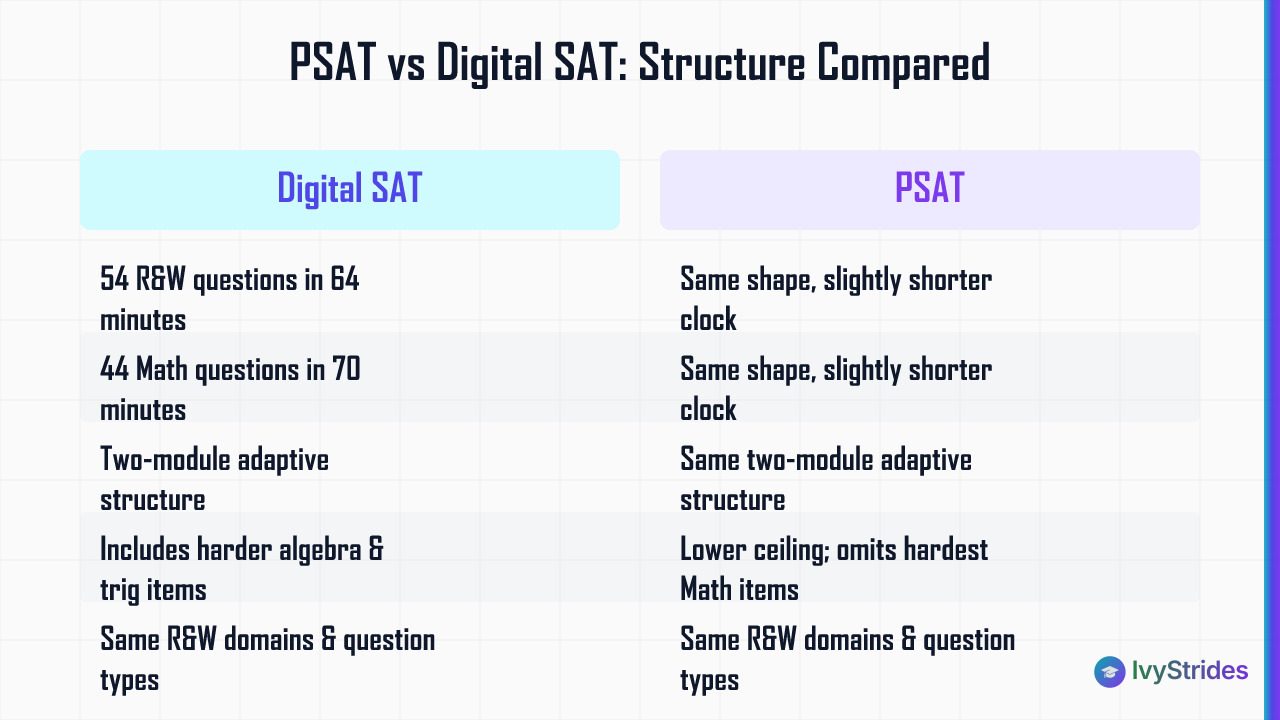
The PSAT and Digital SAT are close cousins by design. Both are section-adaptive: your performance in Module 1 determines whether Module 2 serves you an easier or harder set of questions. That routing logic is identical across the two tests, which is a big part of why the PSAT is a structurally valid predictor.
The Digital SAT runs 54 Reading and Writing questions in 64 minutes across two 27-question modules, then 44 Math questions in 70 minutes across two modules. That's 98 questions in 2 hours 14 minutes of testing. The PSAT mirrors this shape almost exactly on a slightly shorter clock, which is why timing habits transfer cleanly between the two.
The content domains match too. Reading and Writing on both tests draws from Information and Ideas, Craft and Structure, Expression of Ideas, and Standard English Conventions. You'll see the same named question types: Words in Context, Command of Evidence, Rhetorical Synthesis. Math on both covers Algebra, Advanced Math, and Problem-Solving and Data Analysis, including linear equations and systems of equations.
The PSAT and Digital SAT share the same adaptive two-module structure and measure the same core skills, which is exactly why the PSAT is a structurally valid predictor; for a full side-by-side breakdown of format differences, see our guide on the PSAT format.
Where they part ways is the top end of Math. The PSAT has a lower score ceiling and omits some of the harder SAT items, including certain advanced algebra problems and deeper trigonometry applications. So a student who tops out the PSAT hasn't necessarily seen the hardest content the SAT can throw. That gap is the reason high PSAT scorers often have real SAT upside, and it's covered in more depth in is the PSAT harder than the SAT.
PSAT-to-SAT Score Conversion: Reference Points for Common Score Bands
PSAT-to-SAT conversion works off College Board concordance data, and the offset runs roughly 60 to 100 points across most score bands before any prep. Below is a reference table for the bands students search most. Treat every figure as a directional estimate, not a locked forecast.
| PSAT Score | Estimated SAT (no prep) |
| 1090 | ~1140–1160 |
| 1230 | ~1290–1310 |
| 1300 | ~1370–1400 |
| 1420 | ~1500–1520 |
| 1430 | ~1510–1530 |
| 1470 | ~1530–1550 |
| 1480 | ~1540–1560 |
A few reading notes. The conversion is not linear across the full scale; the offset compresses at the very top because the SAT ceiling is only 1600 and there's less room to move. A top 1% PSAT score for 11th graders sits around 1460 or higher, per College Board percentile data. And the authoritative source for exact concordance is always College Board itself, which updates these tables periodically.
Before you use your PSAT score as a predictor, you need to know what it means in percentile terms; our guide to what is a good PSAT score breaks down benchmarks by grade and goal. For the numbers behind the table, see PSAT to SAT score conversion.
Here's the part most students miss: the table shows where you'd land with no prep. It's a floor, not a fate. The real question is how much you close the gap between now and test day.
Why Your PSAT Score May Not Match Your SAT Score (The Honest Reasons)

Photo by Andy Barbour on Pexels
Your PSAT and SAT scores can diverge sharply, and the biggest reason is simple: prep effort between the two tests. A student who does nothing usually lands within about 60 to 100 points of the PSAT conversion. A student who trains hard can blow past it. Same starting score, very different endings.
Time is the second variable. Most students take the PSAT in October of junior year, then sit the SAT in the spring of junior year or fall of senior year. That's months of gap. In our coaching, students who begin structured SAT prep within roughly 4 to 8 weeks of receiving PSAT scores consistently outperform students who wait until spring, because the momentum and the diagnostic insight are both fresh.
Score band matters more than people expect. Prediction is strongest in the 1100 to 1400 range, where content overlap is tightest. At the extremes it gets noisier. Very high PSAT scorers can score lower than predicted because the SAT's harder Math Module 2 introduces content the PSAT never tested. Very low scorers see more variance from test-day nerves and pacing.
That harder Math content is the single most common gap we see in diagnostic results. SAT Math Module 2 hard questions include certain trigonometry applications and tougher systems of equations that simply don't appear on the PSAT. A student who cruised through PSAT Math can hit a wall there. Pacing shifts too: SAT Math runs around 95 seconds per question, tighter than the slightly more generous PSAT clock.
Then there's stakes. The PSAT is low-pressure. The SAT carries the weight of admissions. That pressure changes how some students pace and how they handle a hard opening question. It's real, and it's trainable. Our guides on how to study for the PSAT and how long to study for the PSAT both apply directly to SAT prep, since the skills transfer.
The encouraging pattern: students who complete a full diagnostic-driven program, meaning a diagnostic full-length test, targeted weakness work by a section specialist, and spaced retesting, typically improve about 150 to 200+ points above their PSAT baseline. The gap you're staring at is the opportunity, not the verdict.
Not Sure What Your PSAT Score Means for Your SAT Target?
In 15 minutes, an IvyStrides coach will review your PSAT score, identify your biggest SAT gaps, and recommend the right prep path for your timeline and goals.
What a 1470 PSAT Score Means for the SAT (and for National Merit)
A 1470 PSAT score converts to roughly 1530 to 1550 on the SAT, based on College Board concordance. That places a student around the 96th to 98th percentile for 11th graders, per College Board percentile data. In plain terms, a 1470 is an excellent score with real SAT potential above it.
For 11th graders, the PSAT's predictive role extends beyond the SAT: it is the qualifying test for National Merit, and the Selection Index cutoff in your state determines whether a high PSAT score translates into scholarship eligibility. The Selection Index is calculated from your section scores, and at the 1470 band it typically falls around 219 to 222, depending on your section split.
State variability is the wrinkle. National Merit Semifinalist cutoffs run roughly 209 to 222 across states, and the most competitive states sit at the top of that range. So a 1470 that clears the bar comfortably in one state might fall just short in another. Exact cutoffs shift year to year, which is why we point students to National Merit cutoffs by state rather than a single national number.
On the admissions side, a 1470 PSAT predicting an SAT in the 1530 to 1550 range puts a student inside the competitive band for highly selective schools. Yale's middle 50% SAT composite runs approximately 1500 to 1580 per its Common Data Set. But a predicted score is not an outcome, and a strong score is not an admission. College admissions depend on the full application, not test scores alone. For the mechanics of qualifying, see our guide to the National Merit Scholarship: PSAT cutoffs, Selection Index, and how to qualify (2026).
Is a 740 PSAT Section Score Good or Bad? What It Predicts for the SAT
A 740 PSAT section score is excellent. Each PSAT section, Reading and Writing or Math, is scored 160 to 760 per College Board, so a 740 sits near the top of the section scale, roughly the 97th to 99th percentile among 11th graders for that section. On the corresponding SAT section, which runs 200 to 800, a 740 PSAT section score converts to approximately 770 to 790.
Now the clarification, because this is where the confusion lives. There's a big difference between 740 as a section score and 740 as a total. Two section scores of 740 add up to a 1480 total PSAT, which is a top-tier result. But if a student means 740 as their whole PSAT score, that reading is entirely different.
A 740 total PSAT score would fall below the national average of around 930 for all test-takers, placing the student below the 50th percentile. So the identical number, 740, is near-perfect as a section score and below average as a total. Always check which one you're looking at on your score report before you panic or celebrate.
For the full percentile picture, see our breakdown of the average PSAT score and the detailed PSAT score range and percentiles.
How to Turn Your PSAT Score Into a Concrete SAT Action Plan
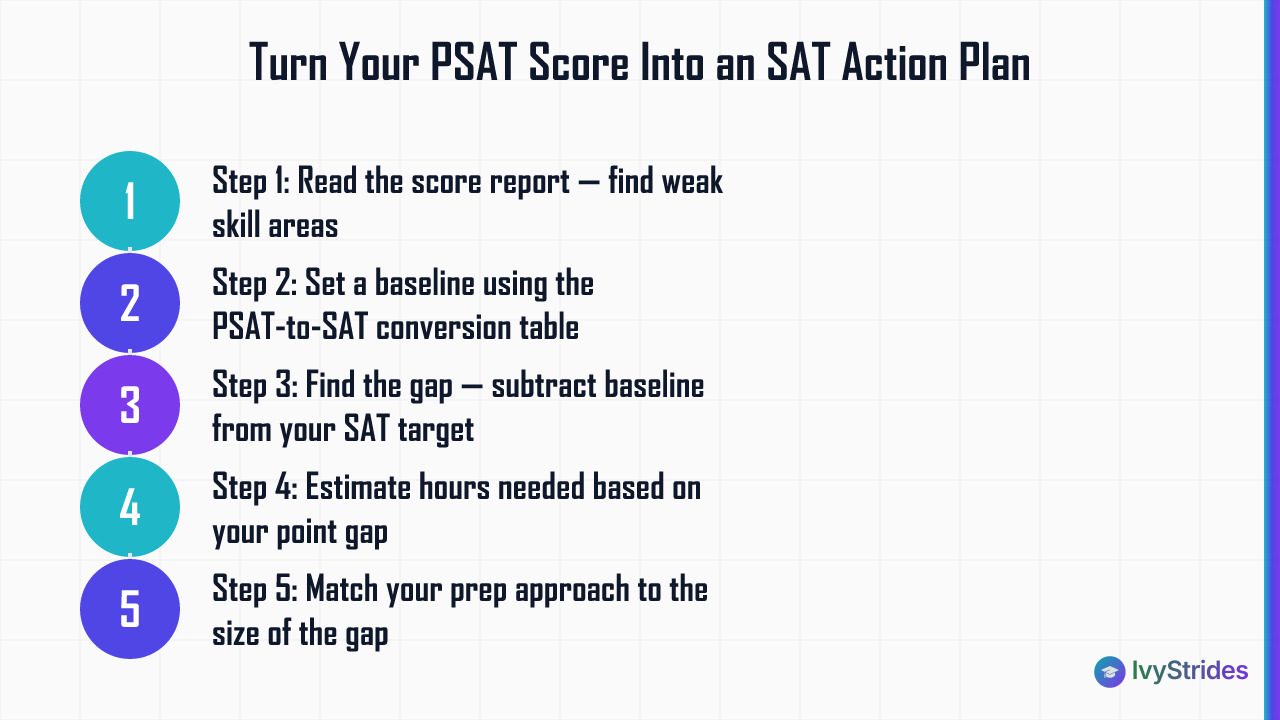
Turning a PSAT score into an SAT plan takes five steps, and the whole thing starts with reading your report correctly. Once you have your conversion estimate, the next step is turning it into a concrete SAT target; our guide on how to use your PSAT score to set an SAT goal walks through that process in detail.
Step 1: Read the score report. Your PSAT report shows section scores, subscores, and a percentile for each, per College Board. Learn how to read your PSAT score report so you can see which skill areas are dragging the total.
Step 2: Set a baseline. Apply the conversion table above to translate your PSAT into a rough starting SAT estimate. This is your floor with no prep.
Step 3: Find the gap. Subtract your baseline estimate from your SAT target. That number is the work in front of you.
Step 4: Estimate the hours. In our coaching, students targeting a 150+ point improvement above their PSAT baseline typically need about 40 to 80 hours of structured prep over roughly 3 to 6 months. Students chasing a 50 to 100 point gain usually need around 20 to 40 hours.
Step 5: Match the approach to the gap. A 50-point gap is often a self-study project. A 200-point gap usually needs section-specialist coaching, because generalist review rarely fixes the specific Module 2 weaknesses that cap a score.
Our diagnostic-driven methodology runs a full-length practice test first, then targeted weakness work by a section specialist, SAT R&W and SAT Math handled by different experts, then spaced retesting to lock in gains. Full-length PSAT and SAT practice tests bridge the two exams cleanly; browse our PSAT practice tests to keep the format fresh. See how PSAT coaching structures the plan around your gap.
One caveat before you decide whether to test at all. Even if a target college is test-optional, a strong SAT score built on a solid PSAT foundation can still strengthen an application; test-optional policies vary by school and year, so check each college's current policy on FairTest or the school's admissions page before deciding whether to submit.
You can read more about our section-specialist model on the IvyStrides About page. Meet the coaches on our tutors page.
Frequently Asked Questions About the PSAT as a Predictor of SAT Performance
If I get a 1230 on the PSAT, what is my predicted SAT score?
A 1230 PSAT points to an SAT in the 1290 to 1310 range with no additional prep, based on College Board concordance. With around 40 to 60 hours of targeted work on the weaker section, students in our coaching at this band typically reach 1350 to 1400.
What is a top 1% PSAT score?
For 11th graders, a top 1% PSAT score is approximately 1460 or higher out of 1520, per College Board percentile data. A student in that range is usually also in National Merit Semifinalist territory in most states, though exact Selection Index cutoffs vary state to state.
What is a 1470 PSAT equivalent to on the SAT?
Roughly 1530 to 1550 on the SAT, based on College Board concordance tables. That range is competitive at highly selective colleges, but admission always depends on the full application, not the score alone.
Is a 740 a bad PSAT score?
It depends on whether 740 is a section or total score. A 740 section score out of 760 is near-perfect and excellent. A 740 total PSAT score sits below the national average of around 930 and lands below the 50th percentile for most grade levels.
Is your PSAT score a good indicator of your SAT score?
Yes, as a directional indicator rather than a precise forecast. The two tests share an adaptive structure and identical question types, so the PSAT reliably signals your starting band. Where you finish depends heavily on how much prep happens between the tests.
What does a 1300 on the PSAT equal on the SAT?
A 1300 PSAT converts to about 1370 to 1400 on the SAT without prep. Students in our coaching at this band who complete a full diagnostic-driven program typically reach 1450 to 1500 within roughly 3 to 5 months of structured work.
Does the PSAT predict the SAT equally well at all score bands?
No. It holds up best between roughly 1100 and 1400, the band where the two tests overlap most in content. Above roughly 1450 the SAT's harder Math content trips up some students who topped the PSAT. At very low scores, test-day factors add more variance.
Do freshman PSAT scores matter for college admissions or National Merit?
Freshman PSAT scores do not count for National Merit; only the 11th-grade PSAT/NMSQT qualifies. Colleges never see PSAT scores either. What a freshman PSAT does give you is an early diagnostic baseline, useful for spotting skill gaps before SAT prep begins. More detail in our guide to whether freshman PSAT scores matter. To build the habit early, start with the best PSAT practice tests.
Your PSAT is the most honest starting line you'll get before the SAT. Read it as a snapshot, convert it carefully, and then spend your effort where the gap actually lives. That's the difference between a score that merely matches the prediction and one that beats it.
Ready to Turn Your PSAT Score Into an SAT Score You Are Proud Of?
Book a free 15-minute strategy call. We will map your PSAT result to a realistic SAT target, show you exactly where points are being left on the table, and build a diagnostic-driven plan to close the gap.

Award-winning author (South Asian Book Award) and graduate of BITS Pilani and UCLA Luskin School of Public Affairs. Brings a published writer's eye to Common App essays and grammatical precision to SAT and ACT R&W instruction.