
How to Qualify for National Merit in 2026: A Step-by-Step Guide That Actually Works
On this page
- What Qualifying for National Merit Actually Means (The 60-Second Version)
- Understanding the Selection Index: The Number That Actually Determines Your Fate
- What PSAT Score Do You Actually Need to Qualify (State-by-State Breakdown)
- How Hard Is It to Qualify for National Merit? An Honest Assessment
- Step 1: Meet the Entry Requirements Before You Sit the PSAT
- Step 2: Take the PSAT/NMSQT in October of Your Junior Year
- Step 3: Understand Where You Land After Scores Are Released
- Step 4: Submit a Confirming SAT Score and Complete Your Application
- Step 5: The Finalist Review, Academic Record, and What Determines Who Becomes a Scholar
- Can You Qualify for National Merit Without Taking the PSAT? The Alternate Entry Process
- How to Raise Your PSAT Score to the National Merit Range: A Practical Prep Framework
- FAQ
- Does a 1440 PSAT score qualify for National Merit?
- Is a 1470 PSAT a good score for National Merit?
- What is the National Merit Scholarship worth in dollars?
- Can a senior qualify for National Merit?
- Is Commended Student the same as National Merit Scholar?
- How does the National Merit application essay differ from the Common App essay?
- Where to Go From Here
To qualify for National Merit in 2026, you must take the PSAT/NMSQT in October of your junior year, be a U.S. citizen or lawful permanent resident, and score in roughly the top 1% of test-takers in your state. That ranking is measured by the Selection Index (not your total PSAT score), which typically falls between 207 and 222 depending on your state. Clear the cutoff and you're a Semifinalist. Submit a confirming SAT score, essay, academic record, and school endorsement to advance to Finalist and, for roughly 7,500 students each year, Scholar.
These requirements come from the National Merit Scholarship Corporation and are cross-referenced against College Board's PSAT/NMSQT documentation throughout this guide. The harder question, whether your projected score in your state actually crosses the line and what's expected in the twelve months after the test, is what the next ten sections address.

What Qualifying for National Merit Actually Means (The 60-Second Version)
The National Merit Scholarship Program is a single-test, single-shot competition administered by the National Merit Scholarship Corporation (NMSC). Roughly 1.5 million students enter each year through the PSAT/NMSQT. About 50,000 receive some form of recognition. Around 16,000 are named Semifinalists, roughly 15,000 advance to Finalist, and approximately 7,500 receive a scholarship as a National Merit Scholar.
Entry has four non-negotiable requirements. You must (1) take the PSAT/NMSQT in the fall of your junior year of a standard four-year high school program, (2) be a U.S. citizen or lawful permanent resident intending to become a citizen, (3) be enrolled full-time in high school and plan to enroll full-time in college immediately after graduation, and (4) score high enough on the Selection Index to clear either the national Commended cutoff or your state's Semifinalist cutoff.
Which test counts matters. The October 2024 PSAT/NMSQT is the qualifying test for the 2026 competition. The October 2025 PSAT/NMSQT is the qualifying test for the 2027 competition. There's no other way in except the narrow Alternate Entry process covered later. Scores are reported on the 320 to 1520 PSAT scale, but the number NMSC actually uses is the Selection Index, and that's where most families get confused. For a deeper breakdown of how the PSAT score scale maps to National Merit cutoffs at every percentile, see our companion guide on what PSAT score do you need for National Merit.
The four tiers, in order: Commended Student (letter of commendation, no advancement), Semifinalist (top 1% of your state, application required), Finalist (application approved), Scholar (one of roughly 7,500 who receive money).
Understanding the Selection Index: The Number That Actually Determines Your Fate
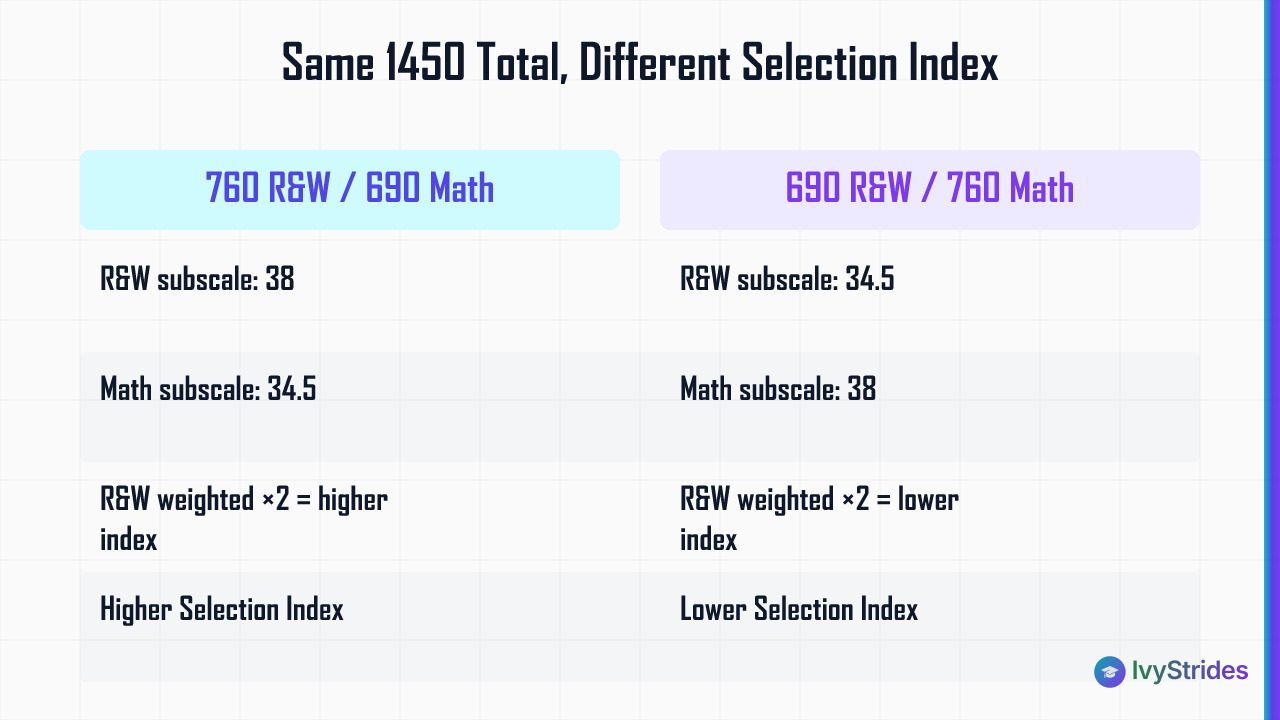
The Selection Index is calculated from your PSAT/NMSQT Reading and Writing and Math section scores. Each section is scored on an 8 to 38 subscale (the section scores you see in the 160-760 range are those subscale numbers multiplied by 20). The formula:
Selection Index = 2 × (Reading and Writing subscale) + 1 × (Math subscale)
Maximum: 228. That's 2 × 38 + 38.
Here's the part most students miss. Reading and Writing is weighted twice as heavily as Math. Two students with identical 1450 totals can land on very different Selection Indexes depending on their split. A student with 760 R&W and 690 Math outperforms a student with 690 R&W and 760 Math on the Selection Index, even though the total is identical. If you're near the cutoff, R&W points are worth twice as much as Math points. That fact changes the entire prep strategy.
The national Commended cutoff typically lands around 207 to 212, roughly the top 3-4% of scorers, about 34,000 students. The Semifinalist cutoff is set separately for each state to identify the top 1% within that state. Verify your specific number against the score report NMSC sends through your high school, which shows your Selection Index directly. Don't try to reverse-engineer it from the total score alone. The Selection Index calculation is covered in full detail, including worked examples for different score splits, in our dedicated guide on what is the Selection Index for National Merit.
What PSAT Score Do You Actually Need to Qualify (State-by-State Breakdown)
Cutoffs vary dramatically. NMSC does not publish them in advance. Historical data from prior competition years is the best proxy families have, and cutoffs shift by roughly 1-3 Selection Index points year over year.
Based on historical cutoff data, here's the pattern:
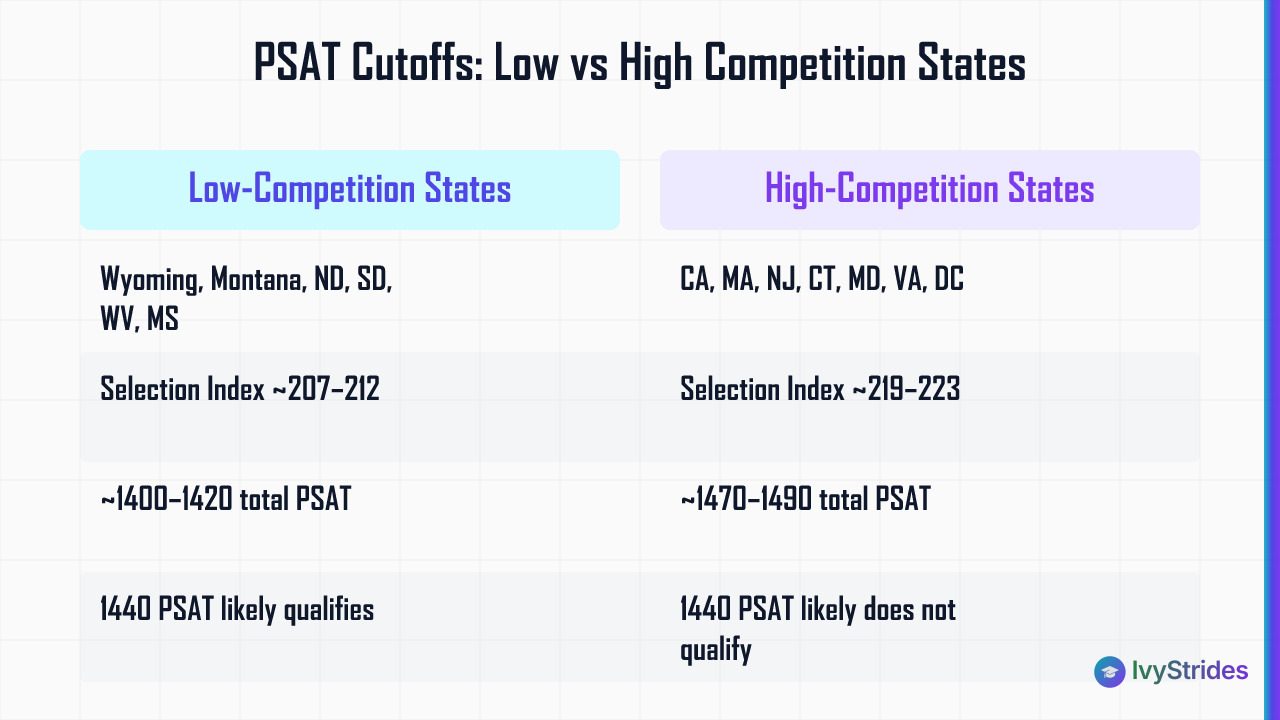
- Low-competition states (Wyoming, Montana, North Dakota, South Dakota, West Virginia, Mississippi): Semifinalist Selection Index roughly 207-212, corresponding to about a 1400-1420 total PSAT depending on section split.
- Mid-range states (much of the Midwest and South, plus Arizona and Nevada): Selection Index roughly 213-217, roughly 1430-1460 total PSAT.
- High-competition states (California, Massachusetts, New Jersey, Connecticut, Maryland, Virginia, Washington, D.C.): Selection Index roughly 219-223, roughly 1470-1490 total PSAT.
Does a 1440 PSAT qualify? In Wyoming, likely yes. In New Jersey, likely no. It depends on your state and your R&W-to-Math split. Does a 1470? Comfortable in most states, borderline in the highest-competition ones. That's why juniors should identify their state's historical cutoff first, then build the prep plan backward from a target Selection Index, not a target total score.
Roughly the top 1% nationally corresponds to about a 1450+ total PSAT, but "top 1% nationally" is not the metric. Top 1% of your state is. To benchmark where you actually stand, take a full-length timed practice test using our PSAT practice tests and score it against your state's historical cutoff.
Because Semifinalists must submit a confirming SAT score, understanding how your PSAT score maps to the SAT scale is essential. Our PSAT to SAT score conversion guide explains the relationship.
How Hard Is It to Qualify for National Merit? An Honest Assessment
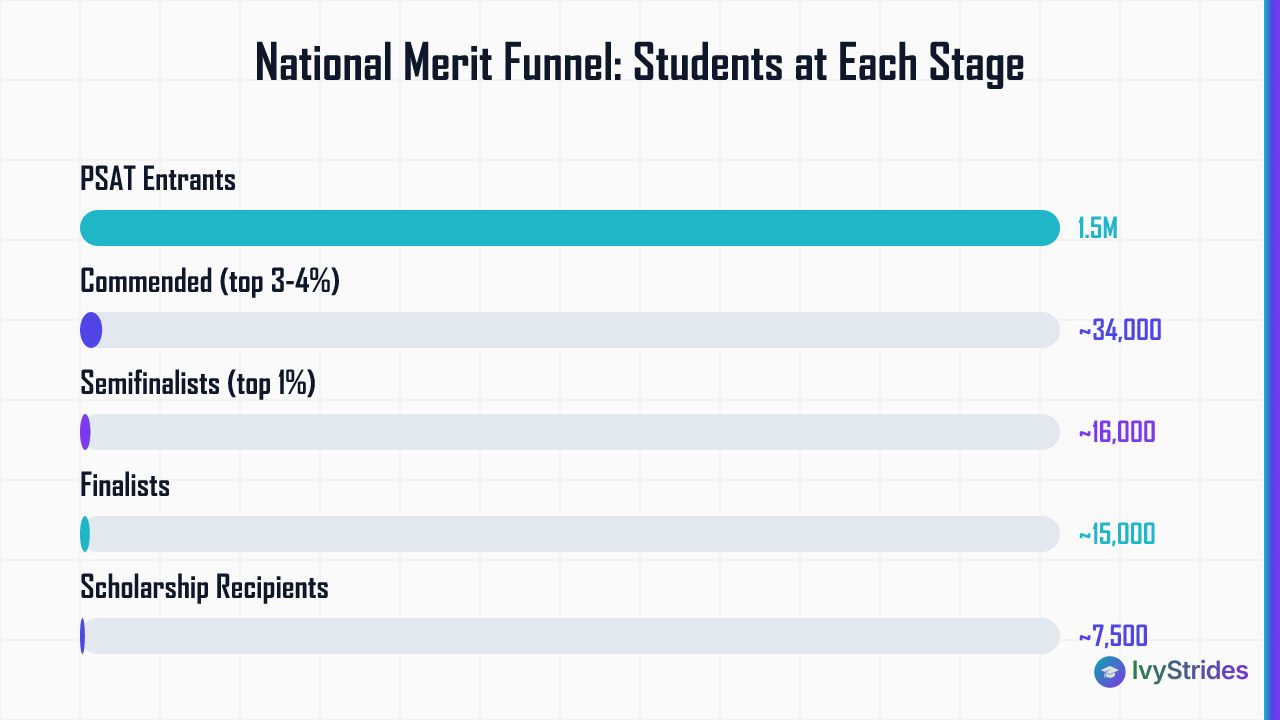
Let's put the funnel in numbers. About 1.5 million students enter through the PSAT. Roughly 50,000 receive recognition. Around 34,000 are Commended (top 3-4%). About 16,000 become Semifinalists (top 1%). Approximately 15,000 advance to Finalist. Roughly 7,500 receive scholarship money. So the odds of any recognition are about 1 in 30, and Scholar-level recognition is roughly 1 in 200.
Most students who earn any National Merit recognition score in the 1400-1520 band on the PSAT. Below 1400, recognition is unlikely except in a handful of the lowest-cutoff states.
Here's the nuance families miss. The Semifinalist-to-Finalist conversion rate is roughly 95%. The application is a compliance and verification process, not a second scoring hurdle. Clear the Selection Index cutoff and complete the application correctly with a valid confirming SAT score, and you almost certainly become a Finalist. The real filtering happens at two points: the initial PSAT score and, later, the Finalist-to-Scholar selection where about half of Finalists receive a scholarship.
In our coaching with students targeting National Merit, the primary barrier is the PSAT score itself, not the paperwork downstream. If you want the full program timeline from PSAT day through Scholar announcement, our guide on how does National Merit work walks through every stage with dates.
Step 1: Meet the Entry Requirements Before You Sit the PSAT
Eligibility rules are strict, and students disqualify themselves on technicalities every year. Per the NMSC program overview, you must:
- Be enrolled full-time as a high school student.
- Take the PSAT/NMSQT in the specified year of your high school program. For a standard four-year program, that's your third year (junior year).
- Plan to enroll full-time in college the fall after high school graduation.
- Be a U.S. citizen, or a lawful permanent resident who has applied for or intends to apply for U.S. citizenship at the earliest opportunity permitted by law.
Sophomores who take the PSAT don't enter the National Merit competition regardless of score. The score is treated as practice. Seniors who never took the PSAT in their junior year can't enter the program as seniors, except through Alternate Entry with documented cause. If you're a junior reading this and considering skipping the PSAT to focus on the SAT, don't. The October PSAT is the only door into National Merit.
Homeschooled students and students on accelerated three-year high school programs have specific NMSC rules on which year counts as qualifying. Contact NMSC directly if that describes you. And if you're aiming at a high Selection Index, your SAT prep is doing double duty already, so cross-reference the tactics in our official SAT study guide 2026 with your PSAT prep plan.
Step 2: Take the PSAT/NMSQT in October of Your Junior Year
The PSAT/NMSQT is administered in October at participating high schools. You register through your school counselor, not directly through College Board. Confirm your school is offering the test and confirm the date by early September. Not every high school automatically registers every junior, and that's the single most common failure point at the entry stage.
The test itself is digital and adaptive, with two sections: Reading and Writing (two modules, about 27 questions each) and Math (two modules, about 22 questions each). Each section reports on a 160-760 scale, for a total of 320-1520. Module 2 in each section is harder or easier based on your performance in Module 1, and the hardest Module 2 questions are where Selection Index gains are won.
Treat this as a high-stakes test, not a warm-up. In our coaching with students targeting National Merit, those who complete at least two full-length timed practice tests before the October PSAT score measurably higher than those who walk in cold. Rough timeline benchmarks:
- Starting at 1350, targeting 1440-1460: roughly 8-12 weeks of structured prep, about 5-7 hours per week.
- Starting at 1400, targeting 1470+: roughly 6-10 weeks, with section-specialist work on R&W Module 2 and advanced algebra in Math Module 2.
- Starting at 1450, targeting 1500+: roughly 6-8 weeks of careless-error elimination and hardest-question timing drills.
If you're serious about a National Merit-range score, prep with a section-specialist coach through our 1-on-1 SAT prep, because the PSAT and SAT share format and content. To calibrate what a competitive score looks like in absolute terms, our writeup on SAT percentiles breaks down the scale.
Step 3: Understand Where You Land After Scores Are Released
PSAT scores are typically released in December of junior year through the College Board student portal. That release tells you your total score, section scores, and (importantly) your Selection Index. It does not yet tell you whether you've qualified for anything. That announcement comes about nine months later.
Here's the timeline for the 2027 competition (juniors who tested in October 2025):
- December 2025: PSAT scores released to students.
- September 2026: NMSC notifies high schools of Commended Students and Semifinalists. Your counselor tells you.
- October 2026: Semifinalist Application deadline (exact date to be published by NMSC).
- February 2027: Finalist announcements sent to schools.
- March-June 2027: Scholar announcements roll out in three waves (National Merit $2,500, Corporate-sponsored, College-sponsored).
For the 2026 competition (juniors who tested October 2024), the Semifinalist Application deadline was in early October 2025, per the NMSC 2026 Requirements and Instructions leaflet. Verify current-year dates through your school counselor or NMSC directly.
You won't receive a letter in the mail from NMSC first. Notifications route through your high school. If your counselor isn't proactive, ask them in early September of senior year whether the school has received the NMSC notification letter. And if you're already thinking ahead about how PSAT scores translate to SAT expectations, our guide on SAT scores 2026 covers the mapping.
Step 4: Submit a Confirming SAT Score and Complete Your Application
If you're named a Semifinalist, the National Merit Scholarship Application (submitted through NMSC's online portal) has five components:
-
Academic record: transcripts through junior year, including course rigor and GPA.
-
Confirming SAT score: an SAT score with a Selection Index at or above NMSC's threshold, sent officially through College Board to NMSC (code 0085).
-
Personal essay: roughly 200-300 words on your activities, achievements, and interests.
-
School endorsement: a recommendation from your principal or counselor.
-
First-choice college: you designate one college; this matters enormously for college-sponsored scholarships.
The confirming SAT is where students most often stumble. NMSC's official guidance is that the SAT score must produce a Selection Index at or above the national Commended cutoff. In practice, a total SAT score of roughly 1400+ usually satisfies this for most students, though the exact required threshold depends on your section split and NMSC's current policy. Take the SAT no later than December of senior year, and ideally by October or November, to leave time to retake if needed. Our PSAT to SAT score conversion guide shows the expected relationship between your PSAT and SAT scores.
The essay is short but not casual. It's evaluated as part of the Finalist review. The same voice-and-specificity principles that make a Common App personal statement compelling apply here, though the content is more achievement-focused. If you want feedback on it, our Common App essay coaches also work on scholarship essays.
Miss the application deadline and you're out. There's no extension mechanism.
Step 5: The Finalist Review, Academic Record, and What Determines Who Becomes a Scholar
Finalist designation is confirmed in February of senior year for students whose applications pass NMSC's compliance and academic review. As noted, roughly 95% of Semifinalists who submit complete applications advance to Finalist. Then the real selection happens.
Three scholarship types are awarded from the Finalist pool:
-
National Merit $2,500 Scholarship: a one-time award funded by NMSC. Roughly 2,500 recipients. Selected on merit criteria without regard to first-choice college.
-
Corporate-sponsored scholarships: funded by companies for children of employees, students in specific career fields, or residents of certain communities. About 1,000 awards. Amounts vary; some are renewable.
-
College-sponsored scholarships: funded by colleges for Finalists who enroll and have designated that college as their first choice with NMSC. Roughly 4,000 awards. Amounts range widely; some colleges offer four-year full-tuition packages, others a few thousand per year. Check the specific policy at each college you're considering.
That first-choice designation is the lever most families underestimate. In our coaching with students who reach Finalist status, the most common reason for missing out on scholarship dollars is not a weakness in the application, it's failing to list the right first-choice college for a college-sponsored award. If a college on your list offers a generous National Merit package and you can see yourself enrolling there, list it as your first choice with NMSC. You can update your first-choice college with NMSC through the spring.
The academic record matters at this stage too. Students aiming for National Merit typically carry a rigorous course load; pairing PSAT prep with strong AP performance strengthens the record NMSC reviews at the Finalist stage. Coverage of your junior and senior year AP schedule through our AP courses online is part of building that record. And because the application essay carries some weight, the same principles that guide a strong Common App essay apply. If you're stuck on what to write about, our post on how to brainstorm college essay ideas is a starting point.
Scholar announcements roll out from March through June of senior year. If you're a Finalist and don't receive a scholarship, you remain a Finalist and can list that recognition on college applications.
Can You Qualify for National Merit Without Taking the PSAT? The Alternate Entry Process
Sometimes. NMSC's Alternate Entry process exists for students who missed the PSAT/NMSQT in their junior year due to (a) documented illness, (b) family or personal emergency, or (c) their school not offering the test. It's not a backdoor for students who forgot to register, chose not to take it, or took it as a sophomore and want a second shot.
The process:
-
Write to NMSC as soon as possible after the missed test date, ideally by early spring of junior year, explaining the reason and providing documentation.
-
If NMSC approves the request, you submit an SAT score as the substitute qualifying measure. The SAT Selection Index (calculated similarly to PSAT: 2 × Reading and Writing + Math on the section subscale) must clear the same state cutoff.
-
Deadlines are strict. NMSC doesn't routinely make exceptions.
Alternate Entry is genuinely narrow. If it applies to you, act fast; the window closes well before senior year. For structured SAT preparation to hit the required confirming or substitute score, our SAT prep overview walks through the coaching options.
How to Raise Your PSAT Score to the National Merit Range: A Practical Prep Framework
If you're benchmarking below your state's cutoff, prep is the answer, and the prep has to be diagnostic-driven, not generic. Here's the framework we use with students targeting National Merit.
Start with a full-length timed diagnostic. Not sections, not a question set. The whole test, timed, in one sitting. Score it, then break the results down by question type (not just section). In our coaching, students who take a diagnostic in the first session identify their weakest four to six question types within an hour, allowing targeted work rather than shotgun review.
Prioritize R&W if you're near the cutoff. Because the Selection Index weights R&W at 2×, a 20-point R&W gain is worth twice as much as a 20-point Math gain. For a student sitting at 730 R&W and 720 Math, pushing R&W to 760 moves the Selection Index by 6 points; pushing Math to 750 moves it by 3. Cutoff crossings often turn on this arithmetic.
Work at the ceiling, not the average. Selection Index-caliber scores require answering Module 2 hard questions correctly. That means the last five questions of R&W Module 2 (rhetorical synthesis, cross-text analysis, and the hardest logical-conclusion items) and the last five of Math Module 2 (advanced algebra, circles, and unusual quadratic setups). Generic prep spreads attention evenly. Targeted prep concentrates on where the marginal points live.
Retest every 3-4 weeks. Full-length, timed, real conditions. Score-band drift, careless errors, and pacing issues show up on full-length practice tests, not on drilled sections. Students who take about four full-length practice tests during a prep cycle gain measurably more than students who take one and drill everything else.
Rough timelines in our coaching:
- 1350 baseline to 1440-1460 target: roughly 10-14 weeks, about 6-8 focused hours per week.
- 1400 baseline to 1470+ target: roughly 8-10 weeks, with heavy emphasis on Module 2 hardest questions.
- 1450 baseline to 1500+ target: roughly 6-8 weeks of surgical work on careless errors and pacing.
For structured practice materials, the College Board's official Bluebook practice tests are the closest match to the actual PSAT. Supplement with free SAT resources for additional targeted question sets. If your ACT prep is also on the table, our writeup on how to raise your ACT score 4 points shows the parallel methodology. For test-week pacing, our SAT last minute tips apply directly to the PSAT because the format is identical.
FAQ
Does a 1440 PSAT score qualify for National Merit?
Sometimes. A 1440 PSAT can qualify in lower-competition states such as Wyoming, Montana, or North Dakota, where Semifinalist cutoffs historically fall around a 1400-1420 total PSAT. In high-competition states like California, Massachusetts, or New Jersey, where cutoffs reach roughly 1470-1490, a 1440 usually earns Commended recognition but not Semifinalist status. The answer also depends on your section split, because the Selection Index weights Reading and Writing at twice the value of Math. Check your state's historical cutoff and calculate your Selection Index directly rather than relying on the total score.
Is a 1470 PSAT a good score for National Merit?
Yes, in most states. A 1470 clears the Semifinalist cutoff comfortably in mid-range and lower-competition states. It's borderline in the highest-competition states, including California and New Jersey, where historical cutoffs have reached roughly 1480-1490. Because NMSC doesn't publish cutoffs in advance and cutoffs shift each year, a 1470 in a borderline state one year may or may not clear the next year's threshold. Your Reading and Writing versus Math split can push you above or below the line.
What is the National Merit Scholarship worth in dollars?
The National Merit Scholarship itself is a one-time $2,500 award funded by NMSC. Beyond that, many colleges offer their own college-sponsored National Merit scholarships to Finalists who enroll and list them as first choice with NMSC. Those awards range from a few thousand dollars to full tuition over four years, depending entirely on the institution. Corporate-sponsored scholarships, funded by companies for employees' children or students in specific fields, also vary widely in amount and renewability. The total value of National Merit recognition depends heavily on which college you attend.
Can a senior qualify for National Merit?
Only if they took the PSAT in their junior year. A senior who took the PSAT/NMSQT in the specified junior year is already in the program and receives their recognition notification in September of senior year. A senior who never took the PSAT can't enter the competition as a senior, except through the Alternate Entry process, which requires documented reasons for missing the junior-year test (illness, emergency, or school not offering the test). Alternate Entry isn't available to students who simply chose not to sit for the PSAT.
Is Commended Student the same as National Merit Scholar?
No. Commended Students score in roughly the top 3-4% of PSAT takers nationally and receive a letter of commendation, but they don't advance to the Semifinalist round and aren't eligible for scholarships. National Merit Scholars are the roughly 7,500 students who complete the application process, are named Finalists, and receive a scholarship award. Commended is a meaningful academic honor worth listing on college applications, but it's a separate and lower tier than Semifinalist, Finalist, or Scholar.
How does the National Merit application essay differ from the Common App essay?
The National Merit Scholarship Application essay is shorter (roughly 200-300 words) and focused on academic interests, extracurricular achievements, and career goals. The Common App personal statement is up to 650 words and covers a broader personal narrative. The same principles of specificity, authentic voice, and concrete detail apply to both, but the National Merit essay is more achievement-focused and less narrative-driven. Don't simply copy your Common App essay into the National Merit slot; the shorter word count and different emphasis require a purpose-built draft.
Where to Go From Here
The Selection Index is a math problem. Your state's cutoff is a target. Everything between "current score" and "target score" is a prep plan, and that plan starts with a diagnostic, not a Google search.

Award-winning author (South Asian Book Award) and graduate of BITS Pilani and UCLA Luskin School of Public Affairs. Brings a published writer's eye to Common App essays and grammatical precision to SAT and ACT R&W instruction.