
Does the PSAT Matter If You Are Not Chasing National Merit?
On this page
- Do Colleges Look at PSAT Scores? The Direct Answer
- Does the PSAT Matter in 9th or 10th Grade Without a National Merit Goal?
- When the PSAT Does Matter for National Merit, Even If You Think You Are Out of Range
- What Your PSAT Score Report Actually Tells You About SAT Readiness
- FAQ: Does the PSAT Matter
- Are PSAT scores a good indicator of SAT scores?
- Do colleges look at PSAT scores?
- What is a good PSAT score?
- Does the PSAT matter for scholarships other than National Merit?
The PSAT matters even without a National Merit goal. The PSAT/NMSQT is a College Board benchmark test on the 320-1520 score scale that mirrors the Digital SAT format. Colleges never see it, so it carries no admissions weight, yet its score report maps your SAT content gaps, domain by domain, before you sit the SAT.
That score report, and the National Merit pathway it opens for juniors, are the two reasons a test "colleges don't see" still earns your October morning. The figures below come from the College Board PSAT/NMSQT pages and the National Merit Scholarship Corporation.

Do Colleges Look at PSAT Scores? The Direct Answer
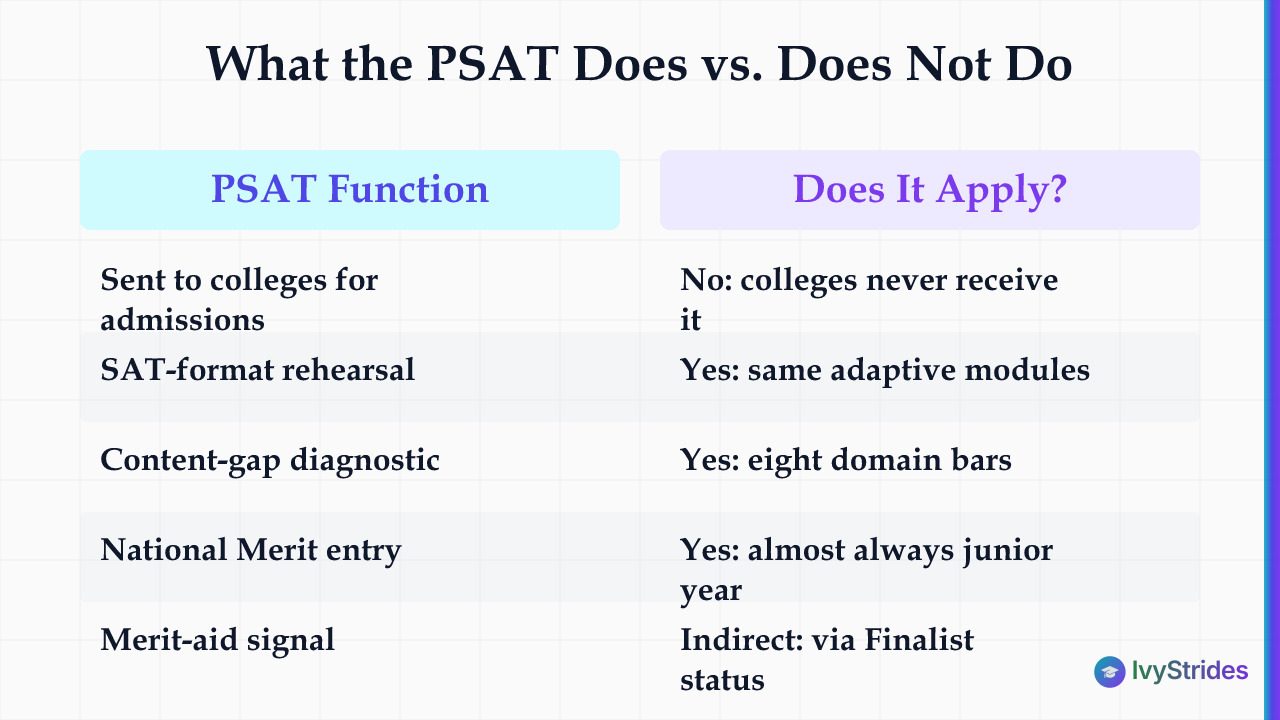
Colleges do not look at PSAT scores. College Board sends them to your school, and in many cases your district and state, and shares PSAT/NMSQT scores with NMSC, the test's cosponsor, but it does not send your scores to colleges. The scores colleges can see are the SAT or ACT scores you choose to send later.
Admissions weight: zero. That is the honest starting point. The main place a PSAT/NMSQT score carries outside value is the National Merit Scholarship Program, where the National Merit Scholarship Corporation uses it to screen entrants.
The PSAT/NMSQT runs on the same two-module multistage adaptive format as the Digital SAT, which is why how the PSAT/NMSQT is structured and timed feels familiar on test day: 98 questions across 2 hours and 14 minutes of testing. College Board lists the PSAT/NMSQT at $18 for 2026-27 on its school and district pricing page.
| Function | Does the PSAT do this? | Who it matters for |
| Admissions score | No, colleges never receive it | No one |
| SAT-format rehearsal | Yes, same adaptive modules | Every grade |
| Content-gap diagnostic | Yes, eight domain bars | Every grade |
| National Merit entry | Yes, almost always in junior year | Grade 11 |
| Merit-aid signal | Indirect, via Finalist status | High scorers |
Does the PSAT Matter in 9th or 10th Grade Without a National Merit Goal?

Photo by Andy Barbour on Pexels
In 9th and 10th grade, the PSAT matters as a no-stakes diagnostic, not as a scholarship test. Neither the PSAT 8/9 nor the PSAT 10 counts for National Merit, and NMSC says a sophomore on the usual four-year path who takes the 2026 PSAT/NMSQT must take it again in 2027, as a junior, to enter. So for a sophomore, the value is pure practice and gap data.
Does a PSAT score matter here? Yes, but only to you. A ninth grader sits the PSAT 8/9, reported on a 240-1440 scale with sections from 120-720. A tenth grader sits the PSAT 10 or the PSAT/NMSQT, both on the 320-1520 scale with sections from 160-760. The three versions share a common scale but serve different grades, which is why the PSAT 8/9, PSAT 10, and PSAT/NMSQT differences come down to grade level, score range, and National Merit eligibility.
Why take it seriously early. The score report hands you eight content-domain progress bars, four for Reading and Writing and four for Math, long before you sit a real SAT. That is a head start no untimed worksheet matches. Your report's percentiles compare your scores with other students who took the same test, and what a good PSAT score looks like by grade shifts with the version you took.
The fall 2026 in-school window for the PSAT/NMSQT and PSAT 8/9 ran October 1 to October 30, 2026, and schools give the PSAT 10 in the spring window, March 1 to April 30, 2027. You do not register on your own: your school or district handles it.
| Grade | Test version | Score scale | Qualifies for National Merit? | Primary value |
| 9 | PSAT 8/9 | 240-1440 | No | Baseline diagnostic |
| 10 | PSAT 10 | 320-1520 | No | SAT-format rehearsal |
| 10 | PSAT/NMSQT | 320-1520 | No, for four-year students | Early practice |
| 11 | PSAT/NMSQT | 320-1520 | Yes | Merit entry plus gap map |
When the PSAT Does Matter for National Merit, Even If You Think You Are Out of Range
The junior-year PSAT/NMSQT is the sole qualifying test for the National Merit Scholarship Program, and that is the one function worth checking even if you assume you are out of range. NMSC will not consider the PSAT 10 or PSAT 8/9 for entry. Because NMSC lets a student enter in only one competition year, missing the junior-year test without an approved alternate entry means missing the program.
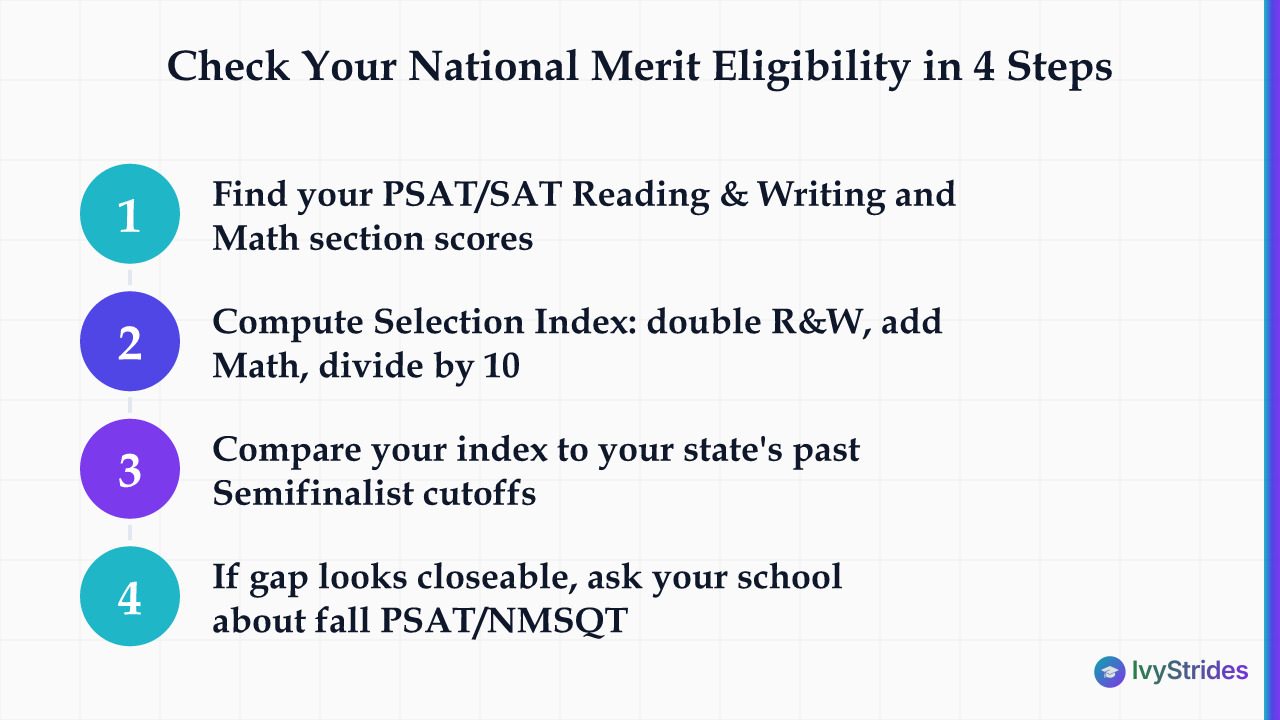
The junior-year October window is the one date a would-be National Merit entrant cannot afford to skip. NMSC screens entrants on the Selection Index, not the total score. NMSC's formula doubles your Reading and Writing section score, adds the Math section score, and divides the total by 10, producing a number College Board reports on a 48-228 scale. NMSC uses it to identify 50,000 high scorers, and more than two-thirds of them, about 34,000, qualify as Commended Students.
Even students who assume they sit far from National Merit range should check their Selection Index against their state's historical cutoff before writing off the junior-year PSAT/NMSQT. NMSC sets Semifinalist qualifying scores state by state, and they vary from year to year, so a student in a lower-competition state may qualify at a score that would fall short elsewhere. That is why National Merit cutoffs by state are worth a two-minute check, and why any number you see before NMSC sets this year's is an estimate.
Where the full process starts. The Selection Index is the first screen in how National Merit works step by step, and each later stage arrives in a set month. NMSC notifies Semifinalists through their high schools in early September 2027, about eleven months after the qualifying test, and Commended Students in late September 2027. NMSC expects about 95% of Semifinalists to become Finalists, and it tells them of Finalist standing in February 2028. In 2028, NMSC will award some 6,700 National Merit Scholarships of three types plus approximately 620 corporate-sponsored Special Scholarships, together worth over $29 million.
Missed the test? The fall 2026 window has closed, so a junior who missed the PSAT/NMSQT because of illness, an emergency, or another extenuating circumstance should write to NMSC as soon as possible, and no later than April 1, 2027, to request another route of entry. The request must be received or postmarked by that date, and what happens if you miss the PSAT as a junior is a narrow process, not an automatic second chance.
-
Find your most recent PSAT or SAT section scores, Reading and Writing and Math.
-
Compute your Selection Index: double Reading and Writing, add Math, divide by 10.
-
Compare it to your state's past Semifinalist cutoffs, knowing the next one is set only after testing.
-
If you are a sophomore and the gap looks closeable, ask your school about the fall 2027 PSAT/NMSQT.
What Your PSAT Score Report Actually Tells You About SAT Readiness
Even if you never chase National Merit, the PSAT matters because its score report tells you which SAT content domains to strengthen first. Its Knowledge and Skills section shows how you performed in eight content domains, four for Reading and Writing and four for Math, with the approximate number of questions in each.
The PSAT/NMSQT reports section scores from 160-760; the SAT reports them from 200-800, on the same common scale. A low bar in Advanced Math on the PSAT is the same weakness you would carry into SAT Math, just caught earlier. Reading the bars right takes a few minutes of orientation, so learn how to read your PSAT score report before you build a plan on it.
Here's the part most students miss: you need no conversion formula. Because the SAT Suite uses a common score scale, College Board says your scores on each test reflect approximately what you would score on the others if you took them today. What moves a score between the two tests is what you learn in between, not a fixed number of points added on. Once you know which domains fall below your target band, using your PSAT score to set an SAT goal becomes a concrete plan rather than a guess.
| Section | Content domain | What a low progress bar signals |
| Reading and Writing | Craft and Structure | Weak on text purpose and word choice |
| Reading and Writing | Information and Ideas | Shaky on inference and evidence |
| Reading and Writing | Standard English Conventions | Grammar and punctuation gaps |
| Reading and Writing | Expression of Ideas | Trouble with transitions and revision |
| Math | Algebra | Linear equations need work |
| Math | Advanced Math | Nonlinear and function gaps |
| Math | Problem-Solving and Data Analysis | Ratios, rates, and data reading |
| Math | Geometry and Trigonometry | Angle, area, and triangle gaps |
So does the PSAT matter if you are not chasing National Merit? Yes, at every grade, for different reasons:
- 9th and 10th grade: treat it as a no-stakes diagnostic and review your eight domain bars.
- 11th grade: compare your Selection Index with your state's past cutoffs.
- Missed it as a junior: write to NMSC so the request is received or postmarked by April 1, 2027, to ask about another route of entry.
In our coaching, every PSAT plan starts with a timed diagnostic so the score report's eight content-domain gaps drive the prep rather than a generic curriculum. IvyStrides coaches read the bars with you and name the first two domains to attack, and PSAT prep coaching at IvyStrides builds the study plan around those two gaps.
FAQ: Does the PSAT Matter
Are PSAT scores a good indicator of SAT scores?
Yes, as a snapshot. Because the PSAT and SAT sit on a common score scale, College Board says your PSAT score reflects approximately what you would score on the SAT if you took it today. What changes your SAT score is the work you do between the two tests, not a fixed offset.
Do colleges look at PSAT scores?
No. College Board says it does not send PSAT scores to colleges, and the tests are not college entrance exams. The main outside use of a PSAT/NMSQT score is National Merit eligibility, which NMSC determines through the Selection Index, not any college.
What is a good PSAT score?
For the PSAT 8/9, College Board says there are no good or bad scores, just information for planning. On the PSAT 10 and PSAT/NMSQT, your report's percentiles show how you compare with other students who took the same test. For National Merit, the benchmark that matters is your state's Selection Index cutoff, which NMSC sets each year and does not publish in advance.
Does the PSAT matter for scholarships other than National Merit?
National Merit is the main scholarship pathway tied directly to the PSAT/NMSQT. Within the same program, corporate sponsors fund Special Scholarships for some high-scoring participants who are not Finalists, most of them children of employees or residents of specific communities, so the PSAT can carry scholarship value beyond the National Merit Scholarships themselves.

Rajesh is a technology leader, entrepreneur, and angel investor with 28+ years in Business & Technology Leadership and Product & Solution Engineering. He is passionate about education, mentoring, and driving digital transformation.