
How Early Should You Start PSAT Prep? A Grade-by-Grade Guide for 2026
On this page
- The Short Answer: When to Start PSAT Prep by Grade
- Which PSAT Are You Taking? The Version Changes Your Timeline
- 8th and 9th Grade: Building the Foundation Without Burning Out
- 10th Grade: The Ideal Year to Take a Real Practice Run
- Am I Already Behind? The Most Common Fear Students Have About PSAT Timing
- Junior Year (Grade 11): The High-Stakes Window and How to Peak in October
- How Many Hours Does PSAT Prep Actually Take? A Score-Gap Framework
- What Score Are You Aiming For? Setting Your PSAT Target Before You Start
- The One Step Every Grade Level Shares: Start With a Diagnostic
- How PSAT Prep Feeds Directly into SAT Readiness
- PSAT Prep and Your Broader College Prep Strategy
- FAQ
- When should I start prepping for the PSAT?
- Is a 1270 a bad PSAT score?
- Is a 1200 a good PSAT score for a 9th grader?
- What is a top 1% PSAT score?
- How many hours of studying does the PSAT require?
- Should I take the PSAT in 10th grade even if it does not count for National Merit?
- Your Next Step
Most students should start structured PSAT prep no later than the summer before 11th grade, giving roughly 10 to 16 weeks before the October PSAT/NMSQT. If your goal is National Merit recognition, that timeline isn't optional. For a practice run in 10th grade, about 4 to 6 weeks of focused prep in the spring is enough. Students taking the PSAT 8/9 in 8th or 9th grade benefit from an early diagnostic baseline, but heavy prep that early is rarely necessary. The right start date depends on your grade, your current score, and your target.
Format and scoring facts throughout this article come from College Board's official PSAT/NMSQT documentation; National Merit cutoff ranges come from the National Merit Scholarship Corporation. The harder question is which version of the PSAT you're actually taking, and how your grade changes the stakes. That's what the next sections work through.

The Short Answer: When to Start PSAT Prep by Grade
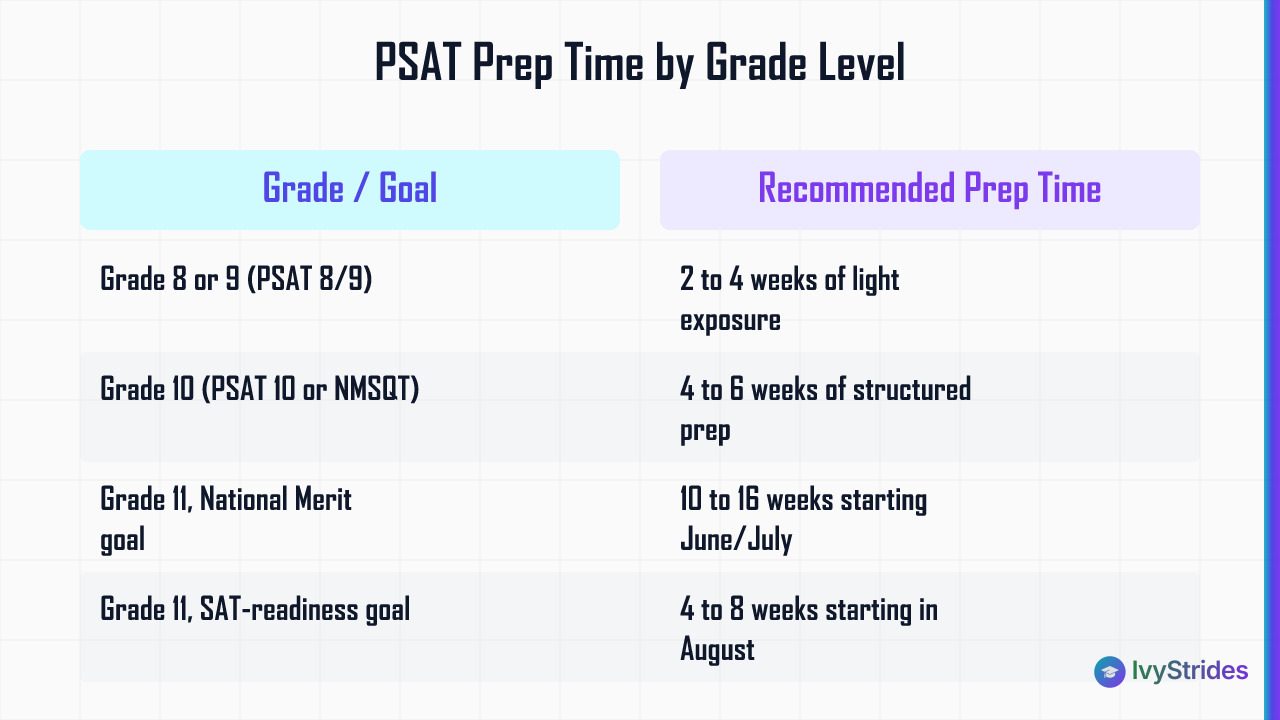
Here's the grade-by-grade breakdown, calibrated to the October 2026 PSAT/NMSQT window:
- Grade 8 or 9 (PSAT 8/9): roughly 2 to 4 weeks of light exposure before the test, if you're taking it. Focus on becoming familiar with the digital adaptive format. No pressure to hit a specific score.
- Grade 10 (PSAT 10 or PSAT/NMSQT as a sophomore): about 4 to 6 weeks of structured prep. This is your practice run before the score counts.
- Grade 11, National Merit goal: roughly 10 to 16 weeks of prep starting in June or July. This is non-negotiable if you want a Semifinalist-competitive Selection Index.
- Grade 11, SAT-readiness or practice goal: around 4 to 8 weeks starting in August is enough if your target is modest and your diagnostic score is already close.
The PSAT/NMSQT primary Saturday for 2026 is October 17, 2026, with the full testing window running October 1 through October 30, per College Board's SAT Suite calendar. For the complete administration schedule, see our PSAT test dates 2026 breakdown.
Regardless of grade, one step is universal: take a full-length, timed diagnostic practice test before you plan anything else. Without it, you're guessing at what to study.
Which PSAT Are You Taking? The Version Changes Your Timeline
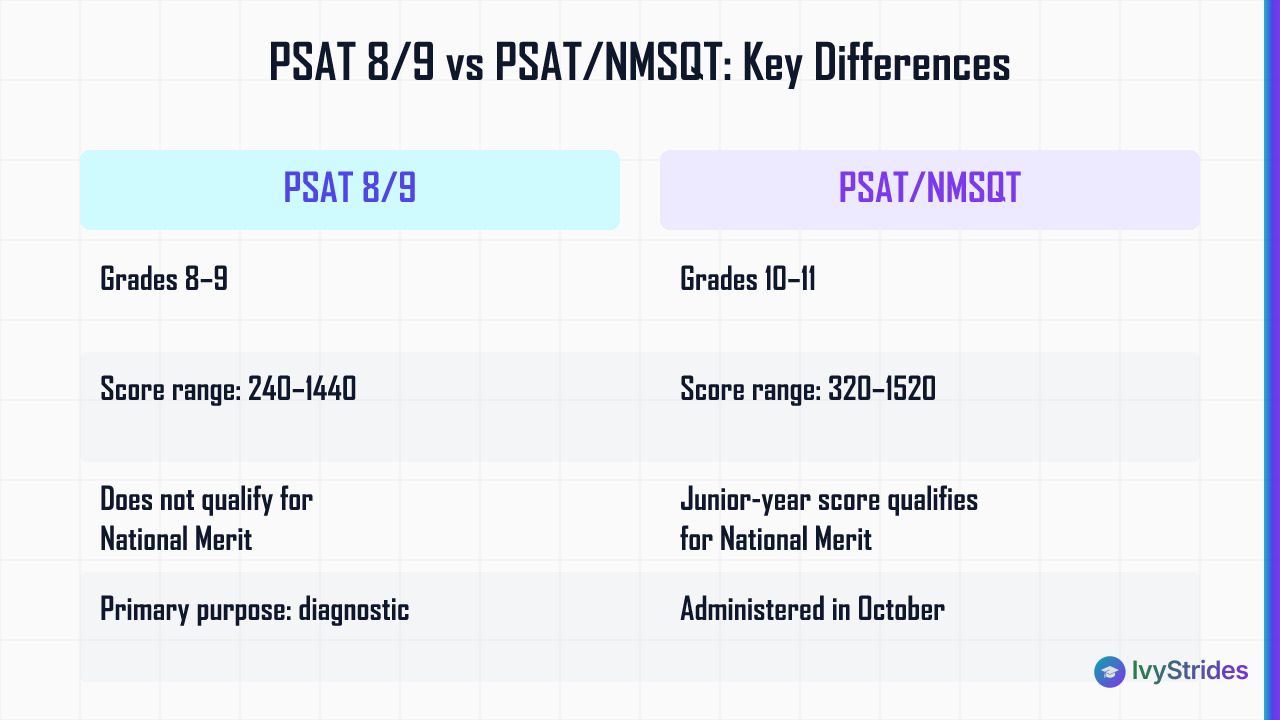
The version of the PSAT you're taking changes both the score scale and the stakes, so understanding the differences between PSAT 8/9, PSAT 10, and PSAT/NMSQT is the logical first step.
PSAT 8/9 is designed for 8th and 9th graders. Score range: 240 to 1440, per College Board. It does not qualify for National Merit. Its value is diagnostic; it gives a student a first real look at the format and content domains they'll see for the next four years.
PSAT 10 is designed for 10th graders and administered in the spring. Score range: 320 to 1520, matching the PSAT/NMSQT scale. It also does not qualify for National Merit, but it's a strong predictor of junior-year PSAT/NMSQT performance.
PSAT/NMSQT is the version most families are asking about. Score range: 320 to 1520. Administered in October. Available to both 10th and 11th graders, but only the junior-year score qualifies for National Merit Scholarship consideration, per College Board. Registration goes through the school, not through College Board directly.
All three sit inside the College Board SAT Suite of Assessments. The content domains, question types, and adaptive module structure are consistent across the progression from PSAT 8/9 up through the Digital SAT. For a deeper side-by-side, see our PSAT versions difference breakdown. If you're weighing when to shift focus toward the full test, our psat vs sat comparison covers the transition.
8th and 9th Grade: Building the Foundation Without Burning Out
Is it too early to prep in 8th or 9th grade? For structured PSAT prep, yes. For the underlying skills that show up on the test, no.
Here's what actually matters at this stage. The average PSAT 8/9 total score for 9th graders sits around 920, per College Board percentile data. A score above roughly 1000 to 1200 places a 9th grader in about the 75th to 90th percentile for that version. Hitting that range doesn't require a prep plan. It requires strong Algebra I and II fundamentals plus a consistent reading habit.
Algebra I and II mastery covers roughly 60% of PSAT Math content: linear equations, systems, quadratics, and basic data analysis. If a student is solid in these before 10th grade, junior-year PSAT prep becomes a matter of pacing and question strategy, not content remediation.
For Evidence-Based Reading and Writing, the highest-use habit is reading about 20 or more minutes per day of moderately challenging material. In our coaching, this is the strongest pattern we see behind sustained R&W growth. It builds the vocabulary and inference range the PSAT tests without any drilling.
Recommended commitment at this stage: roughly 1 to 2 hours per week of light skill-building. Not a full prep regimen. PSAT prep in 9th and 10th grade fits inside a broader college application timeline where AP course selection, extracurricular building, and essay brainstorming all run in parallel. Overloading test prep too early crowds out the other pieces.
10th Grade: The Ideal Year to Take a Real Practice Run
Sophomore year is where the strategy actually starts. You have two options: the PSAT 10 in the spring, or the PSAT/NMSQT in October as a non-qualifying attempt. Either gives you a real practice run under real conditions.
A good PSAT score for a 10th grader sits around 1010 to 1070 for the 50th percentile, per College Board percentile tables. A strong score is roughly 1150 or higher, which lands around the 75th percentile and above. If a sophomore hits about 1300+ on either version, they're already in reasonable range for a junior-year National Merit push. For fuller benchmarks, see our writeup on good PSAT scores for 10th graders.
A workable 10th-grade prep plan: roughly 4 to 6 weeks of structured work, about 3 to 4 hours per week. A consistent 3 to 4 hours per week across 6 weeks adds up to roughly 18 to 24 total hours. Start with a full-length timed diagnostic. Identify the two or three weakest sub-skills. Spend the bulk of the prep hours there. Take one more full-length test in the final week.
Free online resources are a legitimate starting point for students with small score gaps. They matter less for students trying to close a 100+ point gap, because they don't adapt to a specific diagnostic profile, which is where targeted weakness work carries most of the weight. For structured full-length timed practice under real conditions, our PSAT practice tests library gives you the format-matched material.
One reason sophomore year matters so much: taking the PSAT/NMSQT as a sophomore gives you a full dress rehearsal before the score counts. In our coaching, students who do this typically start junior-year prep from a higher baseline than students who take the test cold in 11th grade.
Am I Already Behind? The Most Common Fear Students Have About PSAT Timing
This is the question we get more than any other from juniors in August. Am I too late?
Honest answer: it depends on your gap and your goal.
In our coaching with students at this score band, a 50-point gap to a target score typically closes in roughly 4 to 6 weeks with three to four sessions per week of targeted weakness work. A 100-point gap usually requires about 8 to 12 weeks and roughly 20 to 40 hours of focused prep. A 150+ point gap toward National Merit cutoffs realistically requires starting by June of junior year. The math on that last one is unforgiving. There's no way to compress 60+ hours of targeted work into six weeks without burning out and losing accuracy.
So if you're reading this in early September of junior year with a 150-point gap to National Merit, the honest read is that this year's PSAT/NMSQT is probably not your National Merit shot. That's not a failure. It resets the goal. You still want to prep, because a strong score is a diagnostic for SAT readiness, and every hour you invest here compounds into your SAT prep. Look, the diagnostic result, not the calendar date, is what actually determines whether there's enough time. Wondering where a specific score lands? Our is 1280 a good PSAT score analysis walks through the percentile and Selection Index math.
The single most useful thing you can do this week is take a timed, full-length practice test. Then you'll know.
Junior Year (Grade 11): The High-Stakes Window and How to Peak in October
Junior year is the year the score counts. If your goal is National Merit recognition, the Selection Index cutoffs and state-by-state thresholds covered in our National Merit Scholarship guide should inform exactly how many points you need to gain before October.
Here's the framework. The Selection Index is calculated as 2 × (Reading Test score + Writing and Language Test score + Math Test score), for a maximum of 228. National Merit Semifinalist cutoffs typically range from roughly 209 to 222 depending on state, per National Merit Scholarship Corporation data. These change annually, so verify the current cutoff for your state at nmsc.org before setting a target.
A 1460 PSAT/NMSQT total score corresponds to roughly a 209 to 210 Selection Index, which is close to the lower end of state cutoffs. A 1520 is the maximum. Top 1% nationally is approximately 1480 or higher. A 1270 sits around the 90th percentile: strong, but typically below state Semifinalist cutoffs. Verify current-year percentile tables at satsuite.collegeboard.org before locking in a target.
The prep plan for a National Merit-competitive junior looks like this:
- June: Full-length diagnostic. Identify the specific sub-skills where points are being lost.
- July through August: roughly 3 to 4 targeted sessions per week. In PSAT R&W, that usually means command of evidence, transitions, rhetorical synthesis, and standard English conventions. In PSAT Math, it means linear equations, systems, quadratics, data analysis, and geometry.
- August and September: two full-length timed practice tests, spaced about two weeks apart, to confirm retention and calibrate pacing.
- Early October: light review, no new content. Sleep and pacing rhythm.
Section-specialist coaching matters more at this level than at any other. The sub-skills that unlock a 1460 in R&W differ from the sub-skills that unlock a 750 in Math, and a generalist tutor rarely has depth in both. Our approach pairs students with a section-specialist coach for each side. If National Merit is the target, our how to prep for National Merit guide breaks down the state-specific strategy in more depth.
How Many Hours Does PSAT Prep Actually Take? A Score-Gap Framework
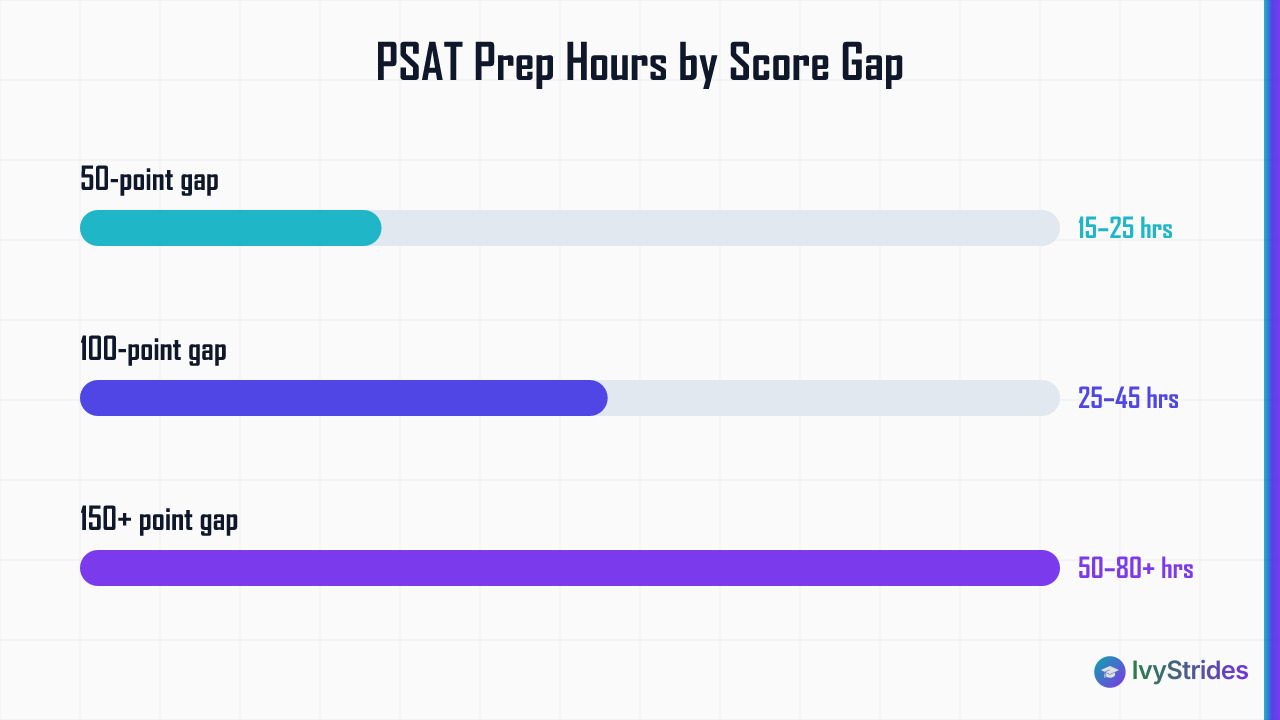
Straight numbers, based on the score gap between your diagnostic and your target:
- 50-point gap: roughly 15 to 25 total hours over about 4 to 6 weeks. That's around 3 to 5 hours per week.
- 100-point gap: roughly 25 to 45 total hours over about 8 to 12 weeks. Roughly 3 to 4 hours per week.
- 150+ point gap (National Merit territory): about 50 to 80+ total hours over 12 to 16 weeks. Realistically 4 to 6 hours per week, with two full-length practice tests folded in.
In our coaching, students who complete the full diagnostic-plus-targeted-weakness cycle typically close score gaps faster than self-directed students working the same hours. The reason is straightforward: effort is concentrated on confirmed weak sub-skills rather than re-studying already-mastered content. In our observation across cohorts, students who skip the diagnostic and study broadly tend to waste a significant share of their prep hours on content they already know.
Free online prep tools are a strong layer for students with small gaps and self-directed discipline. They're less efficient for large gaps because they don't adapt to a student's specific diagnostic profile. If you're wondering whether a free-only plan will get you to your target, our is free PSAT prep enough writeup walks through the decision.
What Score Are You Aiming For? Setting Your PSAT Target Before You Start
Before you can set a prep start date, you need a target score; see our breakdown of what is a good PSAT score by grade and percentile to anchor your plan.
Quick calibration, based on recent College Board percentile tables (verify current-year figures at satsuite.collegeboard.org):
- 50th percentile PSAT/NMSQT: roughly 1010 to 1050
- 75th percentile: roughly 1180 to 1210
- 90th percentile: roughly 1270 to 1300
- 99th percentile (top 1%): approximately 1480+
- Maximum: 1520
A 1270 is not a bad PSAT score. It sits around the 90th percentile nationally. It is, however, typically below most state National Merit Semifinalist cutoffs. Whether it's "good enough" depends entirely on your goal.
A 1200 on the PSAT 8/9 (scored 240 to 1440) for a 9th grader is excellent, roughly the 90th percentile for that version. The same 1200 on the PSAT/NMSQT (scored 320 to 1520) for an 11th grader sits below the 50th percentile and well outside National Merit range. Same number, different meaning, because the scales differ. This is why version matters.
PSAT scores correlate closely with SAT scores on the same content domains. A 1300 PSAT/NMSQT typically predicts roughly a 1300 to 1350 SAT starting point before any additional prep. For per-grade benchmarks, see our good PSAT score by grade reference.
The One Step Every Grade Level Shares: Start With a Diagnostic
A timed, full-length PSAT practice test is the single most important tool at every grade level. It tells you exactly where your prep hours should go.
The full-length PSAT/NMSQT runs about 2 hours 14 minutes: two Reading and Writing modules and two Math modules, roughly 64 minutes per section pair with a break between, per College Board's SAT Suite documentation. Taking one under real conditions produces two pieces of information no self-assessment can give you.
First, your baseline total score. Second, the specific sub-skills where points are being lost. In PSAT R&W, the diagnostic tells you whether the gap is in command of evidence, transitions, rhetorical synthesis, or standard English conventions. In PSAT Math, it tells you whether the gap is in linear equations, data analysis, geometry, or advanced math topics. Broad prep can't answer these questions; only a diagnostic can.
Official College Board PSAT practice materials are available free at satsuite.collegeboard.org. For score-tracking sheets and study planners built for this format, our free downloads page has the templates we use with our own students.
Skip this step and you'll spend hours studying content you already know. Take it, and every subsequent hour compounds.
How PSAT Prep Feeds Directly into SAT Readiness
Your PSAT score is also your earliest SAT readiness signal. Once you have your results, our guide on PSAT results and SAT success shows you the next step in the sequence.
Here's why PSAT prep isn't wasted effort even if you never break a state National Merit cutoff. The PSAT/NMSQT and Digital SAT use the same two-section adaptive structure (R&W and Math), the same question types, and the same content domains, per College Board's SAT Suite documentation. The PSAT is shorter and has a lower ceiling (1520 vs. 1600), but the content difficulty is similar. It's not meaningfully easier; students often assume it is and get caught off guard. For that comparison, see is the PSAT harder than the SAT.
In our coaching, students who complete a structured PSAT prep cycle before their first SAT attempt typically start SAT prep with the diagnostic work already done and the sub-skill map already built. The transition looks like this: complete PSAT/NMSQT in October of junior year, then immediately shift to SAT prep for a March or May SAT attempt. No wasted weeks.
This is why we frame PSAT prep as a two-for-one investment. Every hour spent building command of evidence for PSAT R&W is an hour building command of evidence for SAT R&W. Same question type. Same skill.
PSAT Prep and Your Broader College Prep Strategy
PSAT prep doesn't sit in isolation. Junior year is also when AP courses hit their peak, when GPA gets locked in for early applications, and when essay brainstorming begins in earnest. The families who plan best treat these as one connected strategy.
AP courses in 10th and 11th grade directly reinforce PSAT content domains. AP Precalculus builds the algebra, functions, and modeling fluency that shows up across PSAT Math. AP English Language builds the rhetorical analysis and evidence-based reasoning that shows up across PSAT R&W. If you're already taking an AP, you're already doing part of your PSAT prep. Our AP Precalculus online course is built around the same content foundation that PSAT Math tests.
A caveat on test-optional. Many colleges remain test-optional for 2026 admissions, but policies vary by school and year, per FairTest's current tracker. A strong PSAT score that predicts a strong SAT score is still strategically valuable at many test-optional schools, because a submitted score in the school's mid-50% range remains a positive admissions factor at most institutions. College admissions outcomes depend on the full application (GPA, course rigor, essays, activities, recommendations, and test scores where submitted), not test scores alone. PSAT prep is one component of that broader strategy. For the full grade-by-grade plan across all pieces, see our PSAT strategy by grade overview.
The methodology behind all of this is diagnostic-first, section-specialist, spaced-retesting coaching. Read more about IvyStrides for the full picture.
FAQ
When should I start prepping for the PSAT?
For most students, the summer before junior year (June or July) is the right start for a structured PSAT/NMSQT prep plan, giving roughly 10 to 16 weeks before the October test. Sophomores aiming for a practice run need only about 4 to 6 weeks before their attempt. The universal first step at any grade is a timed, full-length diagnostic practice test to identify exactly which sub-skills need work. Without that baseline, you're guessing.
Is a 1270 a bad PSAT score?
No. A 1270 on the PSAT/NMSQT places a student at approximately the 90th percentile nationally, per College Board percentile data. That's a strong result. However, it typically sits below most state National Merit Semifinalist cutoffs, which generally require a Selection Index equivalent to roughly 1460 or higher. Whether 1270 is "good enough" depends on your goal: for SAT readiness signaling it's excellent; for National Merit it leaves a meaningful gap to close.
Is a 1200 a good PSAT score for a 9th grader?
On the PSAT 8/9 (the version designed for 8th and 9th graders, scored 240 to 1440), a 1200 is excellent, placing the student in approximately the 90th percentile. On the PSAT/NMSQT (scored 320 to 1520), a 1200 for a 9th grader is also a strong early signal, though the PSAT/NMSQT isn't the standard test for 9th graders. Either way, a 1200 in 9th grade gives a student a strong foundation to build toward a National Merit-competitive score by junior year.
What is a top 1% PSAT score?
A top 1% score on the PSAT/NMSQT is approximately 1480 to 1520, based on College Board percentile distributions (verify current-year figures at satsuite.collegeboard.org). The maximum possible score is 1520. Reaching the top 1% nationally places a student well above most state National Merit Semifinalist cutoffs and signals a very high probability of a 1550+ Digital SAT score with continued prep.
How many hours of studying does the PSAT require?
The honest answer depends on your score gap. A 50-point gap to your target typically requires roughly 15 to 25 total hours over 4 to 6 weeks. A 100-point gap requires roughly 25 to 45 hours over 8 to 12 weeks. A 150+ point gap toward National Merit cutoffs typically requires 50 to 80+ hours over 12 to 16 weeks. In our coaching, students who start from a diagnostic and focus only on confirmed weak sub-skills reach their targets faster than students who study broadly without a plan.
Should I take the PSAT in 10th grade even if it does not count for National Merit?
Yes. Taking the PSAT/NMSQT or PSAT 10 in 10th grade gives you a full practice run under real test conditions, produces a diagnostic score you can use to build your junior-year prep plan, and familiarizes you with the digital adaptive format before the score counts. In our observation across student cohorts, sophomores who take the PSAT typically start junior-year prep from a higher baseline than students taking the test cold in 11th grade.
Your Next Step
The right start date isn't a calendar question. It's a diagnostic question. Take a timed, full-length PSAT practice test this week, then map your gap against the grade-specific timelines above. That's the plan.

Award-winning author (South Asian Book Award) and graduate of BITS Pilani and UCLA Luskin School of Public Affairs. Brings a published writer's eye to Common App essays and grammatical precision to SAT and ACT R&W instruction.