
Do Campus Visits Help Your Admission Chances? What Colleges Actually Record
On this page
- Do Campus Visits Actually Affect College Admission Decisions
- What Colleges Actually Record When You Visit Campus
- Which Colleges Actually Track Campus Visits for Admission
- Not sure which schools on your list actually track visits?
- How to Turn a Campus Visit into a Concrete Admissions Asset
- Your visit notes deserve a stronger essay than a generic draft can produce.
- FAQ: Campus Visits and Admission
- Can anyone just walk around a college campus?
- Does visiting a college help you get in?
- How many college visits should I do?
- Do college tours increase chances of getting in?
- Your Next Step on Campus Visits
Campus visits can help admission at some colleges, but the effect depends entirely on the school. Smaller private colleges and mid-tier universities often log visits as a demonstrated-interest signal that can matter at the margin. Highly selective universities, including most Ivy League schools and large public flagships, do not formally consider demonstrated interest. Before you plan a trip, check the school's Common Data Set, Section C7, to see whether "level of applicant's interest" is even listed as a factor. Where it counts, registering for a tour or info session, not just walking around, is what actually gets recorded.
Policies shift year to year, so verify each school for the current cycle. The sections below show which schools track visits, what their systems log when you show up, and how to turn a visit into something concrete in your application.

Do Campus Visits Actually Affect College Admission Decisions
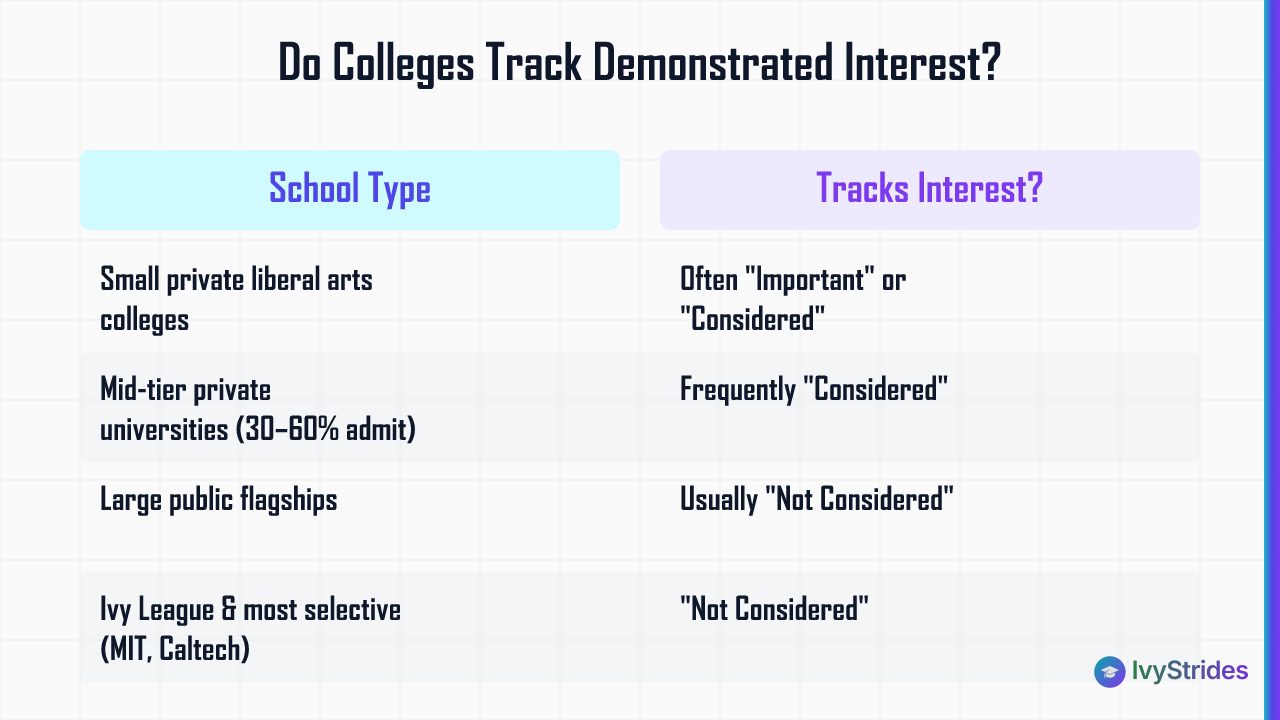
Campus visits affect admission only at colleges that formally track demonstrated interest. Demonstrated interest is the set of actions a college records to gauge how likely you are to enroll if admitted, used as a factor in holistic review at a subset of schools. A visit is one such action. At schools that don't track it, walking the quad changes nothing about your file.
Why do some schools care and others don't? Yield rate, the percentage of admitted students who actually enroll. A school with a lower yield admits students who might pick a competitor, so any signal that you'll say yes, like a registered visit or an Early Decision application, helps the admissions office manage its class. Highly selective universities have such strong yield they don't need the signal. MIT and Caltech both state in their Common Data Sets that they do not consider level of applicant's interest, and most Ivy League schools sit in the same category.
Every college publishes a Common Data Set, and Section C7 rates each admissions factor as "Very Important," "Important," "Considered," or "Not Considered." Find "Level of applicant's interest" on that list and you have your answer for that school. In our coaching, families who check Section C7 before mapping a road trip avoid spending travel budget on schools that ignore interest entirely.
| School Type | Tracks Demonstrated Interest | Why It Matters (or Does Not) | How to Verify |
| Small private liberal arts colleges | Often "Important" or "Considered" | Yield-sensitive; a registered visit reassures them you'll enroll | Common Data Set C7 |
| Mid-tier private universities (roughly 30-60% admit rate) | Frequently "Considered" | Protecting yield against larger-name competitors | Common Data Set C7 |
| Large public flagships | Usually "Not Considered" | High application volume; enroll by formula and stats | Common Data Set C7 |
| Ivy League and most-selective (MIT, Caltech) | "Not Considered" | Yield already very high; no need for the signal | Common Data Set C7 |
For a fuller map of every interest signal beyond the visit, see our guide on how colleges track demonstrated interest. At test-optional schools, admissions offices lean harder on non-score signals, which can make demonstrated interest slightly more consequential; our guide on what test-optional means for your application explains how to decide whether to submit scores.
What Colleges Actually Record When You Visit Campus
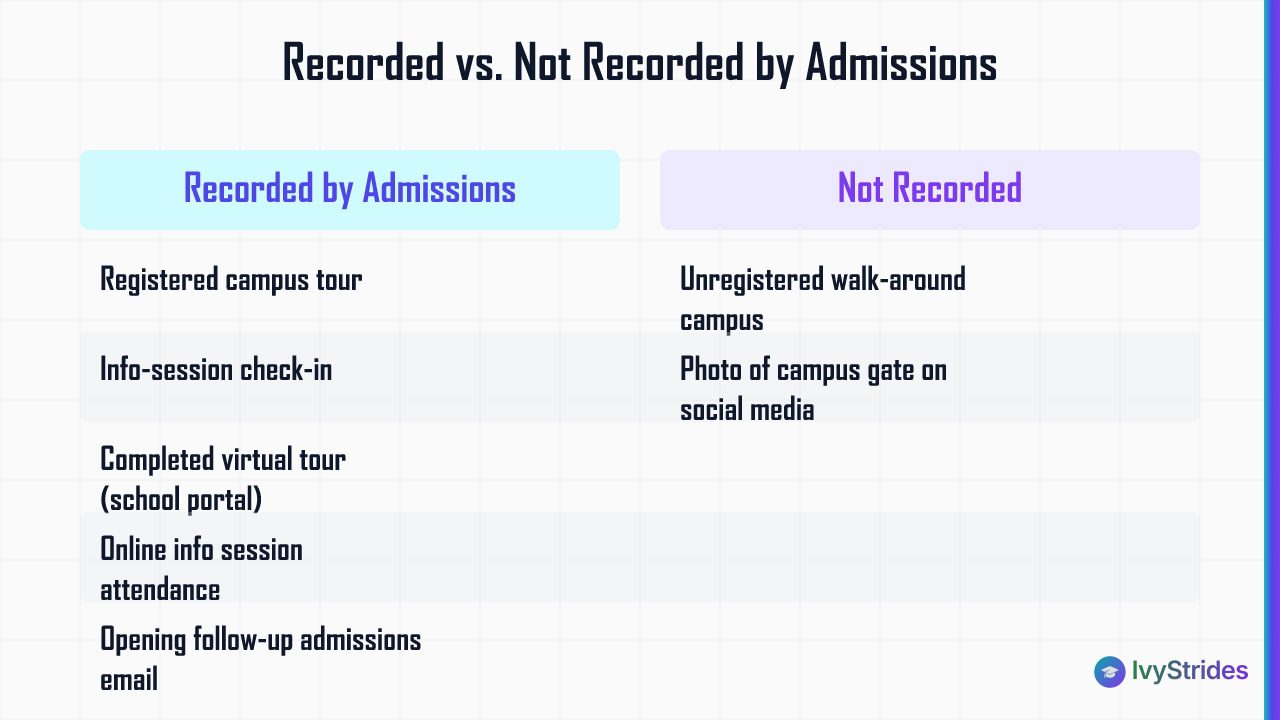
Colleges record the visit actions you register for, not the physical act of being on campus. Admissions CRM systems log a registered tour sign-up, an info-session check-in, a completed virtual tour, and often whether you opened the follow-up email. An unregistered walk-around produces no data point to capture.
Registration is the trigger. When you fill out the tour form on the admissions website with your name and email, you enter the system, and later email opens attach to that same record. "Just showing up" is the most common wasted trip we see.
Can anyone walk around a college campus? Yes. Most campuses are open to the public, and a self-guided stroll is a fine way to get a feel for the place. It won't count as an admissions signal unless you registered something official first.
For international students and families who can't travel, this is good news. Virtual tours and online info sessions enter the CRM identically to in-person events at schools that track interest.
Actions that get recorded vs. actions that do not:
- Registered campus tour, Yes, logged in the admissions CRM
- Info-session check-in, Yes, attendance recorded
- Completed virtual tour (via the school's portal), Yes, at schools that track interest
- Online info session, Yes, same weight as in-person
- Opening the follow-up admissions email, Often tracked
- Unregistered walk-around the campus, No, nothing captured
- Photo of the campus gate on social media, No, invisible to admissions
If a school tracks interest, applying Early Decision is the strongest signal of all, well above any single visit; our breakdown of Early Decision vs Early Action vs Regular Decision explains when that commitment makes strategic sense.
Which Colleges Actually Track Campus Visits for Admission
The schools most likely to track campus visits are smaller private liberal arts colleges and mid-tier private universities, roughly in the 30-60% acceptance range, where yield is a live concern. Large public flagships and the most-selective universities generally list interest as "Not Considered." Policies move year to year, so verify rather than guess from a reputation or a Reddit thread.
| Step | What to Do | Where to Find It |
| 1 | Search "Common Data Set [University Name]" | Google; the PDF usually sits on the school's institutional research page |
| 2 | Open the PDF and jump to Section C7 | Admissions factors table, first few pages |
| 3 | Read the row "Level of applicant's interest" | Rated Very Important, Important, Considered, or Not Considered |
| 4 | Note the rating and the cycle year | Header or cover page of the Common Data Set |
"Important" tells you the visit and other signals carry real weight. "Considered" means it can nudge a borderline file. "Not Considered" means skip the trip for admissions purposes; visit only if you want to see the place. In our coaching, students who sort their list this way stop over-investing in reach schools that ignore interest and start showing up, in person or virtually, at the targets where it registers.
A registered tour is a modest data point. Applying Early Decision, by contrast, is a binding commitment to enroll, the most persuasive interest signal a yield-sensitive school can receive.
For where visits fit in the calendar, our college application timeline and deadlines maps out when each step should happen. Since AP rigor outweighs a visit at every selective school, our guide on how many AP classes for Ivy League and top colleges puts the priorities in order.
Not sure which schools on your list actually track visits?
In a free 15-minute call, an IvyStrides coach will review your college list, flag which schools weight demonstrated interest, and map out where your essays and scores carry the most leverage.
How to Turn a Campus Visit into a Concrete Admissions Asset

Photo by PNW Production on Pexels
The most reliable way to make a campus visit pay off is to convert it into a specific "Why This College" supplemental essay. This prompt, typically 150 to 300 words depending on the school, asks why you want to attend, and it carries consistent weight across every school type, including the ones that ignore demonstrated interest. A visit with no notes produces no essay material. A structured 30-minute note-taking session during or right after the tour produces three to five concrete details you can use.
In our coaching, the strongest Why This College essays cite a named professor's research area, a specific course not offered elsewhere, or a campus-culture detail observed on a tour or virtual session, not generic praise about a beautiful campus. Admissions readers see thousands of "I loved the vibe" sentences. A specific reference to a lab, a seminar, or a program reads as real.
Capture the right things while you're there:
- Academic programs, a specific major, track, or research center you'd join
- Named courses or professors, a class or a faculty member's work you can name
- Student culture, a club, tradition, or advising structure a tour guide described
- Facilities, a lab, studio, library, or resource tied to what you study
- Location and setting, how the setting supports your specific goals, not just "nice weather"
- A guide's or student's exact remark, a quotable line that shows you were listening
How many visits should you do? For most families, three to five in-person visits is a practical target, prioritizing schools that track interest and realistic matches, not only reaches. A virtual tour is legitimate essay material for anywhere you can't reach.
Admissions decisions rest on the full application: scores, GPA, rigor, essays, recommendations, and activities. A visit is one minor signal, and no essay guarantees admission.
Timing visits to fall of junior year gives you enough runway to write strong supplemental essays before early-action deadlines. To turn observations into a finished draft, our guide on 'Why This College' essay examples that worked shows how three students did this. When you're ready for a set of expert eyes, our college admissions essay coaching works 1-on-1 on exactly this.
Your visit notes deserve a stronger essay than a generic draft can produce.
IvyStrides essay coaches work 1-on-1 with students to turn specific campus observations into Why This College essays that admissions readers notice. Book a free call to see how it works.
FAQ: Campus Visits and Admission
Can anyone just walk around a college campus?
Yes. Most college campuses are open to the public, and anyone can walk the grounds. An unregistered walk, though, does not get recorded by admissions, because there's no data point to capture. To make your visit count as demonstrated interest, sign up for an official tour or info session on the admissions office website before you arrive.
Does visiting a college help you get in?
It can, but only at schools that formally track demonstrated interest, typically smaller private colleges and mid-tier universities. At highly selective schools and large public flagships, a visit has little to no effect. The larger benefit at any school is the specific material a visit gives you for a Why This College supplemental essay.
How many college visits should I do?
For most families, three to five in-person visits is a practical target, focused on schools that track interest and on realistic matches. Touring every school on a twelve-college list is rarely necessary. Virtual tours and online info sessions substitute for schools you can't reach, and admissions offices record them the same way.
Do college tours increase chances of getting in?
A registered tour at a school that tracks interest can add a marginal positive signal, but it ranks among the weakest admissions factors next to GPA, test scores, AP rigor, and essay quality. Its biggest value is the concrete observations it generates for a Why This College essay.
Your Next Step on Campus Visits
Campus visits are a research tool first and an admissions signal second. Treat them that way and no trip is wasted, whether or not the school tracks interest.
- Pull the Common Data Set, Section C7, for every school on your list and record whether interest is "Considered," "Important," or "Not Considered."
- Register official tours or online info sessions at the schools that track it; skip the trip for admissions purposes where it's "Not Considered."
- Take structured notes on programs, courses, and culture so every visit feeds a specific Why This College essay.
- Keep your highest-use levers, scores, GPA, AP rigor, and essays, ahead of the visit question.
Want a second read on your list and priorities? Meet the coaches on our tutors page. You can also learn how we work on the About page.

Award-winning author (South Asian Book Award) and graduate of BITS Pilani and UCLA Luskin School of Public Affairs. Brings a published writer's eye to Common App essays and grammatical precision to SAT and ACT R&W instruction.