
How Many Recommendation Letters Do You Need? Requirements by College Type
On this page
- The Short Answer: How Many Recommendation Letters Do You Need for College?
- How Many Recommendation Letters Each College Type Actually Requires
- When Sending an Extra Recommendation Letter Helps (and When It Does Not)
- Not sure which letters to submit or who to ask?
- Timing Your Recommendation Letter Requests Around Application Deadlines
- Ready to build a complete, competitive application?
- FAQ: Recommendation Letter Counts and Requirements
- Is 3 recommendation letters too much?
- Is 2 recommendation letters enough?
- Is 5 letters of rec too much?
- How many recommendation letters do you need for Common App?
- Your Next Step on Recommendation Letters
Most four-year colleges require one school counselor report and two teacher recommendation letters, for a total of three. Highly selective schools such as MIT, Columbia, and Yale follow this same baseline but publish specific subject-area preferences. The Common App allows up to 10 recommenders, but each school reads only the letters it requires or permits. Sending more than a school requests does not improve your chances, and it can suggest you skipped the instructions. Two strong, specific teacher letters almost always outperform three generic ones.
The number varies because two rule sets are at work: the platform sets a ceiling, and each college sets its own required and optional counts. That distinction trips up more applicants than anything else in this part of the file.

The Short Answer: How Many Recommendation Letters Do You Need for College?

A college recommendation letter is a written evaluation submitted on your behalf by a teacher, counselor, or other adult who can speak to your academic ability or character. For most selective four-year colleges, the standard is one school counselor report plus two teacher evaluations. That's three letters total, and it's the count to plan around unless a specific school says otherwise.
Here's the part most students miss. The Common App recommender system lets you invite up to 10 recommenders, but that ceiling is not a target. Each college controls what it actually reads through its own requirements tab.
| College Type | Counselor Letter | Teacher Letters (Required) | Optional Additional Letters | Total Typical Range |
| Ivy League / most-selective | 1 | 2 | 1 (sometimes a peer letter) | 3 to 4 |
| Highly selective private | 1 | 2 | 1 | 3 to 4 |
| Liberal arts college | 1 | 2 (occasionally 3) | 1 | 3 to 4 |
| Mid-size private university | 1 | 1 to 2 | 1 | 2 to 3 |
| Large public university | 0 (often) | 0 to 1 | 0 | 0 to 1 |
| Test-optional applicant (any type) | 1 | 2 | 1 (higher value) | 3 to 4 |
Verify every row against the school's own admissions page before you submit, since requirements shift year to year. For a deeper look at what makes a letter useful to a reader, see our college recommendation letters guide. If your essay isn't done, review what makes a college essay good before you finalize anything.
How Many Recommendation Letters Each College Type Actually Requires
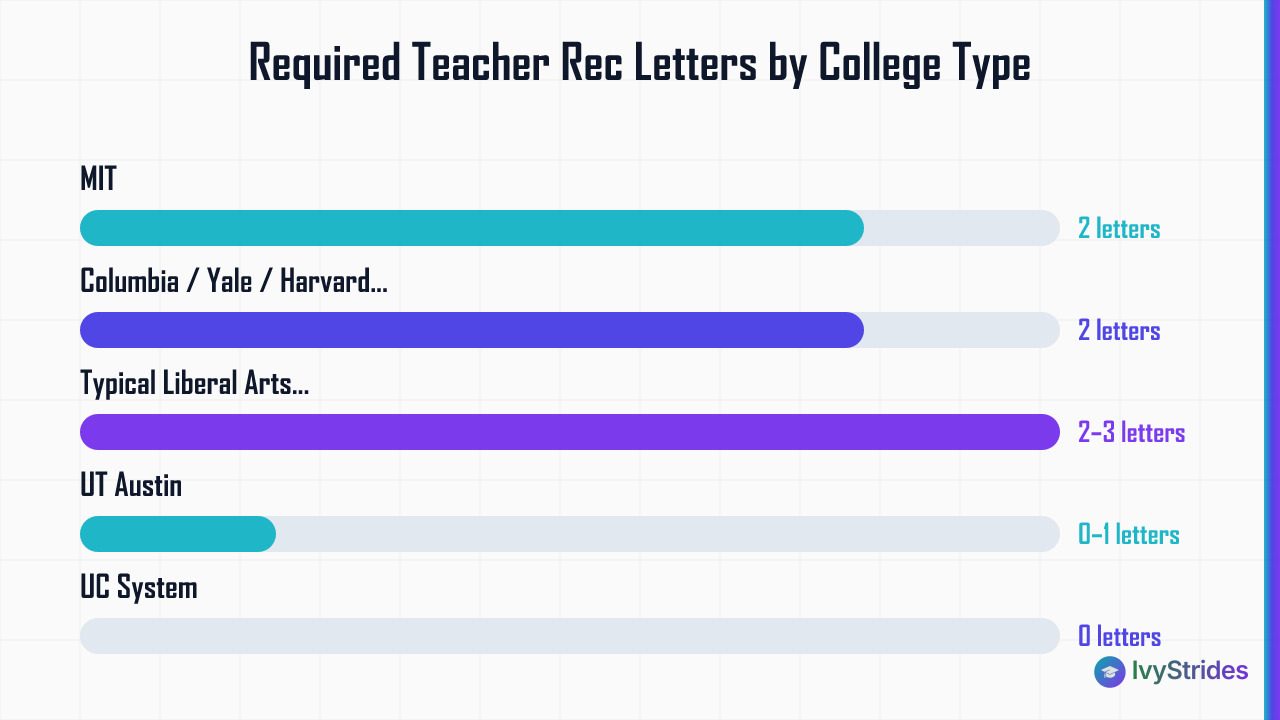
Recommendation letter counts at named selective schools cluster around the one-counselor, two-teacher baseline, but the subject-area guidance differs enough to matter. MIT asks for two teacher letters and recommends one from a math or science teacher and one from a humanities, social science, or language teacher, a preference published on MIT's admissions site.
Large public universities are the outlier most families get wrong. The University of California system and the University of Texas at Austin typically require zero teacher letters for freshman admission. Unsolicited letters sent to a school that doesn't accept them just go unread.
The authoritative source for any named school's requirement is that school's official admissions page or its Common Data Set. Below is a snapshot of common patterns, not a substitute for checking each school yourself.
| School | Counselor Report | Required Teacher Letters | Optional Letters Accepted | Notes |
| MIT | Yes | 2 | Limited | 1 math/science + 1 humanities recommended |
| Columbia | Yes | 2 | Yes (peer recommendation optional) | Baseline plus optional peer letter |
| Yale | Yes | 2 recommended | Yes | Counselor report required |
| Harvard | Yes | 2 | Yes (school report supplements) | 2 teacher letters plus counselor report |
| Dartmouth | Yes | 2 | Yes (peer recommendation accepted) | Peer letter is a genuine optional slot |
| Typical liberal arts college | Yes | 2 (sometimes 3) | Yes | Some request a third teacher letter |
| UC system | No | 0 | No | Letters not part of freshman review |
| UT Austin | No | 0 to 1 | Varies | Verify current cycle on admissions page |
Once you know how many letters each school requires, the next decision is who to ask; see our guide on who should write your recommendation letters. Giving each recommender a completed brag sheet is the single most effective way to help them write a specific letter, and our walk-through on how to fill out a brag sheet shows what to include. These requests fit inside a larger calendar, which our college application timeline maps from junior spring through senior fall.
Admissions decisions rest on the full application, not letters alone. Test-optional policies vary by school and year, so confirm each school's current stance before you build your plan.
When Sending an Extra Recommendation Letter Helps (and When It Does Not)
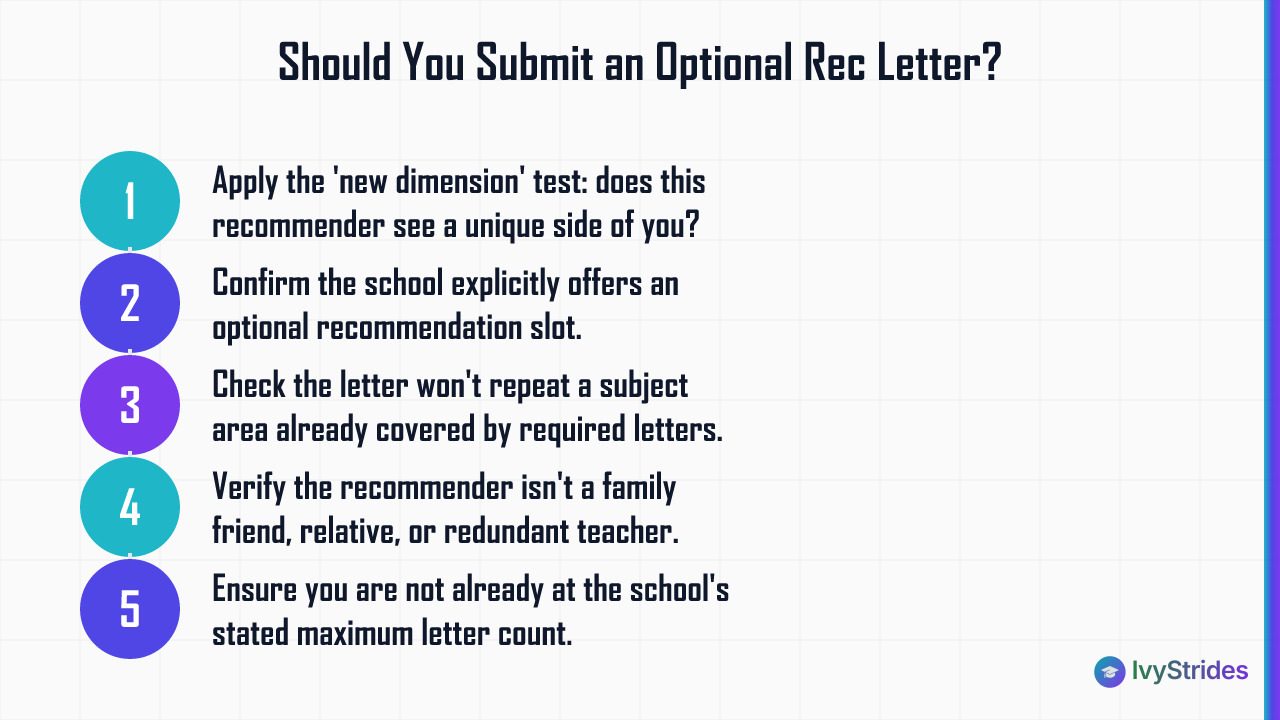
An optional recommendation letter helps only when the recommender can speak to a skill, context, or character trait that appears nowhere else in your admissions file. Call it the "new dimension" test. If a supplemental letter repeats what a required teacher letter already covers, it adds nothing and can cost you the reader's goodwill.
Here's where an optional recommender genuinely earns a slot: a research supervisor who directed your summer lab work, a coach who has trained you for three or more years, or an employer if you've held significant work. Each sees a version of you no classroom teacher can describe. A small number of schools, Dartmouth among them, also accept a peer recommendation, a formalized optional slot rather than a stray extra.
In our coaching with students applying to selective colleges, the most frequent recommendation error is submitting a third academic letter from a teacher in the same subject area as one already sent. That's a redundant letter, and it reads as a lapse in judgment.
So is three too much? No. If the school's baseline is one counselor plus two teachers, three is standard. Is five too much? Almost always, yes. Piling on letters when a school asks for two or three signals you didn't read the instructions and frustrates readers who must process the extras. In our coaching, students who add one well-chosen optional letter alongside two strong required letters don't see a measurable difference in outcomes versus those who submit only the required two. The required letters carry the weight.
Should You Submit an Optional Recommendation Letter? A Quick Check
| Question to Ask Yourself | If Yes | If No |
| Does this recommender see a side of me no teacher does? | Consider submitting | Do not submit |
| Is the school's optional slot explicitly open? | Proceed | Skip it |
| Would this letter repeat a subject already covered? | Do not submit | May proceed |
| Is this person a family friend or relative? | Do not submit | May proceed |
| Am I already at the school's stated maximum? | Do not submit | May proceed |
After confirming your count, make the request well in advance; our guide on how to ask for a letter of recommendation covers timing and follow-up.
Not sure which letters to submit or who to ask?
In a free 15-minute call, an IvyStrides admissions strategist will review your school list, confirm the exact letter requirements, and help you identify the two or three recommenders who make the strongest case for you. Students and parents are both welcome to join.
Timing Your Recommendation Letter Requests Around Application Deadlines
Recommendation letter requests should go out in late spring of junior year, ideally April or May, so recommenders have the full summer to write. The rule we use: give any recommender at least roughly six to eight weeks before the school's submission deadline. Anything tighter risks a rushed, generic letter.
The deadlines you're working back from are predictable. An Early Decision deadline or Early Action deadline usually falls on November 1 or November 15, and Regular Decision deadlines commonly land on January 1. The Common App opens on August 1, and once you invite a recommender, they can submit as soon as they're ready.
There's a scarcity issue too. Popular teachers cap how many students they'll write for in a cycle. Ask in April or May and you secure your spot before that cap fills. When you make the request, hand over a completed brag sheet, your resume, and a clear list of schools with deadlines. In our coaching, students who supply these materials consistently receive more specific letters than those who make a verbal ask with nothing attached.
| Application Round | Typical Deadline | Latest Ask Date | Ideal Ask Date |
| Early Decision / Early Action | Nov 1 or Nov 15 | Early September | April–May of junior year |
| Restrictive Early Action | Nov 1 | Early September | April–May of junior year |
| Regular Decision | Jan 1 | Early November | April–May of junior year |
| Rolling admission | Varies | Roughly 6–8 weeks before submit | Spring of junior year |
The timing of your letters sits inside a larger set of round decisions, so it helps to understand early decision vs early action vs regular decision before you commit.
Ready to build a complete, competitive application?
Book a free 15-minute strategy call. An IvyStrides coach will map your school list, confirm letter requirements, and connect your essays, scores, and recommendations into one coherent plan. Whether you're the student doing the work or the parent keeping the calendar, you'll leave with a clear next step.
FAQ: Recommendation Letter Counts and Requirements
Is 3 recommendation letters too much?
Three letters is the standard at most selective colleges, one counselor report plus two teacher evaluations, so it isn't too many. Going beyond that with a third teacher letter is worth doing only when that teacher reaches a dimension nothing else in your file covers. A redundant third academic letter rarely helps and can read as inattention to the instructions.
Is 2 recommendation letters enough?
Two letters is enough only when the school requires two or fewer. Most selective four-year colleges want a counselor report plus two teacher letters, so submitting two teacher letters without the counselor report would leave your file incomplete. Check each school's specific requirements on its admissions page first.
Is 5 letters of rec too much?
For nearly every undergraduate program, yes. Sending five letters when a school asks for two or three signals poor attention to instructions and burdens the readers who process the extras. Submit what the school requires, plus at most one optional letter that genuinely adds new information.
How many recommendation letters do you need for Common App?
The Common App allows up to 10 recommenders, but that's a platform ceiling, not a requirement. Each school on your list sets its own count, typically one counselor report and two teacher evaluations. Open the requirements tab for each school inside your Common App dashboard before you send anything.
Your Next Step on Recommendation Letters
The baseline is one counselor and two teachers, the platform maximum is a ceiling rather than a goal, and an extra letter helps only when it shows something new. Turn that into action this week.
- Pull up each school on your list and confirm its exact required and optional letter counts on the official admissions page.
- Identify your two strongest teacher recommenders, ideally one for quantitative work and one for writing or humanities.
- Send your requests by late spring of junior year, roughly six to eight weeks ahead of any deadline at the latest.
- Prepare a brag sheet, resume, and school-and-deadline list to hand each recommender.
To see how our coaches approach the full application, read about our team of tutors. You can also learn more on our About page.

Award-winning author (South Asian Book Award) and graduate of BITS Pilani and UCLA Luskin School of Public Affairs. Brings a published writer's eye to Common App essays and grammatical precision to SAT and ACT R&W instruction.