
Using AP Scores for Course Placement: The Complete 2026 Guide for Students and Parents
On this page
- AP Course Placement vs. AP Course Credit: Why the Difference Matters
- How the AP Score Scale Works: What Each Score Level Means for Placement
- How to Find Your College's AP Credit Policy Before You Enroll
- What AP Score Thresholds Do Colleges Actually Require in 2026?
- Why Harvard Does Not Award AP Credit (and What It Offers Instead)
- Not sure which AP scores to send or how to close a score gap before college?
- How to Send AP Scores to Colleges: Timing, Cost, and the Free Score Send Window
- AP Scores and Admissions: What Colleges Actually See
- What to Do If Your AP Score Falls Below Your College's Threshold
- Frequently Asked Questions About Using AP Scores for Course Placement
- Is a 70% a 5 on the AP exam?
- Why does Harvard not accept AP credit?
- Does AP Classroom send all AP scores to colleges automatically?
- Is a 4 a bad AP score?
- What percent of AP students get a 5?
- Is a 6 possible on an AP exam?
- Do AP scores count for college placement tests?
- Can I send AP scores before they are released?
- Know your AP score. Now make it work for you.
Colleges use AP scores of 3, 4, or 5 to grant course placement (skipping an introductory class), course credit (earning credit hours toward your degree), or both. The exact threshold and outcome depend on the individual college and the specific AP subject. Most large public universities award credit for a 3 or higher; many selective schools require a 4 or 5; and a handful of highly selective institutions, including Harvard, grant placement but no transferable credit.
The one tool that settles this for any school is the College Board AP Credit Policy Search. Everything below shows you how to read what it returns, what a 3 versus a 4 versus a 5 actually buys, and the two logistics steps most students get wrong. One caveat up front: these policies change year to year, so verify at the time you enroll, not the year you sat the exam.

AP Course Placement vs. AP Course Credit: Why the Difference Matters
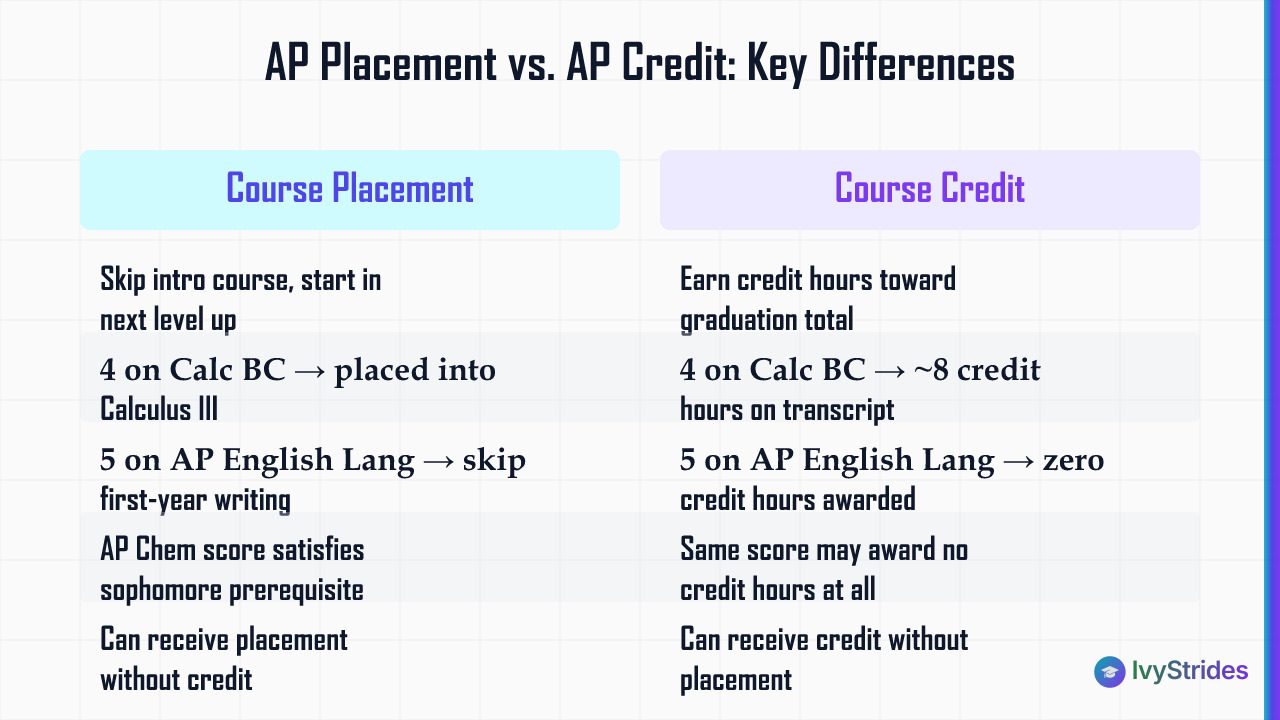
Course placement and course credit are two separate outcomes, and you can receive one without the other. Placement means skipping an introductory course and starting in the next one up. Credit means earning credit hours that count toward the total you need to graduate. A qualifying AP score can trigger placement, credit, both, or neither, depending on the school and subject.
Here's the distinction in practice. A score of 4 on AP Calculus BC at a large state university might award around 8 credit hours and place you directly into Calculus III. That's both outcomes at once: you skip two courses and the hours land on your transcript. Compare a 5 on AP English Language at a selective liberal arts college. That score may satisfy the first-year writing requirement (placement) while awarding zero transferable credit hours. You skip the class. You don't shave hours off your degree total.
The word "advanced" in "Advanced Placement" is literal. In the College Board's own framing, advanced placement means you're placed into a more advanced course, not that you're automatically handed credit. Read every policy line for both columns.
Prerequisite satisfaction is a third, quieter benefit. A qualifying AP Chemistry score often satisfies the prerequisite for a sophomore-level chemistry course even at schools that award no credit for the exam. That unlocks your schedule without touching your credit-hour count. For a school-by-school look at how these outcomes are structured, see our full guide on do colleges accept AP credit.
How the AP Score Scale Works: What Each Score Level Means for Placement
The AP score scale runs from 1 to 5. There is no 6 and no 7 on any AP exam; a 7 you've seen referenced belongs to the IB scale, a separate program. College Board labels a 3 "qualified," a 4 "well qualified," and a 5 "extremely well qualified." Those labels map loosely to what colleges reward.
Before you use scores for placement, it helps to understand what the number represents and when it lands; our guide to AP scores explained covers the release timeline and the scale in detail.
Now the question everyone asks: is a 70% a 5? Not necessarily. No fixed percentage equals a 5 across all exams. College Board sets the raw-to-scaled conversion separately for each subject and each year, based on that year's difficulty. On some exams roughly 65 to 75 percent of available raw points earns a 5; on others the line sits higher or lower. See the official AP score scale table for subject-level detail.
| Score | College Board label | Typical placement value |
| 5 | Extremely well qualified | Credit and/or placement at nearly all schools that accept AP |
| 4 | Well qualified | Credit or placement at the majority of US colleges |
| 3 | Qualified | Credit at many public universities; often placement-only at selective schools |
| 2 | Possibly qualified | Rarely earns credit; occasionally allows placement |
| 1 | No recommendation | No credit or placement |
Across most AP subjects, roughly 10 to 20 percent of test-takers earn a 5, per College Board score distribution data. The rate swings by subject: exams like AP Calculus BC draw a self-selecting, well-prepared population and post higher 5-rates, while broad-enrollment exams run lower. So "good" is contextual. For placement, a 4 clears the bar at most schools, and a 3 clears it at many public universities.
How to Find Your College's AP Credit Policy Before You Enroll
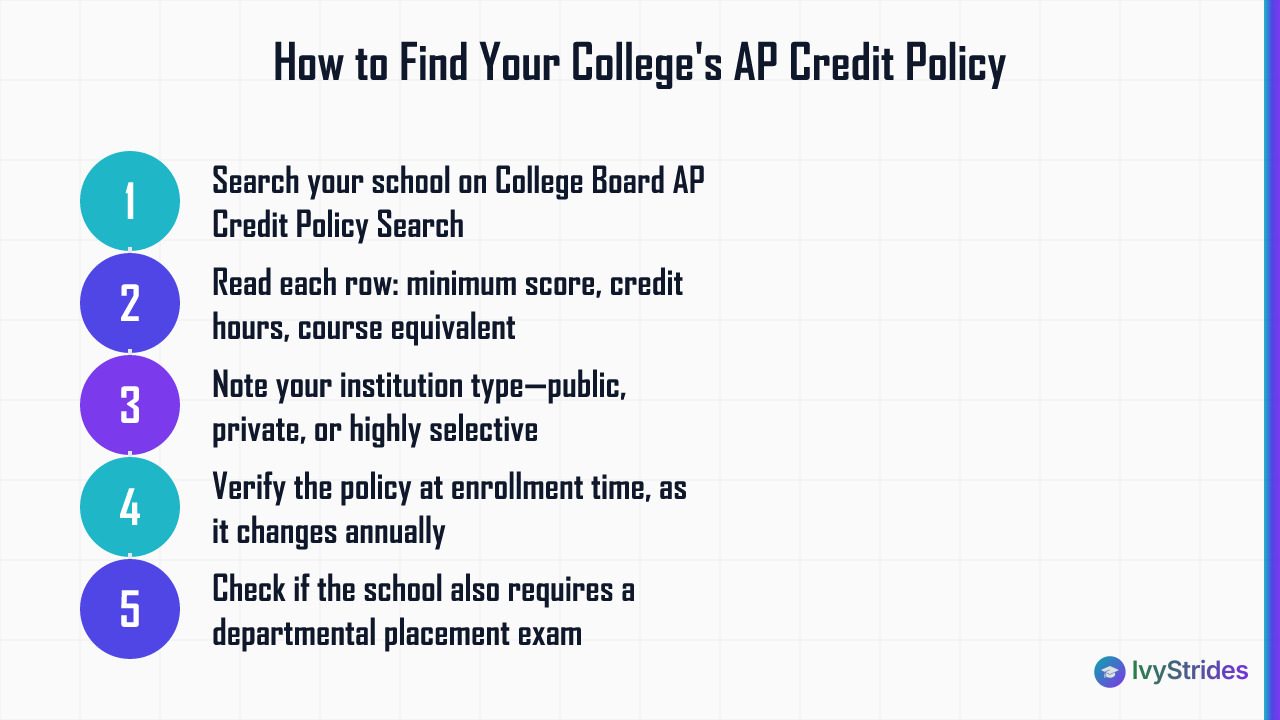
The fastest way to find any school's AP credit policy is the College Board AP Credit Policy Search. Type in the school, and it returns a table organized by AP subject. Do this for every college on your list. No reliable general rule spans all schools, so a policy you confirmed at one university tells you nothing about the next.
Each policy table gives you the same columns: the AP subject, the minimum score required, the credit hours awarded, and the course equivalent. A typical row reads like this: AP Biology, score of 4 or 5, 4 credit hours, equivalent to BIO 101. Read the minimum-score column first, then the credit-hours column, then the course equivalent. Those three tell you whether you place out, how many hours you bank, and which specific course you skip.
Policy varies sharply by institution type:
- Large public universities tend to be the most generous, often awarding credit for a 3 or higher on many subjects.
- Selective private universities commonly require a 4 or 5 and award credit more narrowly.
- Highly selective schools like MIT and Caltech frequently use AP scores only to place you into higher-level courses, not to grant credit toward graduation.
Across hundreds of AP prep students, we see a consistent pattern: those who check their target college's credit policy before exam day are far more motivated to push from a 3 to a 4, because they've already seen the concrete scheduling and financial value of that one point.
Two more things to watch. Policies change annually, so verify at the time you enroll rather than the year you tested. And some schools supplement AP scores with their own departmental placement exams; a qualifying AP score may exempt you from that internal test, or the school may still ask you to sit it. For how AP performance signals rigor beyond placement, see does AP help with college admission. If your score is short of the threshold, our AP exam prep by subject guide maps the path to closing the gap.
What AP Score Thresholds Do Colleges Actually Require in 2026?
The score you need depends on both the school type and the subject. As a practical 2026 benchmark, many large public universities award credit for a 3 or higher on most AP exams, most selective private universities require a 4 or 5, and the most selective institutions cap or eliminate transferable credit. Always confirm the specific figure through the College Board AP Credit Policy Search, since individual colleges set and revise these rules.
| Institution type | Common minimum score | Typical outcome |
| Large public university | 3 (varies by subject) | Credit hours plus placement |
| Selective private university | 4 or 5 | Credit or placement, subject-dependent |
| Highly selective (Harvard, MIT, Stanford) | 5, or placement-only | Limited or no transferable credit; advanced placement |
A few named examples, all verifiable through the College Board tool: Stanford awards credit for scores of 4 or 5 on most AP exams, with subject-specific rules. Princeton grants placement but limits how much credit it awards, so per-subject verification matters there. Note the subject asymmetry too: at a single school, STEM exams like AP Physics or AP Chemistry often demand a higher score than humanities exams for the same credit.
How many credit hours does one AP exam earn? Commonly somewhere in the range of 3 to 8, depending on subject and school. A year-long sequence like AP Calculus BC or AP Physics C can translate into more hours than a single-semester equivalent.
Is a 4 a bad AP score? No. A 4 is "well qualified" and earns credit or placement at the majority of US colleges that accept AP scores. It is, in fact, the most commonly required minimum at selective schools. The number of institutions that award credit only for a 5 is small, and even those often grant placement for a 4. Deciding how many AP courses to load is a different strategic question, covered in how many AP classes for Ivy League and top colleges.
Why Harvard Does Not Award AP Credit (and What It Offers Instead)
Harvard does not award transferable credit hours for AP scores. It offers a program called Advanced Standing, which lets qualifying students pursue more advanced coursework or, in some cases, graduate in three years. So a 5 can earn you placement and eligibility for Advanced Standing at Harvard, but it won't shave credit hours off your degree the way a public flagship would. Verify the current terms directly on Harvard's FAQ page.
To reach Advanced Standing, Harvard typically expects scores of 5 on a specified number of AP exams. The bar is high and the named exams are specific, so a scattered set of 4s won't get you there, even though those 4s are strong scores anywhere else.
Why do schools at this tier work this way? The stated reasoning is that their own introductory courses offer a distinct experience they'd rather students not skip via an outside exam. Other highly selective schools set their own variations. Yale, Princeton, and MIT each handle AP differently, and none of their policies can be assumed from Harvard's. Check each one individually.
In our coaching with students applying to highly selective schools, we regularly clarify that Harvard's Advanced Standing means a 5 buys placement, not credit hours, and that this changes how a student should build a first-year schedule. Planning to "test out" of a semester of tuition at Harvard is a plan that doesn't exist.
Does Harvard still care about AP for admissions? Yes, as a signal. Admissions readers at selective schools weigh the rigor of your AP course load as part of the academic context review, even though the exam scores themselves don't convert to credit. Strong AP performance still works for you at the application stage. And scores of 3 or higher across multiple exams can qualify you for AP Scholar Awards, a recognition that appears on your score report; see AP Scholar Awards explained.
Not sure which AP scores to send or how to close a score gap before college?
Book a free 15-minute strategy call with an IvyStrides AP coach. We'll review your current scores, map them against your target college's credit policy, and tell you exactly what to do next. Students and parents are both welcome on the call.
How to Send AP Scores to Colleges: Timing, Cost, and the Free Score Send Window
AP Classroom does not send your scores to colleges. This is the costliest misconception in the whole process. AP Classroom is a teaching and practice platform used during the school year; it never transmits exam results. To get scores to a college, you send them yourself through the AP student score reporting portal at apstudents.collegeboard.org.
You control exactly which scores go out. Score Choice applies: colleges see only the AP scores you choose to send and never see the ones you withhold. That matters for a subject where you underperformed.
Here's the timing that trips students up. One free score send is available, and the free-send deadline falls in late June of the exam year. Miss that window and each additional score report costs a fee under College Board's current schedule; check the live figure on the sending scores page before you order. Once scores are viewable in the portal, you're deciding which to route where; our how to check your AP scores in 2026 walkthrough covers viewing them step by step.
Can you send scores before they're released? No. Scores must be released first. For 2026, AP scores began becoming available to students starting July 6, 2026. So the late-June free-send deadline and the July release date create a small planning puzzle: you often designate a recipient before you've seen the score. Plan your recipient list with that sequence in mind. International students should also confirm regional fee differences; our note on AP exam fees for international students covers the specifics.
AP Scores and Admissions: What Colleges Actually See
AP scores are separate from the credit question when it comes to admissions, and most colleges do not require them for admission at all. Sending AP scores to an admissions office is optional at the majority of schools; they function as supplementary information, one more data point alongside your transcript, essays, and course load.
Does a 3 look bad on an application? Usually not, and context is everything. A 3 on a demanding exam like AP Physics C or AP Chemistry is not read as a red flag by most admissions officers, who understand those exams' difficulty. If you're weighing whether to report a middling score for admissions purposes, remember it's optional at most schools, so there's rarely a penalty for simply not sending it.
One confusion worth clearing up: test-optional admissions policies do not touch AP credit policies. Test-optional, tracked by FairTest, refers to SAT and ACT score submission for admissions. It has nothing to do with whether a college awards you credit for a 4 on AP Biology. Those are two unrelated policy tracks.
Keep two things distinct on your record. Your AP course grade sits on your high school transcript and is weighted by GPA formulas that differ school to school. Your AP exam score is a separate figure that only reaches a college if you send it. And earning 3s or higher across several exams can trigger AP Scholar Awards, a recognition visible on the score report; details are in AP Scholar Awards. For how SAT and ACT reporting fits the test-optional picture, see what is test-optional and should you submit SAT scores.
What to Do If Your AP Score Falls Below Your College's Threshold

If your score misses the threshold, you have three real paths, and none is the end of the story. AP exams run once a year, in May, so a 2 or 3 in May 2026 can't be redone until May 2027. That gap is either a problem or a runway, depending on how you use it.
First, the college's own departmental placement exam. Many schools let you sit an internal placement test during orientation to demonstrate mastery even without a qualifying AP score. A student who scored a 3 but genuinely knows the material can sometimes place forward this way. Ask the department directly.
Second, just take the introductory course and do well in it. A 2 on AP Calculus AB is not a verdict on your ability to earn an A in Calc I. For many students that's the cleaner path than a retake.
Third, if credit at a selective school is genuinely at stake, prepare for the May retake with targeted work. In our coaching with students preparing for AP Calculus AB, the most common reason a student lands a 2 or 3 instead of a 4 or 5 is weak performance on Unit 5 (Analytical Applications of Differentiation) and Unit 6 (Integration), not the earlier algebra-heavy units where most study time goes. Focused 1-on-1 work on those two units typically closes a 2-to-4 gap within roughly 8 to 12 weeks.
Whether a retake is worth the effort often comes down to the credit-hour value on the table; our take on is AP tutoring worth it walks through that math. For a structured path to a higher score, our AP courses online run one subject specialist per exam. Our how to study for AP exams guide covers the self-directed version. You can also meet the tutors who coach each subject.
Frequently Asked Questions About Using AP Scores for Course Placement
Is a 70% a 5 on the AP exam?
Not necessarily. No fixed percentage equals a 5 across AP exams. College Board sets the raw-score-to-scaled-score conversion separately for each subject and year, adjusting for that exam's difficulty. On some exams roughly 65 to 70 percent of raw points earns a 5; on others the line is higher or lower. Consult the official AP score scale table for your subject.
Why does Harvard not accept AP credit?
Harvard awards no transferable credit hours for AP scores. It offers Advanced Standing instead, which lets students who earn qualifying scores (typically five 5s on specified exams) pursue advanced coursework or graduate early. Harvard's stated view is that its own courses are a distinct educational experience. Your AP scores still demonstrate academic rigor during admissions review. Verify current terms at Harvard's FAQ.
Does AP Classroom send all AP scores to colleges automatically?
No. AP Classroom is a teaching and practice platform and does not transmit exam scores anywhere. You send scores yourself through the AP student score reporting portal at apstudents.collegeboard.org. One free send is available before the late-June deadline; each additional report then costs a fee under College Board's current schedule.
Is a 4 a bad AP score?
No. College Board calls a 4 "well qualified," and it earns course credit or placement at the majority of US colleges that accept AP scores. Most selective universities set their minimum at a 4 or 5, so a 4 meets that bar. Only a small number of highly selective schools restrict credit to 5s only, and even those often grant placement for a 4.
What percent of AP students get a 5?
It varies significantly by subject. Across most AP exams, roughly 10 to 20 percent of test-takers earn a 5, per College Board score distribution data. Self-selecting exams like AP Calculus BC post higher 5-rates; broad-enrollment exams run lower. Check the annual score distribution report for the specific subject you're targeting.
Is a 6 possible on an AP exam?
No. The AP score scale runs 1 to 5. There is no 6 or 7 on any AP exam. References to scores above 5 usually describe IB (International Baccalaureate) exams, which use a 1-to-7 scale. AP and IB are separate programs with separate scoring systems.
Do AP scores count for college placement tests?
At many colleges, a qualifying AP score (commonly 3, 4, or 5 depending on the school and subject) replaces the departmental placement exam entirely. Some schools use AP scores as the primary placement mechanism; others use them alongside their own test. Confirm with the registrar or advising office at your specific college how AP scores interact with any required placement testing.
Can I send AP scores before they are released?
No. Scores must be released before you can send them. College Board releases scores on a rolling basis starting in early July; 2026 scores began appearing July 6. Once yours are visible in the portal, you can send them. The free-send window closes in late June, so missing it means each additional report carries a fee.
Your AP score carries a concrete cash and scheduling value at your target schools, but only if you verify the policy and route the scores correctly. Look up each college through the College Board tool, decide which scores to send before the late-June window, and treat any score below threshold as a retake runway. For deeper detail on the scale itself, AP scores explained is the next read.
Know your AP score. Now make it work for you.
A 15-minute call with an IvyStrides AP specialist will tell you whether your current scores earn credit at your target schools, which subjects are worth a retake, and how to build a prep plan that closes the gap before next May. Bring your questions; parents and students both get answers on the call.

Two decades teaching quantitative and verbal aptitude on standardized tests. Rare dual expertise across Math and Verbal — particularly effective for students with gaps on both sides. Senior AP Mentor for our Calculus and English tracks.