
How to Choose an Online AP Course Provider: 7-Point Checklist for Parents and Students

On this page
- What to Look for in an Online AP Course Provider: The Short Answer
- Point 1: Match the Subject to Your College Goals and Target School Policies
- Point 2: Verify College Board Course Audit Status
- Point 3: Insist on a Per-Subject Specialist, Not a Generalist Teacher
- Not sure which AP course or provider is right for your student?
- Point 4: Choose Live Instruction Over Recorded-Only Courses When Possible
- Point 5: Confirm the Curriculum Covers Every Unit on the Official AP Exam
- Point 6: Ask for Score Data and Check the Provider's Track Record
- Point 7: Decide Whether You Need a Full Course or a Self-Study Support Plan
- How Many AP Courses Should You Take? Balancing Rigor and Burnout Risk
- How IvyStrides AP Classes Online Work: The Per-Subject Specialist Model
- FAQ
- Is there any way to take AP classes online outside of my school?
- Will colleges view online AP courses negatively compared to in-school AP courses?
- What are the easiest AP courses to take online or self-study?
- Can I take AP classes online over the summer to get ahead?
- How do I verify that an online AP course provider is College Board approved?
- Ready to find the right AP course for your student?
To choose an online AP course provider, confirm the provider has completed the College Board course audit for your specific subject, verify that instruction is led by a per-subject specialist rather than a generalist, and check that the curriculum covers every unit tested on the May exam. Live instruction with feedback outperforms recorded-only courses for most students. Match the subject to your college goals and confirm your target school's AP credit threshold before enrolling.
The seven points below come from what we watch separate high-scoring students from underprepared ones every May. Source URLs for AP format, scoring, and curriculum framework claims point to the College Board AP Program at apstudents.collegeboard.org. One caveat to anchor everything that follows: AP credit thresholds vary by college, so the same score of 4 can earn credit at one school and nothing at another.
What to Look for in an Online AP Course Provider: The Short Answer
The College Board offers 42 AP subjects, each scored 1 to 5, with exams administered nationwide on a fixed schedule in May. A quality online provider must align to that exam, not to a generic syllabus. Here is the checklist this article walks through, in order of weight:
-
Match the AP subject to college goals and target school credit policy.
-
Verify College Board course audit status for the specific subject.
-
Insist on a per-subject specialist, not a generalist teacher.
-
Choose live instruction over recorded-only courses when possible.
-
Confirm the curriculum covers every unit on the official AP exam.
-
Ask for score-distribution data and check the provider's track record.
-
Decide whether you need a full course or a self-study support plan.
For context on how IvyStrides structures ap courses online, that page shows the per-subject model we describe below. Keep this caveat in view throughout: AP credit policy varies by college and score, and a strong AP performance is one input into admissions, not a guarantee.
Point 1: Match the Subject to Your College Goals and Target School Policies
Start with strategy, not logistics. The right AP subject is the one that signals rigor to your target schools and earns credit or placement where you actually want to apply.
AP credit thresholds are not uniform. MIT generally requires a 5 in most subjects to grant any credit, while many flagship state universities accept a 3 for elective credit. The reliable way to verify is to search "Common Data Set [University Name]" and read the school's published AP policy alongside their admitted-student profile. Don't guess. A student aiming at a school that only credits a 5 needs a different preparation plan than one whose target accepts a 3.
Subject choice should also align with intended major. A prospective engineering or physics applicant benefits more from AP Calculus BC and AP Physics 1 than from a broad sweep of social science APs. A humanities-leaning applicant gets more signal from AP English Language and AP US History. A computer science applicant should prioritize AP Computer Science A, since most CS programs care about the procedural fluency that exam tests.
Because AP credit thresholds vary by college, a score of 4 at one university may earn the same credit as a 5 at another, so confirming your target school's policy before choosing a subject is a practical first step.
Even at test-optional schools, strong AP scores remain a meaningful rigor signal in the application, so the investment in a quality online AP course provider has admissions value beyond credit hours. The current test-optional landscape is tracked at fairtest.org, and the nuance most families miss is that admissions readers still weight course rigor heavily, even when SAT and ACT submission is optional.
Point 2: Verify College Board Course Audit Status
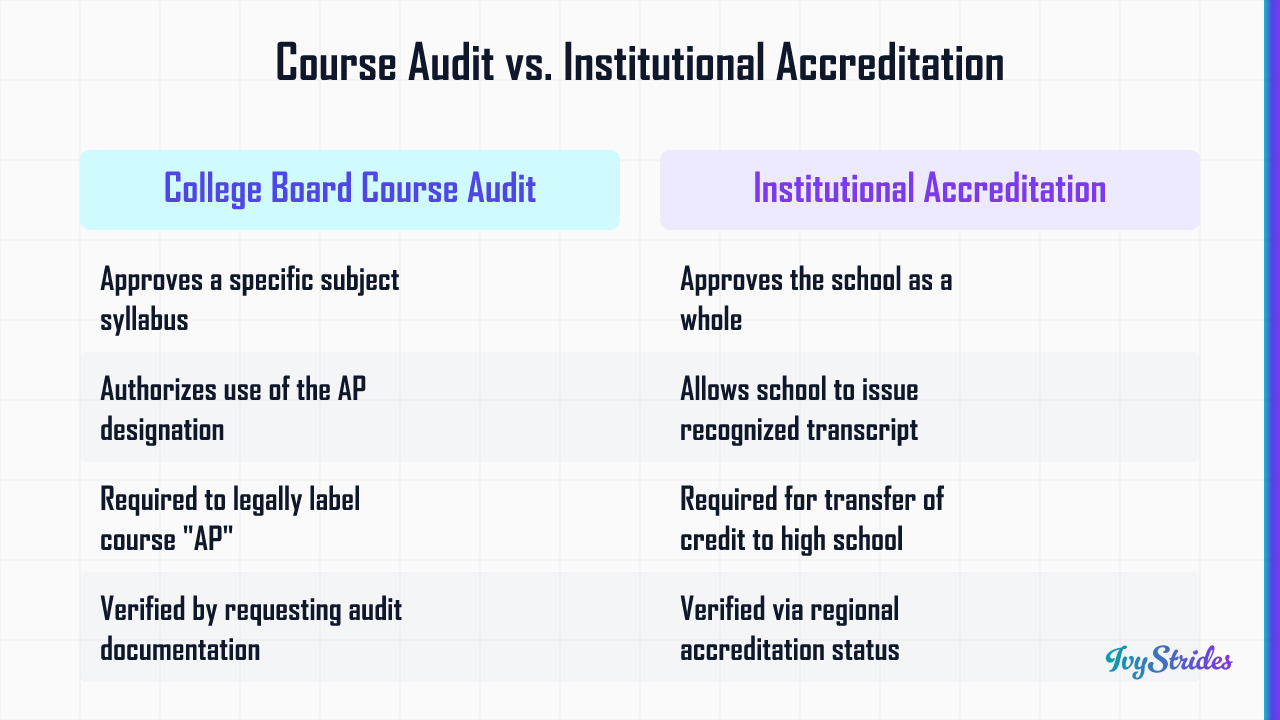
This is the baseline filter. If a provider has not completed the College Board course audit for the specific subject your student wants to take, the course cannot legally be labeled "AP" on a transcript.
The audit process is straightforward in concept. A provider submits a syllabus to the College Board demonstrating full coverage of the official AP curriculum framework for that subject. Once approved, the provider is authorized to use the AP designation. Without that approval, the course is, at best, "AP-aligned" preparation, and high schools may decline to add it to the student transcript with the AP label.
Two practical verification steps:
First, ask the provider directly for their course audit approval documentation for the exact subject. A reputable best online ap courses provider will produce this without friction. A vague response is a disqualifying signal.
Second, understand the distinction between a course audit and broader institutional accreditation. The College Board audit speaks to one specific subject syllabus. Institutional accreditation (regional accreditation of an online school) speaks to whether the school itself can issue a recognized transcript. Many families want both: an audited AP syllabus delivered through an accredited online school, especially when the goal is to add the course to the student's official high school transcript through a transfer of credit.
Point 3: Insist on a Per-Subject Specialist, Not a Generalist Teacher

Photo by Katerina Holmes on Pexels
Here is where most online AP providers fall apart, and where most families don't think to look.
The test: ask the provider how many AP subjects their lead instructor teaches. If the answer is "five" or "all of them," that is a structural quality problem. AP exams are not interchangeable. AP Physics 1 includes experimental design questions where students must propose a procedure, identify variables, and justify a measurement choice. AP Calculus BC includes series convergence problems that demand specific test selection: ratio, comparison, integral. AP Chemistry has multi-step laboratory analysis problems where the free-response section rewards depth of reasoning, not surface familiarity. No single teacher carries deep, current expertise across all of these. The exam scoring rubrics, published by the College Board at apstudents.collegeboard.org, are subject-specific in ways generalist instruction cannot match.
In our coaching, students who switched from a generalist online course to per-subject specialist instruction typically improved their full-length practice exam scores by 1 to 2 score points on the 1-5 scale within 6 to 8 weeks. The gain comes from one thing: free-response technique taught by someone who has scored that exact section, on that exact exam, hundreds of times.
Honestly, this is why IvyStrides assigns one specialist per AP subject. The AP Calculus AB instructor teaches Calculus AB. The Physics specialist teaches Physics. It sounds obvious. It is also rare in the online AP market.
Not sure which AP course or provider is right for your student?
Book a free 15-minute strategy call. An IvyStrides AP specialist will review your student's subject list, college goals, and current schedule, then recommend the right course format and provider fit.
Point 4: Choose Live Instruction Over Recorded-Only Courses When Possible
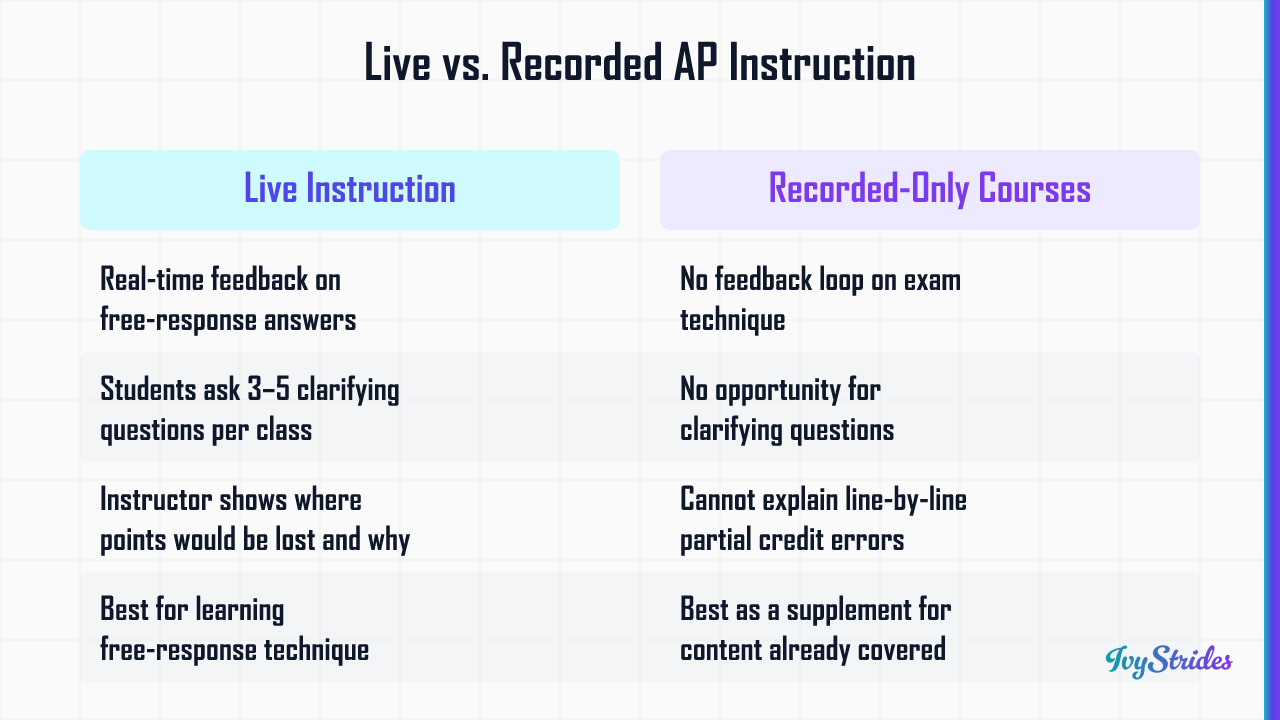
Recorded courses have their place. They are not the place to learn AP free-response technique.
The free-response section is where most score points are won or lost. Look at AP Biology, AP US History, or AP Chemistry, and the multiple-choice section determines roughly half the score. The other half rides on essays, document-based questions, or multi-part calculation problems where partial credit is awarded line by line. Learning to write a free-response answer that scores in the top band requires real-time feedback. A live instructor watches a student attempt the question, then explains where they would have lost points and why.
In our coaching with AP students, those in live sessions with a specialist tend to ask 3 to 5 clarifying questions per class that materially change their approach to exam questions. That feedback loop does not exist in a video library.
When is recorded instruction appropriate? Two cases. First, as a supplement: a student who has already covered the content in a school class and wants targeted exam-strategy review. Second, asynchronous flexibility for international students whose time zones make live US-hosted classes impractical, though most quality providers, including IvyStrides for ap prep courses, offer live scheduling across global time zones precisely to avoid this trade-off.
If your only option is recorded, pair it with a per-subject specialist for periodic 1-on-1 feedback sessions. The cost difference between pure recorded and "recorded plus a few live sessions" is small. The score difference is not.
Point 5: Confirm the Curriculum Covers Every Unit on the Official AP Exam
Each AP subject has a published curriculum framework with numbered units, available on apstudents.collegeboard.org. Request the provider's syllabus and check unit coverage against the framework. This step takes thirty minutes and prevents a common failure mode: enrolling in a course that runs out of time and skips the late-year units.
A few patterns we see:
AP Biology has 8 units. Unit 7 (Natural Selection) and Unit 8 (Ecology) are frequently compressed or skimmed in rushed courses, yet both units show up consistently on the May exam in both multiple-choice and free-response sections.
AP US History is organized into 9 periods. Period 8 (1945-1980) and Period 9 (1980-present) sit at the end of the calendar and routinely get squeezed when a course falls behind. Both periods are heavily tested in the multiple-choice section and frequently anchor document-based question prompts.
AP Computer Science Principles, which IvyStrides covers as AP CS Principles, centers around the Create Performance Task, due in late April. A provider that does not allocate dedicated time to the Performance Task in February and March is setting the student up to submit a rushed artifact.
One more question to ask: what percentage of class time is devoted to free-response practice versus content delivery? In our coaching, courses that reserve at least 30% of total class time for guided free-response work, with the specialist scoring student attempts against the official rubric, produce notably stronger May results.
Point 6: Ask for Score Data and Check the Provider's Track Record
Nationally, roughly 60% of AP exam takers score a 3 or higher across all subjects, based on College Board AP Program data published annually at apstudents.collegeboard.org. That number includes every AP subject and every test-taker. It is the baseline. It is not a quality benchmark for a paid provider.
What you want to ask: what percentage of your students scored a 4 or 5, broken out by subject, for the most recent exam cycle? The "pass rate" (3 or higher) is the wrong number to anchor on, because colleges that grant credit increasingly require a 4 or a 5. A provider that reports only a pass rate is choosing the easier number.
Also worth asking: how is that data collected, and how is it verified? Self-reported student outcomes are useful but soft. Providers who require students to share their official score reports as a condition of providing testimonials are running a tighter feedback loop.
A common parent question we hear: do colleges view online AP courses negatively compared to in-school AP courses? They do not. Admissions readers see the AP exam score reported by the College Board. The score is what carries weight. A 5 from an online course and a 5 from an in-school class are the same on a college application. What matters is that the course is properly labeled AP on the transcript (see Point 2) and that the student sits for the official May exam.
For AP Physics 2, as one example, the strongest predictor of a 4 or 5 we observe is whether the student completed AP Physics 1 with solid command of the unit content first. Provider quality matters, but prior preparation, study hours, and the student's starting baseline matter just as much.
Point 7: Decide Whether You Need a Full Course or a Self-Study Support Plan
Not every AP requires a structured course. Some are realistically self-study with targeted coaching, and the cost difference is meaningful.
AP subjects commonly viable for self-study include AP Human Geography, AP Environmental Science, AP Psychology, and AP Macroeconomics. These exams lean more heavily on multiple-choice content recall and the underlying material is largely factual. A motivated student with a good review book and a specialist on call for free-response practice can earn a 4 or 5 without a full structured course.
AP subjects that benefit strongly from structured instruction include AP Calculus BC, AP Chemistry, AP Physics 1, AP Physics 2, and AP Computer Science A. These exams have free-response sections that demand procedural fluency built over months of guided practice. Self-studying calculus without a specialist to catch errors in your derivative chains is a slow path to a 2.
If you are considering self-studying for an AP exam rather than enrolling in a structured course, the provider checklist still applies: you need exam-aligned materials, a subject specialist to answer questions, and a realistic timeline.
Two logistical notes. First, students can register for the AP exam through their school's AP coordinator (or a nearby testing site) regardless of where they took the course or whether they self-studied. The College Board exam registration process is documented at apstudents.collegeboard.org. Second, summer AP enrollment is available through providers including IvyStrides, with AP Precalculus online as one option. Before enrolling in any summer course, confirm with your high school's registrar that they will accept the external course on the transcript. Schools differ on this, and the time to find out is before you pay tuition.
For students balancing AP prep with SAT or ACT timelines, our guide to online sat prep for busy students covers how to sequence the two without burning out.
How Many AP Courses Should You Take? Balancing Rigor and Burnout Risk
There is no magic number, but there are realistic ranges by college tier.
Highly selective colleges (MIT, Stanford, Ivy League institutions) typically see admitted students with 7 to 12 AP courses across high school, weighted toward junior and senior year. For schools in this band, see our applicant guides for Should You Apply to Johns Hopkins University? Stats and Fit and Should You Apply to Duke University? Key Factors Explained. Strong regional universities and flagship state schools may see admitted students with 3 to 6 APs. The reliable way to calibrate is to search the Common Data Set for each target school, which often publishes the percentage of admitted students with high school class rank or rigor indicators.
Here is the part most families underestimate. A single AP course typically requires 8 to 10 hours of study per week during the semester, plus another 20 to 30 hours of dedicated exam preparation in the 6 weeks before the May exam. Multiply by the number of APs running concurrently, and the math gets honest fast.
A parent recently asked us about her daughter's plan to take 6 APs as a junior alongside varsity volleyball and an editorship on the school paper. Our answer was specific: in our coaching, students who take more than 4 AP courses simultaneously in junior year without structured support show measurable score decline on practice exams by February, often because they are spreading content review too thin. The trade-off matters. One strong AP score (a 5) in a subject relevant to your intended major signals more to admissions than two mediocre scores in unrelated subjects. Quality of rigor beats raw count, especially when paired with strong extracurricular depth.
A practical heuristic: take the most AP courses you can take while still earning A grades, scoring 4 or 5 on the exams, and maintaining the activities that matter to you. That number is different for every student. It is rarely the maximum the school allows.
How IvyStrides AP Classes Online Work: The Per-Subject Specialist Model
Everything in the 7-point checklist above describes how we built ap classes online at IvyStrides.
One specialist per AP subject. The Physics 1 instructor teaches Physics 1. The Calculus BC instructor teaches Calculus BC. No generalist rotation across subjects, because the exam rubrics don't allow for it.
Every engagement starts with a diagnostic assessment to identify unit-level gaps before the first live session. If a student enters AP Chemistry coaching strong on stoichiometry but weak on thermochemistry, the first two weeks target thermochemistry, not the units the student already knows. The hours go where the gaps are.
All AP classes are delivered live online, with scheduling flexibility for students worldwide. Students in Singapore, London, Mumbai, and São Paulo work with the same specialist pool as students in California or New York.
For students preparing for the SAT or ACT alongside APs, we coordinate timelines so diagnostic test cycles, test-prep practice sessions, and AP unit coverage don't collide in the same weeks. Many of the same students are also working with us on college essays, and the common app essay tutor team coordinates with the AP and test-prep coaches to keep the full application timeline coherent.
The starting point for any of this is a 15-minute call. Talk to our counsellors and a specialist will map your student's subjects, college goals, and current schedule into a clear next step.
FAQ
Is there any way to take AP classes online outside of my school?
Yes. Students can enroll in online AP courses through accredited providers independently of their high school. The key requirement is that the provider has completed the College Board course audit for the specific subject. After completing the course, students register for the AP exam through their school's AP coordinator or a nearby designated test site. Exam registration is separate from course enrollment.
Will colleges view online AP courses negatively compared to in-school AP courses?
No. Colleges evaluate the AP exam score reported directly by the College Board, not the course delivery format. A 5 earned after an online course carries the same weight as a 5 from an in-school class. What admissions readers see is the exam score and the course on the transcript with the AP designation, which requires the provider to have completed the College Board course audit.
What are the easiest AP courses to take online or self-study?
AP Human Geography, AP Environmental Science, AP Psychology, and AP Macroeconomics are commonly cited as more accessible for self-study because their exams lean more on multiple-choice content recall and the material is less procedurally complex. That said, "easier" is relative to the student's background. A student with strong math foundations will find AP Statistics manageable, while a student without that base may struggle, regardless of delivery format.
Can I take AP classes online over the summer to get ahead?
Yes. Several providers, including IvyStrides, offer online AP courses during the summer. Before enrolling, confirm two things: that your high school will accept the external course on the official transcript (registrar policies vary), and that the provider has College Board course audit approval for the subject. Summer AP enrollment works best for students who want to free up school-year schedule space or take a subject their school does not offer.
How do I verify that an online AP course provider is College Board approved?
Ask the provider directly for their College Board course audit approval documentation for the specific subject you want to take. The audit process requires providers to submit a syllabus demonstrating full coverage of the official AP curriculum framework, published at apstudents.collegeboard.org. Providers who have passed can label the course "AP" on official transcripts. If a provider cannot produce audit documentation on request, treat that as a disqualifying signal.
The 7-point checklist is the framework. The harder part is applying it to your specific student, your specific subject list, and your specific target schools, and that is where a 15-minute call earns its keep.
Ready to find the right AP course for your student?
In 15 minutes, an IvyStrides AP subject specialist will map your student's goals to the right subjects, confirm the right course format, and outline a realistic path to a 4 or 5 on the May exam. No obligation, no pressure.

Two decades teaching quantitative and verbal aptitude on standardized tests. Rare dual expertise across Math and Verbal — particularly effective for students with gaps on both sides. Senior AP Mentor for our Calculus and English tracks.