
How Do International Students Study AP Online: The Complete 2026 Playbook for a Top Score
On this page
- What International Students Need to Know About AP Exams in 2026
- My School Does Not Offer AP: How to Register as an Independent Candidate
- How to Choose the Right Online AP Course Provider
- A Realistic Study Plan: From Zero to a 4 or 5 in 20 to 26 Weeks
- How Many AP Courses Do International Students Actually Need for Top US Universities?
- AP vs IB: Which One Do US Universities Actually Prefer?
- How AP Scores Fit Into Your US College Application
- Region-Specific Notes: AP Online Study in India, the UK, and Europe
- FAQ
- Can international students take AP courses if their school does not offer them?
- What is the hardest AP exam, and should international students avoid it?
- Is there a way to study AP online for free?
- Do colleges like it if a student self-studies for AP exams?
- How do AP exam registration deadlines work for international students in 2026?
- Does Harvard prefer IB or AP?
- Are international students eligible for the PSAT and National Merit?
International students study AP online by enrolling with a subject-specialist provider, using free College Board AP Classroom videos as a supplement, and registering to sit the exam at an authorized test center in their country. The College Board administers AP exams in over 100 countries, and no US school enrollment is required. In 2026, 28 AP subjects are offered digitally through the Bluebook app. Registration for May 2026 exams closes around November 2025, and a score of 4 or 5 signals strong academic readiness to US admissions officers.
Registration deadlines, the digital-exam list, and country-by-country logistics referenced above come from the College Board's AP Around the World portal. The harder question is what to do when your local school offers zero AP support, and that's what the rest of this playbook covers.
What International Students Need to Know About AP Exams in 2026
The Advanced Placement program is run by the College Board, the same nonprofit that administers the Digital SAT and PSAT/NMSQT. Thirty-eight AP subjects are available internationally in 2026, spanning STEM (AP Calculus AB and BC, AP Physics 1 and 2, AP Chemistry, AP Biology, AP Computer Science A), humanities (AP English Literature, AP US History, AP World History), and languages. Every AP exam is scored on the 1 to 5 scale: a 5 is "extremely well qualified," a 4 is "well qualified," and a 3 is "qualified." Scores of 3, 4, or 5 count as passing.
Here's what changed for 2026. The College Board is administering 28 AP subjects digitally through the Bluebook app, either fully digital or hybrid (digital multiple-choice, paper free-response). That means most international students will sit at least some of their AP exams on a laptop running Bluebook, the same testing app used for the Digital SAT. You don't need to attend a US school to register. Sign up as an exam-only candidate through an authorized international test center and sit the exam alongside enrolled students.
For a broader view of how AP scores signal academic rigor to US universities, see AP certification and what colleges actually see.
My School Does Not Offer AP: How to Register as an Independent Candidate
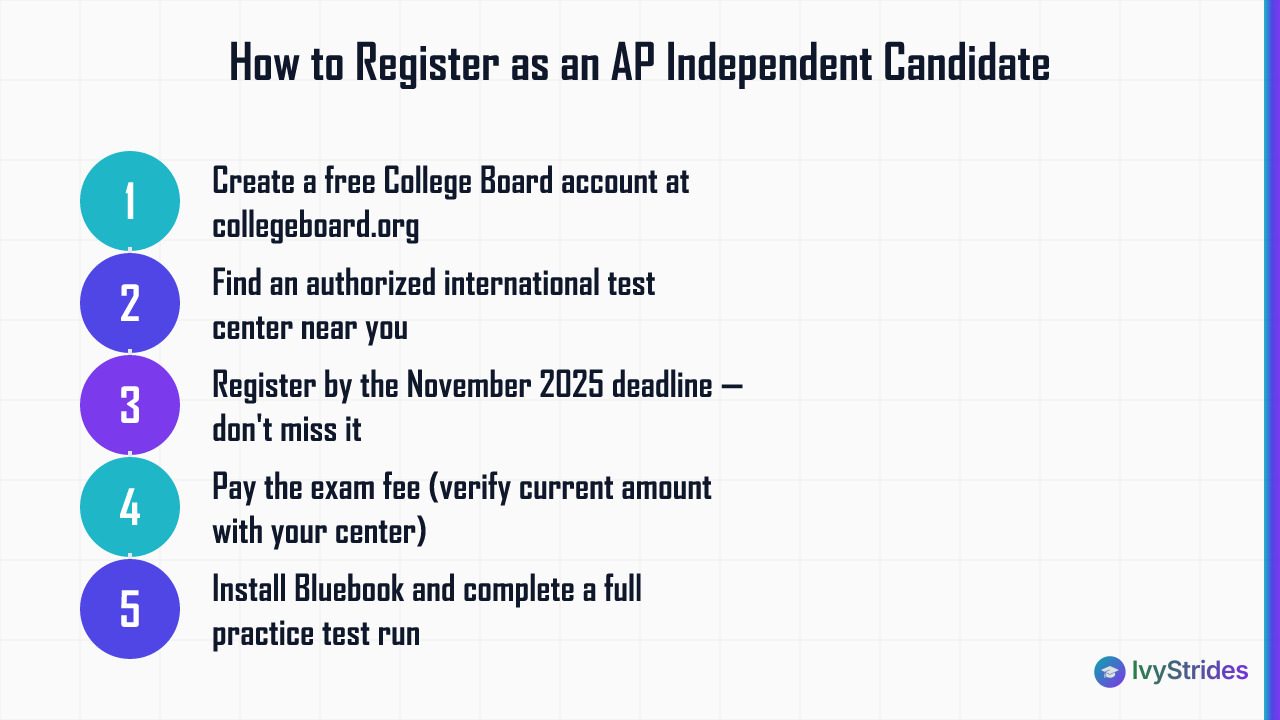
This is the single most common frustration we hear from students in India, the UAE, Singapore, the UK, and continental Europe. Your school doesn't offer AP courses, your counselor can't help you register, and every article you find assumes you're already enrolled in a US-style school. Here's the process, in order.
Step 1: Create a College Board account. Free, five minutes, at collegeboard.org. You'll use this account for AP registration, AP Classroom video access, and eventually AP score reporting.
Step 2: Find an authorized international test center. Not every school in your city is authorized to administer AP exams. Use the AP Around the World center locator. Search by country. Regions with active AP test centers include India (Mumbai, Delhi, Bangalore, Chennai, Hyderabad), the UK, most of Western Europe, the Philippines, and the Middle East. Contact the center directly. Ask two questions: do they accept external candidates, and what is their internal registration deadline (usually earlier than the College Board's public deadline).
Step 3: Register by the November deadline. For May 2026 AP exams, international registration typically opens around September 2025 and closes around November 2025. This is the deadline most international students miss. In our coaching with international students across India, the UK, and Southeast Asia, the most common registration mistake is missing the November deadline because students assume they can register in January like US students can. You can't. Register early.
Step 4: Pay the exam fee. The base AP exam fee is roughly $98 in the US per the College Board. International surcharges apply and vary by country and test center; verify the current fee directly with the College Board and your local center, since fees change annually. Fee waivers exist for qualifying students, though eligibility is set by College Board and varies for international candidates.
Step 5: Download Bluebook and complete a full practice run. For any AP subject you're taking in the digital or hybrid format, the Bluebook app must be installed on your laptop and you must complete at least one full-length practice test inside Bluebook before exam day. Not optional. Students who show up on exam day without Bluebook practice lose 10 to 15 minutes fumbling with the interface, and that's real score damage.
To see the specific subjects we support and how our online AP model works, browse our AP courses online. For a subject-specific example, AP Biology prep walks through what a unit-by-unit plan looks like.
How to Choose the Right Online AP Course Provider
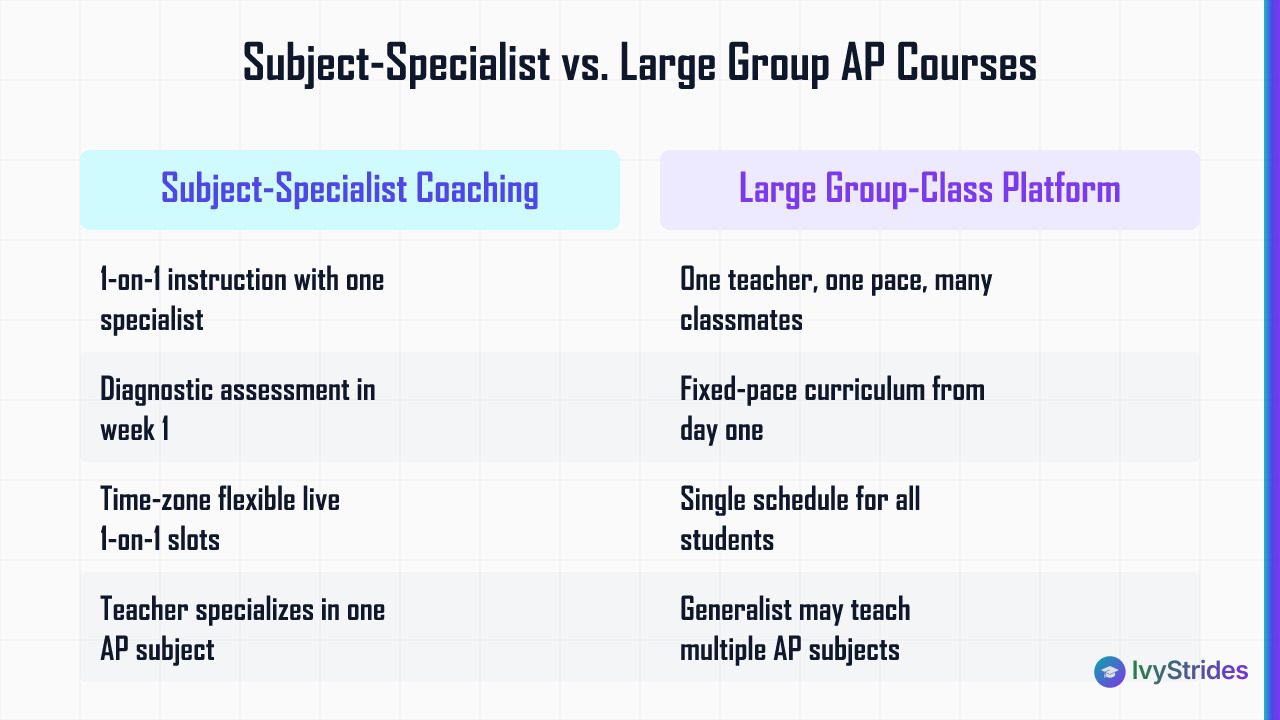
Once registration is handled, the real question begins: who's actually teaching you the material? Online AP providers fall into three buckets. Accredited virtual high schools deliver full-year AP courses with fixed schedules and generalist teachers. Large group-class platforms run cohort courses with one teacher, one pace, and dozens of classmates. Subject-specialist coaching programs, including IvyStrides, deliver 1-on-1 instruction with a teacher who specializes in one AP subject.
Use this five-point checklist when evaluating any provider:
-
College Board alignment. Does the curriculum map cleanly to the current AP curriculum framework units? For AP Chemistry, that means all nine units from Atomic Structure through Applications of Thermodynamics.
-
Subject-specialist teacher. Is your AP Calculus BC teacher a calculus specialist, or a math generalist who also teaches AP Statistics and AP Precalculus? Specialists know exactly which free-response question types have appeared over recent exam cycles.
-
Exam-focused curriculum. Ask to see the pacing. If a provider spends roughly 40 percent of the year on unit 1 and rushes units 8 and 9, that's a red flag for AP Chemistry, where later units carry heavy exam weight.
-
Time-zone flexibility. For international students, this is decisive. Recorded lessons help, but live 1-on-1 slots that fit IST, GMT, or CET matter more.
-
Diagnostic starting point. Does the provider give you a real practice assessment in week 1 to identify your weak units, or drop you into a fixed-pace curriculum regardless of what you already know?
Students who need structured instruction rather than pure self-study can enroll in AP classes online with a subject-specialist teacher who builds a diagnostic-driven plan from the first session. At IvyStrides, that means per-AP-subject specialists, not one teacher across every AP. Our current online AP subjects include AP Calculus AB, AP Calculus BC, AP Physics 1, AP Physics 2, AP Chemistry, AP Computer Science A, AP CS Principles, and AP Precalculus.
For self-directed students on a budget, the free AP Classroom video library is a legitimate supplement. Don't confuse it with a plan. Videos teach content; they don't diagnose your weak units or push you through timed free-response practice.
A Realistic Study Plan: From Zero to a 4 or 5 in 20 to 26 Weeks
Here's the honest version. If you're starting AP Chemistry or AP Calculus BC with no prior AP instruction, you need roughly 20 to 26 weeks of consistent work to have a real shot at a 4 or 5. Not four weeks. Not "the last month before the exam." Twenty to twenty-six.
Weeks 1 to 2: Diagnostic. Sit a full-length practice exam under timed conditions. Score it against the official rubric. The goal isn't a good score; the goal is a map. In our coaching, students who start with a diagnostic assessment in week 1 typically identify 2 to 3 high-impact weak units that, once addressed, account for most of their score improvement.
Weeks 3 to 18: Unit-by-unit study. Work through the College Board AP curriculum framework unit by unit. For AP Chemistry, that's Unit 1 (Atomic Structure and Properties) through Unit 9 (Applications of Thermodynamics), with heavy emphasis on Unit 4 (Chemical Reactions) and Unit 6 (Thermodynamics), the units that carry the most weight in the free-response section. For AP Calculus BC, this means grinding through Unit 10 (Infinite Sequences and Series), which trips up more students than any other topic. Plan on roughly 8 to 12 hours per week for a rigorous STEM subject, and about 5 to 7 hours for lighter subjects like AP Human Geography or AP Environmental Science.
Weeks 19 to 22: Full-length timed practice. At least three full-length exams under real conditions, with error analysis after each. In our coaching, students who complete at least three full-length timed practice exams before the real AP exam are more likely to score a 4 or 5 than students who rely on chapter reviews alone.
Weeks 23 to 26: Targeted review and Bluebook simulation. Return to the two or three weakest units. Run a final Bluebook practice test in the exact digital format you'll see on exam day.
At roughly 8 to 12 hours per week across a 24-week plan, total study time lands around 200 to 280 hours for a rigorous subject. That's the real number to budget against.
Subject selection matters here. AP Chemistry and AP Calculus BC have among the lowest 5-rates nationally; AP Human Geography and AP Environmental Science have notably higher 5-rates. That doesn't mean avoid the hard ones. A 4 in AP Chemistry usually carries more admissions weight than a 5 in AP Environmental Science, but be honest about time budgets. For subject-specific walkthroughs, see AP Chemistry prep and our page on AP Calculus BC.
How Many AP Courses Do International Students Actually Need for Top US Universities?
Short answer: quality over quantity, but the numbers still matter.
International students targeting Ivy League and Top 10 US universities typically present roughly 8 to 12 AP exams by graduation, with most scores at 4 or 5. Students targeting Top 25 to Top 50 schools are typically competitive with about 5 to 8 AP exams. These are directional benchmarks from admitted-student profiles, not thresholds. No magic number guarantees admission anywhere.
Here's the part most international students miss. Admissions officers evaluate your AP load relative to what's actually available at your school. A student at a school offering three APs who takes all three is read more favorably than a student at a school offering fifteen APs who takes three. If your school offers zero APs and you self-study four with strong scores, that's a powerful rigor signal. The admissions officer sees initiative on top of achievement.
A workable grade-level progression:
- Grade 10: 1 to 2 APs. Good candidates: AP Human Geography, AP Environmental Science, AP CS Principles, AP Precalculus.
- Grade 11: 3 to 4 APs. Align with your intended major. STEM applicants add AP Calculus BC, AP Physics 1 or C, AP Chemistry. Humanities applicants add AP US History or AP World History, AP English Language.
- Grade 12: 3 to 4 APs. This is where you show peak rigor. STEM applicants add AP Physics 2 or Physics C, AP Computer Science A, AP Statistics.
Quality still wins. A 5 on AP Calculus BC usually carries more admissions weight than a 3 on ten random subjects. See our AP Precalculus online and AP Physics 2 pages for how we sequence STEM APs across grades 10 and 11.
Caveat: admissions outcomes depend on your full application. AP scores, SAT or ACT scores, essays, extracurriculars, teacher recommendations, and school context all factor in.
AP vs IB: Which One Do US Universities Actually Prefer?
This is the most common question we field from students in Europe, and the answer is cleaner than most blogs make it.
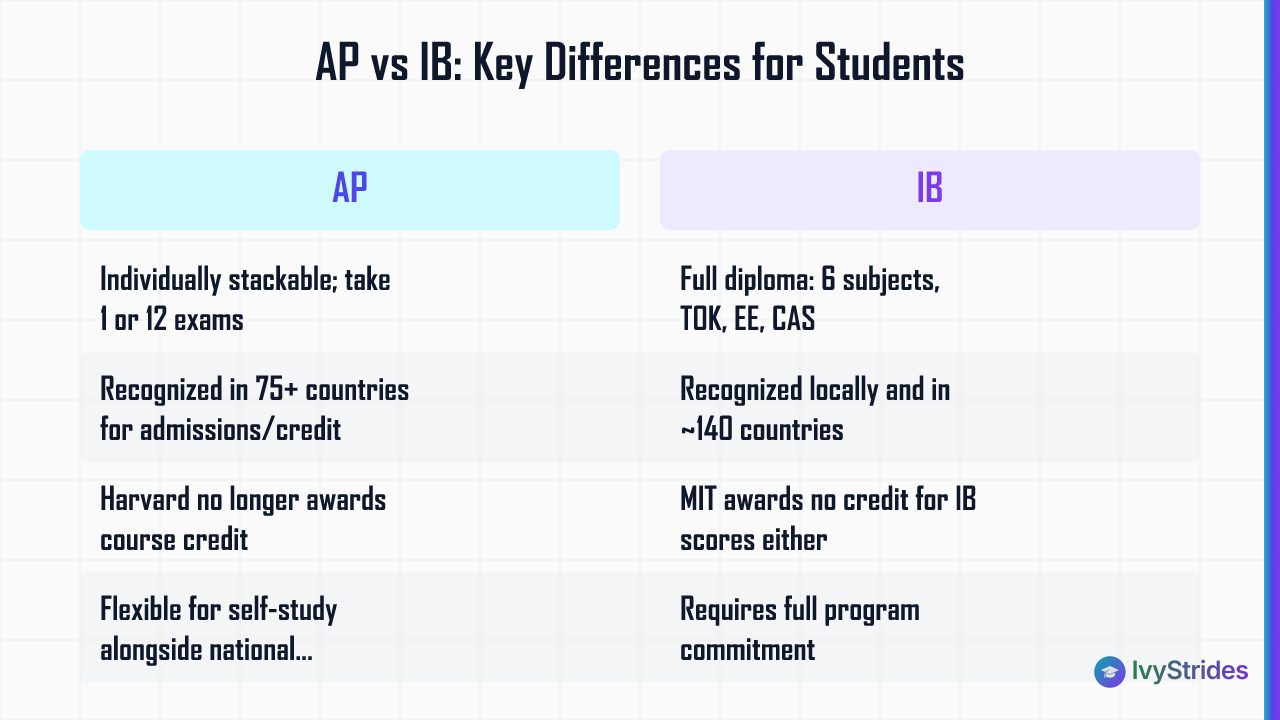
Harvard, MIT, and the rest of the Ivy League state no preference between AP and IB. Both read as academic rigor signals. Neither is scored more favorably in admissions. What has shifted is credit policy. Harvard no longer awards course credit for AP scores. MIT does not award course credit for AP or IB scores, and MIT's stated view is that all freshmen should start on equal academic footing. At schools like these, AP and IB function as signals of academic ambition, not as ways to skip introductory coursework. AP credit policies vary significantly at other institutions; some award credit for a 3, others require a 5, some award none. Verify each target school's policy via its Common Data Set or registrar page.
For students in Europe, the IB Diploma is more widely recognized locally and by universities across roughly 140 countries. AP is recognized in 75 plus countries for admissions and credit purposes. For US universities specifically, the two programs are treated as equivalent rigor.
The structural difference matters more than the "which is harder" debate. IB is a full diploma program: you commit to six subjects, TOK, the Extended Essay, and CAS. AP is individually stackable: you can take one AP exam or twelve, without committing to a full program. That flexibility is exactly why AP works for international students whose local schools don't offer either program. Pick two or three APs that align with your intended major and self-study them alongside your national curriculum.
UK universities including Oxford, Cambridge, and the rest of the Russell Group recognize AP scores as equivalent to A-Levels for admissions purposes, per the College Board's official UK registration documentation.
For related admissions-side context on scholarships that connect to standardized testing, see how does National Merit work, which explains the PSAT pathway for students in US-affiliated schools. For coding-track APs, AP CS Principles is often the entry point.
How AP Scores Fit Into Your US College Application
AP scores are one lever in a five-lever application. Handle them well and they reinforce every other lever. Handle them badly and they undercut the story you're trying to tell.
For international applicants, AP scores and SAT or ACT scores work together as a two-part rigor signal. A strong AP record can reinforce a competitive test score or, at test-optional schools, partially compensate for a score not submitted. Even at test-optional schools, a slate of 4s and 5s on AP exams provides objective evidence of academic readiness that admissions officers can weigh when a student chooses not to submit SAT or ACT scores. Test-optional does not mean AP scores are irrelevant. In many ways, at test-optional schools AP scores matter more, because they're one of the few remaining objective data points.
In our coaching with international students, those who pair a strong AP score slate with a competitive SAT or ACT score are typically viewed as stronger candidates than those relying on AP alone. Test-optional policies vary by school and by year; don't assume any policy is permanent.
A strong AP score load is most effective when paired with a compelling college admissions essay that contextualizes the academic rigor within the student's personal story. A 5 in AP Chemistry says you can handle college-level chemistry. Your Common App essay is what tells the admissions officer why you'd choose to. For students building the essay side of the application, see our common app essay tutor page. Earlier in the process, how to brainstorm college essay ideas is the right starting point.
Caveat, one more time: admissions outcomes depend on the full application, not AP scores alone.
Region-Specific Notes: AP Online Study in India, the UK, and Europe
Country logistics vary. Here are the specifics for the three regions we field the most questions from.
India. The College Board lists authorized AP test centers across Mumbai, Delhi, Bangalore, Chennai, Hyderabad, Pune, and other major cities. Register through the international College Board portal, then confirm your seat with the local center. Indian students on the CBSE or ICSE track routinely add two to four APs in grades 11 and 12 to strengthen US applications. Popular subject combinations for STEM applicants: AP Calculus BC, AP Physics C or Physics 1, AP Chemistry, AP Computer Science A.
United Kingdom. AP exams are administered at authorized centers across the UK, and the College Board publishes a dedicated UK registration PDF. AP scores are recognized by Oxford, Cambridge, LSE, Imperial, and the broader Russell Group as equivalent to A-Level performance for admissions purposes. UK-based students on GCSE and A-Level tracks who plan to apply to US universities often use two or three APs in subjects outside their A-Level slate to broaden the academic story.
Continental Europe. AP exams are available in most European countries through authorized centers. For students on the IB or a national curriculum (Baccalauréat, Abitur, IB), AP exams work as a targeted supplement rather than a replacement. If you're an IB Diploma candidate applying to US universities, adding one or two APs in your intended major area signals extra depth without disrupting your diploma.
Time-zone logistics matter for live instruction. IvyStrides delivers AP coaching online across IST, GMT, CET, and every zone in between, with 1-on-1 slots scheduled around each student's school day.
FAQ
Can international students take AP courses if their school does not offer them?
Yes. International students can register as exam-only candidates through the College Board's international portal, study independently or through an online provider, and sit the exam at an authorized test center in their country. No US school enrollment is required. This is the exact path most of our international students take.
What is the hardest AP exam, and should international students avoid it?
AP Physics C: Mechanics and AP Chemistry consistently have among the lowest 5-rates nationally. International students shouldn't avoid hard exams if they're relevant to their intended major. A 4 or 5 on a difficult AP subject typically carries more admissions weight than a 5 on an easier one. The real question is whether you can commit roughly 8 to 12 hours per week for 20 to 26 weeks to that subject with a subject-specialist teacher.
Is there a way to study AP online for free?
The College Board's AP Classroom video library is free with a College Board account and taught by experienced AP teachers. A few other legitimate platforms offer AP-aligned content at no cost. Free resources work best as a supplement to structured instruction, not as a standalone plan for students targeting a 4 or 5 on a rigorous subject like AP Chemistry or AP Calculus BC. Content is free; diagnostics, feedback, and pacing are what you're paying for when you hire a coach.
Do colleges like it if a student self-studies for AP exams?
Admissions officers generally view self-studied AP exams positively when the student earns a 4 or 5, because it demonstrates initiative and intellectual curiosity beyond the school curriculum. A self-studied 3 is less compelling. The score is what matters; how you prepared is secondary. If you're going to self-study, commit to the timeline that gets you to a 4 or 5, or pick a different subject.
How do AP exam registration deadlines work for international students in 2026?
For May 2026 AP exams, registration typically opens around September 2025 and closes around November 2025 for international students. Exact deadlines vary by country and by individual test center; many centers set internal deadlines earlier than the College Board's public deadline. Check the College Board's international registration page and your local authorized center well in advance, since seats at international centers can fill quickly.
Does Harvard prefer IB or AP?
Harvard states no preference between IB and AP. Harvard no longer awards course credit for either program, so both function identically as academic rigor signals in admissions. A full IB Diploma and a strong AP course load are read as equivalent demonstrations of academic ambition. Pick the program that fits your school context and your bandwidth.
Are international students eligible for the PSAT and National Merit?
International students enrolled in US-affiliated schools may also be eligible for the PSAT/NMSQT, which opens the National Merit scholarship pathway alongside their AP preparation. Eligibility rules for the National Merit program itself are restricted; the PSAT as a diagnostic tool for the Digital SAT is available more broadly.
Studying AP online as an international student is a solved problem. The College Board's international infrastructure is real, the digital exam format is stable, and a 20 to 26 week plan with a subject-specialist teacher gets committed students to a 4 or 5. What tips the outcome is the plan itself and who's holding you to it.

Two decades teaching quantitative and verbal aptitude on standardized tests. Rare dual expertise across Math and Verbal — particularly effective for students with gaps on both sides. Senior AP Mentor for our Calculus and English tracks.