
Is AP Tutoring Worth It? An Honest Look at When It Pays Off
On this page
- The Short Answer: AP Tutoring Is Worth It Under These Specific Conditions
- Which AP Subjects Benefit Most from One-on-One Tutoring
- When AP Tutoring Is Not Worth It (Be Honest With Yourself)
- What Good AP Tutoring Actually Looks Like (and What to Avoid)
- AP Tutoring vs. Taking an AP Class Online: Which One Do You Actually Need?
- How AP Scores Fit Into Your Broader Admissions Strategy
- How to Choose an AP Tutor: Four Questions to Ask Before You Pay
- A Realistic Timeline: How Many Hours of AP Tutoring Do You Actually Need?
- FAQ
- What are the benefits of one-on-one AP tutoring compared to a group class?
- Is AP tutoring worth it for AP Calculus AB specifically?
- Should I get a tutor for AP Computer Science if I already know some coding?
- Do AP scores still matter if my target colleges are test-optional?
- How is AP tutoring different from taking an AP class online?
- Are online AP tutoring programs as effective as in-person tutoring?
- The Bottom Line
AP tutoring is worth it when three conditions line up: you have a real score gap (scoring a 2 or 3 on diagnostics, targeting a 4 or 5), the subject has a steep conceptual curve (AP Calculus AB/BC, AP Chemistry, AP Physics 1/2, AP Computer Science A), and you still have enough runway before the May exam to act on the coaching. In our coaching with students in the 2-to-3 score band, a diagnostic-led plan of roughly 10 to 20 focused hours typically moves a student one full score point. Without those conditions, self-study with official College Board AP materials is often enough.
The rest of this article shows you how to check each condition against your own situation, which AP subjects have the highest tutoring ROI, what a real diagnostic-driven plan looks like, and how to spot a provider who will waste your money.
The Short Answer: AP Tutoring Is Worth It Under These Specific Conditions
AP exams are scored 1 to 5. Most colleges award credit or advanced placement for a 3, 4, or 5, though credit and placement policies vary by institution and department. The scoring scale is set by the College Board AP Program, and it's the anchor for every ROI decision that follows.
Three conditions decide whether tutoring pays off.
Condition 1: You have a defined score gap. A student sitting at a 2 targeting a 3, or a 3 targeting a 5, has room to move. A student already scoring a strong 4 on full-length diagnostics is closer to diminishing returns, and self-directed free-response practice may serve them better than paid hours.
Condition 2: The subject rewards structured coaching. AP Calculus AB, AP Calculus BC, AP Chemistry, and AP Physics 1 have steep conceptual curves where a specialist tutor can compress the learning timeline meaningfully. Subjects with lower conceptual barriers (AP Psychology, AP Human Geography) usually don't justify the same investment.
Condition 3: You have time to act. Tutoring started fewer than about 3 weeks before the May exam rarely produces a full score-point gain. If you're inside that window, a targeted strategy session may be more useful than a full tutoring engagement.
For students who need more than exam-week cramming, enrolling in ap courses online with a subject-specialist teacher builds the conceptual foundation that makes any later tutoring far more efficient.
Which AP Subjects Benefit Most from One-on-One Tutoring
Not every AP is created equal. Here's the honest subject-by-subject read.
AP Calculus AB and BC. These are among the highest-ROI subjects for one-on-one work. On the AB exam, a significant share of test-takers each year score below a 3, per the College Board AP Program. The most common unit gaps we see in diagnostics sit in Unit 5 (Analytical Applications of Differentiation) and Unit 6 (Integration and Accumulation of Change). BC adds Units 9 and 10 (parametric equations, polar functions, and infinite series), which is where generalist tutors often lack depth. Targeted work on these units with a Calculus-specialist tutor is where the score movement happens. See how we structure AP Calculus AB prep.
AP Chemistry. Historically one of the tougher exams for a 5, with a large concentration of gaps in Unit 4 (Chemical Reactions) and the kinetics and equilibrium units. The free-response section punishes students who can compute but can't explain, which is exactly what specialist AP Chemistry coaching is built for.
AP Physics 1 and 2. Algebra-based, but conceptually dense. Students who "understand the formulas" often lose points on the multi-part free-response items where reasoning is graded separately from calculation. High ROI for subject-specialist tutoring in the 2-to-4 band. If Physics is your gap, look at focused AP Physics 1 prep.
AP Computer Science A vs. AP CS Principles. These are different exams. CSA tests Java syntax, object-oriented programming concepts, and algorithm analysis defined in the College Board curriculum framework. CS Principles is broader and less code-heavy. Students with informal coding experience often have real gaps in formal OOP concepts and free-response code tracing on CSA. That's where an AP Computer Science A specialist earns their fee.
Lower-priority subjects for paid tutoring. AP Psychology, AP Human Geography, AP Environmental Science, and several of the AP history exams reward disciplined self-study more than paid hours. Save the tutoring budget for the subjects above.
When AP Tutoring Is Not Worth It (Be Honest With Yourself)
Look, we'd rather tell you not to hire us than take money for hours that won't move your score. Here's when AP tutoring is the wrong investment.
You're inside the 3-week window before the May exam. Tutoring started fewer than roughly 3 weeks out rarely produces a full score-point gain in our coaching. Inside that window, a single strategy session plus disciplined free-response practice from the College Board question bank is usually a better use of time and money than a rushed tutoring package.
You're not going to do the work between sessions. AP tutoring compounds when the student practices between meetings. If a session is the only hour of AP work you'll do that week, you're paying for review, not gain. Be honest about your schedule before you commit.
You're already scoring a 4 on full-length timed diagnostics. At that point, additional tutoring hours have diminishing returns compared to targeted free-response practice against official rubrics. A short, focused strategy engagement may move you to a 5. A 20-hour package probably won't.
The subject already fits your strengths. If you're comfortably in the 4-to-5 range on AP Psychology or AP Human Geography practice materials, self-study with the College Board CED and official practice exams will get you the rest of the way.
You're being offered a "generalist" AP tutor. Red flag. AP Chemistry and AP Calculus BC require fundamentally different subject expertise. A tutor who claims to cover AP Calculus, AP Chemistry, AP English Literature, and AP US History equally well is telling you they cover none of them deeply.
What Good AP Tutoring Actually Looks Like (and What to Avoid)
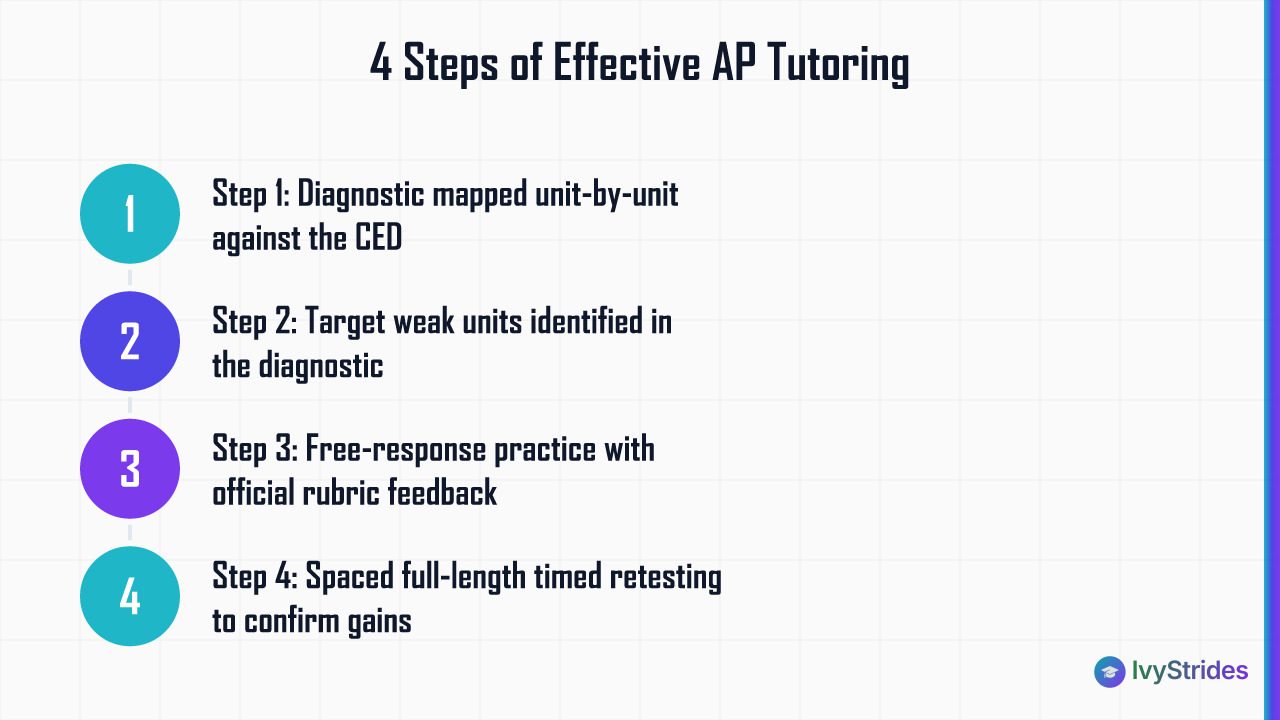
Every effective AP tutoring engagement at IvyStrides starts with a diagnostic that maps a student's performance against the College Board curriculum framework unit by unit, so no tutoring hour is spent on material the student already knows. That sentence describes an actual methodology. Here's what it means in practice.
Step 1: Diagnostic against the CED. The College Board publishes a Course and Exam Description (CED) for every AP subject listing the specific units and learning objectives. A real diagnostic gives you a scored full-length exam and a unit-by-unit map of where points were lost. If a provider skips this step, walk away.
Step 2: Targeted weakness work. Sessions focus on the units where the diagnostic showed loss, not a linear march through the whole curriculum. For an AP Calculus BC student weak in Unit 10 (series convergence), the plan drills series convergence, not a review of derivatives the student already owns.
Step 3: Free-response practice with rubric-based feedback. AP exams have both multiple-choice and free-response sections. Free-response rubrics are publicly available from the College Board. A qualified tutor uses those rubrics on student work, session by session. If your tutor never opens a rubric, they're guessing at scoring.
Step 4: Spaced retesting. Full-length timed practice sets, spaced across the engagement, confirm that gains stick. In our coaching, students who complete at least two full-length timed practice sets before the May exam consistently outperform those who only review content notes.
Red flags to reject: no diagnostic, no free-response work, one tutor listed for every AP subject, and outcome claims stated as guarantees rather than typical ranges.
Green flags: the tutor cites specific CED units by number, has taught the current exam format (not the pre-2020 version of AP Physics or the old AP US History rubric), and frames outcomes as "typical for students at this band" rather than promised scores. If you're weighing BC-level Calculus, see AP Calculus BC prep. If it's CS Principles, look at AP CS Principles.
AP Tutoring vs. Taking an AP Class Online: Which One Do You Actually Need?
These are different products. Confusing them is how families overspend.
An AP class online is a year-long, curriculum-based course taught by a subject-specialist teacher. It covers the full CED, builds the conceptual foundation, and produces the coursework and pacing structure a student needs to actually learn the subject. This is what you enroll in when your school doesn't offer the AP, when your school's AP teacher is weak, or when you're self-studying an AP not offered at your school.
AP tutoring is exam-focused and gap-filling. It targets the specific units and question types where a student is underperforming, usually in the 6-to-12 weeks before the May exam.
Here's the practical read: a student who takes an AP class online with a subject-specialist teacher through the school year and then adds roughly 5 to 10 hours of targeted exam-strategy tutoring in April is better positioned than a student who does 20 hours of tutoring cold in April with no foundation. In our coaching, students who have already completed the full CED before tutoring begins move faster through gap-filling work and hit a 4 or 5 more consistently.
If you're a 10th or 11th grader deciding for next year, the class comes first. If you're a 12th grader in April with a diagnostic 2, tutoring is the tool. If you're between them, both. See our best online ap courses catalog. For algebra-based physics specifically, AP Physics 2 prep.
How AP Scores Fit Into Your Broader Admissions Strategy
Strong AP scores, particularly 4s and 5s in subjects relevant to your intended major, send a signal to admissions officers that goes beyond what a test-optional policy can erase. Here's how to think about the investment.
AP scores live on the high school transcript. They're visible to admissions officers whether or not you self-report exam scores separately. A 5 in AP Chemistry on the transcript of a prospective bio major reads differently than an "AP Chemistry" course listing with no score attached.
College credit and placement. Most colleges award credit or advanced placement for a 3, 4, or 5, but policies vary by institution and department. A 5 on AP Calculus BC places students into Calculus III at many universities, but not all. Check each target college's credit policy directly before assuming.
Test-optional does not neutralize AP scores. Test-optional policies apply to SAT and ACT scores, not to AP scores on the transcript. Per FairTest, test-optional policies vary by school and year, and even at test-optional schools a strong AP record continues to signal academic rigor. Verify the current policy at each target college.
AP tutoring alongside SAT/ACT prep. Families weighing AP tutoring costs alongside SAT or ACT prep should know that both investments compound: a strong AP record strengthens the transcript, while a strong SAT or ACT score strengthens the quantitative signal. If you're still deciding whether the ACT even factors in, our take on does the ACT matter for college admission is worth a read.
AP coursework fuels essays. AP courses and scores give students concrete academic material to reference in college application essays, particularly supplemental prompts about intellectual curiosity or academic challenge. If your essays need shaping, a common app essay tutor turns that raw material into a real narrative. When you're mapping the calendar, see college application deadlines.
One caveat we surface constantly: college admissions outcomes depend on the full application, not AP scores alone. Anyone who tells you otherwise is selling you something.
How to Choose an AP Tutor: Four Questions to Ask Before You Pay
Ask these four questions of any provider, including us, before writing a check.
1. Is this tutor a specialist in this specific AP subject, or a generalist? The green answer names the tutor, the specific AP, and the tutor's depth in that subject. The red answer is a smooth pitch about "our tutors cover all APs."
2. Does the program start with a diagnostic mapped to the College Board curriculum framework? The green answer describes a scored full-length diagnostic and a unit-by-unit report. The red answer is "we'll figure out the gaps as we go."
3. Does the tutor practice free-response questions with rubric-based feedback? The green answer references College Board free-response rubrics by name and shows sample marked-up student work. The red answer focuses only on multiple-choice drills.
4. What is the typical score improvement for students at my current score band? The green answer is a range with an hour count and a "typical, not guaranteed" caveat. The red answer is a promised score or a vague "big improvements" line.
You can meet our AP specialist tutors directly and see how they answer each question in a diagnostic call. If you want the full catalog of subjects we teach and the coaching model behind them, our ap prep courses page walks through the methodology.
A Realistic Timeline: How Many Hours of AP Tutoring Do You Actually Need?
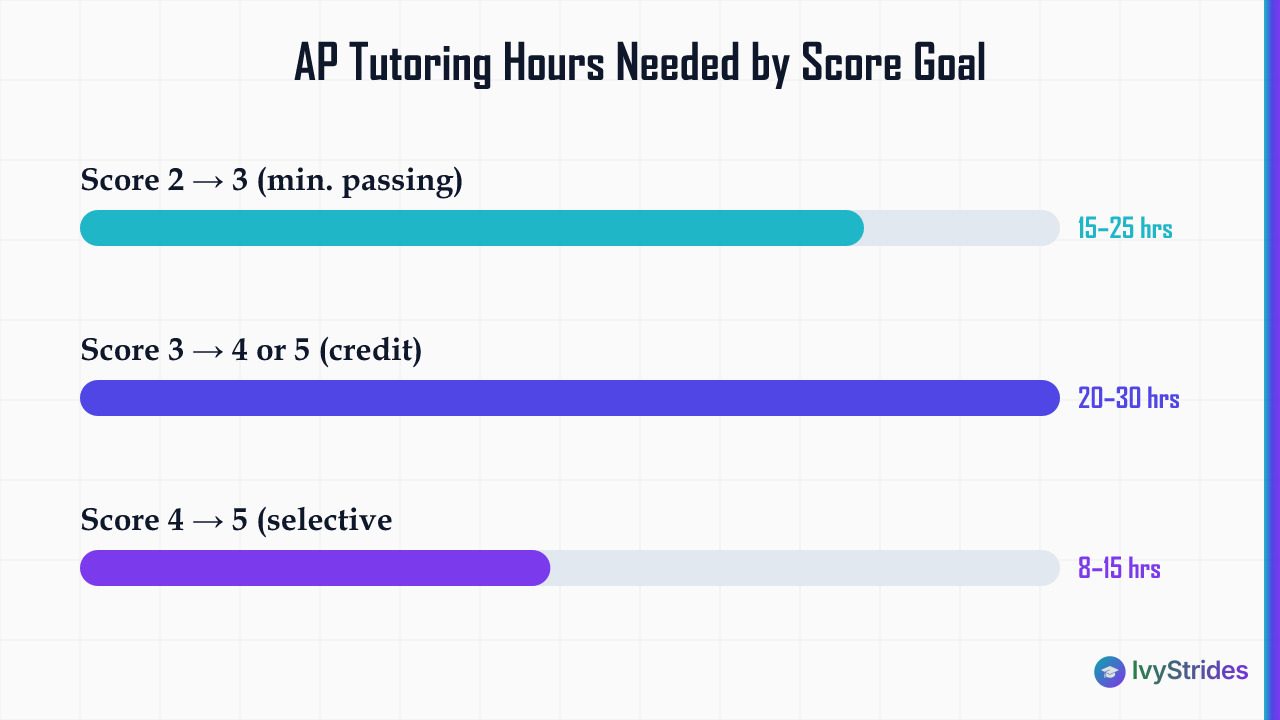
Concrete ranges from our coaching, framed as typical for students at each score band. Individual results depend on baseline, effort between sessions, and subject.
Scenario 1: Currently scoring a 2, targeting a 3 (minimum passing). Typically about 15 to 25 hours of targeted tutoring over roughly 8 to 12 weeks, assuming the student completes assigned practice between sessions. The focus is content gaps first, then free-response structure. This is where a specialist matters most, since the student is still building foundational concepts.
Scenario 2: Currently scoring a 3, targeting a 4 or 5 (credit-qualifying). Typically around 20 to 30 hours over 10 to 14 weeks, with heavier emphasis on free-response mastery and timing under pressure. Multiple-choice review shrinks. Timed FRQ practice with rubric feedback grows.
Scenario 3: Currently scoring a 4, targeting a 5 (selective college signaling). Typically about 8 to 15 hours of highly targeted work on the specific units and question types where points are being lost. This scenario often benefits from short, intense engagements rather than long-term packages.
Timeline constraint: starting tutoring fewer than roughly 4 weeks before the May exam limits realistic gains to partial score improvements in most subjects. If you're inside that window, prioritize a diagnostic and one or two strategy sessions over a full package.
Hours per week: most students in our coaching meet once or twice per week for 60 to 90 minutes and complete roughly 2 to 4 hours of independent practice between sessions. Load beyond that produces diminishing returns.
Numbers matter, but so does the rest of the application. When you're modeling AP hours against essay hours, our guide on how to answer Common App prompts helps you sequence the two.
FAQ
What are the benefits of one-on-one AP tutoring compared to a group class?
One-on-one tutoring targets the specific units and question types where the individual student is losing points, rather than following a fixed curriculum pace. In group classes, the teacher serves the median student, which means fast students wait and slow students fall behind. In one-on-one sessions built from a diagnostic, every hour serves that student's actual gaps.
Is AP tutoring worth it for AP Calculus AB specifically?
AP Calculus AB has one of the steeper conceptual curves in the AP catalog, with a large share of test-takers scoring below a 3 each year. In our coaching with students in the 2-to-3 score band, targeted work on limits, derivatives, and integration applications (Units 1 through 6 of the College Board framework) with a Calculus-specialist tutor typically produces meaningful score gains when started at least roughly 8 weeks before the May exam.
Should I get a tutor for AP Computer Science if I already know some coding?
Informal coding experience and AP CSA performance are different skills. The exam tests specific Java syntax, object-oriented programming, and algorithm analysis defined in the College Board CED. Students who "know how to code" from personal projects often have gaps in formal OOP concepts and free-response code tracing, which is exactly where a subject-specialist tutor moves the score.
Do AP scores still matter if my target colleges are test-optional?
Yes. Test-optional policies apply to SAT and ACT scores, not to AP scores on the transcript. AP scores are visible to admissions officers regardless of a college's test-optional status. A strong AP record, particularly 4s and 5s in major-relevant subjects, continues to signal academic readiness. Verify each college's current policy directly, since test-optional rules vary by school and year.
How is AP tutoring different from taking an AP class online?
An AP class online covers the full year-long curriculum in a structured course format taught by a subject-specialist. AP tutoring is exam-focused and gap-filling, targeting specific units where a student is underperforming. They're complementary: a student who takes a full AP class online and adds targeted tutoring in the final 6 to 8 weeks before the May exam is in the strongest position.
Are online AP tutoring programs as effective as in-person tutoring?
In our coaching with students worldwide, online one-on-one AP tutoring produces outcomes comparable to in-person sessions when the tutor is a real subject specialist and sessions follow a diagnostic plan. The format matters far less than the tutor's subject expertise, the diagnostic step, and the presence of rubric-based free-response practice.
The Bottom Line
AP tutoring is a specific tool for a specific problem: a real score gap in a conceptually demanding subject with enough time before May to act. When those three conditions hold, the ROI is high. When they don't, honest self-study with official College Board materials will serve you better than a tutoring package. The hardest part is diagnosing your own situation accurately before you commit budget.

Two decades teaching quantitative and verbal aptitude on standardized tests. Rare dual expertise across Math and Verbal — particularly effective for students with gaps on both sides. Senior AP Mentor for our Calculus and English tracks.