
How to Check Your AP Scores in 2026: A Step-by-Step Walkthrough
On this page
- How to View Your AP Scores on the College Board Portal: Step-by-Step
- Where to Find Your AP Scores: The College Board Account Explained
- What Your AP Score Report Shows: Reading the 1-5 Scale
- Can You See AP Scores from Years Ago? Accessing Your Full AP Score History
- Sending AP Scores to Colleges: Free Score Send vs. Official Reports
- Is There a Legitimate Way to See AP Scores Early in 2026?
- Not Sure What Your AP Score Means for College Credit or Your Next Step?
- What to Do After You See Your AP Score: Three Paths Forward
- Path 1: Your score met or exceeded your target (4 or 5)
- Path 2: Your score is a 3, and your target school wants a 4 or 5
- Path 3: Your score is a 1 or 2
- FAQ: Checking and Viewing AP Scores
- Where can I view my AP scores?
- Can you see AP scores on your phone?
- Can I see my AP scores from years ago?
- Is a 70% correct a 5 on the AP exam?
- Do colleges automatically see my AP scores?
- How do I see the breakdown of my AP score by section?
- Is there a legitimate way to see AP scores early?
- How do I view my AP scores on a college portal after I enroll?
- Your AP Score Is the Starting Point, Not the Finish Line
To view your AP scores in 2026, go to apstudents.collegeboard.org/view-scores and sign in with the College Board username and password you used when you registered for AP exams. Select AP Scores from the navigation menu to see every score on file, download your report, or send scores to a college. The 2026 AP scores began releasing Monday, July 6, 2026, on a rolling basis by subject.
That release schedule and portal path come from the College Board AP Students site. The harder question is what to do once you can see the number: whether a 3 counts at your target school, whether colleges receive the score automatically (they don't), and what a retake path looks like if the number is lower than you needed. The rest of this walkthrough handles each.

How to View Your AP Scores on the College Board Portal: Step-by-Step
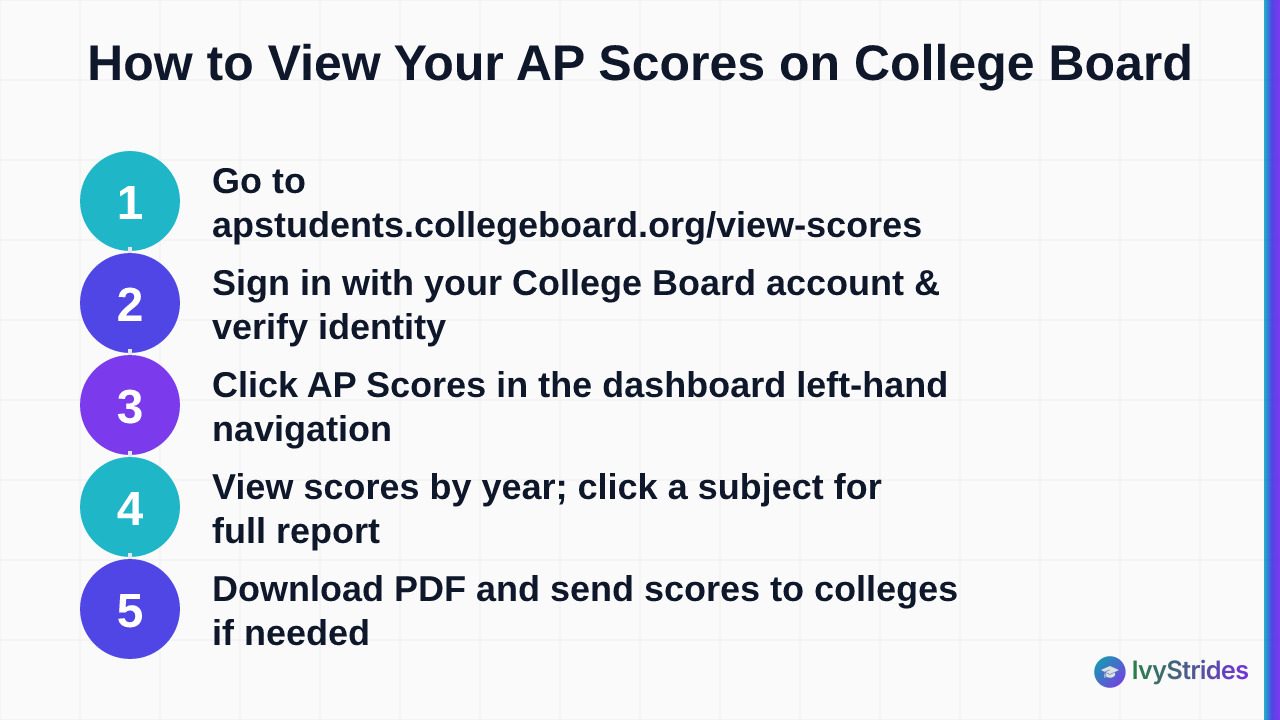
The AP Students portal is the only official place to view your AP scores. Below is the exact click path, in order. It takes about two minutes if your login still works.
Step 1. Open a browser and go to apstudents.collegeboard.org/view-scores.
Step 2. Click Sign In in the top-right corner. Use the same College Board account your AP coordinator registered you under. This is the same account that holds your SAT and PSAT scores.
Step 3. Complete two-step verification with the email or phone number on file, if prompted.
Step 4. From your dashboard, click AP Scores in the left-hand navigation. On mobile, tap the menu icon first.
Step 5. Your AP score dashboard appears. Every exam you've ever taken through this account shows here, grouped by year, with the 1-5 scaled score next to each subject.
Step 6. Click any subject to open the full AP score report, including section-level feedback where the College Board provides it (available on many, though not all, AP exams).
Step 7. Use the Download or Print button to save a PDF for your records. Parents: this PDF is what most families archive before the student's account transitions into their college login.
Step 8. If it's your senior year, click Send Scores to Colleges while you're already in the portal. The free score send has a hard deadline, covered below.
Two things trip students up. First, scores drop on a rolling basis by subject, so a friend seeing their Calculus BC on July 6 does not mean your AP Lang is late. Check back over the following days. Second, the College Board does not email you when your score posts. You have to log in and look.
For what those numbers mean, see AP Scores Explained: the 1-5 scale and what counts as a good score.
Where to Find Your AP Scores: The College Board Account Explained
Your College Board account is the single source of truth for AP, SAT, and PSAT/NMSQT scores. There's no separate "AP portal" and no separate "score account." One login at collegeboard.org, and your AP scores live at apstudents.collegeboard.org once you're in.
Two points of confusion come up every year.
AP Central is not your portal. AP Central is the College Board site for teachers and AP coordinators. Students who Google "AP portal" sometimes land there and can't find their scores because the portal isn't built for them. Bookmark apstudents.collegeboard.org instead. In our coaching, this is a weekly clarification when a student says they "can't find the score page."
The College Board app works on your phone. Download the College Board app from the App Store or Google Play, sign in with the same credentials, and your scores appear under the AP section. The mobile web at apstudents.collegeboard.org also works in Safari or Chrome.
Forgot your login? From the sign-in page, click Forgot Username or Password. College Board sends a reset link to the email tied to the account. If you also forgot the email, use the Get Help Signing In flow, which asks for your date of birth and high school to recover the account. In our coaching, this is the single most common reason students can't see their scores on release day. The account exists; they just can't remember the email they used in ninth grade.
One rule to remember: your scores are tied to the account you used at registration, not to your school portal or your college portal. If you accidentally created a second College Board account somewhere along the way, older scores may not appear until you contact AP Services for Students and ask for the accounts to be merged. Doing this before you need to send scores saves real stress in June.
Planning next year's exams? Our guide to how to register for AP exams walks through the AP coordinator process and the deadlines that arrive earlier than most students expect.
What Your AP Score Report Shows: Reading the 1-5 Scale
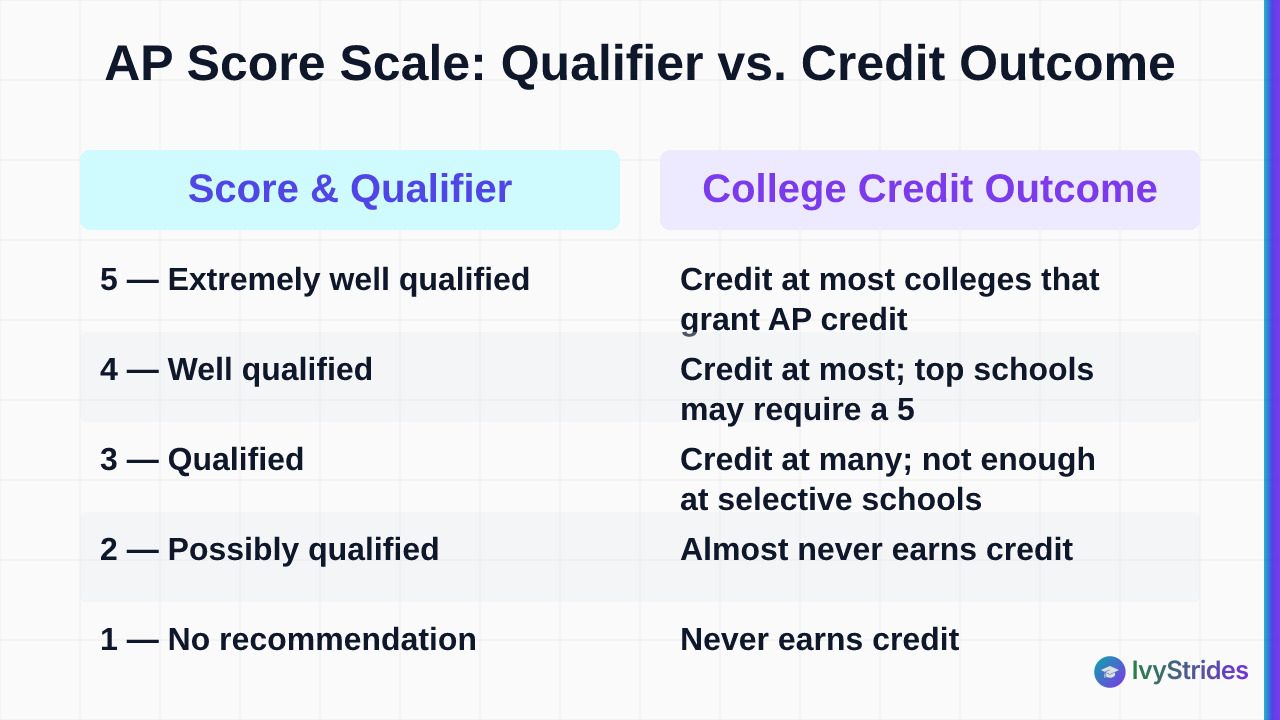
AP exams are scored on a 1 to 5 scale. The number in your portal is your scaled score, not a percentage. Here's what each level means at the level colleges use it:
| Score | Qualifier (College Board) | Typical meaning for college credit |
| 5 | Extremely well qualified | Credit at most colleges that grant AP credit |
| 4 | Well qualified | Credit at most colleges; competitive schools sometimes require a 5 |
| 3 | Qualified | Credit at many colleges; often not enough at highly selective ones |
| 2 | Possibly qualified | Almost never earns credit |
| 1 | No recommendation | Never earns credit |
Notice the hedge in the third column. AP credit policy is set by each college, not by the College Board, so a 3 in AP Psychology may earn credit at a large state university and no credit at a private research school. Always check the school's AP credit page before assuming.
Does 70% correct equal a 5? No. This is one of the most common misconceptions we field. College Board converts your raw score (multiple-choice points plus free-response points) to the scaled 1-5 through a curve that changes by subject and year. On many AP exams, roughly 65 to 75 percent of available points is enough for a 5, but on some subjects the threshold is lower and on a few it's higher. The exact cut points are set after each administration.
What the score breakdown shows. Depending on the subject, your report may include:
- Section-level performance (multiple-choice vs. free-response)
- Topic-area or unit-area feedback (e.g., "Unit 4: Learning" on AP Psychology)
- Your school's average, your state's average, and the global average for the subject
- A link to the College Board's official AP Score Distributions for the year
Once you can see your score, the next question is what it actually means: our full breakdown of the AP Scores Explained: the 1-5 scale and what counts as a good score walks through subject-by-subject score distributions and what counts as a good AP score for admissions vs. credit.
For the credit question specifically, see do colleges accept AP credit.
Can You See AP Scores from Years Ago? Accessing Your Full AP Score History
Yes. The College Board stores your AP scores indefinitely, and every AP exam you've ever taken shows up in the same portal at apstudents.collegeboard.org/view-scores. If you tested in 2022, 2023, and 2024, all three years appear grouped by exam date when you sign in.
This surprises a lot of incoming college freshmen. Students often ask us in July whether they've lost access because they're heading to college in the fall. They haven't. The College Board account belongs to you, not your high school, and it stays with you after graduation. Same login, same URL.
A few caveats worth knowing:
- Viewing is free forever. Log in and look at any prior year's scores at no cost.
- Sending an official report for a prior year costs money. The free score send only applies to the exam year you just took, before the annual deadline. To send scores from an earlier year to a college, you pay a per-report fee through the College Board score reporting system.
- If you can't see old scores, it's usually two accounts. As noted above, some students create a new College Board account for the SAT or for college registration and later realize their AP scores are stuck on a separate account. AP Services for Students can merge them if you contact support with proof of identity.
Same logic applies if you're trying to find old SAT scores. See how to find old SAT scores from years ago for that walkthrough.
Sending AP Scores to Colleges: Free Score Send vs. Official Reports
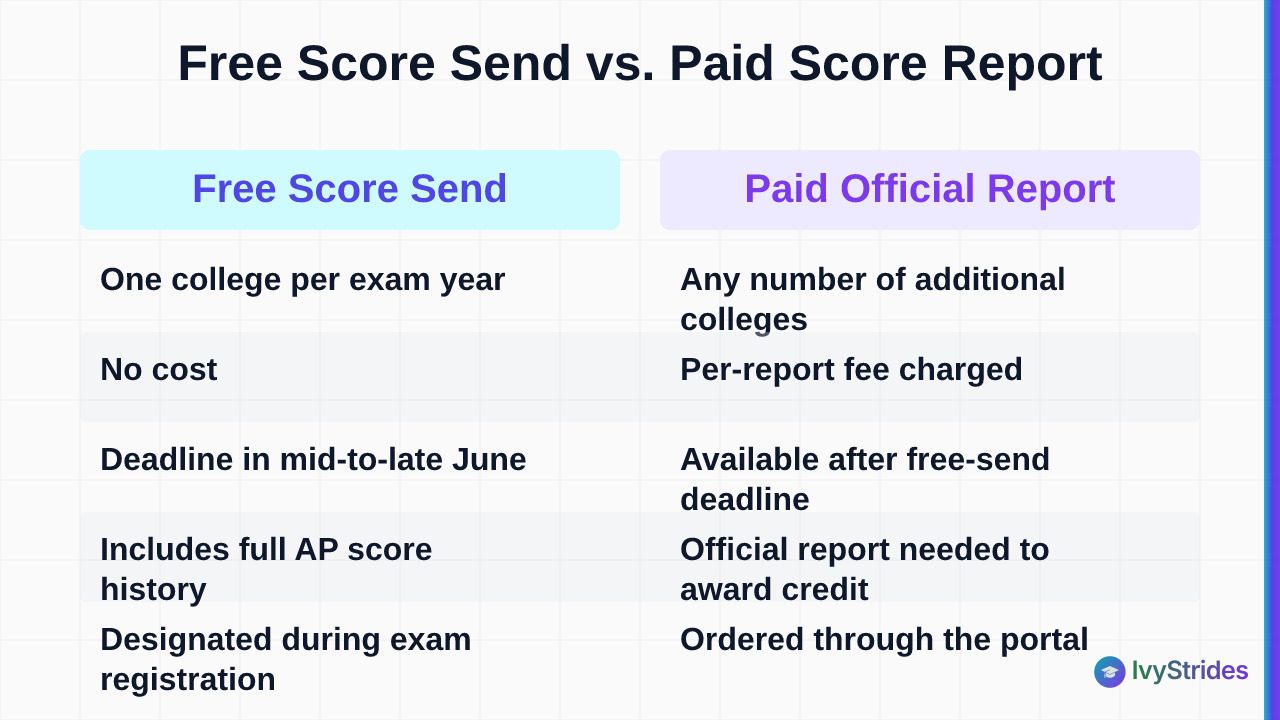
Colleges do not automatically receive your AP scores. This is the single most costly assumption we see families make. The College Board sends nothing to any college until you specifically tell it to.
Here's how the sending process works.
Free score send (one per exam year). When you register for AP exams, you can designate one college to receive your scores for free. You can update or change that designation any time before the annual deadline, which typically falls in mid-to-late June (the College Board publishes the exact date on the AP sending-scores page each year). The free send includes every AP score in your history, not just the current year's, delivered as one official report.
Paid additional reports. After the deadline, or if you want to send to more than one college, each additional official score report costs a per-report fee, payable in the portal.
Score Choice. You can withhold specific AP scores from a report using the "Score Withholding" or "Score Cancellation" options. Withholding a single subject from a report costs a fee per college. Cancellation removes the score from your record permanently and is not reversible. In our coaching, we rarely recommend cancellation. A 1 or 2 on one AP does little damage on a college application, and permanently deleting a score you might later need for placement is a decision that's hard to undo.
Self-reporting vs. official reports. Many colleges ask you to self-report AP scores on the Common App or on the application itself, and they don't require an official College Board report until you enroll. Once enrolled, the school needs the official report to award credit. Check each college's admissions FAQ. Policies vary, and mailing an official report unnecessarily costs money you don't need to spend.
The strategic question isn't "should I send my scores" but "which ones and when." A 4 or 5 sent early strengthens your application at test-aware schools. A 3 in a core AP for your intended major is more nuanced. If you're deciding whether to send borderline scores, book the strategy call below and we'll walk through it with you.
Related process guide: how to send SAT scores to colleges. And if you're weighing whether AP exams are worth the fee for an international student, see AP exam cost.
Is There a Legitimate Way to See AP Scores Early in 2026?
No. The only official source is the College Board portal, and 2026 scores began releasing July 6 on a rolling schedule. There is no verified way to see your official AP score before College Board posts it to your account.
A few unofficial workarounds float around every year. Here's the honest assessment.
College admission portals (sometimes accurate, sometimes not). Students already admitted to certain universities (the University of Florida and UIUC come up most often in Reddit threads) have reported seeing AP scores appear in their student portal's unofficial transcript view a day or two before the College Board release. Some threads describe using browser "Inspect Element" tricks to reveal hidden score fields. In our coaching, we've seen these workarounds turn out correct most of the time and wrong sometimes. Treat any early number as unofficial until College Board confirms it in your AP Students portal.
Third-party "early AP score" websites. Every year, a handful of sites promise to reveal AP scores before July 6 in exchange for your College Board login. Don't use them. College Board does not endorse or share data with third parties, and handing over your credentials is a phishing risk. If a site is asking for your password, it's not a service, it's a security incident waiting to happen.
Notification emails. College Board does not send you an email when your specific score posts. Some students set up push notifications through the College Board app, but the reliable move is to check the portal directly on and after July 6.
"How to see AP scores early as a senior." Seniors sometimes ask whether their score arrives earlier because they're using it for placement. It doesn't. Everyone in the same rolling window gets the same release, and colleges usually receive official reports on the same schedule.
Short version: wait for the College Board release, or check your college portal cautiously if you're already admitted. Nothing else is reliable.
Not Sure What Your AP Score Means for College Credit or Your Next Step?
Whether you're a student staring at a 3 you thought would be a 5, or a parent trying to figure out whether a retake makes sense, book a free 15-minute strategy call with an IvyStrides AP coach. We'll review the score, explain what it means for your target colleges, and map out a plan if a retake or stronger AP prep is the right move.
What to Do After You See Your AP Score: Three Paths Forward
Your AP score is data, not a verdict. What matters is the next decision. Three scenarios, three moves.
Path 1: Your score met or exceeded your target (4 or 5)
Send it. If your college of choice is still in your free-score-send window, use it. If not, decide whether the paid report is worth the fee based on whether the school offers credit for that subject. Then archive the PDF of your score report. You'll need it during college registration to confirm credit posting.
If you're a junior with a strong 4 or 5, list it prominently on your Common App academic sections. A 5 in AP Chemistry as a sophomore, for example, signals major-readiness to admissions readers considering you for a STEM program.
Path 2: Your score is a 3, and your target school wants a 4 or 5
This is the most common tough spot we see. A 3 is a passing score by College Board's definition, but competitive universities often set the credit threshold at 4 or 5. Whether a 3, 4, or 5 earns you college credit depends entirely on the specific school's policy, which we cover in our guide to do colleges accept AP credit.
Your options:
- Retake the exam next spring if you're still in high school and the subject matters for placement or major.
- Skip the credit and take the intro course in college if the AP is peripheral to your major.
- Send the score anyway if your school is test-flexible; a 3 rarely hurts, it just may not help.
Registration for a retake runs through your school's AP coordinator, and deadlines arrive earlier than most students expect. If you're planning ahead, the AP exam dates 2026 post has the calendar.
Path 3: Your score is a 1 or 2
Honest read: a 1 or 2 rarely appears on college applications because most students choose not to self-report it, and if the school is test-flexible for AP, it doesn't factor in. What matters is whether the underlying subject knowledge matters to you.
If the AP was for a subject you'll continue in college (say, a low score in AP Biology when you're a prospective bio major), a retake with a diagnostic-driven plan is the right move. If it was an elective outside your intended field, you can move on. In our coaching, students who score a 2 on their first attempt and follow a diagnostic-led retake plan (targeted weakness work, spaced retesting on full-length practice exams) typically reach a 3 or 4 on the next sitting.
The most productive move is a structured retake plan: our how to study for AP exams and score a 4 or 5 guide covers the diagnostic-first approach our coaches use with students targeting a 4 or 5. For the structured version with a subject specialist, our AP courses online run per-subject with one teacher per exam, not a generalist tutor across all APs. If you're weighing whether coaching is worth the cost, is AP tutoring worth it breaks it down.
One reminder on scope. AP scores are one input to a college application, not the input. Admissions committees read the full file, and a strong essay, transcript, and set of activities carries more weight than one AP score in isolation. Test-optional policies apply to SAT and ACT; they don't map onto AP scores the same way, because AP is a course credential, not an admissions test.
FAQ: Checking and Viewing AP Scores
Where can I view my AP scores?
Go to apstudents.collegeboard.org/view-scores. Sign in with the College Board account you used when you registered for AP exams, then click AP Scores in the navigation menu. Every subject you've tested appears grouped by year. The 2026 exam scores began releasing July 6 on a rolling schedule.
Can you see AP scores on your phone?
Yes. The College Board site is mobile-responsive, so any modern phone browser works. The College Board app also displays AP scores after sign-in. Same credentials on either.
Can I see my AP scores from years ago?
Yes. Your College Board account keeps every AP score from every year you've tested, and viewing prior-year scores is free. Sending an official report for a prior year to a college requires a per-report fee through the score reporting system.
Is a 70% correct a 5 on the AP exam?
Not necessarily. AP scores use a curve that converts raw points to the 1-5 scale, and the conversion changes by subject and year. Roughly 65 to 75 percent of available points is enough for a 5 on many AP exams, but the exact threshold varies. No fixed percentage guarantees a specific score.
Do colleges automatically see my AP scores?
No. Colleges receive AP scores only when you send them through the College Board score reporting system. One free score send is available per exam year, before the annual deadline in June. Some colleges also let you self-report scores on your application, but they'll want an official report for credit once you enroll.
How do I see the breakdown of my AP score by section?
Sign in to apstudents.collegeboard.org and click into the specific subject. For many AP exams, the report shows section-level feedback (multiple-choice vs. free-response) and topic-area strengths. Depth varies by subject.
Is there a legitimate way to see AP scores early?
No verified early source exists. Some admitted college applicants have reported seeing scores in their college's unofficial transcript view a day or two before the College Board release, but those numbers are unofficial and can change. Third-party "early AP score" sites are not endorsed by the College Board and are a security risk.
How do I view my AP scores on a college portal after I enroll?
After enrollment, your college's registrar posts AP credit to your transcript once they process your official College Board score report. Log in to your college's student portal (Workday, Athena, Howdy, or whatever your school uses) and check your unofficial transcript or academic history to see whether credit has been applied. If it hasn't after a few weeks, contact the registrar with a copy of your official AP score report.
For subject-specific prep once you know what you're facing, see AP exam prep by subject.
Your score is one data point in a longer plan. Sending strategically, planning a retake, or building next year's AP schedule around a stronger foundation is where the real use lives.
Your AP Score Is the Starting Point, Not the Finish Line
Book a free 15-minute call with an IvyStrides AP specialist. We'll look at your score in context, weigh it against your target schools' credit policies, and help you and your family decide the next move: send, retake, or restructure next year's AP load.

Two decades teaching quantitative and verbal aptitude on standardized tests. Rare dual expertise across Math and Verbal — particularly effective for students with gaps on both sides. Senior AP Mentor for our Calculus and English tracks.