
How to Write a Meaningful Conclusion in 2026: A Step-by-Step Guide That Actually Works
On this page
- What Makes a Conclusion Meaningful in Any Essay
- How to Write a Meaningful Conclusion: A Four-Step Process
- Four Conclusion Mistakes That Weaken an Otherwise Strong Essay
- Conclusion Examples for Students: What Good Endings Actually Look Like
- FAQ: Writing a Meaningful Conclusion
- What is an example of a good conclusion?
- What are the three R's when writing a conclusion?
- How to effectively write a conclusion?
- What is a good ending for a conclusion?
- Your Next Step on a Meaningful Conclusion
A meaningful conclusion is the final paragraph that synthesizes your argument and explains why it matters, rather than restating what you already said. Restate your thesis in fresh language, connect your points into one insight, answer the "so what," and close with a single resonant thought.
That four-step sequence works for academic essays, argumentative essays, and college admissions essays alike. The moves below draw on framework language from the UNC Writing Center and the Harvard College Writing Center, plus patterns we see across hundreds of student drafts.
What Makes a Conclusion Meaningful in Any Essay
A meaningful conclusion synthesizes your argument instead of summarizing it. Summary lists what you said; synthesis shows what those points add up to. That single distinction separates a closing paragraph that lands from one that just fills space at the bottom of the page.
The UNC Writing Center puts it plainly: a conclusion should pull the argument together into something the reader did not have at the start, not simply restate the thesis. A conclusion can only synthesize what the essay's core idea actually is, so if you are still unsure what your essay is really about, the college essay ideas guide helps you find the through-line before you try to close it.
Keep it short. The University of Hull Library recommends a conclusion of around 10% of the total word count. A 500-word essay gets roughly a 50-word conclusion. The Common App caps the personal statement at 650 words, which means your conclusion has roughly 65 words to do its job. IvyStrides derives that 65-word figure by applying the 10% rule to the Common App limit; neither source publishes the combined number.
For an AP free-response answer, the conclusion signals that your argument is complete, not that you ran out of time. It does not need length. It needs to close the loop.
| Move | What it does | Example signal phrase |
| Summary | Lists points already made | "First I argued, then I showed" |
| Restatement | Repeats the thesis verbatim | "As stated, the answer is X" |
| Synthesis | Connects points into one insight | "Together, these show that X" |
| So-what | Names the broader significance | "Which means, beyond this essay" |
How to Write a Meaningful Conclusion: A Four-Step Process
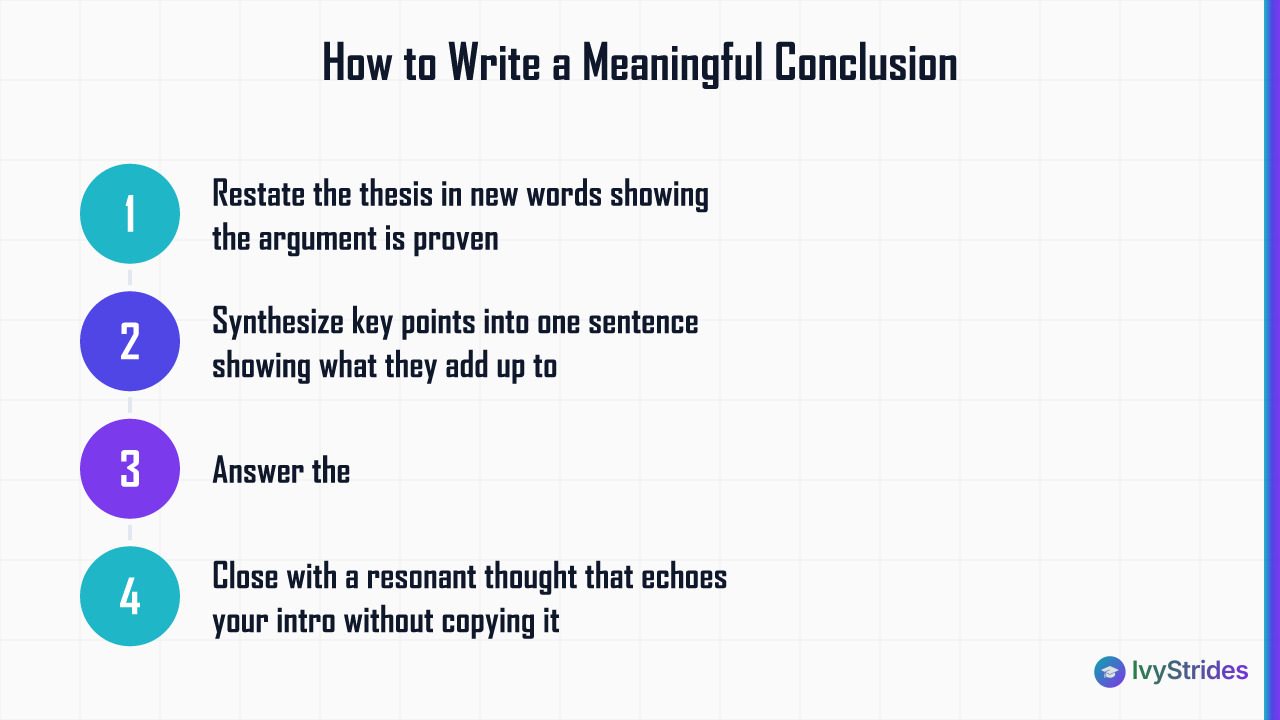
Four steps produce a meaningful conclusion: restate the thesis in fresh language, synthesize your key points into one insight, answer the "so what," and close with a resonant final thought. Each step is a distinct rhetorical move, and skipping the third leaves most conclusions flat.
Because synthesis is the goal, start with a thesis restatement that uses different vocabulary than your introduction. The SNHU Library FAQ advises rephrasing the main idea in a fresh, new way rather than copying old sentences. If the intro said "curfews reduce teen freedom without improving safety," the restatement might open on the tension between control and trust, not the same nine words.
Answer the "so what." This is the single most important sentence in the conclusion. The UNC Writing Center's "So What Game" finds it fastest: ask "so what?" after your main claim, then ask it again of the answer, until you reach the broadest honest implication. Harvard calls this the "now what," the move that leaves readers with something to think about or do.
Then close on one resonant thought: a forward-looking question, a big-picture perspective, or an image that echoes your opening. Never open the paragraph with "in conclusion." Start on the idea itself.
-
Restate the thesis in new words that signal the argument has been proven, not just stated.
-
Synthesize the key points into a single sentence that shows what they add up to.
-
Answer the "so what" by naming why the argument matters beyond the page.
-
Close with a resonant thought that echoes your introduction without copying it.
After you draft the conclusion using these four steps, revise the whole essay so the ending matches the voice of everything above it. Our guide to how to edit and revise your college essay walks through that pass.
Four Conclusion Mistakes That Weaken an Otherwise Strong Essay
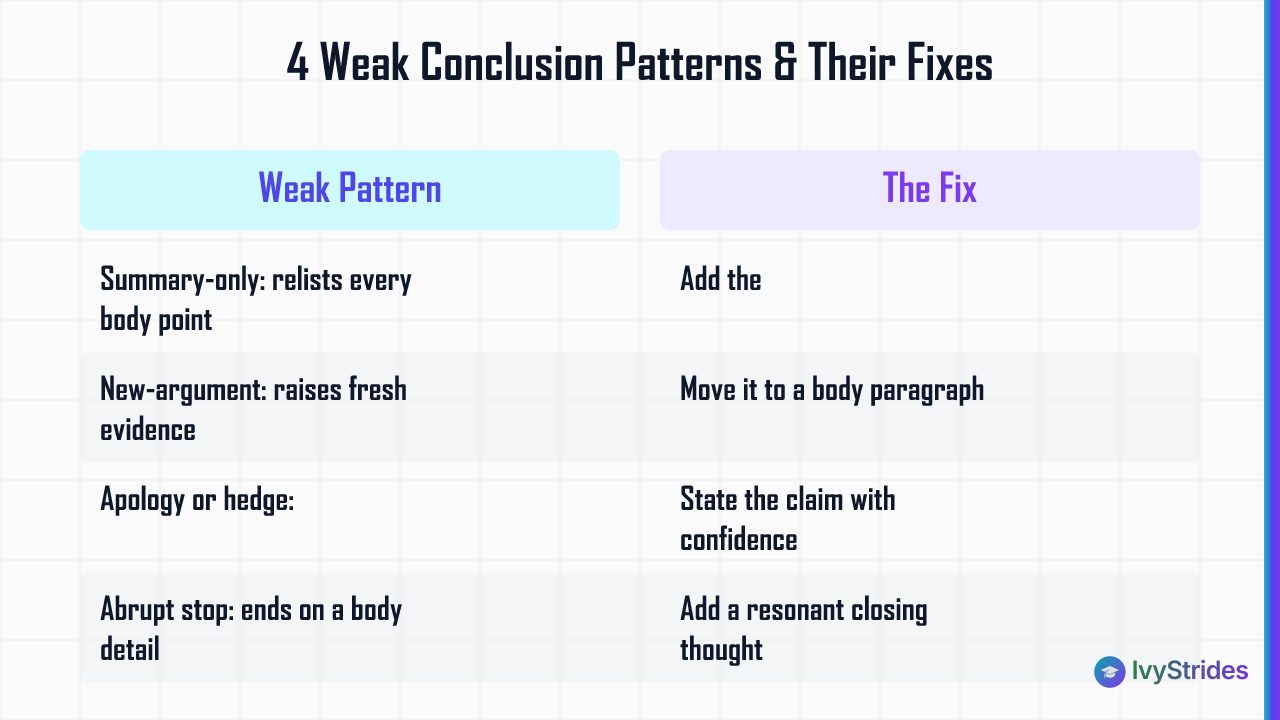
Four conclusion patterns undercut essays that are strong everywhere else: the summary-only restatement, the new-argument conclusion, the apology or hedge, and the abrupt stop. Naming them gives you a diagnostic to run on your own draft right now.
The same four-step logic that builds a strong ending explains why these fail. The summary-only conclusion just relists points, so it adds no synthesis. The UNC Writing Center flags two others directly: the "Sherlock Holmes" conclusion, which introduces new evidence at the finish line, and the "grab-bag," which tosses in unrelated topics. Harvard is blunt about the first: never introduce new evidence or arguments in the conclusion.
The most common error is repetition. In our coaching with students on college admissions essays, the top conclusion mistake is a word-for-word restatement of the opening paragraph, which reads as if the writer stopped thinking. If your conclusion is the last thing you revise, the college essay editing guide walks through how to tighten the whole draft without losing your voice.
| Pattern | What it looks like | The fix |
| Summary-only | Relists every body point | Add the "so what" implication |
| New-argument | Raises fresh evidence | Move it to a body paragraph |
| Apology or hedge | "This is just my opinion" | State the claim with confidence |
| Abrupt stop | Ends on a body detail | Add a resonant closing thought |
Once you can name the pattern, the fix is usually a single sentence. But on a college application piece with a deadline days away, a second reader catches what you cannot. Our guide to how to get feedback on your college essay covers how to ask for that read.
Conclusion Examples for Students: What Good Endings Actually Look Like

Photo by RDNE Stock project on Pexels
Conclusion examples for students work best as before-and-after pairs, because the contrast shows the synthesis move that a rule alone cannot. Take an argumentative essay arguing that schools should extend lunch breaks.
The weak version restates and stops: "schools should extend lunch breaks because students need time to eat and relax." That repeats the thesis and adds nothing. It falls straight into the summary-only pattern.
The strong version synthesizes and redirects: "When students have real time to eat and decompress, the classroom stops being a place they endure and becomes one they can actually use. A longer lunch is not a break from learning. It is the condition that makes learning possible." The "so what" does the work in that last line.
The same principle carries into admissions writing. In our coaching, a conclusion that echoes the opening image and adds a forward-looking implication consistently reads stronger to admissions readers than one that restates the thesis verbatim.
A strong conclusion alone will not decide an admission; the outcome depends on the full application. But it is the last impression the reader takes away. If you want the full arc from opening to close, our guide to how to write a college essay covers the whole structure. An admissions essay coaching coach can read your conclusion against real prompts.
Run this checklist against your draft before you submit:
- Fresh language: Does the restatement avoid copying the intro word for word?
- Synthesis: Does one sentence connect your points into a single insight?
- So-what: Have you named why the argument matters beyond the page?
- No new arguments: Did you keep fresh evidence out of the ending?
- Resonant close: Does the last line feel earned, not abrupt?
- Length: Is the conclusion about 10% of your total word count?
The move most students skip is the "so what." Fix that one, and a mechanical paragraph becomes a meaningful conclusion.
FAQ: Writing a Meaningful Conclusion
What is an example of a good conclusion?
A good conclusion restates the thesis in fresh language, synthesizes the key points into one insight, and closes with a broader implication. For a persuasive essay arguing that schools should extend lunch breaks, a strong ending would not repeat "schools should extend lunch breaks." It would say something like: "When students have time to eat and decompress, the classroom becomes a place they can actually use." The synthesis and the "so what" carry the weight, not the repetition.
What are the three R's when writing a conclusion?
The three R's are Restate, Reflect, and Redirect. Restate means rephrasing the thesis in new language. Reflect means connecting the argument's key points into a single takeaway. Redirect means pointing the reader toward the broader significance or a next step. Redirect is the move most students skip, and it is the one that makes a conclusion feel meaningful rather than mechanical.
How to effectively write a conclusion?
Write an effective conclusion by following four steps: rephrase the thesis, synthesize the key points instead of just listing them, answer the "so what" question, and close with one resonant thought. Avoid opening with "in conclusion" or "to summarize." The four-step section above gives example phrasing for each move.
What is a good ending for a conclusion?
A good ending is a single sentence that echoes the essay's opening image, poses a forward-looking question, or states the broadest implication of the argument. It should feel like the essay earned its last line. Weak: "So that is why lunch breaks matter." Strong: "A longer lunch is not a break from learning; it is the condition that makes learning possible."
Your Next Step on a Meaningful Conclusion
You have a named four-step process, four mistakes to avoid, and a checklist to run before you submit. The ending is the last thing a teacher or admissions reader remembers, so it is worth the extra pass.
- Apply the four steps to your current draft, in order.
- Run the pre-submission checklist and fix any box you cannot check.
- Confirm the "so what" sentence is there; that is the one most drafts miss.
- If the essay is a college application piece, get a second reader before your deadline.

Award-winning author (South Asian Book Award) and graduate of BITS Pilani and UCLA Luskin School of Public Affairs. Brings a published writer's eye to Common App essays and grammatical precision to SAT and ACT R&W instruction.