
Where High School Research Actually Gets Published, and Which Journals to Avoid
On this page
- Why High School Research Publication Matters for College Admissions
- Which Journals Actually Accept High School Research Papers
- How to Get a High School Research Paper Ready for Submission
- What High School Research Publication Actually Costs
- FAQ: High School Research Publication
- How to get a research paper published as a high schooler?
- How hard is it to get a research paper published?
- How much will it cost to publish a research paper?
- Can a high schooler publish in IEEE?
- Your Next Step on Publishing High School Research
High school students can get research published by submitting to student-built journals like the Journal of Student Research, the Journal of Emerging Investigators, or the National High School Journal of Science. High school research publication is the process of getting an original student paper peer-reviewed and printed in a recognized journal. Most reputable ones are free.
Those journals each list scope, review type, and cost on their own submission pages, cited below. The harder problem is telling a legitimate journal from a predatory one, and knowing whether your paper is ready before you hit submit. That is what the rest of this page settles.
Why High School Research Publication Matters for College Admissions

Photo by Andy Barbour on Pexels
A published research paper signals to admissions officers that a student produced original work above standard coursework, which is the definition of an academic spike. A published paper is one of the clearest ways to demonstrate a research spike on a college application, but only if the journal carries enough credibility for an admissions reader to recognize it.
Two places on the application. You list the research project under the Activities section of the Common App, and you can note the publication in Additional Information (Common App). The publication is the credential; the project is the activity.
Credibility over count. Admissions officers distinguish a peer-reviewed student journal, where reviewers actually evaluate methodology, from a vanity outlet that prints anything for a fee. One paper in a real journal outweighs three in outlets nobody recognizes. A predatory publication is not neutral; a reader who spots the outlet may read it as a judgment lapse.
| Application Component | Where Research Publication Appears | What It Signals |
| Activities section | The research project itself | Sustained independent work |
| Additional Information | The publication credit | Recognized output |
| Recommendation letter | Mentor's account of the work | Validated rigor |
| Intended major essay | Thread tying research to field | Coherent academic direction |
The spike works hardest when the paper connects to the student's intended major or a longer extracurricular thread. A biology paper reads differently on a pre-med application than a one-off contest entry does. Research projects often begin inside structured programs, so it helps to know which research competitions for high school students feed cleanly into a publishable paper.
How a published paper fits the broader application narrative, including exactly where to list it, is a question best worked through with a college admissions counseling specialist. Admissions outcomes depend on the full application, not any single element.
Which Journals Actually Accept High School Research Papers
Five journals reliably review and publish high school work: the Journal of Student Research, the Journal of Emerging Investigators, the National High School Journal of Science, The Concord Review, and the American Journal of Student Research. Students pursuing math olympiad preparation or independent maths research at IvyStrides often ask the same question: once the project is finished, where does it go? The answer depends on subject and format.
The Journal of Student Research (JSR) is a multidisciplinary, peer-reviewed journal that accepts both high school and undergraduate submissions and is free to submit (JSR). The Journal of Emerging Investigators (JEI) focuses on STEM and runs mentored peer review by graduate students, also free (JEI).
The National High School Journal of Science (NHSJS) is explicitly high-school-focused, STEM, and free. The Concord Review is the one serious outlet for history and humanities; it is highly selective and charges a submission fee, so check the current rate on its site. The American Journal of Student Research (AJSR) is open-access, carries ISSN 2996-2218, and accepts high school and undergraduate work.
| Journal | Subject Area | Review Type | Cost to Submit | Typical Decision Timeline |
| JSR | Multidisciplinary | Peer-reviewed | Free | 12 to 24 weeks |
| JEI | STEM | Mentored peer review | Free | 8 to 20 weeks |
| NHSJS | STEM | Peer-reviewed | Free | 8 to 16 weeks |
| The Concord Review | History, humanities | Editorial | Fee applies | Varies |
| AJSR | Multidisciplinary | Peer-reviewed | Free | 8 to 24 weeks |
Review timelines across reputable student journals run roughly 8 to 24 weeks (futureforward.app). Students who completed a project through a science competition program, such as Regeneron ISEF or a university summer placement, are often best-positioned to submit to a peer-reviewed student journal, because the methodology has already survived outside scrutiny.
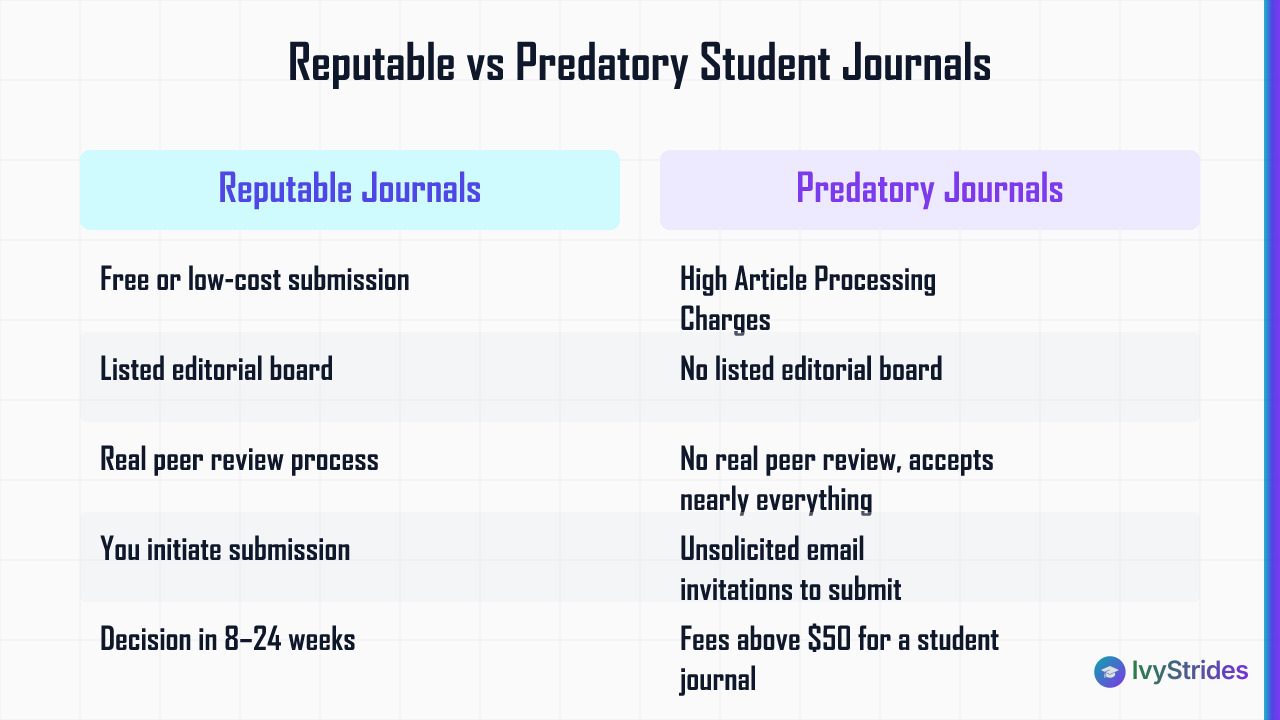
How to spot a predatory journal. A predatory journal charges high Article Processing Charges with no real peer review and accepts nearly everything. Watch for three signals: unsolicited email invitations to submit, fees above $50 for a student journal, and no listed editorial board. Any one of those should stop you.
Students whose paper grew out of contest maths can route it through our math olympiad and research program for a submission plan. Humanities students can see the wider landscape of writing programs for high school students that recognize this kind of work.
How to Get a High School Research Paper Ready for Submission
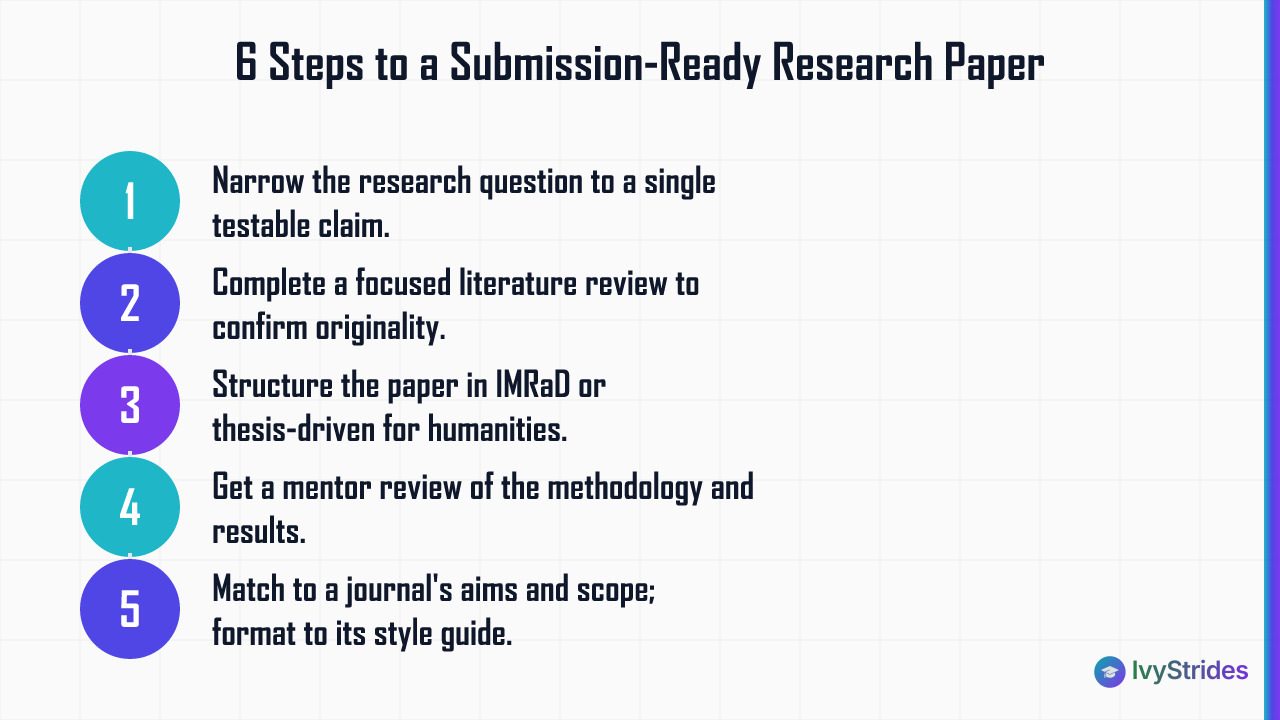
A high school research paper is submission-ready when it has a specific research question, a sound research methodology, the correct structure for its field, and a mentor who has checked the work. Because credibility separates a real publication from a vanity one, the steps below are what a peer-reviewed journal's reviewers actually look for.
For STEM work, the standard is IMRaD structure: Introduction, Methods, Results, Discussion. Humanities papers use a thesis-driven format instead. Before submitting, read the journal's aims and scope page and two or three of its published papers; reputable student journals expect it (riseglobaleducation.com). Skipping the style guide is the most common cause of a desk rejection, before a reviewer ever reads the science.
The mentor matters more than most students expect. A faculty mentor, graduate student, or subject-specialist teacher validates your methodology and findings, and JEI and several other journals require or strongly recommend one. In our coaching with students pursuing a research spike, those who secure a mentor before drafting, rather than after, consistently produce papers that need fewer revision rounds.
-
Narrow the research question to a single testable claim.
-
Complete a focused literature review to confirm originality.
-
Structure the paper in IMRaD, or thesis-driven for humanities.
-
Get a mentor review of the methodology and results.
-
Match the paper to a journal's aims and scope, then format to its style guide.
-
Submit through the journal's portal and respond to reviewer comments.
If your research question is still too broad to finish, the earlier work of scoping it is covered in how to find a maths research topic a high schooler can actually finish. In our coaching, the papers that reach submission fastest are those where the question was narrowed to one testable claim before writing began.
What High School Research Publication Actually Costs
Most legitimate student journals are free to submit and free to publish, including JSR, JEI, NHSJS, and AJSR. Because a large upfront fee with no editorial board is the clearest predatory signal, cost doubles as a screening tool: the price tells you a lot about whether the outlet is real.
Professional open-access journals work differently. They charge Article Processing Charges that typically run from about $500 to $3,000 or more, and those figures vary by journal, so check the outlet's own fee schedule. Those APCs are not appropriate for a standalone high school submission without a university co-author. The Concord Review is the rare legitimate student outlet that charges a submission fee.
| Journal Type | Typical Cost to Submit | Peer-Reviewed? | Admissions Credibility |
| Student journal (JSR, JEI, NHSJS, AJSR) | Free | Yes | High |
| The Concord Review | Fee applies | Editorial | High, humanities |
| Professional open-access | $500 to $3,000+ | Yes | High, rarely solo |
| Preprint server | Free | No | Low, not peer-reviewed |
| Predatory outlet | High APC | No | None or negative |
The IEEE question, directly. IEEE publishes peer-reviewed engineering and computer science research. A high schooler can appear as a co-author alongside a faculty mentor, but solo submission is rarely accepted (echelonscholars.com). Start with JEI or JSR and treat IEEE as a longer-term goal with a university collaborator.
Preprints, if you want early visibility. A preprint server posts your paper before peer review finishes, for free. arXiv and the Research Archive of Rising Scholars post work at once, but a preprint is not peer-reviewed, so it carries less admissions weight than a published paper.
Counting the roughly 2 to 4 weeks of formatting and mentor review before the review clock starts, plan on about 12 to 28 weeks from finished draft to a published credit (IvyStrides estimate, built on the futureforward.app per-journal windows). Acceptance is never guaranteed, and journal prestige varies widely.
FAQ: High School Research Publication
How to get a research paper published as a high schooler?
Choose a specific, original research question, structure the paper in IMRaD format for STEM or a thesis-driven format for humanities, and secure a mentor review. Then select a journal that explicitly accepts high school submissions, format to its guidelines, and submit. Most reputable student journals are free and return a decision in about 8 to 24 weeks.
How hard is it to get a research paper published?
In student-focused journals like JSR or JEI, acceptance is achievable for a well-structured, original paper with a clear methodology. In professional journals, acceptance without a faculty co-author is rare. The main barriers are originality, the quality of your research methodology, and formatting the paper to the journal's specific style guide before a reviewer sees it.
How much will it cost to publish a research paper?
Most legitimate student journals, including JSR, JEI, and NHSJS, are free to submit and free to publish. Professional open-access journals charge Article Processing Charges of roughly $500 to $3,000 or more, which are not appropriate for standalone high school submissions. A journal charging a large fee upfront with no listed editorial board is a predatory outlet.
Can a high schooler publish in IEEE?
A high school student can appear as a co-author alongside a faculty mentor at IEEE, but solo submission from a high schooler is rarely accepted. Students with strong STEM research are better served starting with JEI or JSR and treating IEEE as a longer-term goal with a university collaborator.
Your Next Step on Publishing High School Research
You now have five legitimate journals, the cost picture, and the preparation sequence. The move from here is narrow and concrete, not a guess.
- Pick one or two journals whose subject area matches your paper.
- Read each one's aims and scope page and two published articles.
- Confirm whether the journal requires a mentor review, and line one up if it does.
- Format the draft to the journal's style guide before you submit.
- Set your submission date against your earliest application deadline, allowing for a review window that can run into the months.

Two decades teaching quantitative and verbal aptitude on standardized tests. Rare dual expertise across Math and Verbal — particularly effective for students with gaps on both sides. Senior AP Mentor for our Calculus and English tracks.