
How to Write a Scholarship Essay: The Complete 2026 Playbook for a Top Score
On this page
- What a Scholarship Essay Actually Is (and Why It Differs from a College Essay)
- Why Scholarship Essays Matter More Than Most Students Realize
- How to Start a Scholarship Essay: Opening Hooks That Actually Work
- The Step-by-Step Process for Writing a Scholarship Essay from a Blank Page
- I Have a Blank Page and a Deadline: How to Break Through and Start Writing
- How to Write a Scholarship Essay About Yourself: Connecting Achievements to the Prompt
- How to Write a 500-Word Scholarship Essay: Structure and Word-Count Discipline
- What Makes a Scholarship Essay Stand Out to a Committee Reader
- What Not to Write in a Scholarship Essay: Mistakes That Cost Students Awards
- How to Reuse Your College Essay Core Without Submitting the Same Document
- FAQ
- How do I introduce myself in a scholarship essay without sounding like a resume?
- What are the 5 D's of college essays and do they apply to scholarship essays?
- How do I write a scholarship essay explaining financial need without it sounding like a plea?
- Can I submit the same scholarship essay to multiple scholarships?
- How formal should a scholarship essay be in tone?
- How long does it take to write a scholarship essay?
To write a scholarship essay, read the prompt closely, research the donor's mission, and open with a specific scene or question rather than a biographical statement. Connect one concrete story from your life to the scholarship's stated values, then explain how the award advances a named goal. Keep every sentence tied to the prompt. A focused 500-word essay that answers the exact question outperforms a polished 650-word essay that wanders.
That short version holds up, but the execution is where students lose points. This playbook walks through the seven-step process, the opening hooks that get an essay read to the end, the paragraph-by-paragraph structure for a 500-word limit, and the phrases that quietly signal "generic" to a committee reader. One caveat matters up front: scholarship outcomes depend on the full application, the donor's criteria, and the applicant pool for that cycle. No essay approach guarantees an award. A strong essay gives you the best possible shot with the story you already have.
What a Scholarship Essay Actually Is (and Why It Differs from a College Essay)
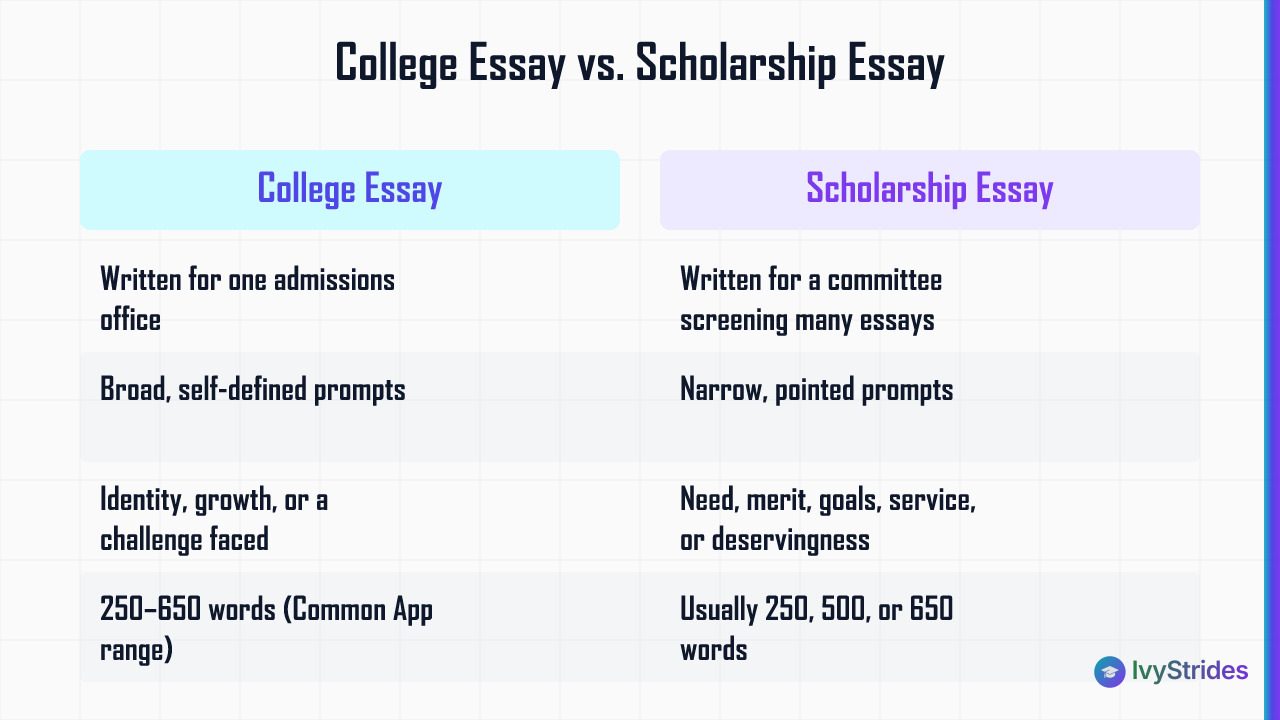
A scholarship essay is a short piece of writing, usually 250, 500, or 650 words, that a donor organization uses to decide whether to fund a specific student. That's the whole job. Unlike a general college essay, it isn't written for one admissions office reading your entire file. It's written for a committee reader who is often screening dozens of essays against a single question: does this applicant fit what we're trying to fund?
Here's where students trip. The Common App personal statement runs 250 to 650 words per Common App's official documentation, and it responds to broad, self-defined prompts about your identity, your growth, or a challenge you faced. A scholarship prompt is narrower and pointed. It usually falls into one of five categories: a financial need essay, a merit essay, career goals, community service, or the classic "why do you deserve this scholarship?" Each of those wants different evidence and a different tone.
So the personal statement and the scholarship essay are cousins, not twins. The story underneath can overlap. The framing, the opening hook, and the closing almost never should. A merit prompt wants proof of accomplishment. A financial need prompt wants context plus resilience plus a named next step the money enables. Treat them as the same document and you'll answer neither question well.
If you're already deep in your application essays, our one-on-one help for common app essay work carries directly into scholarship writing, because both reward specificity over summary.
Why Scholarship Essays Matter More Than Most Students Realize
Money. That's the blunt answer. A scholarship essay is often the single deciding factor between a full ride and a partial award, or between an award and nothing. The reader isn't grading your prose for a class. They're deciding where a finite pool of dollars goes.
The stakes have shifted in recent years. In a test-optional admissions environment, where policies vary by school and year per the FairTest tracker, the written components of an application carry more weight when a score isn't on the table. At schools where test scores are optional, scholarship committees often place even greater weight on the essay, making writing quality a direct lever on both admission and funding outcomes.
But don't assume scores are irrelevant. Some institutional scholarships use SAT or ACT score thresholds as an initial filter before the essay is even read, so a competitive test score and a strong essay work together rather than independently. These score floors, when they exist, are usually published in a school's Common Data Set. If you're weighing whether to send a score at a test-optional school, our breakdown of should you submit ACT scores if test-optional walks through the decision.
Merit prompts add another layer. When a donor asks about academic achievement, a documented AP record gives you concrete evidence instead of adjectives. "I earned a 5 in AP Biology" says more than "I'm passionate about science." If you're building that record now, our ap courses online are structured around the actual exam framework, which is what produces a score you can cite later. One more caveat: AP credit and scholarship eligibility criteria vary by institution and cycle. Verify directly with each provider.
How to Start a Scholarship Essay: Opening Hooks That Actually Work
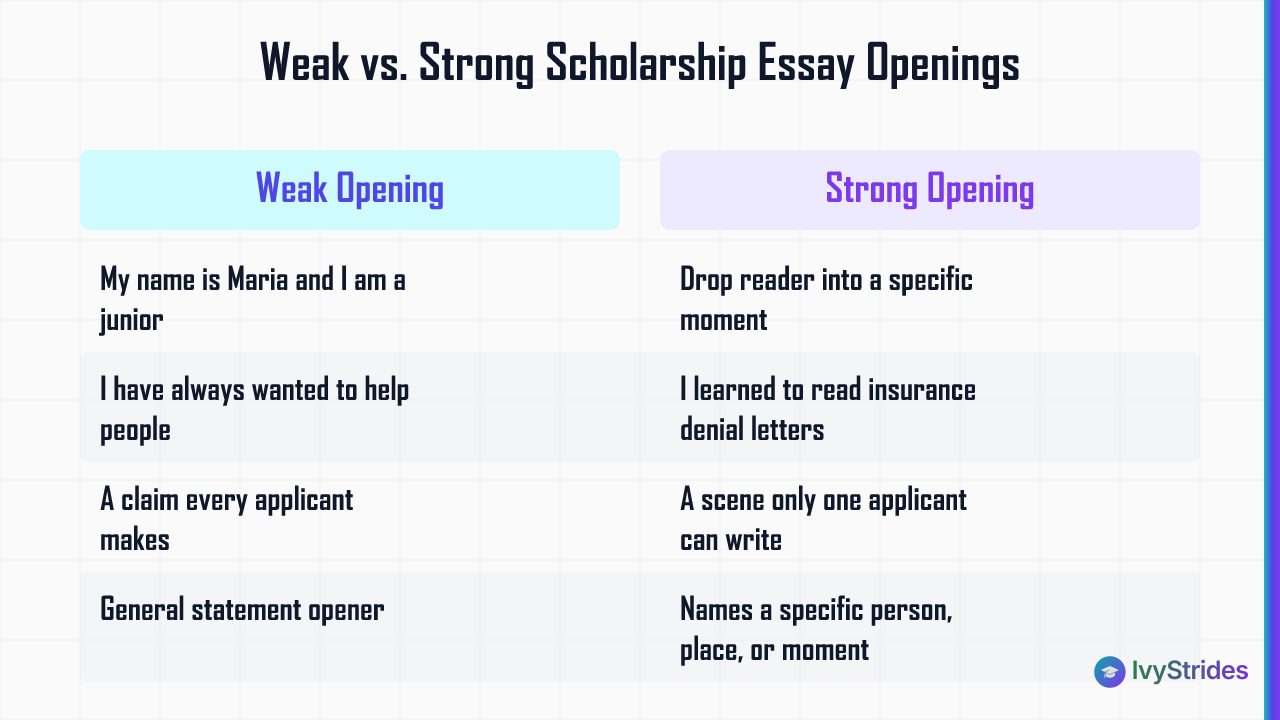
The first sentence decides whether the second sentence gets read. A committee reader moving through a stack gives your opening a few seconds. Waste them on "My name is Maria and I am a junior at Lincoln High School" and you've spent your best real estate on information already in your application form.
Four hook types reliably earn the next sentence. The anecdote opening drops the reader into a moment: "The generator died at 2 a.m., and my grandmother's oxygen machine went quiet." The scene-setting opening builds a place: "The community fridge on Marlowe Street was empty by Tuesday every week, and I was the one who noticed." The question hook poses something the reader wants answered: "What does it cost to be the first person in your family to fill out a FAFSA form alone?" And the biographical sketch, used well, reveals character through a single telling detail rather than a résumé line.
Now the contrast that matters most. Compare "I have always wanted to help people" against "I learned to read insurance denial letters before I learned to drive." The first is a claim every applicant makes. The second is a scene only one applicant can write, and it does the same work in fewer words.
In our coaching, essays that name a specific person, place, or moment in the first two sentences get read more completely than those that open with a general statement. A strong opening sentence should immediately engage the reader, a principle that holds across academic writing broadly. That specificity is what buys you the reader's attention for the rest of the piece.
One warning as you draft and cut: your voice can bleed out during editing. Our guide on how to keep your voice while editing covers how to tighten without going stiff.
The Step-by-Step Process for Writing a Scholarship Essay from a Blank Page

Photo by Rufaro Makaya on Pexels
Seven steps, in order. Follow them and the blank page stops being intimidating.
Step 1: Read and annotate the prompt. Underline every verb and every noun that tells you what to write about. "Describe a challenge you overcame and how it shaped your career goals" is actually three instructions: a challenge, how you overcame it, and a career connection. Miss one and the essay reads as off-prompt no matter how well written it is.
Step 2: Research the donor's mission in about 15 minutes. Open the organization's About page, read its mission statement, and skim its past award criteria or previous winners if listed. You're looking for the values they fund. A donor built to support first-generation students wants a different emphasis than one funding future engineers. This step takes about a quarter of an hour and changes everything downstream.
Step 3: Brainstorm personal stories that match the prompt. Aim for five to eight candidate stories before you commit to one. Most students grab the first idea and force it. The stronger essay usually comes from your third or fourth candidate, the one you almost dismissed.
Step 4: Choose one story and build a thematic thread. One story. Not four accomplishments in a list. Pick the single moment that best answers the prompt and identify the through-line, the idea that connects your opening scene to your future goal. That thematic thread is what makes 500 words feel like one essay instead of five fragments.
Step 5: Draft the introduction, body, and conclusion. Write the whole thing without stopping to perfect sentences. Your essay introduction sets the scene, the body develops the story and its meaning, and the conclusion delivers a forward-looking goal tied to the donor's mission. This is the narrative arc in three moves.
Step 6: Cut to the word limit without losing voice. Cut summary sentences that restate your intro first. Then adverbs that add length without meaning. Then any sentence that doesn't answer the prompt. What survives is tighter and more you, not less.
Step 7: Revise for prompt alignment, not just grammar. Read your draft with the prompt beside it. Does every paragraph earn its place against the question asked? Grammar is the last pass, not the first. For a structured way to get eyes on a draft, our guide to how to get feedback on your college essay covers what to ask a reader for. When you want a coach to run that alignment check, our essay review service is built for exactly this pass.
I Have a Blank Page and a Deadline: How to Break Through and Start Writing
The paralysis is real, and it's usually not a writing problem. It's a decision problem. You don't know which story to tell, so you tell none.
Three moves break it.
First, the timed freewrite. Set a timer for 10 minutes and write toward the prompt with zero editing. Bad sentences allowed. Typos allowed. The only rule is you don't stop. In our coaching, students who produce a messy first draft in under 20 minutes consistently write stronger final essays than those who outline for days without drafting a single paragraph. Motion beats planning here.
Second, the story inventory. Write down five facts about your life that a stranger would find surprising. Not impressive. Surprising. Then pick the one most relevant to the prompt. Surprising facts carry specificity built in, and specificity is what a committee reader remembers.
Third, prompt decomposition. Take a vague prompt like "Why do you deserve this scholarship?" and break it into three answerable sub-questions: What have I actually done? What do I want to do next? How does this award connect the two? Answer those three in order and you have a draft skeleton without ever staring at the abstract question.
The goal of all three is a minimum viable draft, a complete-if-rough version you can improve. You can't revise a blank page.
Parents, this is a good moment to help without taking over. Our guide on how can parents help with the college essay draws the line between useful support and edits that erase your student's voice.
How to Write a Scholarship Essay About Yourself: Connecting Achievements to the Prompt
Writing about yourself is where good essays go generic. The instinct is to list: honor roll, team captain, volunteer hours, the works. That reads as a résumé the committee already has.
The fix is to anchor your self-description in a single specific moment and let the reader infer the rest. In our coaching, students who ground their self-portrait in one concrete scene outperform those who list multiple achievements across the same word count. A reader remembers the night you rebuilt the robotics chassis at 1 a.m. They forget "I am dedicated and hardworking."
Two phrases to retire. "I am a unique and interesting person" is one of the most cited generic lines in scholarship rejection feedback, precisely because claiming uniqueness is the least unique thing you can do. Show the uniqueness through action; never assert it.
When the prompt is merit-based, cite hard evidence. A 4 or 5 in AP Chemistry, a documented leadership role with a measurable result, a project with a named outcome. Merit-based scholarship prompts frequently ask about academic achievement, and a strong AP course record with documented scores gives you concrete evidence to cite rather than vague claims about being a hard worker. If your AP record still has room to grow, our ap prep courses are organized around the exam's actual units, which is what turns effort into a score you can point to.
For community service and leadership stories, the structure is the same: one scene, one clear stake, one thing you learned or changed. Not the whole history of the club. Community impact lands when it's specific, not when it's summarized.
How to Write a 500-Word Scholarship Essay: Structure and Word-Count Discipline
Five hundred words is roughly five tight paragraphs. Here's an allocation that works, give or take a few words per section.
Introduction, about 80 words: open with your hook and establish the scene. Body paragraph one, about 120 words: the story and its context, what actually happened. Body paragraph two, about 120 words: the impact and your growth, what changed in you or around you. Body paragraph three, about 100 words: your career goals and the explicit connection to the donor's mission. Conclusion, about 80 words: a forward-looking statement that lands the thematic thread.
That's 500 words with a clear job for every paragraph. Notice there's no room for a paragraph that just describes how great you are. Every section moves the story or the argument forward.
When you're over the word limit, cut in this order. Summary sentences that restate the introduction go first; they're pure repetition. Then adverbs that inflate length without changing meaning. Then any transition sentence doing nothing but connecting. Your transitions should be efficient, often just a few words at the start of the next idea rather than a full sentence.
For a 250-word essay, compress to three beats: one story beat, one impact sentence, one forward-looking sentence. There's no room for a separate conclusion. The last sentence of your one body section carries the closing weight. Cutting a 500-word draft to 250 is harder than writing 250 from scratch, so decide your limit before you draft.
Watch your voice through all this cutting. Our guide to how to keep your voice while editing shows how to stay tight and still sound like yourself.
What Makes a Scholarship Essay Stand Out to a Committee Reader
Specificity. If you take one idea from this entire playbook, take that. Generic essays blur together in a stack; specific ones stick.
Three signals separate a memorable essay from an average one. The first is concrete specificity over generality. In our coaching, essays that name a specific person, place, or moment in the opening are read more completely than those that lead with a broad statement. Names, dates, and sensory detail do work that adjectives can't.
The second is donor mission alignment. Reference the organization's named program, its award history, or its stated values by name. A reader can tell within seconds whether you researched them or mass-mailed a template. "Your foundation's focus on rural healthcare access is exactly why I'm writing this" reads completely differently than "I would be honored to receive your generous award."
The third is voice authenticity. Your sentence rhythm and word choice should match how you actually talk, not how you imagine a formal essay should sound. Stiff, thesaurus-heavy prose reads as a mask. The same voice-preservation and prompt-alignment skills that IvyStrides coaches apply to supplemental essays translate directly to scholarship writing, because both formats reward specificity over summary.
Close with a forward-looking goal statement. The committee is funding a future, not just a past. Tell them precisely what their money makes possible. If you want a coach in your corner on this, our common app essay tutor work is built around drawing out exactly these signals.
What Not to Write in a Scholarship Essay: Mistakes That Cost Students Awards
Some mistakes are fatal regardless of how strong the rest of your essay is. Here's what quietly kills otherwise good submissions.
Generic opening sentences. "I have always been passionate about learning" tells the reader nothing and burns your best line. Restating the prompt verbatim. The committee wrote the prompt; they don't need it read back. Overusing "I." Start counting. If nearly every sentence opens with "I," the essay reads as a monologue rather than a story. Vary your sentence openings.
Filler conclusion phrases. "Finally," "in sum," and their cousins announce that you've run out of things to say. Land your last sentence on the goal, not on a signpost. Vague claims without evidence. "I'm a natural leader" means nothing without the scene that proves it. Show the moment; skip the label.
Exceeding the word limit. This one's a hard disqualifier at many organizations. Submitting over the stated limit signals you either can't follow directions or didn't read them, and a committee funding responsible students reads that clearly. Respect the count.
And the mistake that stings most because it's so avoidable: the wrong scholarship name. When you reuse an essay across applications, you'll eventually leave the previous organization's name in the text. A committee reading its own name replaced by a competitor's tosses the essay immediately. Proofread specifically for the scholarship's name and the donor's mission language before every single submission. A second reader catches these fast; our essay review service exists partly to catch exactly this class of error before it costs you.
How to Reuse Your College Essay Core Without Submitting the Same Document
You've already written a Common App personal statement. Reusing it for scholarships is smart. Pasting it in unchanged is not.
If you have already drafted your Common App personal statement, the core story you developed there is often the strongest raw material for a scholarship essay introduction, though the framing must shift to match the donor's specific mission. The Common App personal statement runs 250 to 650 words per Common App's official documentation, which gives you a fuller story to compress from. Trim it to 500 or 250 and you have room to spare.
Here's the reuse rule that keeps you honest: the story can be the same, but the opening, the framing, and the conclusion must be rewritten to match the scholarship prompt. Your Common App essay might open on the same moment. But where it pivoted to your identity or your growth, the scholarship version pivots to the donor's mission and the specific goal their money advances. Same raw footage, different edit.
In our coaching, students who treat each scholarship essay as a separate writing task, even when the underlying story repeats, consistently produce stronger donor-aligned submissions than those who paste and lightly edit. The paste-and-tweak approach almost always leaves fingerprints: a sentence aimed at admissions, not at the donor, that the committee reader will notice.
When does reuse work, and when doesn't it? Reuse the core when the scholarship prompt genuinely connects to your central story. Write fresh when the prompt asks about something your personal statement never touched, like a specific career field or a community you served. Forcing an unrelated story onto a new prompt is worse than starting over.
Parents supporting this process, the how can parents help with the college essay guide applies here too. For hands-on adaptation across multiple applications, our one-on-one help for common app essay coaches work with students to reframe one core story for several donors without losing what made it strong.
FAQ
How do I introduce myself in a scholarship essay without sounding like a resume?
Skip the biographical opening. "My name is X and I am a junior at Y High School" tells the reader nothing your application form doesn't already say. Instead, open with a specific moment that reveals your character through action. Let the reader infer who you are from what you did and how you responded, not from a list of credentials. Character shown always beats character claimed.
What are the 5 D's of college essays and do they apply to scholarship essays?
The 5 D's framework (Describe, Discuss, Demonstrate, Distinguish, Deliver) is a coaching tool, not an official College Board or Common App methodology, and it maps cleanly onto scholarship essays. Describe the moment, Discuss why it mattered, Demonstrate what you learned, Distinguish how it connects to the scholarship's mission, and Deliver a forward-looking goal statement. Each D roughly corresponds to a section of a 500-word structure. Use it as scaffolding, then let your voice reshape it.
How do I write a scholarship essay explaining financial need without it sounding like a plea?
Frame financial need as context, not as the central argument. Describe the specific circumstance briefly, then pivot quickly to what you've done despite it and what named next step the scholarship enables. The committee wants to fund potential, not hardship alone. Resilience plus a concrete goal is far more persuasive than an account of difficulty by itself. One caveat: financial need alone doesn't qualify you for any specific award, and criteria vary by provider.
Can I submit the same scholarship essay to multiple scholarships?
You can reuse the same core story across applications, but each submission must be rewritten to align with that scholarship's specific prompt and the donor's mission. Submitting an identical essay to two scholarships with different prompts signals you didn't read the question carefully, and that's a common rejection reason. At minimum, rewrite the opening, the donor-connection paragraph, and the conclusion for each one. And proofread for the correct scholarship name every time.
How formal should a scholarship essay be in tone?
Formal enough to be taken seriously, conversational enough to sound like a real person wrote it. Avoid slang and heavy contraction use, but don't reach for stiff academic language that distances the reader either. Think of the target register as a confident, clear letter to a respected adult you haven't met. That balance keeps your voice intact while staying professional.
How long does it take to write a scholarship essay?
In our coaching with students, a well-structured 500-word scholarship essay typically takes about 3 to 5 hours across brainstorming, drafting, and two revision passes. Rushing to a single draft in under an hour produces essays that answer the prompt only on the surface. Spreading the work across two or three sessions, with a break between your draft and your revision, consistently improves the final result. The gap between drafts lets you see your own writing more clearly.
Scholarship essays reward the same skills that strong college essays do: a specific story, a clear thread, a tone that sounds like you, and precise alignment with what the reader is looking for. Get those right and you've given yourself the best possible shot with the material you already have. You can learn more about IvyStrides and how we work. To see who does this work with students, meet the coaches.
This article is current as of 2026 and is reviewed annually. Scholarship eligibility, criteria, and award amounts vary by provider and cycle; verify details directly with each scholarship organization.

Award-winning author (South Asian Book Award) and graduate of BITS Pilani and UCLA Luskin School of Public Affairs. Brings a published writer's eye to Common App essays and grammatical precision to SAT and ACT R&W instruction.