
How Long to Study for the PSAT? The Honest, Data-Backed Answer for 2026
On this page
- How Long to Study for the PSAT: The Direct Answer for 2026
- How Many Hours Should You Study for the PSAT, by Score Band
- Not Sure Which Score Band You Are In?
- When Should You Start Studying for the PSAT, by Grade
- PSAT Study Timeline for National Merit: What Juniors Need to Know
- Is the PSAT Hard? What to Expect Before You Start Prepping
- How to Structure Your PSAT Study Sessions (Week-by-Week Framework)
- How PSAT Prep Hours Convert to SAT Readiness
- Frequently Asked Questions About PSAT Study Time and Scores
- What is a top 1% PSAT score?
- Is a 740 a bad PSAT score?
- Is 3 months enough time to study for the PSAT?
- Is there any point in studying for the PSAT with only one week left?
- How many hours a day should I study for the PSAT?
- Should I take the PSAT in 10th grade?
- Is the PSAT very hard?
- Ready to Turn Your PSAT Timeline Into a Real Plan?
Most students need 20 to 50 total hours of PSAT study, spread across roughly 6 to 8 weeks. The right number depends on your current score and your goal. A student scoring around 950 who wants to reach 1100 typically needs 30 to 40 hours. A junior targeting National Merit Semifinalist range, roughly 1400 or above depending on state, should plan around 50 to 60 hours over 3 to 4 months. The honest first step is a full-length diagnostic practice test, because without a baseline score, any hour estimate is a guess.
These ranges come from the College Board PSAT/NMSQT page for format and scoring, plus our own coaching for the hour estimates. The harder question is not how many hours exist in the abstract; it's how many hours you need, and that answer only appears once you know your starting point. The next section breaks the range down by score band.
How Long to Study for the PSAT: The Direct Answer for 2026
PSAT study duration is the number of hours and weeks a student invests preparing for the PSAT/NMSQT, and for most students it lands between 20 and 50 total hours across a 6 to 8 week window. National Merit-track juniors are the exception; they need a longer runway of 3 to 6 months.
Here's the part most students skip. You cannot set a real timeline without a baseline diagnostic. The College Board publishes official full-length PSAT practice tests inside Bluebook, the same digital app used on test day. Take one, score it, and you'll know whether you're a 20-hour student or a 50-hour student. In our coaching, students who diagnose first set more accurate timelines and waste fewer hours polishing sections that were already strong.
A quick format grounding, because it drives everything below. The current PSAT/NMSQT is digital and section-adaptive: 98 questions in 2 hours 14 minutes of testing, scored on a 320 to 1520 scale, per the College Board. It splits into a Reading and Writing section of 54 questions in 64 minutes and a Math section of 44 questions in 70 minutes. Each section runs two adaptive modules.
| Situation | Total study hours | Typical window |
| Score maintenance / awareness | Under 20 | About 3 to 4 weeks |
| Moderate improvement | 20 to 40 | About 6 to 8 weeks |
| Competitive / National Merit range | 50 to 65+ | About 3 to 6 months |
The College Board's research on Official SAT Practice links around 6 to 8 hours of focused practice to about a 90-point score gain, and because the PSAT shares the SAT's content, that finding carries straight across. For a fuller breakdown of the test itself, see our guide to the Digital PSAT format, sections, and timing. To set a target, start with what is a good PSAT score.
How Many Hours Should You Study for the PSAT, by Score Band
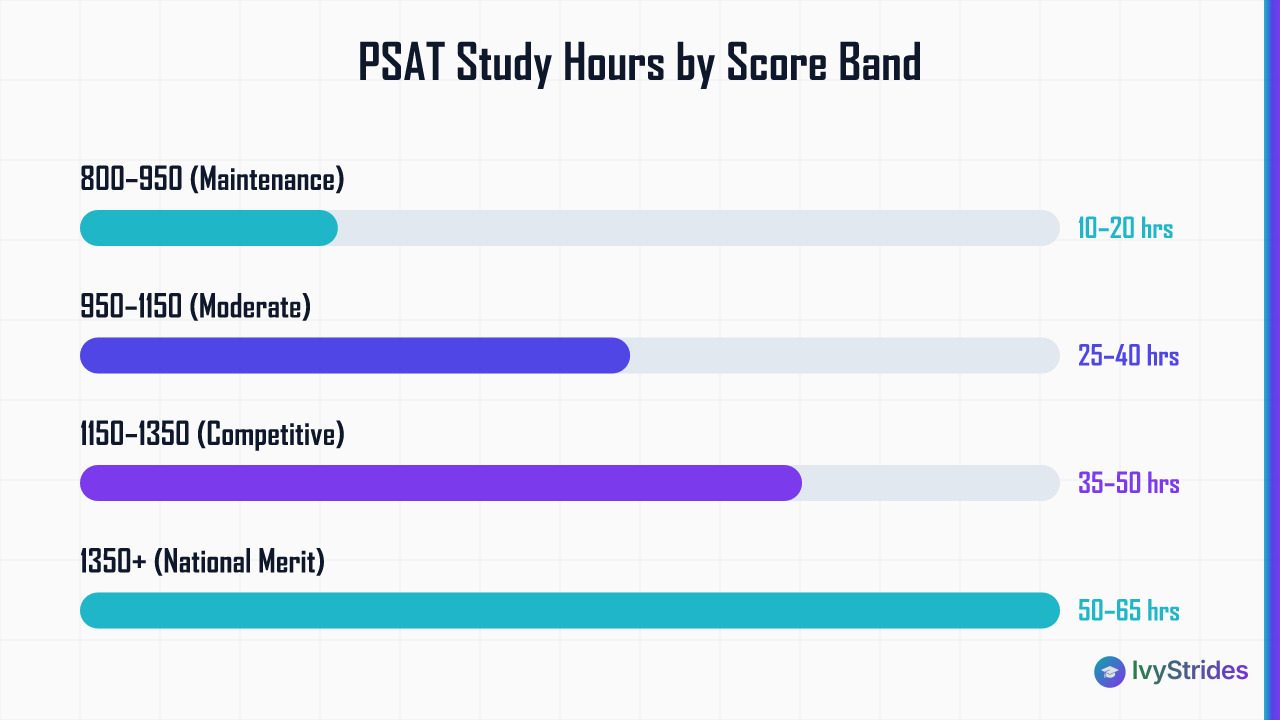
Your PSAT study hours scale with the size of your score gap, not with vague ambition. A student sitting at 800 who wants steady improvement needs a fraction of the hours a junior climbing toward National Merit does. Below are the four score bands we use in coaching to place a student, each tied to the size of the jump and the difficulty of the questions between here and there.
| Current PSAT score | Prep type | Total hours | What the hours target |
| 800 to 950 | Maintenance / awareness | 10 to 20 | Format familiarity, pacing, careless-error reduction |
| 950 to 1150 | Moderate improvement | 25 to 40 | One weak section, foundational content gaps |
| 1150 to 1350 | Competitive | 35 to 50 | Harder Module 2 questions, timing under pressure |
| 1350+ | National Merit sprint | 50 to 65 | Near-perfect accuracy, top question types |
Why the wide spread? The last 100 points cost far more hours than the first 100. Moving from 950 to 1100 usually means fixing foundational gaps, which respond quickly. Moving from 1350 to 1450 means eliminating the handful of hardest questions in Math Module 2 and the trickiest inference items in Reading and Writing, and those come slowly.
Where the hours go matters as much as how many. The PSAT's Reading and Writing section is 54 questions in 64 minutes; Math is 44 questions in 70 minutes, per the College Board. A diagnostic tells you which section is bleeding points. In our coaching, a student down 120 points in Math but even in Reading and Writing spends roughly 70 percent of study hours on Math, not a tidy 50-50 split.
The diagnostic-driven principle in one line: the test places you in a band, and the band sets the hours. Guessing skips the only step that makes the estimate real. For official full-length options to run that baseline, compare choices in our PSAT practice test roundup. Once you know your target study window, the next step is building the actual session-by-session plan: see our full How to Study for the PSAT in 2026: A Plan to Hit National Merit Range for a week-by-week breakdown toward National Merit range.
Not Sure Which Score Band You Are In?
Book a free 15-minute strategy call. We will review your baseline score (or help you get one), identify your weakest PSAT sections, and give you a realistic study-hour target before you spend a single hour on the wrong material.
When Should You Start Studying for the PSAT, by Grade
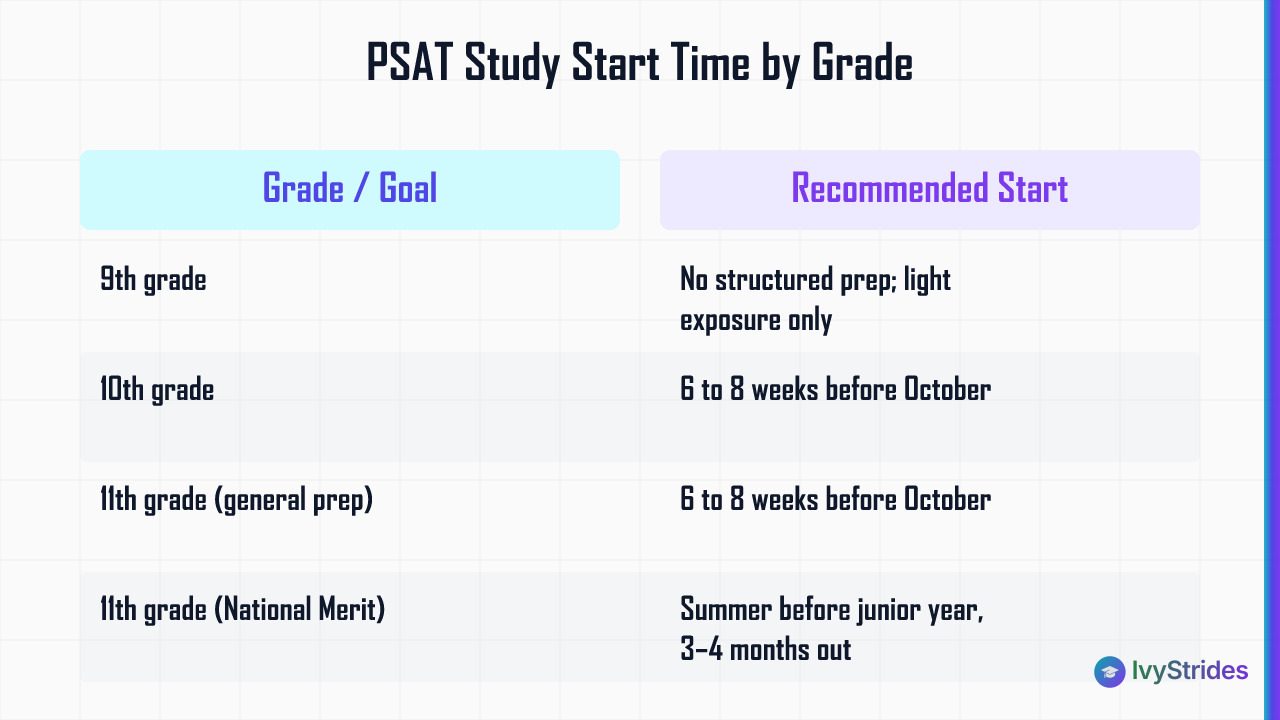
Your start point depends on your grade, and the fixed anchor is the October test date, administered at most US high schools each fall, per the College Board. Count backward from October and the right start point becomes clear.
There are three versions of the test, and the distinction changes the stakes. The PSAT 8/9 is for 8th and 9th graders. The PSAT 10 is a spring test for sophomores. The PSAT/NMSQT is the fall test, and only the junior-year sitting feeds the National Merit Scholarship Program. Same adaptive format, different score scales and purposes.
| Grade | Recommended start | Rationale |
| 9th | No structured prep; light exposure only | Establishes a baseline, no stakes attached |
| 10th | About 6 to 8 weeks before October | Enough for most goals; builds format comfort a full year early |
| 11th (general prep) | About 6 to 8 weeks before October | Sufficient if National Merit is not the goal |
| 11th (National Merit) | Summer before junior year, 3 to 4 months out | The gap to Semifinalist range takes time to close |
Freshmen don't need a study plan. A ninth grader who sits the PSAT 8/9 cold gets a useful reference point, and that's the whole job at that stage. Structured prep this early hits diminishing returns fast, because the content is a year or more from being taught in class.
Sophomores are a different story. Taking the 10th-grade PSAT gives you a real score on the official adaptive format and flags your weakest section a full year before the high-stakes junior test. In our coaching, students who sit the sophomore PSAT enter junior-year prep with a sharper, more efficient plan and less test-day anxiety.
For a start-point breakdown across every grade from 8th through 11th, read our How Early Should You Start PSAT Prep? A Grade-by-Grade Guide for 2026. Confirm the current year's schedule against our PSAT test dates 2026 page before you lock a timeline, since dates shift annually.
PSAT Study Timeline for National Merit: What Juniors Need to Know
National Merit prep demands a longer, more structured window than general PSAT prep: plan 3 to 4 months and around 50 to 65 total hours, not the standard 6 to 8 weeks. The reason is the score you're chasing. Semifinalist status is decided by the Selection Index, and reaching it means near-perfect accuracy across a full test.
The Selection Index is calculated as (2 × Reading and Writing section score) + Math section score, then scaled, per the College Board. Notice the weighting: Reading and Writing counts double. A junior who is strong in Math but shaky in Reading and Writing is at a structural disadvantage for National Merit, and the study plan has to reflect that.
Semifinalist cutoffs run roughly a Selection Index of 209 to 222 depending on your state, which corresponds to a PSAT score of about 1400 to 1520. Those cutoffs are set annually and vary by state, so check the current year before you fix a target. No specific score guarantees Semifinalist status. Below Semifinalist sits the Commended Scholar threshold, a nationally uniform and lower bar that's a realistic secondary goal.
Here's the timing pattern that matters most. In our coaching, juniors who begin National Merit prep in June or July consistently reach higher Selection Index scores than those who start in September. A student moving from the 1200 to 1300 range toward 1400+ is closing 100 to 200 points at the hardest end of the scale, and that math doesn't fit into six weeks. A consistent 6 to 8 hours a week across a full semester adds up to the 50 to 65 hours the jump typically takes.
If National Merit is your target, the Selection Index cutoffs and full qualification pathway are covered in our The National Merit Scholarship: PSAT Cutoffs, Selection Index, and How to Qualify (2026) guide. For the state-by-state numbers, see our National Merit cutoffs by state breakdown.
Is the PSAT Hard? What to Expect Before You Start Prepping
The PSAT is moderately challenging, and it's slightly easier than the SAT because it caps at a lower ceiling: 320 to 1520 versus the SAT's 400 to 1600, per the College Board. Same format, same content domains, lower top end. Students often ask whether the PSAT is harder than the SAT before committing to a prep timeline; the short answer is no, but the gap is smaller than most expect.
What makes the PSAT feel hard is the adaptive structure, not the content. Each section runs two modules. Module 1 is a fixed blend of easy, medium, and hard questions. Your Module 1 performance then determines whether Module 2 serves an easier or harder set, and Module 2 is where the score is decided. A student who has never seen this format walks in expecting a flat difficulty curve and gets surprised.
Two spots cost students the most points. In our coaching, the Reading and Writing Module 2 pacing and the advanced algebra in Math Module 2 are the two most common score-loss areas across PSAT students. Students run out of time on the harder second Reading and Writing module; in Math, the advanced algebra and data-analysis questions in Module 2 catch students who never drilled them.
So the PSAT is not a test you walk into cold and score well on, but it's also not one that requires months of dread. Knowing the adaptive format ahead of time removes most of the surprise. For a direct comparison of the two tests, read our take on whether the is the PSAT harder than the SAT. To see where you'd land relative to peers, check the average PSAT score.
How to Structure Your PSAT Study Sessions (Week-by-Week Framework)

Photo by cottonbro studio on Pexels
A PSAT study plan works best as short, spaced sessions rather than weekend marathons. In our coaching, students who study 30 to 45 minutes per day, 4 to 5 days per week, outperform students who cram 3-plus hours on Saturdays. The PSAT tests reasoning patterns that need time to settle, not facts you can hold overnight. Here's the 6-week framework we build for a typical student.
| Week | Focus | Sessions |
| 1 | Full-length diagnostic in Bluebook; analyze score report | One timed test plus one review session |
| 2 to 3 | Section-level weakness work (R&W vs Math) | 3 to 4 sessions, 45 to 60 min each |
| 4 to 5 | Mixed, timed drills on weak question types | 3 to 4 sessions, 45 to 60 min each |
| 6 | Second full-length test; compare to baseline | One timed test plus adjustment session |
| 7 to 8 (if time) | Final targeted review, exam-day logistics | 2 to 3 short sessions |
Week 1 is non-negotiable. Take a full-length official practice test in Bluebook, the College Board's own platform, then read the score report against the four content domains. Reading and Writing splits into Information and Ideas, Craft and Structure, Expression of Ideas, and Standard English Conventions. Math splits into Algebra, Advanced Math, Problem-Solving and Data Analysis, and Geometry and Trigonometry.
Weeks 2 through 3 pour hours into your weakest domain, not a balanced sweep. If your report shows Standard English Conventions bleeding points, that's where the sessions go. Weeks 4 and 5 shift to timed, mixed drills so you practice switching between question types under a clock, which is how the real modules feel. Week 6 is your checkpoint: a second full-length test tells you whether the hours moved the needle. The College Board's finding that around 6 to 8 hours of Official SAT Practice links to roughly a 90-point gain is a reasonable yardstick against your own before-and-after.
Free official practice covers the drilling well. It won't tell a National Merit-track student which of the hardest Math Module 2 patterns to prioritize when time is short; that's where section-specialist coaching moves faster for students with large gaps. Choosing the right practice tests matters as much as the hours you put in: our guide to the best PSAT practice tests compares official and third-party options. To decode your baseline results, read how to read your PSAT score report.
How PSAT Prep Hours Convert to SAT Readiness
PSAT prep hours are not spent on a throwaway test; they transfer almost entirely to the SAT. The PSAT/NMSQT and the Digital SAT share the same section-adaptive structure and the same content domains, per the College Board. Every hour you spend on Reading and Writing Craft and Structure questions, or on Math Advanced Math questions, counts toward both tests.
The scales map onto each other too. The PSAT's 320 to 1520 range sits just below the SAT's 400 to 1600 range, so a PSAT score is a reasonable predictor of where an untouched SAT score would land. That makes the PSAT score report a diagnostic tool for SAT planning: the same weak domain that cost you PSAT points is the one to prioritize when SAT prep begins.
This is the compounding effect parents ask about. Your prep carries forward because the two tests share a format and content. In our coaching, students who complete a structured PSAT prep cycle enter SAT prep with a clearer weakness profile and typically need fewer total SAT hours to reach their target, because the diagnostic work is already done.
For the exact number-to-number mapping, see our PSAT to SAT score conversion guide. If you want to know whether your current result is a strong launch pad, read Are Your PSAT Results 2025 Good Enough for SAT Success in 2026?. One caveat: a strong PSAT score helps you plan, but it does not substitute for a strong SAT score at test-required schools, and test-optional policies vary by school and year.
Frequently Asked Questions About PSAT Study Time and Scores
What is a top 1% PSAT score?
A top 1% PSAT/NMSQT score is approximately 1460 or above on the 320 to 1520 scale, based on College Board percentile data. For an 11th grader, that range usually puts a student in or near National Merit Semifinalist contention. The exact bar is set by the Selection Index and your state's cutoff, not the total score alone.
Is a 740 a bad PSAT score?
Context decides. A 740 sits below average for 11th graders, where the 50th percentile falls around 1010, so for a junior aiming at competitive colleges it signals a real gap worth structured prep. For a 9th grader on the PSAT 8/9, a 740 reads as a baseline within a normal range, not a verdict.
Is 3 months enough time to study for the PSAT?
For most goals outside National Merit, yes. At 3 to 4 sessions a week of about 45 minutes, you accumulate roughly 40 to 50 hours over 12 weeks. In our coaching with students starting in the 950 to 1100 band, that's typically enough for a 100 to 150 point improvement. National Merit juniors should use all three months and lean toward the top of the hour range.
Is there any point in studying for the PSAT with only one week left?
Yes, though keep expectations honest. One week won't close a large gap, but it's enough to learn the adaptive format and rehearse pacing, roughly 71 seconds per Reading and Writing question and 95 seconds per Math question. Take one timed practice test, review your errors, and chase format familiarity, not content mastery.
How many hours a day should I study for the PSAT?
Around 30 to 45 minutes per session, 4 to 5 days a week, which lands near 2.5 to 4 hours weekly. In our coaching, that spaced rhythm beats long weekend blocks. The PSAT rewards reasoning patterns that take repeated exposure to internalize, and cramming doesn't give them time to stick.
Should I take the PSAT in 10th grade?
Yes, even though the sophomore PSAT does not count for National Merit. It hands you a real baseline on the official adaptive format and flags your weakest section a full year before the junior test. Students who sit the 10th-grade PSAT typically enter junior-year prep with a more efficient plan and less anxiety.
Is the PSAT very hard?
Moderately. It runs the same adaptive format as the Digital SAT, with two modules per section where Module 2 difficulty adjusts to your Module 1 performance. Most students find Math Module 2 advanced algebra and Reading and Writing pacing the toughest parts. Slightly easier than the SAT, but not a test to walk into unprepared. For deeper benchmarks, see PSAT score range and percentiles and our guide on How to Qualify for National Merit in 2026.
The honest version of PSAT prep isn't a fixed number of hours; it's the number your diagnostic tells you. Take a full-length practice test this week, find your gap, and build the plan around it. That's the difference between studying and studying the right things. Our section-specialist coaches do this for students at every band, and you can read about our approach on the About page. You can also meet the tutors who run these plans.
Ready to Turn Your PSAT Timeline Into a Real Plan?
Our PSAT coaches work 1-on-1 with students at every score band, from first-time test-takers to National Merit contenders. In 15 minutes, we can map your diagnostic score to a study schedule and tell you exactly where your hours will move the needle most.

Award-winning author (South Asian Book Award) and graduate of BITS Pilani and UCLA Luskin School of Public Affairs. Brings a published writer's eye to Common App essays and grammatical precision to SAT and ACT R&W instruction.