
The National Merit Scholarship: PSAT Cutoffs, Selection Index, and How to Qualify (2026)
On this page
- What Is the National Merit Scholarship Program? (The 60-Second Version)
- What PSAT Score Do You Need for National Merit? Selection Index Cutoffs by State (2026)
- What Qualifies You for National Merit? The Four-Stage Competition Path
- How Hard Is It to Qualify for National Merit, and Is It Worth the Effort?
- From Semifinalist to Finalist: What the Application Actually Requires
- What the National Merit Scholarship Actually Pays: $2,500, Corporate Awards, and Full-Tuition Offers
- The National Merit Timeline: From October PSAT to Spring Scholarship Announcement
- How to Raise Your Selection Index Before the Qualifying PSAT
- FAQ
- Does a 1400 PSAT score qualify for National Merit?
- How rare is it to become a National Merit Scholar?
- Can you get a full ride through National Merit?
- What is the National Merit Scholarship essay prompt?
- Are homeschool and international students eligible for National Merit?
- What is the difference between a Commended Student and a Semifinalist?
- Where to Go From Here
The National Merit Scholarship Program is an annual academic competition run by the National Merit Scholarship Corporation (NMSC), entered by taking the PSAT/NMSQT in 11th grade. NMSC uses a Selection Index score, not your PSAT total, to identify roughly 16,000 Semifinalists using state-specific cutoffs. For the Class of 2026, those cutoffs land approximately between 209 and 222 in high-competition states and roughly 207 to 212 in lower-competition states. About 7,500 students ultimately receive scholarships ranging from a one-time $2,500 award to full tuition at participating universities.
Every structural fact in this article traces back to NMSC and College Board's PSAT/NMSQT page. The next section starts with the piece students misjudge most: your PSAT total (out of 1520) is not the qualifying number. The Selection Index is.
What Is the National Merit Scholarship Program? (The 60-Second Version)
The National Merit Scholarship Corporation is a private, nonprofit organization that screens roughly 1.5 million qualifying entrants each year and awards approximately $50 million in scholarships annually, per NMSC. The entry vehicle is one test: the PSAT/NMSQT, taken in October of 11th grade at a participating high school.
Four tiers of recognition emerge from that pool:
- Commended Students: roughly 34,000 students scoring just below their state's Semifinalist cutoff. A meaningful academic credential, but no scholarship attached.
- Semifinalists: about 16,000 students, representing the top 1% in each state by Selection Index. Announced in September of senior year.
- Finalists: approximately 15,000 Semifinalists advance after submitting a complete application. Announced in February of senior year.
- Scholars: about 7,500 winners chosen from the Finalist pool. That's less than 1% of the initial 1.5 million entrants.
If your score falls in the Commended-to-Semifinalist range, understanding what is a good PSAT score at each grade level helps you translate a raw number into competitive context.
What PSAT Score Do You Need for National Merit? Selection Index Cutoffs by State (2026)
The Selection Index formula is the piece most students miss. It's calculated by doubling the sum of your three test scores: Reading, Writing and Language, and Math. Each test score falls between 8 and 38. So the Selection Index range is 48 to 228.
Worked example. A student scores 38 on Reading, 37 on Writing and Language, and 36 on Math. Selection Index = (38 + 37 + 36) × 2 = 222. That's Semifinalist-competitive in every state in the country. Now consider a 1400 PSAT total. Depending on how those points split between Evidence-Based Reading and Writing and Math, and how the ERW section breaks into its two underlying test scores, a 1400 typically maps to a Selection Index roughly in the 210 to 214 range. That's Semifinalist-qualifying in a lower-competition state like Wyoming or West Virginia. It falls short in New Jersey or Massachusetts.
Understanding what a good PSAT score looks like at each grade level helps you gauge how far your current score sits from the National Merit Semifinalist range in your state. For broader benchmarking against the PSAT score range and grade-level percentiles, that context matters as much as the raw cutoff.
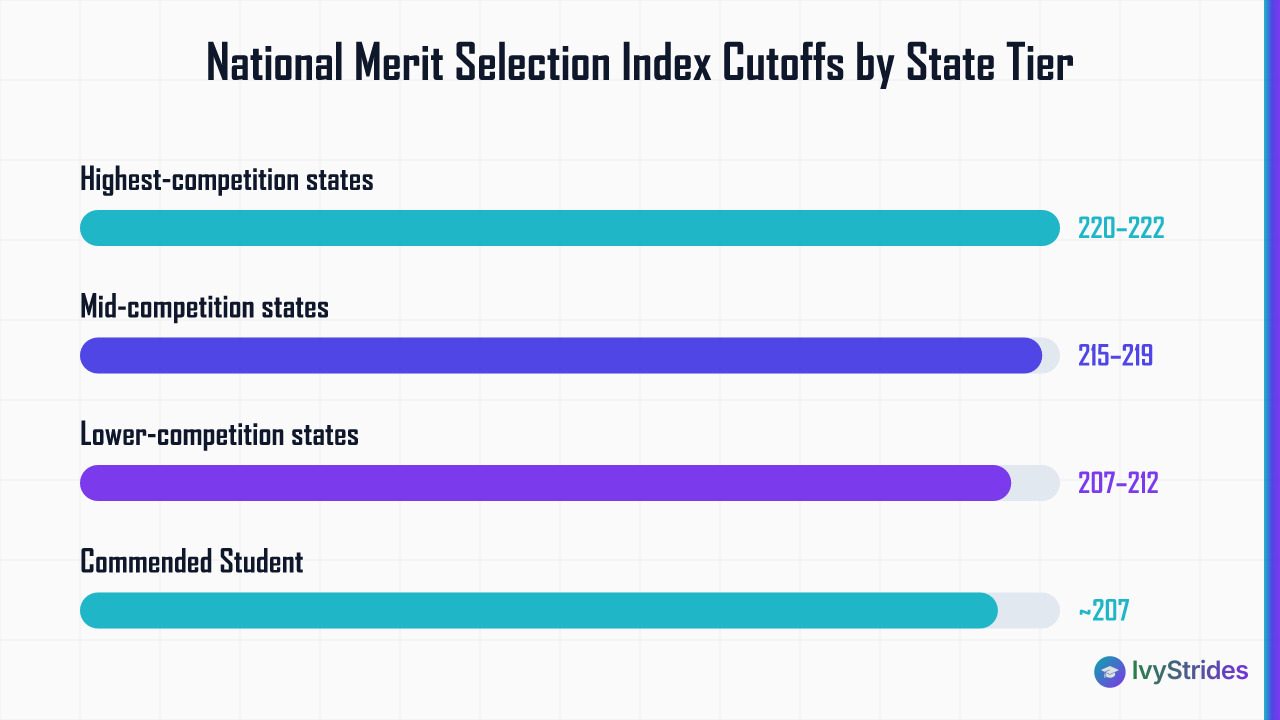
Here's the approximate Class of 2026 landscape (must-verify against NMSC's September 2025 official announcement):
- Highest-competition states (New Jersey, Massachusetts, Maryland, the Washington D.C. area, California): historically around 220 to 222
- Mid-competition states (most of the Northeast, Texas, Illinois, Virginia, Colorado): historically around 215 to 219
- Lower-competition states (North Dakota, Wyoming, West Virginia, Mississippi, Alaska): historically around 207 to 212
- Commended Student threshold (national, not state-specific): approximately 207
So is 1280 a good PSAT score for National Merit purposes? Not for Semifinalist range in any state, but it's a strong 10th-grade baseline with clear runway if you start prep now. Working through full-length PSAT practice tests under timed conditions is how you turn that baseline into a Selection Index gap you can measure.
One caveat: state cutoffs typically shift by 1 to 3 points year over year, and third-party trackers estimate before NMSC's official September release. Always confirm your state's current cutoff against NMSC's announcement before making decisions.
What Qualifies You for National Merit? The Four-Stage Competition Path
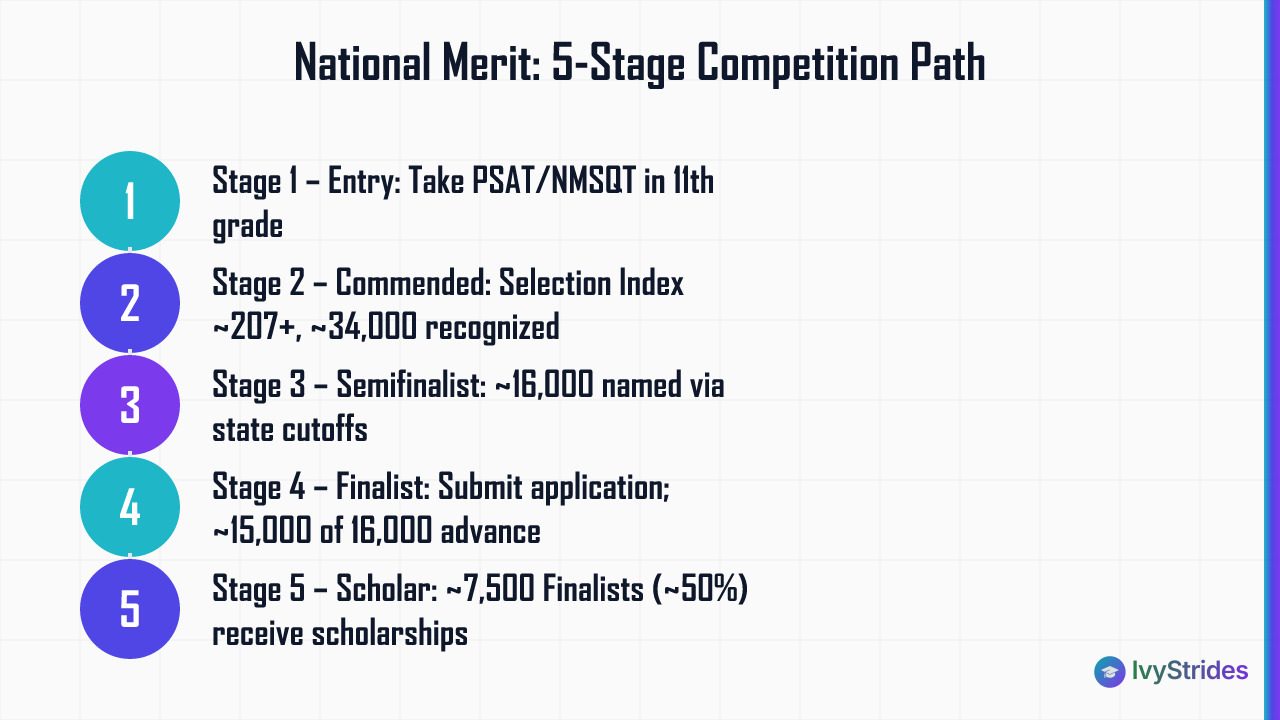
Stage 1 is entry. You must take the PSAT/NMSQT at a participating high school in the specified administration of your 11th-grade year, be a U.S. citizen or lawful permanent resident, and be enrolled full-time on track to graduate. Homeschool and international-U.S.-citizen students are eligible under NMSC rules if they test at a participating school.
Stage 2 is Commended Student status. If your Selection Index sits below your state's Semifinalist cutoff but above the national Commended threshold (approximately 207 for the Class of 2026), you'll be recognized as one of roughly 34,000 Commended Students. No scholarship, but the recognition goes on your college application.
Stage 3 is Semifinalist. About 16,000 students are named each September of senior year based on state cutoffs. This is where the state-competition effect bites hardest. A 218 Selection Index is Semifinalist in Ohio and Commended in New Jersey.
Stage 4 is Finalist. Semifinalists must submit a full application including academic transcript, principal endorsement, an SAT or ACT confirming score, and a brief essay. Roughly 15,000 of 16,000 Semifinalists advance. If you understand PSAT test dates 2026 and register on time, and you complete the application carefully, the conversion rate is high.
Stage 5 is Scholar. About 7,500 Finalists receive one of three scholarship types. That's roughly 50% of Finalists. The difference between PSAT and SAT matters here too, because your confirming SAT score is one of the pieces NMSC uses to validate that your PSAT performance wasn't a one-off.
How Hard Is It to Qualify for National Merit, and Is It Worth the Effort?
Honestly? For most students, the answer depends on two numbers: how far your current Selection Index sits below your state's cutoff, and how many months you have before the qualifying October PSAT.
The competition is genuinely rare. Scholars represent less than 1% of the 1.5 million entrants. But the framing that matters isn't "am I in the top 1% nationally?" It's "am I in the top 1% by Selection Index in my state, and can I close the specific gap between where I am now and where the cutoff will land?"
Here's the honest calculus. In our coaching with students targeting National Merit range, those who begin prep in 10th grade typically have more runway to close a roughly 10 to 15 point Selection Index gap than students who start in the fall of junior year. A 5 to 10 point gap below the cutoff is workable with structured prep. A 20+ point gap in a high-competition state like New Jersey is a much steeper climb, and the honest recommendation may be to redirect energy toward SAT score gains and the broader admissions profile.
Don't dismiss Commended status. About 34,000 students earn it each year, and it still reads as a top-3% national academic credential on a college application. Look at good PSAT scores for 10th graders to see where a competitive sophomore baseline lands.
The financial stakes matter too. A handful of universities, including the University of Alabama, the University of Oklahoma, and the University of Southern Mississippi, have historically offered full-tuition or full-ride packages to National Merit Finalists who enroll. If any of those schools is a genuine fit, the ROI on serious PSAT prep looks very different from chasing the base $2,500 award.
In our coaching, students who take a full-length PSAT diagnostic first typically identify 2 to 3 specific skill gaps that account for the majority of their Selection Index deficit. That diagnostic is the honest starting point. Without it, you're guessing about how to study for the PSAT instead of targeting the questions that will move your score.
From Semifinalist to Finalist: What the Application Actually Requires
Named a Semifinalist in September of senior year? The good news is the conversion rate to Finalist is high: roughly 15,000 of 16,000 advance. The application is not a major filter as long as you complete it correctly and on time. The bad news is the pieces that make up the application land in the busiest stretch of senior year, on top of college applications.
Here's what NMSC requires:
- Academic record: your high school submits transcripts and confirms course rigor and GPA
- School endorsement: the principal or designated official certifies your academic standing and character
- Confirming SAT or ACT score: a score consistent with your PSAT performance
- Essay: a brief personal essay submitted through the NMSC Online Scholarship Application (OSA)
- First-choice college declaration: college-sponsored awards require enrollment at the sponsoring institution
The confirming score requirement trips students up. NMSC doesn't publish an exact cutoff, but the expectation is that your SAT or ACT falls in the same competitive range as your PSAT. Finalists must submit a confirming score, so the PSAT prep you do for National Merit feeds your SAT trajectory directly. A 220 Selection Index on PSAT paired with a 1350 cold SAT sit raises flags. Understanding PSAT to SAT conversion helps you set a realistic confirming-score target. Structured work on how to improve your SAT score is how you get there.
The Semifinalist essay is short. The same clarity-of-voice principles that strengthen a Common App personal statement apply here. It's not a full personal-statement replacement; it's a brief piece that demonstrates you're the student your transcript suggests. Don't overwrite it.
The primary reasons Semifinalists fail to advance: missed deadlines, an incomplete OSA, or a confirming score materially below PSAT range. First-choice college can be updated in the OSA portal before the deadline, so if your college list shifts through the fall, that's a manageable change per NMSC's Competition Steps FAQ.
What the National Merit Scholarship Actually Pays: $2,500, Corporate Awards, and Full-Tuition Offers
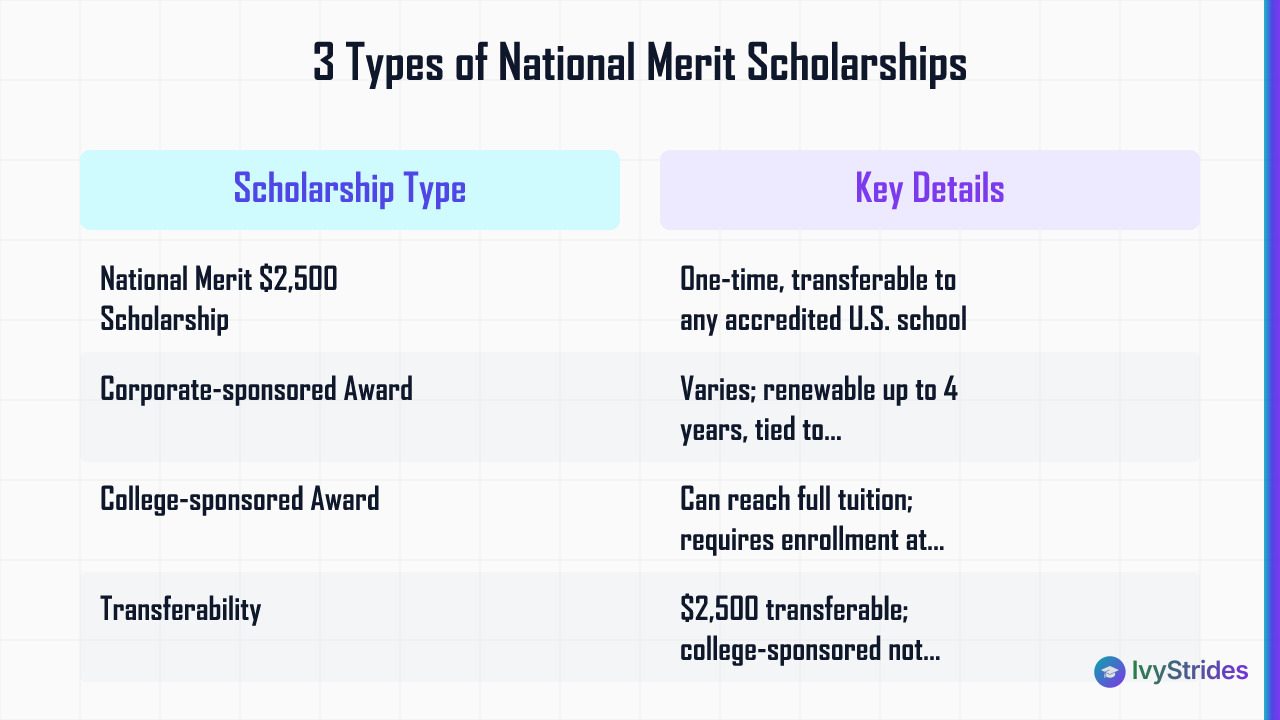
Three types of National Merit scholarships exist, and they're often confused. The differences matter for planning.
National Merit $2,500 Scholarship: a one-time award, transferable to any regionally accredited U.S. institution. This is the "base" award most people picture when they hear "National Merit Scholar." Meaningful recognition, but $2,500 against a $90,000 sticker price is not a life-changing financial award on its own.
Corporate-sponsored National Merit Scholarships: sponsored by companies, often tied to employees' children or students planning to major in specific fields. Amounts vary widely, and some are renewable for up to four years. If a parent's employer is an NMSC corporate sponsor, that eligibility can be significant.
College-sponsored National Merit Scholarships: the largest financial opportunity. These come from participating universities and require enrollment at the sponsoring institution. Awards can reach full tuition or full-ride status. The University of Alabama, the University of Oklahoma, the University of Southern Mississippi, and others have historically offered generous packages to enrolled Finalists and Scholars. Because these awards require enrollment, they aren't transferable, and exact amounts and eligibility rules change year to year. Verify directly with each university's financial aid office.
Colleges that offer large college-sponsored National Merit awards often review the full academic profile, including AP course load and AP exam scores, when deciding which Finalists receive their institutional scholarship. If a college-sponsored National Merit award is a real financial target for your family, strengthening your AP profile through our ap courses online becomes a parallel investment, not a separate one.
For students whose target list runs in a different direction, like the highly selective private universities, National Merit recognition functions as a credential rather than a scholarship path. Full-tuition college-sponsored awards are concentrated at flagship public universities that use them for merit-based recruiting. That's a real decision families make with eyes open: Should You Apply to Duke University? Key Factors Explained is a different question than "should I use my National Merit status at Alabama?"
The National Merit Timeline: From October PSAT to Spring Scholarship Announcement
The only PSAT/NMSQT administration that counts for National Merit entry is the one taken in October of 11th grade, so knowing the exact test dates and registration window is the first logistical step. Miss the window and you miss the competition for that year, with no makeup path.
Here's the timeline students and parents should be tracking:
- October of junior year: PSAT/NMSQT administered. For the Class of 2026, the qualifying test was October 2024.
- December/January: PSAT scores released through College Board. This is when you calculate your Selection Index and compare against your state's estimated cutoff.
- September of senior year: Semifinalist announcements released. Notifications come through your high school, not directly to you.
- Fall of senior year: Semifinalist Online Scholarship Application window opens. Exact deadlines communicated by NMSC to designated Semifinalists.
- February of senior year: Finalist announcements released.
- Spring of senior year: Scholar announcements begin, with most college-sponsored awards announced by May.
Register for the PSAT/NMSQT through your high school, not directly through College Board. Homeschool students should contact a local participating high school by the summer before junior year to arrange testing. Confirm dates on the College Board PSAT/NMSQT page and cross-check with PSAT test dates 2026. To gauge whether your practice scores forecast the outcome you need, check are your PSAT results good enough for SAT success.
How to Raise Your Selection Index Before the Qualifying PSAT
If your current score sits roughly 10 to 20 Selection Index points below your state's cutoff, a structured PSAT prep plan starting in 9th or 10th grade is the most reliable way to close that gap before the qualifying test.
Our approach starts every plan with a full-length PSAT diagnostic. That single test tells us four things: your current Selection Index, your section-level gap (ERW versus Math), the specific question types costing you the most points, and how much runway you have before October of junior year.
Here's the math that makes the Selection Index feel movable rather than mysterious. Each of the three test scores (Reading, Writing and Language, Math) ranges from 8 to 38. A 5-point gain on each of the three produces a 30-point Selection Index improvement, because the sum is doubled. Most students don't need equal gains across all three; they need targeted gains on the sections where the diagnostic exposed the biggest weaknesses.
Section-specialist coaching matters here. In our coaching, students paired with a separate ERW specialist and a separate Math specialist typically close specific skill gaps faster than students working with a generalist tutor across both sections. A qualitative pattern we see: students in high-competition states with a roughly 10 to 15 point Selection Index gap who work section-specialist plans consistently reach Semifinalist range more often than those who prep casually across both sections. Coaches are organized by section on our tutors page.
For students in high-competition states, even a 10 to 15 Selection Index point gap requires structured, diagnostic-driven prep rather than casual review. A fair question worth asking early: is the PSAT harder than the SAT? The content overlap is significant, which means PSAT prep pays double dividends into SAT performance. Spaced retesting using full-length PSAT practice tests roughly every 4 to 6 weeks confirms whether targeted work is translating into Selection Index gains, or whether the plan needs adjustment.
FAQ
Does a 1400 PSAT score qualify for National Merit?
A 1400 PSAT total translates to a Selection Index of roughly 210 to 214 depending on how the score is split between ERW and Math. That range qualifies in some states, typically lower-competition states with cutoffs around 207 to 212, but falls short in high-competition states like New Jersey or Massachusetts where the cutoff reaches 220 to 222. Check your state's specific cutoff for the Class of 2026 against your calculated Selection Index, not your total score.
How rare is it to become a National Merit Scholar?
National Merit Scholars represent less than 1% of the roughly 1.5 million students who enter the competition each year. About 16,000 are named Semifinalists, roughly 15,000 advance to Finalist, and approximately 7,500 receive a scholarship. A Finalist has roughly a 50% chance of winning a scholarship, but reaching Finalist status in the first place requires a Selection Index score in the top 1% of students in your state.
Can you get a full ride through National Merit?
The base National Merit Scholarship is $2,500, a one-time award. Several universities, however, offer college-sponsored National Merit awards that can cover full tuition or provide a full-ride package to Finalists or Scholars who enroll. The University of Alabama, the University of Oklahoma, and the University of Southern Mississippi have historically offered generous packages. These awards require enrollment at the sponsoring institution and are not transferable, and specific amounts change year to year, so verify directly with each university's financial aid office.
What is the National Merit Scholarship essay prompt?
The Semifinalist application includes a brief personal essay submitted through the NMSC Online Scholarship Application. NMSC does not publish the exact prompt publicly in advance; Semifinalists receive the prompt and instructions when they're notified of their status in September of senior year. The essay is one component of the application alongside the academic record, school endorsement, and confirming SAT or ACT score.
Are homeschool and international students eligible for National Merit?
Homeschool students are eligible if they take the PSAT/NMSQT at a participating high school during the specified administration and meet all other NMSC requirements. International students who are U.S. citizens or lawful permanent residents and are enrolled in a U.S. high school are also eligible. Students attending school outside the United States at a school that administers the PSAT/NMSQT may also be eligible; contact NMSC directly for specific circumstances.
What is the difference between a Commended Student and a Semifinalist?
Both designations recognize high PSAT performance, but only Semifinalists advance in the scholarship competition. Commended Students score just below the Semifinalist cutoff for their state, and roughly 34,000 students receive this recognition each year. Commended status doesn't come with a scholarship but is a meaningful academic credential for college applications. Semifinalists, by contrast, are in the top 1% of students in their state by Selection Index and are eligible to apply for scholarship awards.
Where to Go From Here
National Merit is a lever you can move, but only if you start from a real diagnostic and a clear gap analysis against your state's cutoff. The students who reach Semifinalist range are rarely the ones who prepped hardest. They're the ones who prepped most specifically.

Award-winning author (South Asian Book Award) and graduate of BITS Pilani and UCLA Luskin School of Public Affairs. Brings a published writer's eye to Common App essays and grammatical precision to SAT and ACT R&W instruction.