
How Much Does the PSAT Cost? The Honest, Data-Backed Answer for 2026
On this page
- What the PSAT Costs in 2026: The College Board Fee Explained
- What You Actually Pay for the PSAT: School Fees, Waivers, and Add-Ons
- Is the PSAT Worth Paying For? A Grade-by-Grade Answer
- PSAT Costs for International Students and Homeschoolers: What Changes
- FAQ: PSAT Cost and Score Value
- Does it cost money to take the PSAT?
- Is a 400 PSAT score good?
- Is $1500 good for PSAT?
- Can you take the PSAT for free?
- Your Next Step on the PSAT Cost Question
The College Board sets the PSAT/NMSQT and PSAT 10 base fee at $18 for 2026-27; the PSAT 8/9 is $14. The PSAT/NMSQT is the College Board's pre-SAT assessment and the qualifying exam for the National Merit Scholarship Program. Students rarely pay $18 directly, because schools pay it and many absorb the cost.
Those figures come from the College Board's District and School Pricing page, cited in full below. The harder question, and the one this page settles, is whether you personally will owe anything and whether the fee earns its place for your grade.
What the PSAT Costs in 2026: The College Board Fee Explained
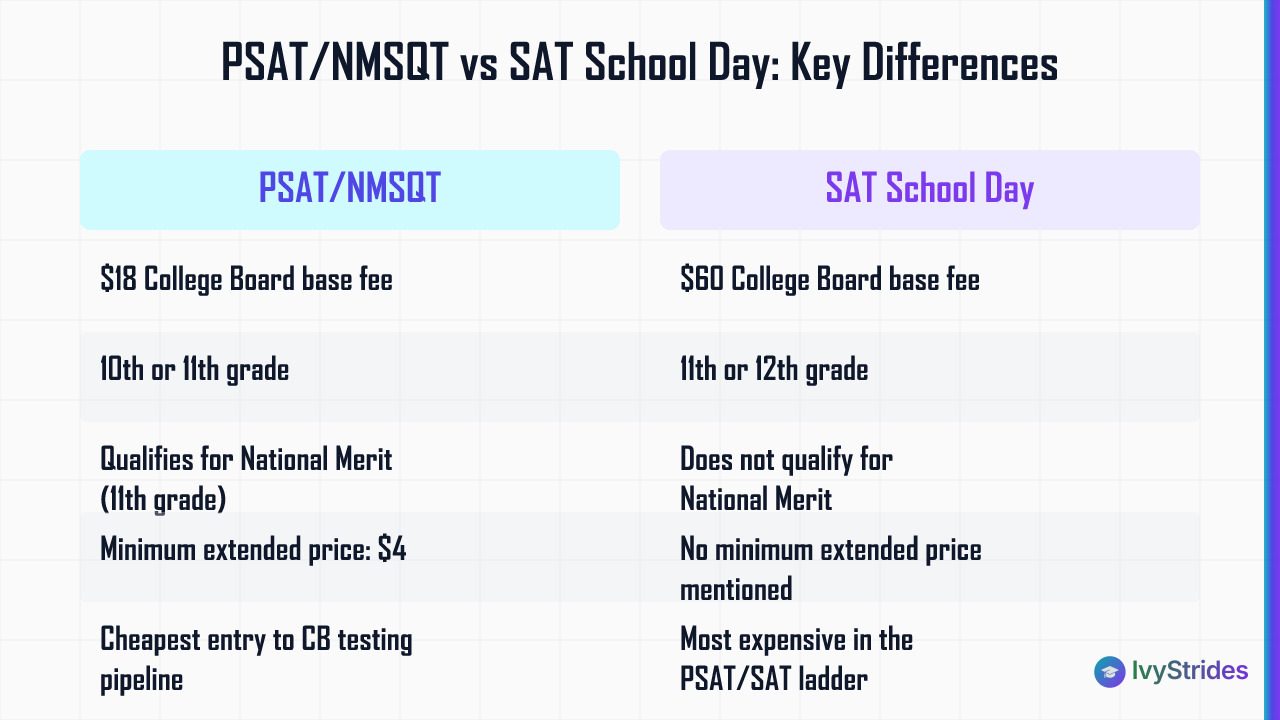
The PSAT/NMSQT base fee is $18 for 2026-27, matched by the PSAT 10 at $18 and undercut by the PSAT 8/9 at $14. These are the College Board list prices schools pay per student, not a checkout figure a family sees on a personal account.
The PSAT sits inside the SAT Suite of Assessments, the College Board's grade-tiered ladder of exams. Here is what each version costs and which one matters for scholarships.
| Exam | Grade | College Board Base Fee | Qualifies for National Merit? |
| PSAT 8/9 | 8th or 9th | $14 | No |
| PSAT 10 | 10th | $18 | No |
| PSAT/NMSQT | 10th or 11th | $18 | Yes (11th grade scores) |
| SAT School Day | 11th or 12th | $60 | No |
The list price is a floor, not a ceiling. After school-level adjustments and grants, the minimum extended price can drop to $4 for the PSAT/NMSQT, PSAT 10, and PSAT 8/9. That is a school-side figure, so no student pays $4 out of pocket unless the school passes an unusually low fee straight through.
Compare the $18 PSAT/NMSQT fee to the $60 SAT School Day fee and the gap is the whole point: the PSAT is the cheapest entry to the College Board's testing pipeline. That low fee is exactly why the value question later in this article is not really about the money.
What You Actually Pay for the PSAT: School Fees, Waivers, and Add-Ons
What you actually pay for the PSAT depends entirely on your school, and it lands in one of three scenarios: the school covers it, the school passes the fee to you, or a fee waiver zeroes it out. Because the PSAT uses school-administered registration rather than a personal College Board account, the school is your billing counter, not the College Board.
Registration itself runs through your school, not through a personal College Board account, so the first step is confirming your school's sign-up deadline. That single fact reshapes the cost picture. The PSAT carries no late-registration fee, because you never register individually the way you would for the SAT.
Scenario one, school pays. Many high schools absorb the full $18 for every student and administer the test as a school day. In that case the PSAT is free to you, and you owe nothing.
Scenario two, school passes the fee. Other schools bill the $18 back to families, sometimes with a small administrative surcharge for proctoring and materials. That local add-on often rounds the total to around $20. The school sets the surcharge, not the College Board, so the only way to know your number is to ask your counselor.
Scenario three, fee waiver. Fee waivers are available for eligible 11th graders who demonstrate financial need, and they remove the student-side cost entirely. Your school counselor administers the waiver; the College Board does not process it directly, and a waiver is not confirmed until the counselor verifies eligibility.
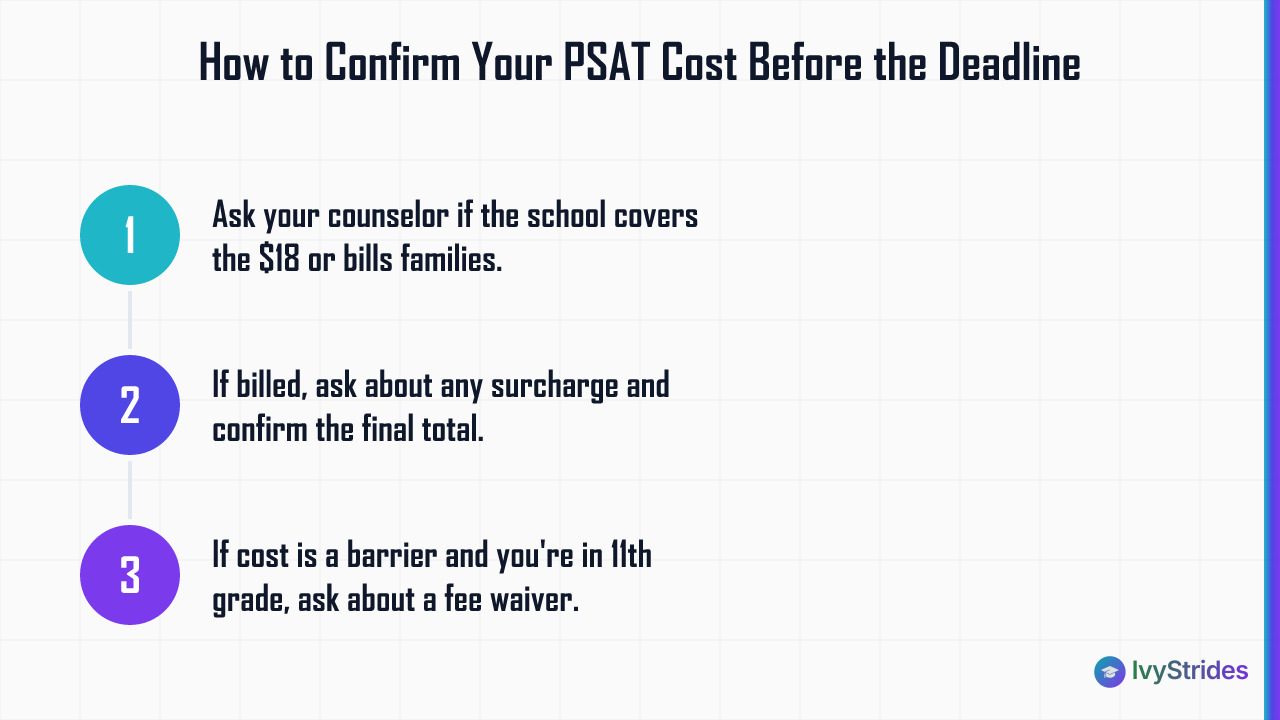
Use this short sequence before your school's deadline.
-
Ask your counselor whether the school covers the $18 or bills it back to families.
-
If billed, ask whether an administrative surcharge applies and what the final total is.
-
If cost is a barrier and you are in 11th grade, ask your counselor about a fee waiver and what documentation it needs.
Once you know the school handles payment, the next practical questions are the PSAT test dates 2026 and how the sign-up flow works. If you want the full walkthrough, our guide on how to register for the PSAT covers the counselor conversation step by step.
Is the PSAT Worth Paying For? A Grade-by-Grade Answer
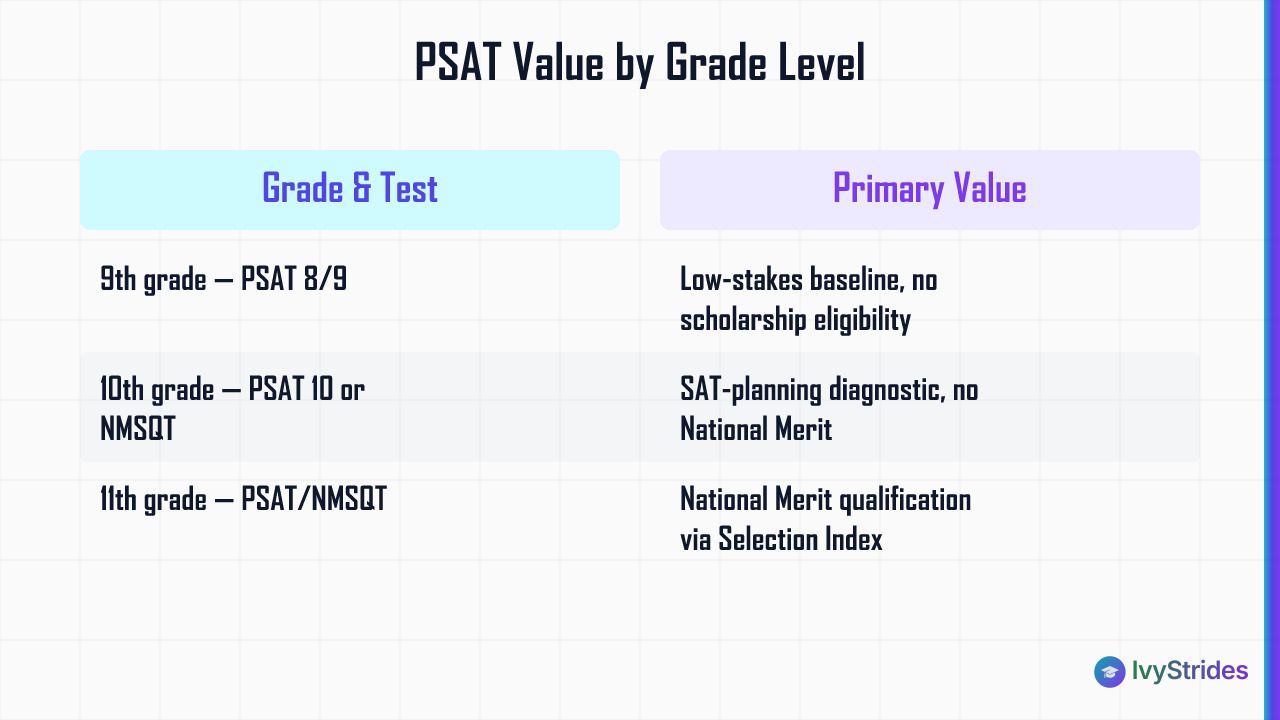
Whether the PSAT is worth $18 depends almost entirely on your grade, because only 11th-grade PSAT/NMSQT scores feed the National Merit Scholarship Program. A fee that is optional for a 9th grader is close to mandatory for an 11th grader chasing recognition.
The same three scenarios that decide your fee, school pays, school bills, or waiver, barely move the value math, since the dollar figure is small either way. What changes the value is what the score does for you.
| Grade | Which PSAT | National Merit Eligible? | Primary Value |
| 9th | PSAT 8/9 | No | Low-stakes baseline |
| 10th | PSAT 10 or PSAT/NMSQT | No | SAT-planning diagnostic |
| 11th | PSAT/NMSQT | Yes | National Merit qualification |
Ninth grade. A 9th grader gets a low-stakes first read on the digital format and a score to measure growth against. Nothing counts toward scholarships, so treat it as free data if the school covers it.
Tenth grade. A 10th grader uses the result as a diagnostic to shape SAT planning. The PSAT/NMSQT scores on a range of 320 to 1520, the same 160-to-760 section scale you will see on the SAT, so a sophomore score tells you which section needs the most work first.
Eleventh grade. This is the year the $18 buys something you cannot buy later. Only the PSAT/NMSQT, not the PSAT 10 or PSAT 8/9, qualifies a student for National Merit. The National Merit Scholarship Corporation (NMSC) screens entrants using the Selection Index, which runs 48 to 228. You get it by doubling the Reading and Writing section score, adding the Math score, and dividing by 10. College Board publishes the formula and the section ranges; IvyStrides applies them to confirm the 48-to-228 scale.
For 11th graders in competitive states, the Selection Index cutoff can sit above 220, which makes the $18 fee the cheapest possible entry to a scholarship worth thousands. NMSC sets those cutoffs by state and by year, and College Board does not publish them, so treat any specific number you see online as unofficial.
In our coaching with 11th graders, the students who skip the PSAT over the $18 fee are often the same ones who later wish they had a Selection Index baseline when SAT prep begins.
Once you know the fee is covered, the next question is how many weeks of prep it takes to make the October test date count. A diagnostic-first plan earns its place here: IvyStrides PSAT prep maps a student's current baseline to the Selection Index range that matters in their state, so juniors know before October whether the gap is closable.
Two links worth following from here. Our guide on how long should you study for the PSAT sets a realistic week count. is the PSAT a good predictor of the SAT explains how far a sophomore score forecasts the real thing.
PSAT Costs for International Students and Homeschoolers: What Changes
International students and homeschoolers pay the same $18 base fee for the PSAT/NMSQT, but access, not price, is the real hurdle. Because the PSAT uses school-administered registration, no individual sign-up route exists; you take it through a participating school.
The same fee a US junior sees applies abroad, so the cost logic from the school-fee scenarios above carries straight over. What differs is finding a host site and confirming eligibility.
| Student Situation | How to Access the PSAT | Fee | National Merit Eligible? |
| US school | Through your own school | $18 (often covered) | Yes, 11th-grade PSAT/NMSQT |
| International | Through a participating school abroad | $18 base | Only with US citizenship/residency |
| Homeschool | Through a nearby host school | $18 base | Only with US citizenship/residency |
Homeschoolers contact a local participating school to arrange a seat, ideally in late summer before the October window. International students at an American or international school abroad usually take it on the same schedule as their US peers.
One eligibility rule matters regardless of fee: National Merit requires US citizenship or lawful permanent residency, plus intent to become a citizen where relevant. An international student who is not a citizen or permanent resident can still sit the PSAT/NMSQT, but the scores will not feed NMSC screening.
Across students we work with internationally, the practical barrier is finding a host school, not the fee itself. Even without National Merit eligibility, the 320-to-1520 score is a useful SAT diagnostic, which is why many international juniors still take it. If you are unsure which version your school offers, our breakdown of the PSAT 8/9 vs. PSAT 10 vs. PSAT/NMSQT differences sorts it out, and structured PSAT prep coaching can build the plan once the seat is confirmed.
FAQ: PSAT Cost and Score Value
Does it cost money to take the PSAT?
It depends on your school. The College Board charges schools $18 per student for the PSAT/NMSQT. Many schools absorb that cost entirely, so students pay nothing. Others pass the fee to families, sometimes with a small administrative surcharge. Eligible 11th graders can apply for a fee waiver through their school counselor.
Is a 400 PSAT score good?
No. The PSAT/NMSQT scores on a scale of 320 to 1520, so 400 sits near the bottom of the range and well below the national average of roughly 930. Treat a score at that level as a diagnostic starting point for SAT prep, not a benchmark to celebrate. Score interpretation is a bigger topic than the fee question, so it has its own dedicated guide.
Is $1500 good for PSAT?
A 1500 PSAT/NMSQT score is exceptional. The maximum is 1520, so 1500 places a student near the very top of test-takers and comfortably above the Selection Index level that National Merit Semifinalist consideration usually requires. For context, the national average sits around 930. Exact cutoffs still vary by state and year, and NMSC is the only authority on them.
Can you take the PSAT for free?
Yes, in two ways. First, many schools pay the $18 fee for every student, making the test free to take. Second, eligible 11th graders who demonstrate financial need can apply for a College Board fee waiver through their school counselor, which removes the student-side cost entirely. A counselor confirms eligibility before the waiver applies.
Your Next Step on the PSAT Cost Question
You now know the fee, who pays it, and whether it earns its place in your grade. The number is small; the decision is not.
- Confirm with your counselor whether the school covers the $18 or bills it back.
- If cost is a barrier and you are in 11th grade, ask about a fee waiver early.
- Register before your school's internal deadline, well ahead of the October window.
- Treat the score as a diagnostic first, and a National Merit stake second if you are a junior.
Award-winning author (South Asian Book Award) and graduate of BITS Pilani and UCLA Luskin School of Public Affairs. Brings a published writer's eye to Common App essays and grammatical precision to SAT and ACT R&W instruction.