
Is Free PSAT Prep Enough to Make National Merit? An Honest Answer
On this page
- The Short Answer: It Depends on Your Score Gap and Your State
- What Score Do You Actually Need? National Merit Cutoffs by State
- How Free PSAT Prep Resources Actually Work (and Where They Stop)
- The Score-Gap Framework: When Free Prep Is Enough and When It Is Not
- What a 1300, 1400, or 1470 PSAT Score Means for Your SAT and Admissions
- Does the PSAT Really Matter for College Admissions?
- A Practical Prep Plan: How to Use Free Resources Strategically
- FAQ
- What is a 1470 PSAT equivalent to on the SAT?
- How many students score 1520 on the PSAT?
- Does a 1400 PSAT qualify for National Merit?
- Is free official PSAT prep good enough?
- Is a 1270 PSAT score good?
- When should a student start preparing for the PSAT?
- Where This Leaves You
For most students, free PSAT prep is enough to reach the average score range (roughly 1010 for both 10th and 11th graders, per College Board percentile data). Reaching a National Merit Semifinalist cutoff is a different problem. Cutoffs run from around 1400 in low-competition states to about 1520 in California, and whether free prep is enough depends almost entirely on the gap between your current score and your state's number. Free resources handle format familiarity and foundational skills. They don't handle personalized gap analysis.
Format and scoring specifics in this article come from the College Board's PSAT/NMSQT page; cutoff figures come from the National Merit Scholarship Corporation and are historical approximations that shift year to year. The harder question, what to do with your specific score gap, is where the next section starts.
The Short Answer: It Depends on Your Score Gap and Your State
The Digital PSAT/NMSQT scores on a 320 to 1520 scale across two adaptive sections: Reading and Writing (160-760) and Math (160-760), per the College Board. National Merit Semifinalist cutoffs, released each September by NMSC after the prior October's test, sit roughly between 1400 and 1520 depending on where you live. That range is enormous. A 1460 puts a student comfortably above the cutoff in Wyoming, Montana, or North Dakota. That same 1460 falls short in California, New Jersey, Maryland, and Massachusetts.
So the first number to establish isn't "what's a good PSAT score." It's "what's the current cutoff in my state, and how far am I from it?" The free official resources most students start with, the Bluebook app practice tests and College Board's official free digital practice, are excellent for learning the test's shape. They aren't built to close a specific 90-point Reading and Writing section gap for a specific student. In our coaching with students aiming for National Merit, the state cutoff is the first number we establish before recommending any prep path. For a broader benchmark, here's our reference on what is a good PSAT score.
What Score Do You Actually Need? National Merit Cutoffs by State
National Merit uses a Selection Index, not the composite score most students memorize. Before deciding whether free prep is enough, you need a concrete target: a good PSAT score for National Merit purposes isn't the same as a good score for general college readiness, and the difference can be roughly 150 to 200 points.
The Selection Index equals (Reading and Writing score + Math score) × 2, capped at 1520 on the same scale as the composite. NMSC then sets a state-by-state Semifinalist cutoff based on roughly the top 1% of test takers in each state, with a national Commended Scholar threshold at approximately the top 3-4%. Because the top 1% of any given state's testing pool differs sharply, cutoffs stratify by tier.
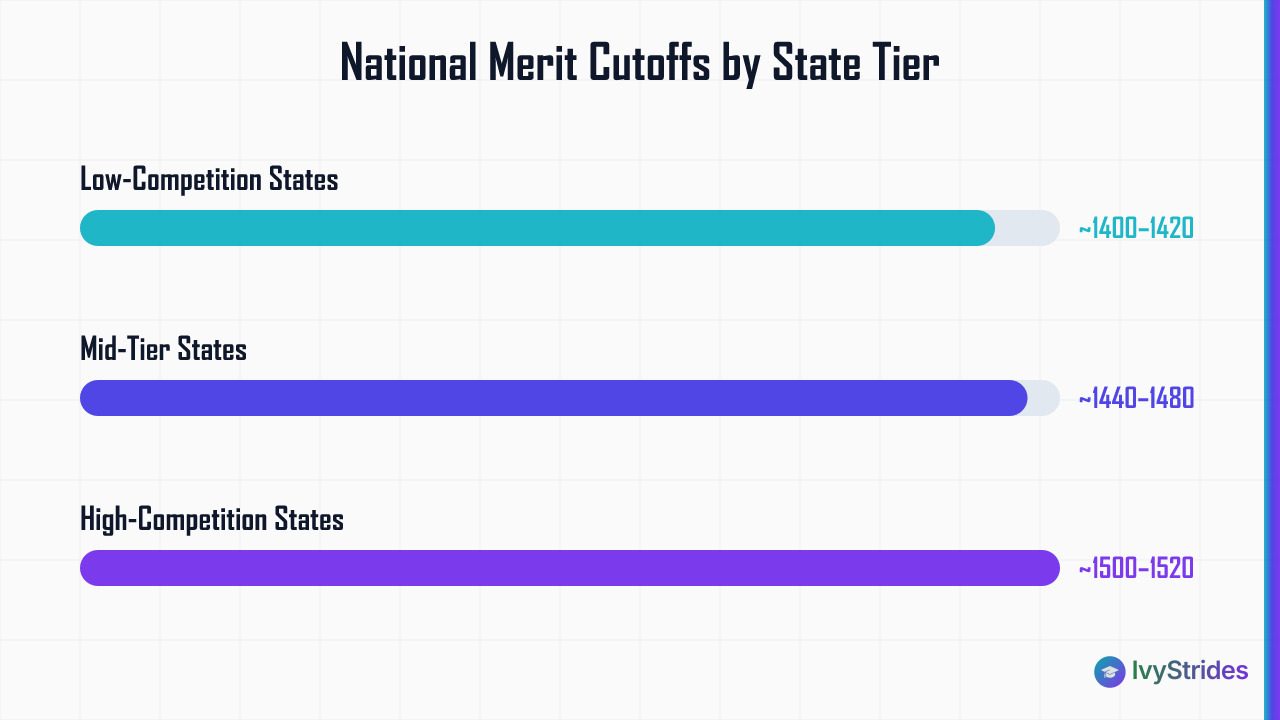
Historically, low-competition states (Wyoming, Montana, North Dakota, West Virginia) have settled around 1400 to 1420. Mid-tier states across much of the Midwest and Southeast land roughly around 1440 to 1480. High-competition states (California, Maryland, New Jersey, Massachusetts, Washington, Virginia, D.C.) run roughly 1500 to 1520. The National Merit Scholarship program uses a state-specific Selection Index cutoff, not a national composite threshold, so a student in California needs a meaningfully higher score than a student in Wyoming to reach Semifinalist status.
Cutoffs are announced about 11 months after the October test administration, which means a November 2025 test-taker won't know the official 2026 cutoff until September 2026. Plan against the prior two years' cutoff for your state and add a small buffer.
A 1470 means very different things in different zip codes. In our coaching with juniors in Iowa or Alabama, a 1470 typically clears the cutoff with room to spare. In California, that same 1470 sits roughly 40 to 50 points short of what's usually needed. A perfect 1520 is the only truly safe score nationwide, and it lives inside the 1490-1520 band that College Board reports as the 99th percentile for 11th graders. Very few students hit a clean 1520. Treat it as a stretch ceiling, not a base case.
For deeper mechanics on how the Selection Index is calculated and how NMSC moves students from Semifinalist to Finalist, see our full write-up on National Merit Scholarship cutoffs and Selection Index. Sophomores wondering how their October result fits the picture should also read our benchmarks on good PSAT scores for 10th graders. One caveat worth stating plainly: cutoff numbers cited in any online article, including this one, are historical approximations. Verify your state's most recent published cutoff on NMSC's site before you finalize a target.
How Free PSAT Prep Resources Actually Work (and Where They Stop)
The two most common free resources are the official Bluebook app from College Board and the College Board's free digital practice through its official learning partner. Both use real, retired PSAT and SAT items, and both replicate the digital adaptive format that debuted in fall 2023. Because the PSAT and SAT share the same question types, adaptive structure, and scoring logic, strong PSAT prep and strong SAT prep overlap almost entirely, which means time invested in PSAT prep compounds directly into SAT readiness.
Here's what free resources genuinely do well. Bluebook simulates the actual test-day interface, including timing (about 2 hours 14 minutes total per the College Board), the two-module Reading and Writing and Math sections, and the between-module break. Official personalized practice diagnoses which of the four content domains you're weakest in (Craft and Structure, Information and Ideas, Standard English Conventions, and Expression of Ideas on the Reading and Writing side; Algebra, Advanced Math, Problem-Solving and Data Analysis, and Geometry and Trigonometry on the Math side) and serves practice questions in those areas. For a student who has never opened the test, that's genuinely useful and genuinely free.
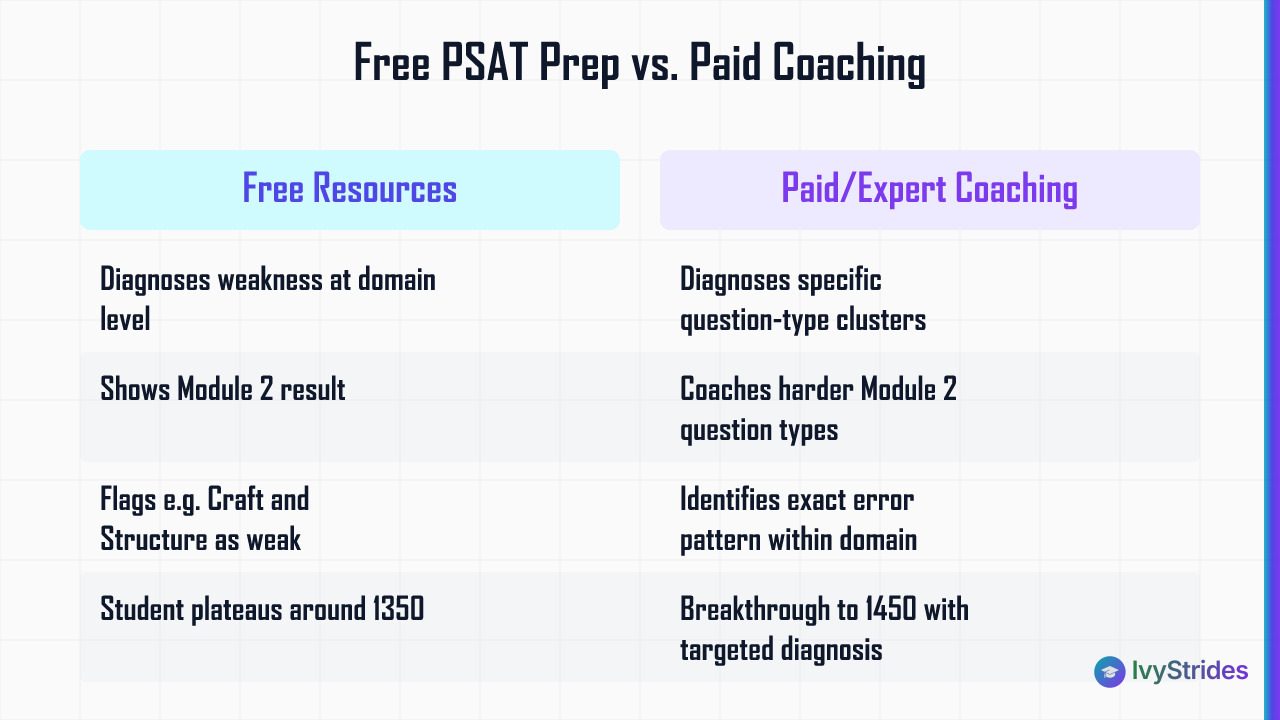
Where they stop is granularity. Free platforms cluster errors at the domain level. They'll tell you Craft and Structure is your weakness. They won't tell you that within Craft and Structure, you're consistently missing Rhetorical Synthesis questions when the answer requires identifying the primary rhetorical goal rather than a secondary one, and that your Command of Evidence errors all come on questions where the passage presents contradictory data. That second layer of diagnosis separates a plateau at 1350 from a breakthrough to 1450. In our coaching, students who plateau on free personalized practice typically have a specific cluster of roughly 3 to 5 question types driving their score ceiling, and a diagnostic review with a section-specialist coach surfaces the pattern in one session.
Two other honest points. First, free downloadable PSAT practice test PDFs exist on the College Board site, but the digital Bluebook practice is a far better simulation, because the paper format no longer matches the real exam. Second, the adaptive nature of Module 2 means score ceilings live in the harder Module 2 questions. If your Module 1 performance routes you to the easier Module 2, your absolute score ceiling drops. Free practice will show you your Module 2 result but rarely coaches the specific harder-Module-2 question types.
For a fuller breakdown of the format overlap, see the difference between PSAT and SAT. If you want structured practice under real timing conditions, our library of PSAT practice tests is built for that.
The Score-Gap Framework: When Free Prep Is Enough and When It Is Not
Here's the rule we use with families on the free strategy call. Take a full-length Bluebook practice test. Subtract your composite from your state's National Merit cutoff. The size of that gap decides your path.
Gap of 0 to 80 points. Free prep, used with discipline, is often sufficient. You already know the test's mechanics. You need targeted repetition on your weakest 3 to 5 question types, an error log, and 2 to 3 more full-length timed practice tests before October. A student at 1420 in Iowa (historical cutoff around 1440) fits here. Budget roughly 3 to 4 hours per week for about 8 to 10 weeks.
Gap of 80 to 200 points. Structured, diagnostic-driven prep is typically the honest answer. In our coaching with students in the 1250 to 1380 band targeting a 1450+ cutoff, meaningful movement usually requires roughly 10 to 15 hours of targeted section-specialist work beyond what free resources provide, spread across about 10 to 14 weeks. Gains come from spaced retesting against specifically identified weaknesses, not from generic drill volume. Free practice can be part of the plan. It's rarely the whole plan.
Gap of 200+ points. You need a multi-cycle plan and realistic expectations. A student at 1200 targeting 1470 is looking at roughly 8 to 12 months of consistent work across both sections, and the honest framing with parents is that National Merit is a stretch goal, not a base-case outcome. What is achievable in that window is a strong SAT score, and in our coaching a 1200 PSAT often becomes a 1400+ SAT for students completing the 1-on-1 program. That's a serious admissions asset even without Semifinalist status.
Grade matters too. The grade you're in when you take the PSAT changes the stakes significantly: a 10th grader has time to course-correct with free resources, while an 11th grader taking the qualifying test has a single shot at National Merit. For a fuller view of how prep should shift between sophomore and junior year, see our guide to PSAT strategy by grade. Students aiming for National Merit are often the same students taking multiple AP courses, and coordinating PSAT prep timing around AP exam season is a practical scheduling consideration worth planning early.
One more piece of the framework: no prep plan, free or coached, works without a diagnostic starting point. If a second full-length practice test after about 4 weeks of targeted work shows less than 40 points of movement, that's the signal to escalate. Continuing the same unguided approach for another month rarely changes the trajectory. When families reach that point, that's when we usually recommend looking at 1-on-1 PSAT prep with a section-specialist coach.
What a 1300, 1400, or 1470 PSAT Score Means for Your SAT and Admissions
The PSAT and SAT sit on nearly the same scale for a reason. Question types, adaptive modules, content domains, and scoring logic are aligned. The PSAT tops out at 1520 and the SAT tops out at 1600, which means the PSAT compresses slightly at the high end but tracks the SAT closely everywhere else.
Using College Board concordance framing as a directional estimate: a 1300 PSAT typically indicates a starting SAT range of about 1300 to 1350 with no additional prep. That's roughly the top 10 to 15% of test takers, above average but not competitive for National Merit in any state, and below the median score at highly selective universities. A 1400 PSAT corresponds to an SAT range of about 1400 to 1450, which sits at the low end of the middle-50% range at several top-30 schools. A 1470 PSAT points to an SAT range of about 1470 to 1520, placing the student in roughly the top 1 to 2% of test takers. That 1470 is a Semifinalist score in most of the country and borderline in the most competitive states.
For admissions specifically, the PSAT score itself is never submitted to colleges. What you eventually submit is your SAT (or ACT). The PSAT matters through two channels: it qualifies juniors for National Merit, and it predicts SAT readiness. A 1470 PSAT taken in October of junior year, followed by about 3 to 4 months of continued prep, frequently becomes a 1500+ SAT for students completing our 1-on-1 program. That's admissions-relevant. The PSAT number itself isn't.
Two caveats worth surfacing plainly. Test-optional policies vary by school and by year; check the current status of any school you're targeting through FairTest before you assume scores are or aren't required. And college admissions depend on the full application, not test scores alone. National Merit Finalist status is a meaningful signal. It isn't a substitute for a strong GPA, essays, and course rigor.
For related score-band context, see is the PSAT harder than the SAT and our benchmark analysis on is 1280 a good PSAT score.
Does the PSAT Really Matter for College Admissions?
Direct answer: for most students, the PSAT matters in three specific ways, and none of them involve submitting the score to a college.
First, National Merit. If you reach Semifinalist status and then Finalist, that recognition goes on your application. It carries genuine weight, and some universities (a handful of large public flagships and select privates) attach specific scholarship packages to Finalist status. Scholarship amounts and eligibility rules vary by institution; verify with each school's financial aid office rather than trusting a third-party list.
Second, the PSAT is the most accurate SAT predictor available. In our coaching, students who take it seriously in 10th grade arrive at 11th-grade SAT prep with a measurable head start, typically about 60 to 100 points ahead of students who did no prep at all. That's a repeatable pattern across cohorts, not a marketing claim.
Third, it's a low-stakes rehearsal for the digital adaptive format. Test-day pacing, module transitions, the Bluebook interface, the between-module break, the mental fatigue of a 2-hour-plus adaptive test, all of it is easier to handle the second time. Sophomore PSAT gives you that first time.
What the PSAT doesn't do: it isn't submitted to colleges as a stand-alone score. National Merit Finalist status can strengthen a college application, but it works alongside, not instead of, a strong personal statement and supplemental essays. Students planning heavy junior-year AP course loads should coordinate PSAT prep to avoid collision with AP exam season in early May. October PSAT prep and May AP prep don't overlap directly, but the year-long study capacity does. Our ap courses online are structured to sit alongside SAT/PSAT prep on a coordinated calendar. For a broader view of how PSAT results predict SAT readiness, see PSAT results and SAT readiness.
A Practical Prep Plan: How to Use Free Resources Strategically
Use free resources in this order. Skipping a step wastes weeks.
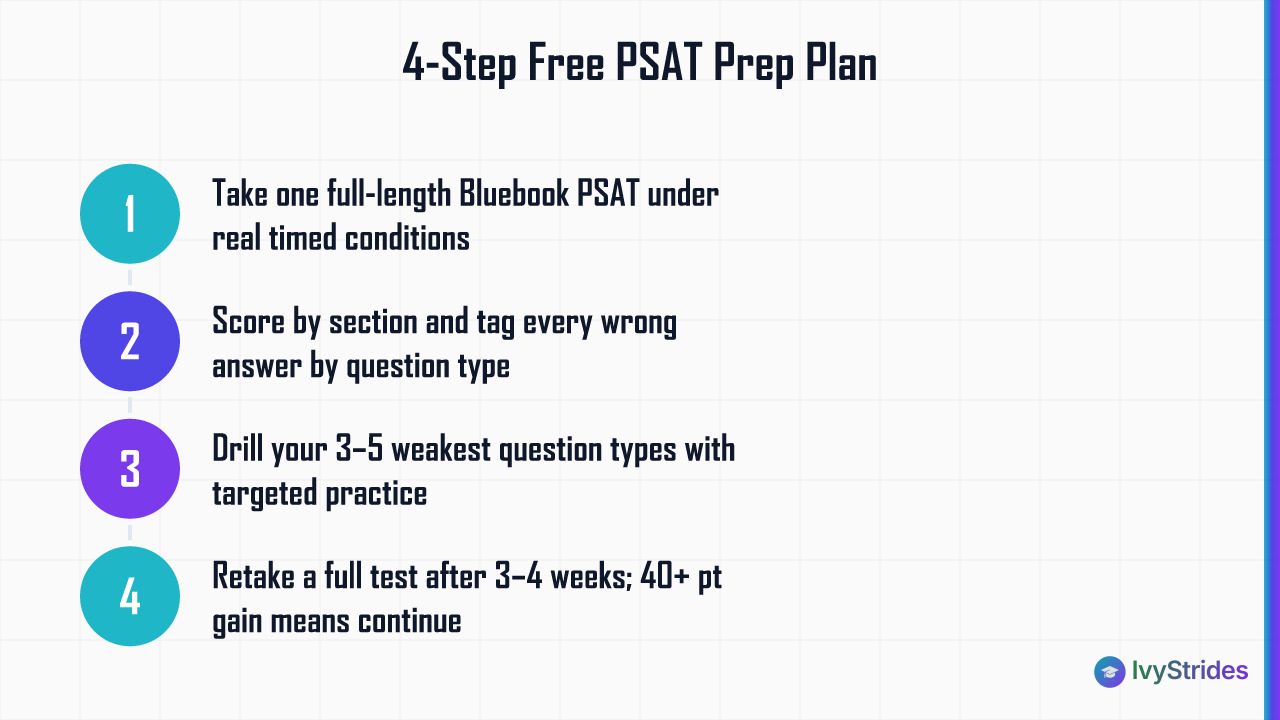
Step 1: Take one full-length Bluebook PSAT practice test under real timing. That's 2 hours 14 minutes with the scheduled break, phone in another room, no pausing. Anything less than a real simulation gives you an inflated baseline and a false sense of where you stand.
Step 2: Score by section and identify your error patterns. Don't just look at the composite. Break out Reading and Writing and Math separately. Then go one level deeper: within each section, tag every wrong answer by question type (Rhetorical Synthesis, Command of Evidence, Words in Context, Systems of Equations, Linear Functions, and so on). You want to identify the 3 to 5 question types with the highest error rate. This is the single highest-use habit in free prep. In our coaching, students who track errors this way consistently outperform students who retake tests without this analysis, even with identical hours logged.
Step 3: Drill those specific question types, not random practice. Official personalized practice can serve targeted questions in your weak domains. Use it for that, not for generic mixed sets. If you can't get enough targeted volume from one platform, other free official College Board practice materials cover the same domains.
Step 4: Retake a second full-length practice test after about 3 to 4 weeks of targeted work. If your composite improved by 40 or more points, the plan is working. Continue. If improvement is under 40 points, the plateau signal is real, and adding a diagnostic session with a section-specialist coach is the logical next step.
A realistic time budget: roughly 3 to 4 hours per week for about 8 to 10 weeks before the October test date is the honest baseline for meaningful score movement. Daily 30 to 45 minute focused sessions retain better than 2-hour marathon sessions. For a lightweight tool to keep your error log organized, our sat mistake tracker works for PSAT prep too, since the question domains are shared. Confirm your test date early: PSAT test dates 2026 walks through the fall administration window.
FAQ
What is a 1470 PSAT equivalent to on the SAT?
A 1470 PSAT corresponds closely to a 1470 to 1520 SAT range, since both tests use the same scoring logic and question types. The PSAT ceiling of 1520 compresses slightly against the SAT's 1600 ceiling, so the very top of the PSAT scale maps to the very top of the SAT scale. Treat the conversion as a directional predictor, not a guarantee. SAT performance still depends on continued preparation and test-day execution.
How many students score 1520 on the PSAT?
A 1520 is a perfect PSAT score. For 11th graders, the 1490 to 1520 band represents around the 99th percentile according to College Board percentile data. The number of students hitting a clean 1520 nationally is a small fraction of the top 1%. For 10th graders, the top 1% threshold is slightly lower, roughly 1420 to 1520, since sophomores are earlier in their content preparation.
Does a 1400 PSAT qualify for National Merit?
Sometimes. In low-competition states (Wyoming, Montana, North Dakota, West Virginia), cutoffs have historically hovered around 1400 to 1420, making a 1400 borderline competitive. In high-competition states (California, New Jersey, Maryland, Massachusetts), cutoffs run closer to 1510 or 1520, which puts a 1400 well below the line. Always verify the current year's cutoff for your specific state through NMSC's announcement in September.
Is free official PSAT prep good enough?
Official free resources are strong for foundational skill-building and format familiarity, especially for students roughly 100 to 200 points below their target. The official College Board sourcing means question types and difficulty calibration are accurate. Where they fall short is granular personalization: free platforms can't identify the specific 3 to 5 question-type patterns holding an individual student back the way a diagnostic session with a section-specialist coach can. For students targeting National Merit cutoffs in competitive states, treat free resources as a supplement to, not a replacement for, targeted coached practice.
Is a 1270 PSAT score good?
A 1270 places a student in roughly the top 10% of test takers, which is a solid result for general college readiness. It isn't competitive for National Merit Semifinalist status in any state, since cutoffs begin around 1400. A student at 1270 aiming for National Merit is looking at a 130 to 250 point gap, which typically requires structured, diagnostic-driven prep rather than free resources alone. For SAT purposes, a 1270 PSAT usually translates to a starting SAT range of about 1270 to 1320.
When should a student start preparing for the PSAT?
For 11th graders taking the qualifying October PSAT, starting in June or July of the summer before gives roughly 10 to 14 weeks of runway, which is sufficient for meaningful movement with consistent effort. For 10th graders, the PSAT isn't the National Merit qualifier, so pressure is lower. Treat it as a diagnostic baseline and start light prep in September. In our coaching, students who begin with a full-length diagnostic practice test at least about 8 weeks before test day consistently outperform students who begin in the final two weeks.
Where This Leaves You
The honest answer to "is free PSAT prep enough" depends on your gap, your state, and your grade. Take the Bluebook practice test. Find your state's cutoff. Do the subtraction. If the gap is under about 80 points and you're disciplined, free resources can carry you. If it's larger, honestly assess whether unguided prep has closed similar gaps before. If it hasn't, the diagnostic conversation is the fastest way to find out what's actually holding your score back. You can meet the tutors who coach at each score band. To learn more about how we work, read our about page.

Award-winning author (South Asian Book Award) and graduate of BITS Pilani and UCLA Luskin School of Public Affairs. Brings a published writer's eye to Common App essays and grammatical precision to SAT and ACT R&W instruction.