
Does Applying Early Action Increase Your Chances? What the Numbers Can and Cannot Show
On this page
- What Early Action Acceptance Rates Actually Show at Selective Schools
- Why Early Action Acceptance Rates Can Mislead: The Self-Selection Effect
- When Early Action Gives You a Real Edge and When It Does Not
- Is Your Application Ready for an Early Action Deadline?
- Early Action vs. Early Decision: Which Round Actually Moves the Needle More
- FAQ: Early Action and Your Admission Chances
- What is the downside to early action?
- Is it better to apply ED or EA?
- Does early action increase chances of scholarships?
- Does early action increase chances at schools like UT Austin or UMich?
- Your Next Step on Early Action
Early action is a non-binding early round, and MIT, Yale, Harvard and UT Austin all say it gives no admissions advantage: you get an earlier answer, not better odds. Harvard adds that its higher early admit rate reflects the strength of its applicant pool rather than timing. Where a school does claim an edge, as Duke does, the round is binding early decision: Penn admitted 1,266 early decision applicants for a fall 2025 entering class of 2,420.
The raw rate gap is real, but it mixes two things: who applies early and how a school builds its class. Sort those apart and the decision gets clearer. For fall 2027 entry, the November 1 early deadlines at Harvard, Yale, Princeton, MIT and Penn have passed, so if you have not applied yet, the live question is whether to use a round still open or spend the extra weeks strengthening the file for regular decision.

What Early Action Acceptance Rates Actually Show at Selective Schools
Early-round admit rates at selective schools often run well above regular decision rates. Each school's Common Data Set reports early decision applicants and admits, and many schools announce early action results themselves.
The gap is real, but it does not prove that timing caused the admit. Harvard says its higher Restrictive Early Action admit rate reflects "the remarkable strength of the applicant pool" rather than a benefit of timing, and that any one student's decision would likely be comparable in either round.
Here are the published figures from three selective schools. Two of the three early rounds are binding early decision, not non-binding early action, which matters for how you read them.
| School | Early round | Admitted early | Regular or all rounds | Source and year |
| Duke | Early decision (binding) | 13.7% of ED applicants | 3.7% of RD applicants | Duke admissions FAQ, 2025-2026 |
| Penn | Early decision (binding) | 1,266 of 9,503 | 3,570 of 72,544, all rounds | Penn Common Data Set 2025-26, fall 2025 class |
| Yale | Single-choice early action (non-binding) | 779 of 7,140 | 2,328 of 54,919, all rounds | Yale News, Class of 2030 (fall 2026 entry) |
Penn's early decision admit rate sits well above its all-rounds rate. Duke's early decision rate runs several times its regular rate, and Duke says applying early decision "has an advantage in the admissions process." Both rounds are binding, so neither shows what a non-binding early action round would do.
Why Early Action Acceptance Rates Can Mislead: The Self-Selection Effect
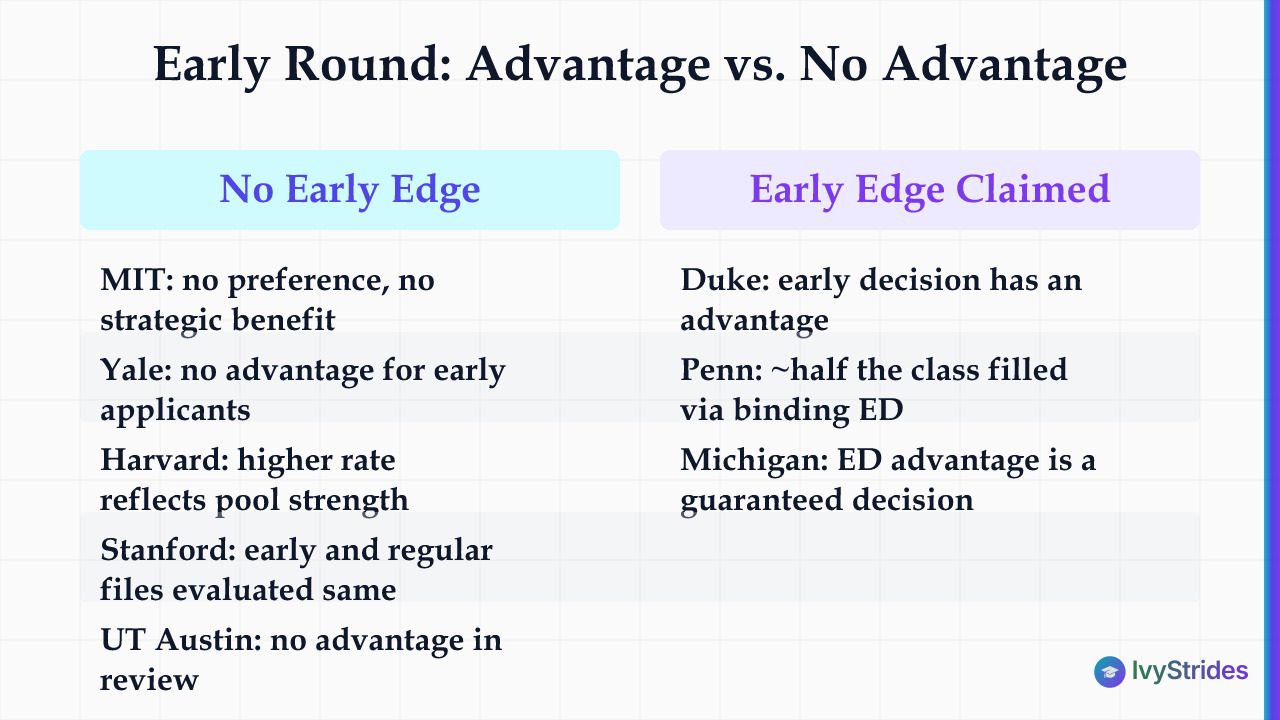
The self-selection effect is the reason early action acceptance rates can mislead. Students choose their round, and if those with finished, strong files are the ones who choose to apply early, the early pool starts out stronger before timing plays any role. Harvard describes that pattern in its own early round, which is why the gap alone proves nothing about timing.
Some schools say so outright. MIT says there is no strategic benefit to applying early action rather than regular action; only the deadlines differ. UT Austin says its October 15 early action deadline gives no advantage in review, and Yale says it gives early applicants no advantage. When a school publishes that position, take it at face value.
| School | Early plan | What the school says about an early edge |
| MIT | Early action, non-restrictive | No preference, no strategic benefit |
| Yale | Single-choice early action | No advantage for early applicants |
| Harvard | Restrictive early action | Higher early rate reflects pool strength, not timing |
| Stanford | Restrictive early action | Early and regular files evaluated the same way |
| UT Austin | Early action, non-binding | No advantage in review |
| Duke | Early decision, binding | Early decision has an advantage |
| Michigan | Binding ED, nonbinding EA | Chief ED advantage: a guaranteed decision date |
Binding rounds are where class composition bites. Penn admitted 1,266 early decision applicants for a fall 2025 entering class of 2,420 (its Common Data Set 2025-26), so about half the class had committed before regular decision results went out. Non-binding rounds account for many offers too: 779 of Yale's 2,328 Class of 2030 admits came through early action, yet Yale gives early applicants no advantage. A large early share is a reason to prioritize an early deadline only when your file is ready, and the pressure is strongest where the round is binding.
Daily SAT and ACT prep on YouTube: short strategy videos from IvyStrides. Subscribe to IvyStrides on YouTube.
When Early Action Gives You a Real Edge and When It Does Not
Early action is worth it when your application is fully ready by the school's early deadline; where a school states no advantage, what you gain is an earlier answer. It can hurt when your essays or scores are not ready, because some early denials are final: Yale and MIT do not let a student denied early apply again in the regular round.
Timing is the second test. With most November 1 early deadlines for fall 2027 now passed, a file that needs more work can go to a round still open: binding early decision II at schools such as Vanderbilt, due January 1, 2027, or a regular deadline such as UT Austin's December 1 or Yale's January 2. An earlier answer is worth less than a stronger file.
Restrictive early action changes the calculus. Harvard, Yale and Princeton use a restrictive or single-choice early action plan, which is non-binding but bars early applications to other private US colleges and binding early plans at public universities, with narrow exceptions; Stanford's Restrictive Early Action sets its own limits on its admissions page. Borderline scores raise the stakes, because a rushed submission locks in a weaker file.
Test policy interacts with timing. For fall 2027 entry, MIT, Yale and Penn require the SAT or ACT, while Duke is test-optional for the 2026-2027 cycle. FairTest tracks test-optional schools, but each college's own testing page sets its policy. For score ranges, the federal NCES College Navigator lists 25th, 50th and 75th percentile SAT and ACT scores of enrolled first-time students wherever a school reports them. Admissions outcomes depend on the full application, not timing alone.
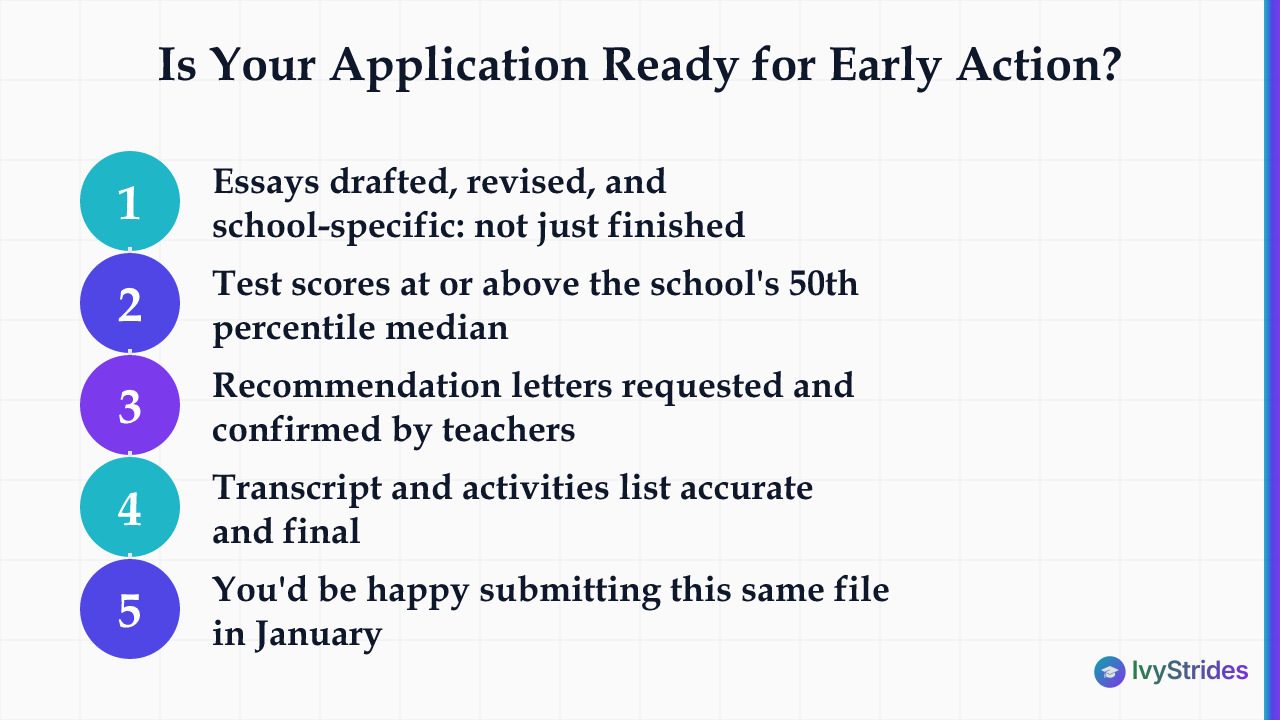
Is Your Application Ready for an Early Action Deadline?
- Personal essay drafted, revised, and at its best, not merely finished
- Supplemental essays for each early school complete and school-specific
- Test scores at or above the school's median (50th percentile) for enrolled students, if you are submitting them
- Recommendation letters requested and confirmed by your teachers
- Transcript and activities list accurate and final
- You would be happy submitting this same file in January
Readiness is the gating variable, and it is hard to judge from inside your own file. IvyStrides' counseling for 11th and 12th graders puts strategy, counseling and essay coaching in one plan: essays coached draft by draft, early applications submitted with every requirement checked, then regular-round applications completed and decisions weighed from December to the deposit.
Early Action vs. Early Decision: Which Round Actually Moves the Needle More
Early decision is the round where a school may state an edge, as Duke does, while MIT, Yale and UT Austin say their non-binding early rounds give none. That lift comes at a cost early action never charges: once admitted under early decision, you must enroll and withdraw your other applications.
The readiness test from the section above still gates both rounds. A binding commitment does not rescue a file that is not ready; it just locks you into the result.
| Factor | Early Action | Early Decision |
| Binding? | No | Yes, you must enroll |
| Stated edge | None at MIT, Yale or UT Austin | Duke says yes |
| Financial aid | Not bound; compare offers before you commit | Commit before comparing offers |
| Apply elsewhere early? | Yes, unless the plan is restrictive | No second binding early plan |
| Second round? | Varies by school | ED II at some, such as Vanderbilt |
| Best when | File ready, want options | Clear first choice, aid fine |
A binding offer means accepting one aid package without comparing others, so settle whether early decision is workable when you need financial aid before you commit. Duke itself tells students who want to compare aid packages to apply regular decision.
The decision rule is short. Choose early action when the school is not a clear first choice or when comparing aid offers matters. Choose early decision when the school is your clear first choice and aid is not a constraint. If neither fits, applying regular decision instead of early gives your file the extra months.
FAQ: Early Action and Your Admission Chances
What is the downside to early action?
The main downside is submitting before the file is ready: at Yale and MIT, an early denial rules out a regular-round application in the same cycle. Restrictive early action also limits your other early applications. A deferral moves your file to the regular round instead, and what a deferral signals about your application shapes what you send next.
Is it better to apply ED or EA?
Duke says its binding early decision round has an advantage, but early decision commits you before you can compare aid offers. Early action is the better choice when the school is not a clear first choice, or when comparing aid packages matters to your family.
Does early action increase chances of scholarships?
Timing matters most where a scholarship has its own deadline. Vanderbilt sets December 1, 2026 for merit scholarship applications, a month before its January 1, 2027 regular deadline, and Harvard's restrictive early action rules allow a non-binding early application elsewhere when a scholarship requires that timing. Check each school's scholarship page before choosing a round.
Does early action increase chances at schools like UT Austin or UMich?
UT Austin says its October 15 early action deadline gives no advantage in review; it brings a decision or deferral by January 15, 2027, and its regular deadline is December 1. Michigan offers binding early decision alongside nonbinding early action and names a guaranteed decision date as the chief advantage of early decision. Always check the school's own admissions page for its stated early action policy.
Your Next Step on Early Action
Early action rewards a ready file, not an early calendar. The higher early rate you see can reflect a stronger pool and, in binding rounds, class composition, so the question that decides your next move is whether your application is at its best by the deadline still ahead of you. Start there.
- Confirm each target school's early round type: standard EA, restrictive EA, or ED.
- Check whether the school fills a large share of its class early, using its Common Data Set or class profile.
- Compare your scores against the school's published middle-50% band before deciding to submit them.
- Finish and revise every essay to the point where you would be glad to send it in January.
- If any piece is not ready, use the extra weeks for regular decision rather than rushing early.
College admissions insights on LinkedIn: follow IvyStrides for application guidance and counseling updates.

Hemant is a seasoned entrepreneur, investor, and growth strategist with deep ground in education and technology-driven learning. His core training is in Mathematics and Physics — he authored Physics for IB Diploma: Ultimate Revision Guide, recognized as a top student resource.