
MIT Early Action Brings No Strategic Benefit: How to Pick Your Round
On this page
- Does MIT Early Action Actually Help Your Odds?
- MIT Early Action Requirements: What the Nov 1 File Must Include
- How to Decide Between MIT Early Action and Regular Action
- What Happens If MIT Defers Your Early Action Application
- FAQ: MIT Early Action Questions
- Is MIT Early Action binding?
- How many students does MIT accept through Early Action?
- Can I apply to both Harvard and MIT Early Action?
- Does MIT Early Action help your chances compared to Regular Action?
- Your Next Step on the MIT Round Decision
MIT Early Action is a non-binding, non-restrictive early round with a November 1 deadline and mid-December decisions. Applying EA does not commit you to enroll or block you from applying elsewhere. MIT also says applying early carries no advantage.
That last line comes straight from MIT's admissions office, stated plainly on its blog. So the round you pick is a readiness question, not a strategy lever. The real work is deciding whether your file is genuinely finished by late October.

Does MIT Early Action Actually Help Your Odds?
MIT Early Action is non-binding and non-restrictive: an EA admit can decline the offer, and MIT itself places no limits on applying early to other schools at the same time, though any restrictions those schools set still apply (MIT Admissions). That structure matters because it removes the usual reason an early round lifts your odds. A binding commitment signal does not exist here.
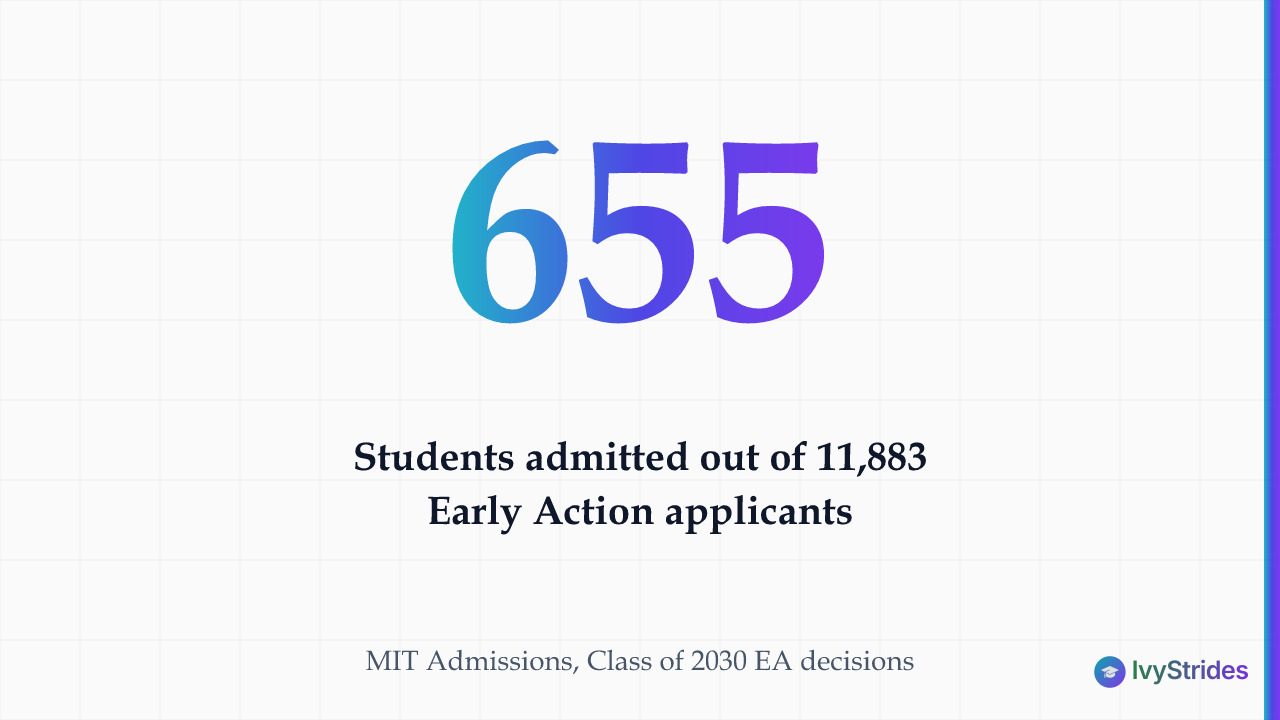
Early numbers need context. For the Class of 2030, MIT offered admission to 655 of the 11,883 students who applied Early Action. Even where an early rate looks higher, that is not an advantage. The EA pool self-selects toward applicants whose files were ready in October, which skews it stronger.
A stronger pool produces a higher admit rate even when the round itself grants nothing. MIT states this directly: there's no strategic benefit to applying Early Action. Read that as freedom, not warning. You submit when your file is strong, not to chase a number.
This is where non-restrictive EA differs from binding Early Decision at other schools. Under ED at a school like Penn or Duke, the acceptance-rate gap partly reflects a real enrollment promise. MIT asks for no such promise, which is why how binding Early Decision compares to non-restrictive Early Action changes how you read every early-round statistic.
One rule carries real weight. A student denied EA cannot reapply in Regular Action the same cycle (MIT Admissions). You apply once per entry year, EA or RA, not both.
| Factor | Early Action | Regular Action |
| Binding? | No | No |
| Deadline | November 1 | January 4 |
| Decisions | Mid-December | Mid-March |
| Outcomes | Admitted, denied, or deferred | Admitted or denied |
| Reapply if denied? | No | Not applicable |
| Application portal | MIT portal | MIT portal |
MIT Early Action Requirements: What the Nov 1 File Must Include

Photo by https://kaboompics.com/ on Pexels
You submit the MIT Early Action file through the MIT application portal, not the Common App, by November 1, with decisions in mid-December (MIT Admissions). Those decision dates follow directly from the round structure above. Here, you will not reuse a Common App personal statement.
Because MIT runs its own portal, the writing load is specific. MIT requires four short-answer essays of roughly 100 to 200 words each and four short responses of 40 to 50 words each (MIT Admissions). Those eight pieces stay identical regardless of round, so essay readiness is a primary factor in whether November 1 is realistic. If you haven't started drafting the eight MIT essays and short responses by early October, Regular Action is usually the honest call.
Scores are a hard constraint. MIT is test-required for the 2026-27 cycle, so you must submit an SAT or ACT score, and score readiness shapes your EA timing (MIT Admissions). A borderline score and a planned retake can decide the round for you, which is why MIT's SAT and ACT score requirements belong in your timeline now, not in December. Test-required policies vary by school and year; MIT requires scores for this cycle.
MIT's activity form caps you at four activities, filled on MIT's own form rather than a resume (MIT Admissions). MIT requires two teacher letters, recommending one from a math or science teacher and one from a humanities, social science, or language teacher (MIT Admissions). An alumni Educational Counselor conducts an interview if available; MIT waives it with no adverse effect when it cannot offer one, and the Common Data Set rates the interview Important (MIT CDS 2025-26).
| Component | Notes |
| Application form | MIT portal, not Common App |
| Deadline | November 1 for EA; January 4 for RA |
| SAT or ACT | Required; submit an SAT or ACT score |
| Short-answer essays | Four, about 100 to 200 words each |
| Short responses | Four, 40 to 50 words each |
| Activities | Four maximum, on MIT's form |
| Teacher letters | Two, math/science plus humanities recommended |
| Interview | Alumni EC if available, waived if not |
How to Decide Between MIT Early Action and Regular Action
The MIT Early Action decision comes down to one test: is your file genuinely complete and competitive by late October, or are you rushing it to beat a deadline? Because MIT requires those teacher letters, essays, and scores by November 1, that readiness check is concrete.
One limit sits outside MIT's control: Harvard's Restrictive Early Action and the Single-Choice Early Action programs at Yale and Princeton each rule out an Early Action application to MIT, a private university, so none of them can be paired with MIT EA. MIT itself sets no limits on other early applications, but it requires you to follow the rules of any restrictive early program you also apply to (MIT Admissions).
That flexibility means the round is almost never the reason to wait. The reason is readiness. MIT rates Character/personal qualities as Very Important and does not consider alumni relation or state residency (MIT CDS 2025-26), so your short responses and activities have to show initiative, collaboration, and hands-on creativity, the values MIT names on its own what-we-look-for page. A rushed file rarely does.
The students best positioned for EA are those whose files are complete and competitive by late October, not those who rush to meet the deadline. Before you weigh the acceptance-rate gap, check whether your activity narrative and short responses reflect MIT's values around initiative and hands-on creativity.
If Harvard, Princeton, or Yale is also on your list, the early round becomes a real choice: spending your one restrictive early pick on any of them means applying to MIT in Regular Action, and choosing MIT EA means applying to those three in their regular rounds. If your SAT or ACT score sits below MIT's middle 50%, the round choice matters less than whether a borderline score supports an early submission given a realistic retake.
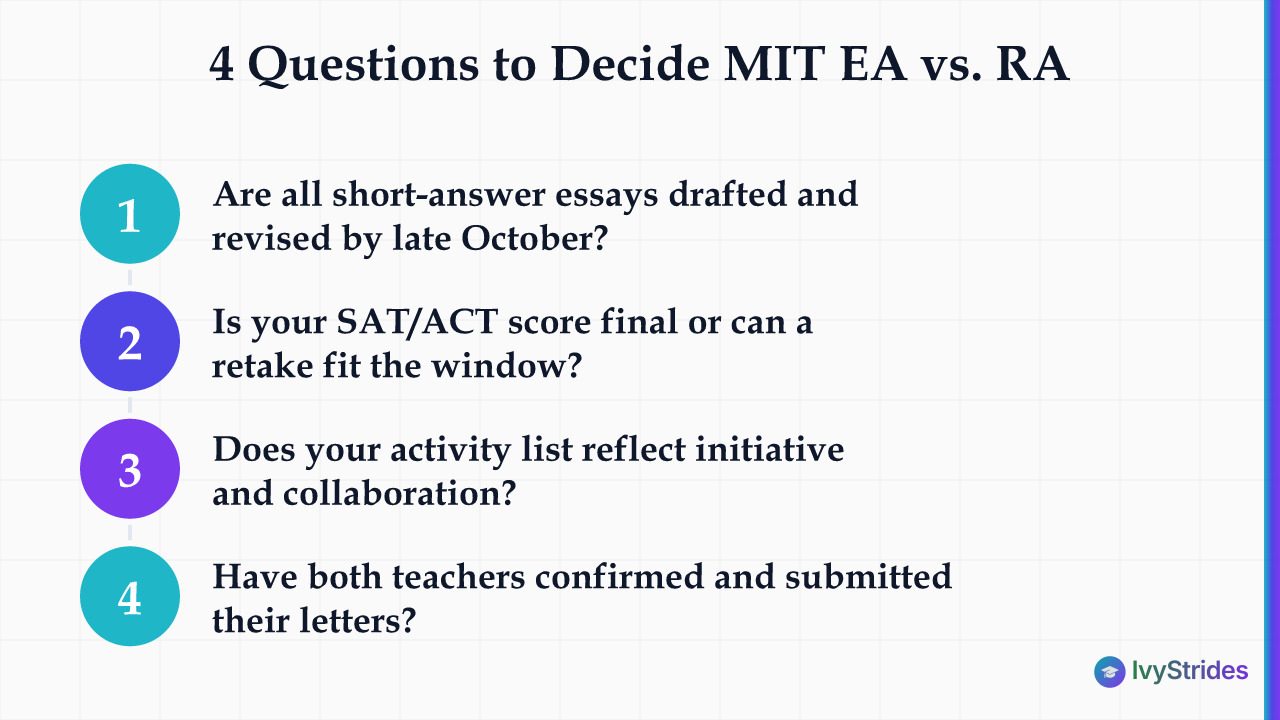
Four questions settle it:
-
Are all four short-answer essays and four short responses drafted and revised, not just outlined, by late October?
-
Is your SAT or ACT score final, or can a retake clear the submission window?
-
Does your four-activity list reflect initiative and collaboration, not just titles?
-
Have both teachers confirmed and submitted their letters?
A clear activity narrative and strong course rigor build over several years, so a file that is genuinely EA-ready by October starts well before senior year. IvyStrides' counselors review your full file against MIT's published selection values to help you weigh EA against RA, as part of grade-by-grade college admissions planning.
What Happens If MIT Defers Your Early Action Application
A deferred MIT Early Action application moves into the Regular Action pool for a second read; admit, defer and deny are the three possible EA outcomes (MIT Admissions). Deferral is not a soft rejection. MIT defers a substantial share of its EA applicants, and those files compete fully in March.
Once your file re-enters the RA pool, the February Updates and Notes form is the one update MIT asks you to send. MIT's deadline table lists the FUN form, with midyear grades if available, "for deferred EA, admitted EA, and admitted RA students" (MIT Admissions). Knowing what a deferral signals and what to do next helps you use that form to turn a holding decision into a concrete next move.
The one tactical move that counts. If your SAT or ACT score improved after your EA submission, self-reporting the new score in the application portal is one of the few concrete ways to strengthen a deferred file. Remember the hard rule: a student denied EA, as opposed to deferred, cannot reapply RA the same cycle (MIT Admissions). Deferral keeps you in; denial ends the cycle.
| Outcome | What It Means | Your Next Step |
| Admitted | Offer of a place | File the FUN form; decide by the May reply deadline |
| Deferred | Moved to RA pool | File the FUN form with new grades |
| Denied | Cycle over for this year | Cannot reapply RA this cycle |
FAQ: MIT Early Action Questions
Is MIT Early Action binding?
No. MIT Early Action is non-binding and non-restrictive. Admitted EA students are not required to enroll and can keep applying to other schools. MIT's one limit is that you cannot apply both EA and RA in the same entry year, but restrictive early programs elsewhere, such as Harvard's, Yale's, and Princeton's, do not allow an MIT EA application alongside them.
How many students does MIT accept through Early Action?
For the Class of 2030, MIT offered admission to 655 of the 11,883 students who applied Early Action and deferred 7,738 to Regular Action (MIT Admissions). Those numbers are not a strategic advantage: the EA pool self-selects toward applicants whose files were ready in October.
Can I apply to both Harvard and MIT Early Action?
No, not both in the early round. Harvard's Restrictive Early Action bars an Early Action application to any other private institution, and MIT is private. Harvard does allow non-binding early applications to public universities, military academies, and universities outside the United States, but MIT is none of these, and Yale's and Princeton's Single-Choice Early Action programs rule out MIT EA in the same way. You can apply to Harvard REA and MIT in Regular Action, or to MIT EA and Harvard in Regular Decision.
Does MIT Early Action help your chances compared to Regular Action?
No. MIT's admissions office says applying early carries no strategic advantage. The EA pool self-selects toward applicants whose files are ready by November 1, which is why early numbers can look stronger. File readiness matters more than round choice.
Your Next Step on the MIT Round Decision
The round is a readiness question, not a strategy move. MIT grants no edge for applying early, so the honest work is checking whether your file is finished and competitive by late October. Admissions outcomes depend on the full application, not the round you pick.
- Confirm all four short-answer essays and four short responses are drafted and revised, not outlined.
- Lock your SAT or ACT score, or schedule a retake that clears the submission window.
- Review your four activities against MIT's stated values of initiative and collaboration.
- If deferred, prepare the February Updates and Notes form with midyear grades, and self-report any new score in the application portal.

Rajesh is a technology leader, entrepreneur, and angel investor with 28+ years in Business & Technology Leadership and Product & Solution Engineering. He is passionate about education, mentoring, and driving digital transformation.