
UPenn Early Decision Acceptance Rate: 13%, by Penn's Own Numbers

On this page
- UPenn Early Decision Acceptance Rate: What Penn's Own Numbers Show
- Is Applying Early Decision to UPenn Actually Easier Than Regular Decision?
- What the UPenn Early Decision Application Actually Requires
- How to Decide Whether UPenn Early Decision Is the Right Move for Your Profile
- FAQ: UPenn Early Decision Acceptance Rate
- Is it easier to get into UPenn Early Decision?
- Can I get into UPenn with a 1300 SAT?
- Is it harder to get into UPenn or Princeton?
- What is the UPenn Early Decision acceptance rate for international students?
- Your Next Step on Penn Early Decision
UPenn's Early Decision acceptance rate was about 13% for the Class of 2029: 1,266 admitted from 9,503 ED applications, per Penn's Common Data Set 2025-26. The overall rate for that class was 4.9% (3,570 of 72,544), so binding Early Decision ran roughly 2.7 times higher.
Penn publishes the counts, not the percentages, so IvyStrides divides the admits by the applications to get both rates. One point the raw gap hides: ED and Regular Decision draw very different applicant pools, so a 13% figure does not mean any single student's odds triple.
UPenn Early Decision Acceptance Rate: What Penn's Own Numbers Show
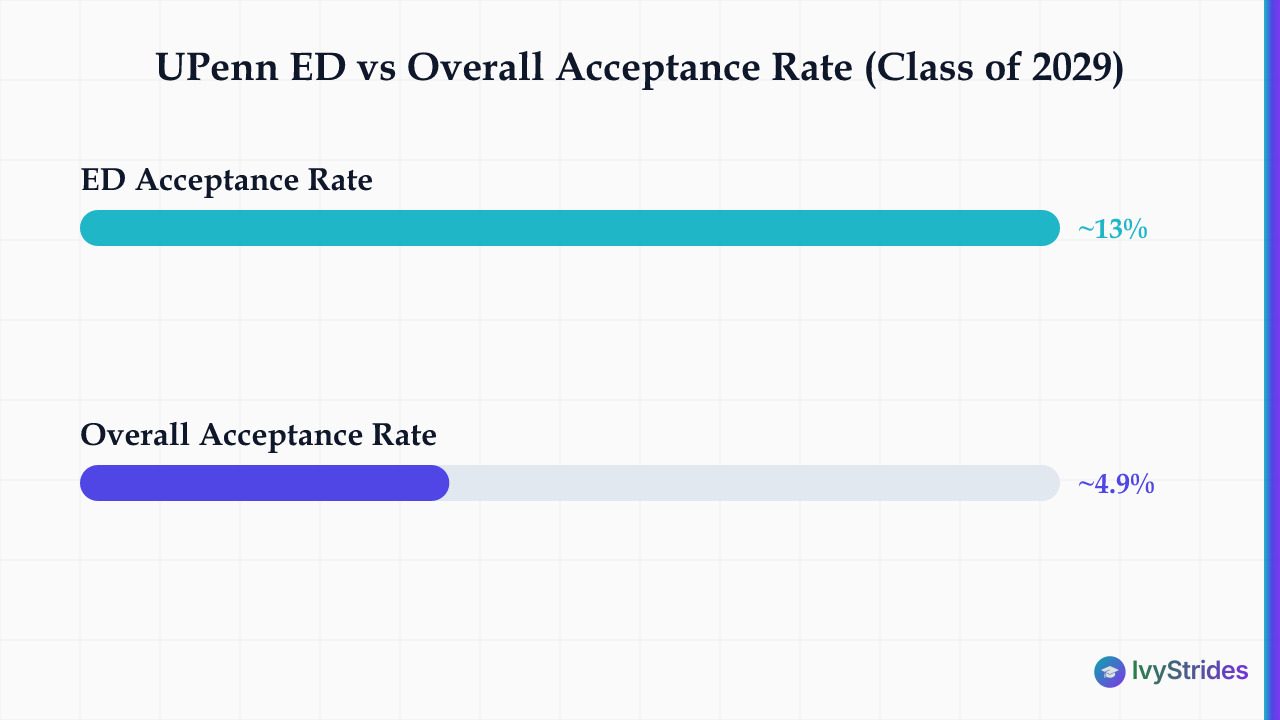
UPenn Early Decision is Penn's binding first-round admissions plan, and it admitted about 13% of applicants for the Class of 2029. A student who applies ED to Penn commits to enrolling if admitted and to withdrawing every other application. That commitment is signed by the student, a parent, and the school counselor.
Where the number comes from. Penn's Common Data Set 2025-26 reports 9,503 ED applications and 1,266 ED admits for the Class of 2029. IvyStrides divides one by the other for the roughly 13% ED acceptance rate. The same document (section C1) gives 72,544 total applicants and 3,570 admits, so the overall rate lands near 4.9%.
The newer Class of 2030 tells a second part of the story. Penn's Incoming Class Profile reports 61,264 total applications and states that about 52% of the enrolled class was admitted through Early Decision, with 2,416 students enrolling.
Penn does not publish a Class of 2030 ED rate, so keep that 52% separate from the Class of 2029 CDS figures. They answer different questions: one is your odds in the round, the other is how much of the class the round fills.
| Class Year | ED Applications | ED Admits | Estimated ED Rate | ED Share of Class |
| 2029 (fall 2025) | 9,503 | 1,266 | ~13% | not published |
| 2030 (fall 2026) | not published | not published | not published | ~52% |
IvyStrides calculates the Class of 2029 ED rate from the CDS counts; Penn publishes the 52% share for the Class of 2030.
The deadline that matters is fixed. Penn's binding ED deadline is November 1, 2026 for the 2026-27 cycle, with a decision in December, per Penn's first-year applicants page. Regular Decision closes January 5, 2027. If Penn is genuinely your first choice, build your calendar around that November date, and Penn's SAT requirements show where admitted students' scores actually fall.
Is Applying Early Decision to UPenn Actually Easier Than Regular Decision?
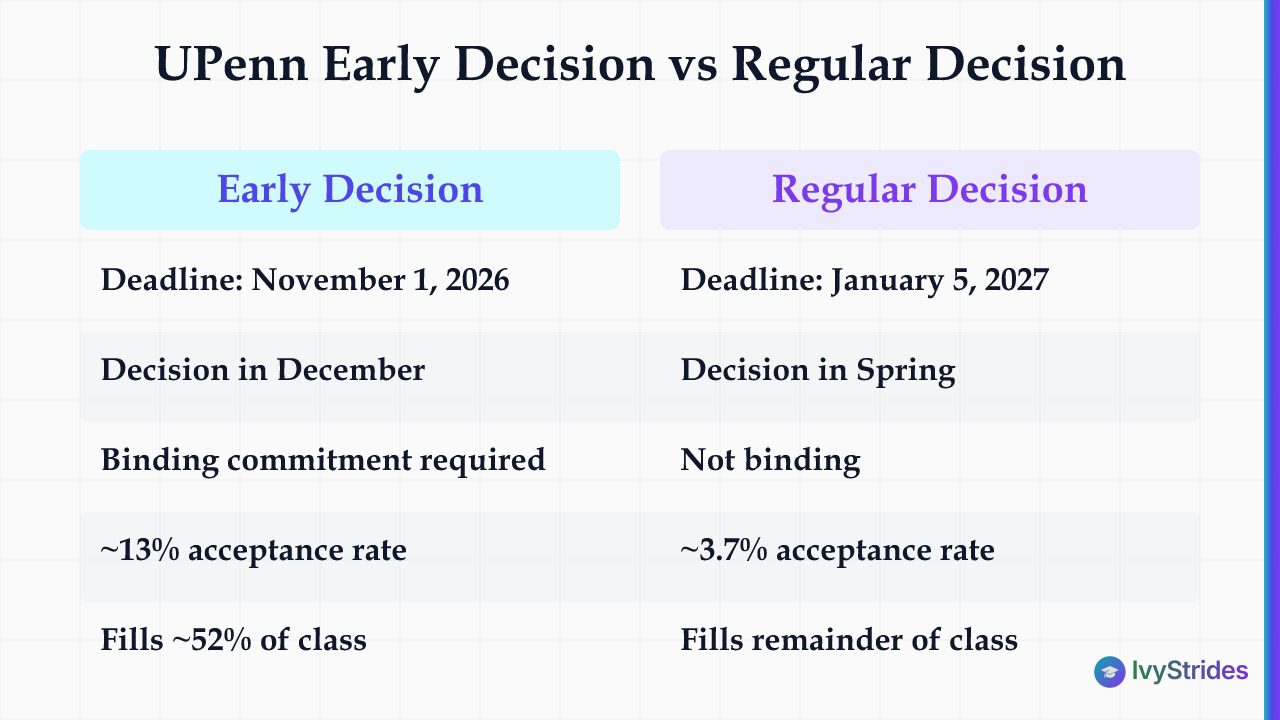
Statistically, yes, but the gap is smaller than it looks. Penn's ED acceptance rate of about 13% sits well above the 4.9% overall rate, and higher still than the roughly 3.7% rate outside ED. IvyStrides subtracts the ED counts from the totals (2,304 admits from 63,041 non-ED applicants) to estimate that non-ED figure.
That said, the gap overstates the advantage for a borderline applicant. Two things inflate it. First, the ED pool self-selects: students who apply ED have committed to Penn and usually have finished files. Second, Penn fills roughly half the class in this round, which shifts the arithmetic.
No signaling shortcut. Penn does not track or consider demonstrated interest, and its Common Data Set rates level of applicant's interest as "Not Considered." So the ED edge is structural, a class-building choice Penn makes, not a reward for showing enthusiasm. The comprehensive whole-person review applies the same way in both rounds; no single component is favored.
| Factor | Early Decision | Regular Decision |
| Deadline | November 1, 2026 | January 5, 2027 |
| Decision | December | Spring |
| Binding | Yes | No |
| Estimated rate (fall 2025) | ~13% | ~3.7% (outside ED) |
| Share of class filled | ~52% (Class of 2030) | remainder |
| Review process | Holistic, whole-person | Holistic, whole-person |
Both estimated rates are IvyStrides calculations from Penn's CDS 2025-26 counts.
If you are still weighing ED against EA and RD across your list, how binding and non-binding early rounds differ shapes your backup plan. Penn has no Early Action program, so the only early option here is binding.
What the UPenn Early Decision Application Actually Requires
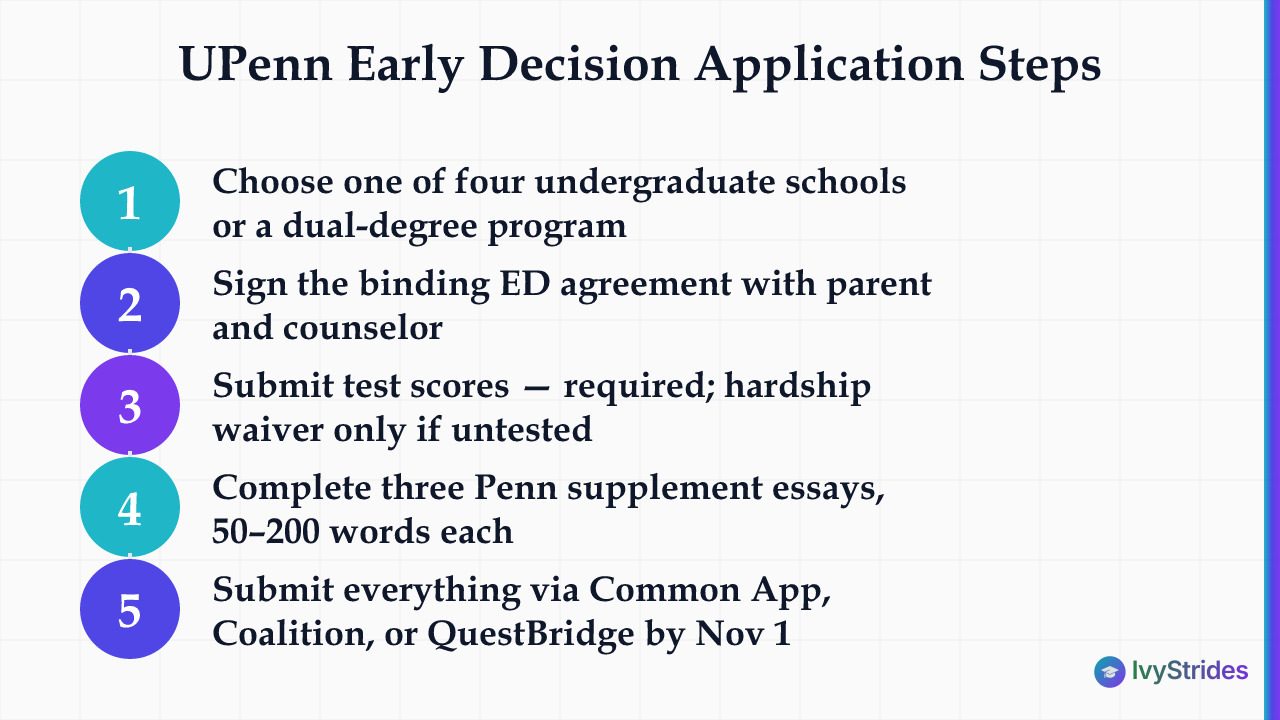
The UPenn Early Decision application has one hard deadline and several moving parts. You apply by November 1, 2026, sign a binding ED agreement, choose one of Penn's four undergraduate schools, and submit Penn's supplemental essays alongside your Common App. The ED agreement is signed by you, a parent, and your counselor.
Pick one school. You apply to a single undergraduate school: the College of Arts and Sciences, Wharton, Penn Engineering, or Penn Nursing, or to a coordinated dual-degree program such as Huntsman, LSM, M&T, NHCM, or VIPER. Each school reads for different signals. Wharton wants demonstrated leadership and math including calculus; Engineering wants stated reasons for choosing engineering and strong physics and math; Nursing wants commitment to patient care and strong chemistry and biology, per Penn's academics page.
The essays are short and specific. Penn asks all first-year applicants two prompts, a brief thank-you note and a community essay, plus one school-specific prompt. The writing page gives each a 50 to 200 word limit; confirm the live limit on the Common App before you submit.
Have your score ready before November 1. Penn is test-required for 2026-27, and its testing policy applies to all first-year, international, homeschooled, transfer, and QuestBridge applicants; the only waiver is for students who have not tested and face genuine hardship. If you have tested, you must submit.
| Item | Notes |
| ED agreement | Signed by student, parent, counselor |
| School choice | One of four schools or a coordinated program |
| Common App essay | 650-word personal statement |
| Penn supplements | Two for all applicants plus one school-specific, 50-200 words each (confirm on Common App) |
| Test scores | Required; hardship waiver only if you have not tested |
| Recommendations | One counselor plus one core-subject teacher; one optional |
| Interview | Not offered; rated Not Considered on the CDS |
| Platform | Common App, Coalition, or QuestBridge (one only) |
In our essay coaching, Penn's school-specific answer is often submitted without naming a specific course, lab, or faculty member. Penn explicitly suggests naming specific classes, research, or groups. Building this package, the school-specific essays, recommendation strategy, and deadline sequencing, is what IvyStrides' college admissions counseling for grades 11 and 12 covers as one connected plan.
How to Decide Whether UPenn Early Decision Is the Right Move for Your Profile
Penn Early Decision makes sense when four things line up: Penn is a true first choice, your score sits in or near the top band Penn reports, your school-specific essay can name real Penn programs, and you have a strong backup plan if you are deferred or denied. The higher ED rate rewards a finished file, not a rushed one.
Where scores land. In the Class of 2030, 63% of submitted SATs were 1500-1600, 22% were 1400-1490, 9% were 1300-1390, and 6% were 1290 or below, per Penn's Incoming Class Profile. Those are reported bands for enrolled students who sent a score, not a cutoff. Still, a score below the top band is a real risk factor for a binding round, because you cannot walk it back once admitted.
In our counseling, students with a score below Penn's top reported band often ask whether to hold for RD; the answer depends on whether the rest of the file is genuinely competitive, not just whether the score is close. Penn's CDS rates five factors "Very Important": rigor of secondary school record, academic GPA, application essay, recommendations, and character. Penn frames that character around a Benjamin Franklin ideal, open-minded, inventive, practical, focused on social good.
| Profile Factor | ED Makes Sense If... | Consider Waiting If... |
| First choice | Penn is clearly #1 | You are still comparing options |
| Test score | Inside/above top reported band | Well below and a retake is close |
| School-specific essay | Names real Penn classes/labs | Still generic or unwritten |
| Financial aid | Reviewed and workable | Package unseen and cost matters |
| Backup plan | Strong RD list ready | No safety schools yet |
A note on comparisons. Penn is test-required for fall 2027 entry, while Princeton is test-optional for the same cycle, so the two demand different strategy. Do not read one policy onto the other. And because ED is binding, review Penn's financial aid package before signing the agreement; families should treat that step as non-negotiable.
If your score is close to Penn's top band but not yet inside it, applying Early Decision with a borderline test score weighs pushing for ED against waiting for a retake. Either way, build a Regular Decision list with strong backups alongside your Penn ED commitment.
FAQ: UPenn Early Decision Acceptance Rate
Is it easier to get into UPenn Early Decision?
Statistically, yes. Penn admitted about 13% of ED applicants for the Class of 2029 versus 4.9% overall, per its Common Data Set 2025-26, and roughly 52% of the Class of 2030 was admitted through Early Decision. But the ED pool is self-selected and already committed, so the raw gap overstates the edge for a borderline applicant.
Can I get into UPenn with a 1300 SAT?
Penn is test-required for 2026-27. In the Class of 2030, 63% of submitted SATs were 1500-1600, 9% were 1300-1390, and 6% were 1290 or below, per Penn's Incoming Class Profile. A 1300 sits well below most enrolled students, but not outside the class entirely. Penn rates five factors "Very Important," so the rest of the file matters.
Is it harder to get into UPenn or Princeton?
Both are extremely selective. Penn admitted 4.9% of fall 2025 applicants (CDS 2025-26) and is test-required for fall 2027 entry. Princeton is test-optional for fall 2027. Neither is meaningfully easier; the score strategy simply differs between them.
What is the UPenn Early Decision acceptance rate for international students?
Penn does not publish a separate ED rate for international students. Penn's test requirement applies to international applicants too, with a hardship waiver for students who have not tested. The fall 2025 ED rate of about 13% is the best public figure available.
Your Next Step on Penn Early Decision
Penn's roughly 13% ED rate is a real edge over the 4.9% overall rate, but it rewards a finished application, not a fast one. The binding commitment means you should be sure of the fit, the score, and the essays before November 1.
- Confirm Penn is your genuine first choice, since ED binds you.
- Check your SAT or ACT against the score bands Penn reports for the Class of 2030.
- Draft the school-specific essay naming real Penn classes or labs.
- Review the financial aid picture before signing the ED agreement.
- Build a strong Regular Decision backup list in parallel.

Award-winning author (South Asian Book Award) and graduate of BITS Pilani and UCLA Luskin School of Public Affairs. Brings a published writer's eye to Common App essays and grammatical precision to SAT and ACT R&W instruction.